Tuesday, September 12, 2023
PPI and CPI preview: why Paul Krugman’s “Goldilocks” economy is likely to prove “transitory”
Saturday, September 9, 2023
Weekly Indicators for September 4 - 8 at Seeking Alpha
- by New Deal democrat
My Weekly Indicators post is up at Seeking Alpha.
The tug of war between the headwind of high interest rates and the tailwind of low commodity and consumer inflation continues.
As usual, clicking over and reading will bring you right up to the present on the data and bring me a smal $$$ reward for my efforts.
Friday, September 8, 2023
Coronavirus update: the virus is back; everyone should return to their prior precautions and get boosted this fall
- by New Deal democrat
At the beginning of this year, I indicated that I anticipated only writing about Covid if something significant was happening. It is, so let’s look at the data.
Thursday, September 7, 2023
Despite 6+ month low in initial claims, yellow caution flag remains
- by New Deal democrat
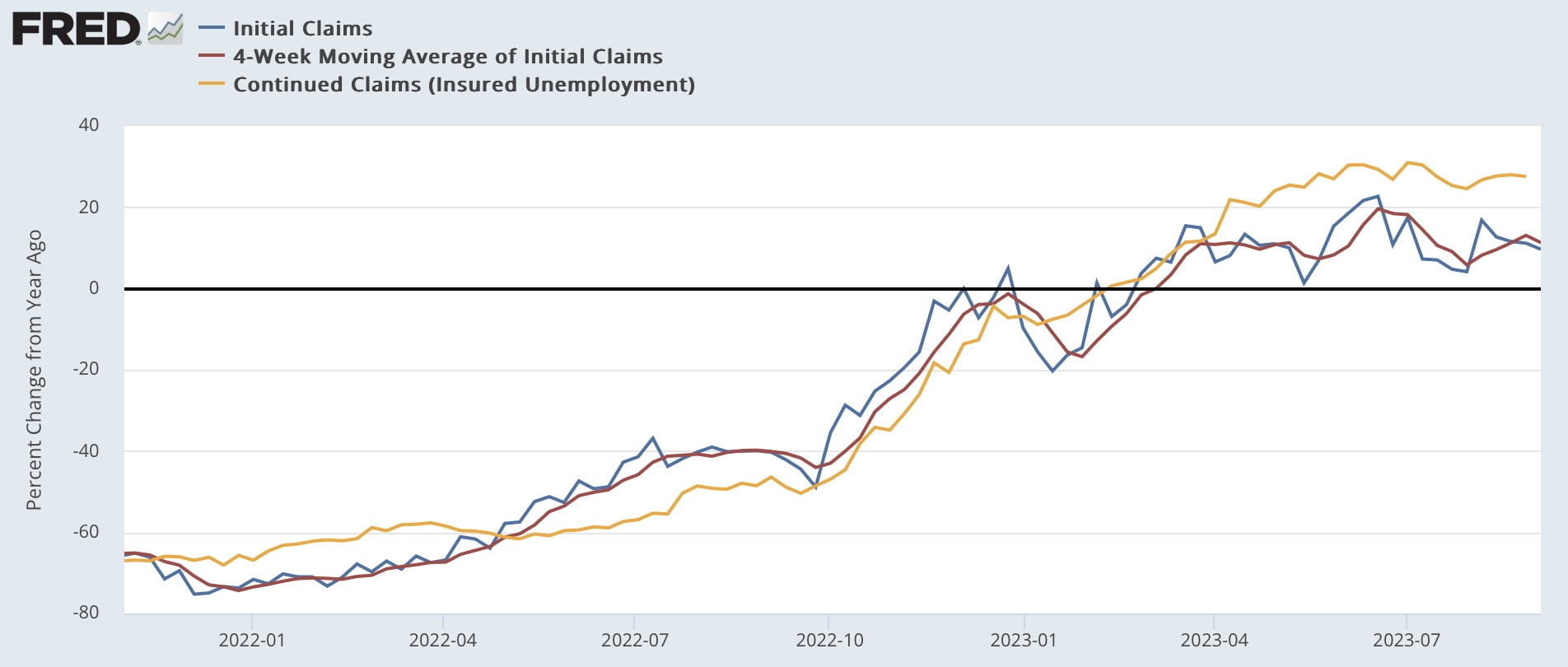
Last week the initial claims numbers justified restarting the yellow caution flag. This week initial jobless claims declined -13,000 to a 6+ month low of 216,000. The 4 week moving average declined -8,500 to 229,250. With a one week lag, continuing claims declined 40,000 to 1.679 million:
Wednesday, September 6, 2023
Scenes from the August employment report - and a warning
- by New Deal democrat
The weekly lull after last Friday’s employment report will end tomorrow. In the meantime, let’s take a deeper dive into a few important trends in that report.
Tuesday, September 5, 2023
Vehicle sales and residential and manufacturing plant construction continue to outweigh general manufacturing downturn
- by New Deal democrat
No important economic news today, but on Friday in addition to the employment report we did get our typical 1st of the month snapshot of manufacturing, vehicle sales, and construction, so let’s look at each.
Saturday, September 2, 2023
Weekly Indicators for August 28 - September 1 at Seeking Alpha
- by New Deal democrat
My Weekly Indicators post is up at Seeking Alpha.
The long leading indicators continue to forecast that a hard landing is out there, while the short leading indicators - aided by a sharp increase in consumer spending in the past few weeks - say it isn’t close to being here, at least not yet,
As usual, clicking over and reading will bring you up to the virtual moment as to the condition of the economy, and also bring me a little lunch money.
Friday, September 1, 2023
August jobs report: deceleration shows up in spades
- by New Deal democrat
My focus remains on whether jobs growth continues to decelerate, particularly manufacturing and residential construction jobs, but also total construction and goods production jobs as a whole; as well as watching for the increase in jobless claims to translate into a higher unemployment rate (a leading relationship that it has had for over 50 years).
And, with help from some significant downward revisions, further deceleration did indeed turn up in spades during August.
Here’s my in depth synopsis.
- 187,000 jobs added. This would be the lowest since January 2021, except for revisions to the prior two months, making June the lowest at 105,000 followed by July at 157,000.
- Private sector jobs increased 179,000. Government jobs increased by 8,000
- June was revised lower by -80,000 and July by -30,000, for a total of -110,000. The three month moving average decreased to 175,000, the lowest since the pandemic lockdowns except for January 2021.
- The alternate, and more volatile measure in the household report rose by 222,000 jobs. The YoY% gain in this report is +1.8%.
- The U3 unemployment rate rose -0.3% to 3.8%, the highest since February 2022 . The civilian labor force, the denominator in the figure, rose sharply (by 736,000), and the numerator, the number of unemployed, also rose sharply (by -514,000).
- U6 underemployment rate rose 0.4% back to 7.1%, the highest since May 2022.
- Further out on the spectrum, those who are not in the labor force but want a job now rose 133,000 to 5.370 million, vs. its post-pandemic low of 4.925 million set this past March.
- the average manufacturing workweek, one of the 10 components of the Index of Leading Indicators, was unchanged at 40.1, equal to its lows earlier this year and down -0.6 hours from its February 2022 peak of 40.7 hours.
- Manufacturing jobs rose by 16,000.
- Within that sector, motor vehicle manufacturing jobs declined -100.
- Construction jobs increased by 22,000.
- Residential construction jobs, which are even more leading, rose by 2,400. It nevertheless continues to appear likely that January was the peak for this sector.
- Goods jobs as a whole rose 36,000. These should decline before any recession occurs. They remain up 1.6% YoY, which remains a very good pace compared with most of the last 40 years.
- Temporary jobs, which have generally been declining late last year, declined further, by -19,000, and are down 242,000 since their peak in March 2022.
- the number of people unemployed for 5 weeks or less rose 217,000 to 2,221,000.
- Average Hourly Earnings for Production and Nonsupervisory Personnel increased $.06, or +0.2%, to $29.00, a YoY gain of +4.5%, and the lowest since June 2021.
- the index of aggregate hours worked for non-managerial workers increased 0.3%, and is up 1.2% YoY, a slight uptick from last month’s 1.1%, which was the lowest since March 2021.
- the index of aggregate payrolls for non-managerial workers rose 0.6%, and increased 5.8% YoY, 0.2% slightly lower than last month, and the lowest since March 2021. Nevertheless this is significantly above the inflation rate, meaning average working class families have more buying power.
- Leisure and hospitality jobs, which were the most hard-hit during the pandemic, rose 40,000, -290,000, or -1.7% below their pre-pandemic peak.
- Within the leisure and hospitality sector, food and drink establishments rose 14,900, but remain -32,400, or -0.3% below their pre-pandemic peak.
- Professional and business employment rose 19,000. These tend to be well-paying jobs, But this series has been decelerating, and is currently up 1.4% YoY, its lowest YoY gain since March 2021.
- The employment population ratio was unchanged at 60.4%, vs. 61.1% in February 2020.
- The Labor Force Participation Rate rose 0.2% to 62.8%, vs. 63.4% in February 2020.
Thursday, August 31, 2023
Real personal spending (driven by vehicles?) spikes, income stalls, saving tanks, and inflation edges back up
- by New Deal democrat
As I have repeated for the past several months, in the current economy the personal spending and income report is just as important as the jobs report. That’s because, despite the downturn in manufacturing production and many parts of the housing market, consumer spending especially on services has continued to power the economy forward.
YoY initial claims restart the yellow caution flag, suggest unemployment will rise towards 4.0%
- by New Deal democrat
I’ll post on personal income and spending a little later.
Wednesday, August 30, 2023
July JOLTS report: is the game of reverse musical chairs in employment ending?
- by New Deal democrat
Tuesday, August 29, 2023
Frozen homeowners mean record low inventory, meaning existing home prices have stopped declining
- by New Deal democrat
Before discussing this morning’s reports on existing home prices, let’s start with a look at new listings and total active listings of housing inventory, which are very instructive:
Monday, August 28, 2023
Fed rate hikes in the face of declining commodity prices: an analysis of 4 precedents
- by New Deal democrat
We live in interest-ing commodity times. Over the weekend, my latest piece at Seeking Alpha highlighted the strong contrary pulls of higher interest rates and lower commodity prices. While not unique, as we’ll see below, the disconnect is the most severe in 100 years.