Friday, January 13, 2017

How close are we to "full employment"?


 - by New Deal democrat

Paul Krugman ignited a small kerfluffle this week when he suggested that we are close enough to full employment that any fiscal stimulus would lead to "crowding out."  Jared Bernstein disagreed.

I think Bernstein is correct.  We aren't yet at full employment. 

One way to look at this is to compare the UNemployment rate (U3) with the UNDERemployment rate (U6):


In the above graph, we see that in the last two expansions, the U6 rate was at its current 9.5% rate, when U3 was about 5.3%.  In other words, our current situation is akin to what we had at 5.3% unemployment in the last two expansions -- not a recession rate to be sure, but not full employment either.

An even better way, I think, is to look at two perennially lackluster employment series:  "Not in the Labor Force, but Want a Job Now" and "Part Time for Economic Reasons."

In the below graphs I show how they compare with the official unemployment rate during this expansion vs. the prior two expansions (the "part time" series only goes back to 1994).

Here is Not in Labor Force, but Want a Job Now:


During the best years of both expansions since 1994, about 4.6 million people +/-300,000, put themselves in this category. As of December 2016, this was at about 5.6 million people -- or 1 million over periods of full employment.

Here is Part Time for Economic Reasons:


During the best years of the 1990s expansion, a little over 3 million people put themselves in this category.  During the weaker 2000s expansion, it was a little over 4 million.  This too as of December 2016 stood at about 5.6 million people.

In other words, to get to the best years of even the weaker 2000s expansion, we would need 1 million people who want a job to enter the workforce, plus another 1.5 million part-timers to find full time employment.

As of last month, the civilian labor force was 159,640,000 people.  Thus we need a little over 1.5% improvement in the employment situation (2.5 million of 160 million) to get to what constituted full employment in the last two expansions.

Thursday, January 12, 2017

Corporate profits lead stock prices, year-end 2016 update


 -by New Deal democrat

Corporate profits, as a long leading indicator, tend to lead stock prices, which are a short leading indicator. I've updated this analysis through year-end 2016,  This post is up at XE.com.

As an aside, I will post my forecast for the second half of 2017 once Q4 GDP, which will include the long leading indicators of private residential investment and proprietors' income, is reported in two weeks.

Wednesday, January 11, 2017

Gas prices set to drive inflation over Fed's target


 - by New Deal democrat

In case you hadn't already noticed, that big decline in gas prices you saw at the pump has come to an end.  At the moment gas prices are up about 20% YoY.  Thus gas prices are one of my five graphs to watch in 2017.

Which means, this is a good time to revive a back-of-the-envelope calculation I used to do when gas prices of $4 would act as a choke collar on economic growth.

The calculation goes like this:  core inflation has reliably run at +0.1% or +0.2% a month.  Almost all of the variability in the remaining number is due to gas prices. Based on past experience, take the change in gas prices in any given month, divide it by 10, and add that to the underlying core inflation rate.  That will give you the non-seasonally-adjusted inflation rate for any given month, +/-0.1%.

Here's what that looks like over the last year. Blue is the average change in gas prices in the month divided by 10, red the non-seasonally-adjusted inflation rate, and green the seasonally adjusted inflation rate:


Note that gas prices rose in December 2016, unlike December 2015.  That suggests that December 2016 inflation, after seasonal adjustment, is likely to be about +0.2%. Since December 2015 was -0.3%, that will raise the YoY inflation rate from 1.7% to over 2%.

Since consumer inflation bottomed in February of last year, here's what consumer inflation looks like since then:


From February through November, consumer prices rose +1.9%. An additional +0.2% will make that +2.1% for 10 months -- above the Fed's 2% target.  So unless we have a big miss in the next employment report, I expect the Fed to chase this inflation with a rate hike.

Tuesday, January 10, 2017

My forecast for the first half of 2017


 -by New Deal democrat

My forecast for the economy through the middle of the year is Up at XE.com.

Taiwan Isn't Large Enough to Meaningfully Leverage Against China

China has a GDP of a little over 11 Trillion dollars while Taiwan's is 523 billion.  China is over 20 times as large as Taiwan.  It simply isn't large enough to leverage against China.

We see the same thing when we look at the most recent trade information from the Census Bureau:


Our balance of trade with China is 22x larger than that with Taiwan (top panel).  Our exports to China are 5x larger than those with Taiwan.

Trying to use Taiwan against China is a fool's errand from the start.

Monday, January 9, 2017

Why John Taylor -- a Leading Candidate to Replace Yellen -- Shouldn't Be Fed President

From Bloomberg:

With just over a year remaining on Janet Yellen's current term as chair of the Federal Reserve, comments from three of her potential successors at this this weekend's annual American Economic Association meeting are noteworthy. Glenn Hubbard of Columbia University, along with Stanford University’s John Taylor and Kevin Warsh, are all seen by Fed watchers as potential future chairs should President-elect Donald Trump decide not to re-nominate Yellen. All three criticized the U.S. central bank for trying to do too much, and suggested interest rates would be higher if they were in charge.

There are two reasons Taylor should not lead the Fed:

1.) He is the leading proponent of having the Fed use mechanical rules to determine policy.  Taylor authored the "Taylor Rule," an equation that he believes should completely govern the Fed's interest rate policy. The rule is very useful as a basis for policy discussion.  Despite that benefit, Taylor's argument assumes his equation is infallible -- that it will always be correct in any circumstance.  That assumption is incorrect; nothing, especially in economics, is that simple.  There is always "another hand" that should offer policy guidance.  And binding the Fed's hands would have prevented them from engaging in the extraordinary measures during and after the Great Recession.

2.) Taylor continually compared the Obama recovery to the Reagan recovery, an economic apples to oranges comparison.  The Federal Reserve caused the recession preceding Reagan: They increased interest rates to wring inflation out of the economy -- a policy that worked brilliantly.  Once rates started to move lower, the economy faced little to no structural headwind to naturally slow economic growth.  Perhaps just as important, Reagan's tenure began just as the baby-boomers were beginning their peak earnings time in life.  This started a long period when the labor force participation rate increased, adding additional stimulus to the economy. 

Obama's recovery was preceded by an entirely different precursor: a debt-deflation recession and recovery.  This is an entirely different economic scenario then that faced by Reagan and one that leads to a far slower recovery.  In a post-debt deflation economy, consumers are burdened by debt values that, ins some cases, are higher than asset values, leading to slower spending as consumers allocate additional resources to paying down debt rather than other goods.  The de-leveraging process can take years, acting as a slight to large drag on economic growth.  And unlike Reagan, Obama faced a declining LFPR as the baby boomers started to retire, which also lowered GDP growth.

Taylor has yet to acknowledge either fact in his analysis.  There are two possible reasons for his oversight.  1.) He is unaware of the difference between the recoveries.  Given Taylor's stature, this is highly doubtful.  But it this is the reason is is automatically disqualifying because it belies a profound ignorance of economic history.  2.) He is aware of the differences, but for political reasons refused to acknowledge them.  This is the more likely reason.  Taylor is a University of Chicago economist; he is inherently biased against government action and activist policy.  However, if this is the reason, it is also disqualifying because it indicates he is more interested in political outcomes than positive economic outcomes.


Five graphs for 2017: #1, real wages and real consumer spending


 - by New Deal democrat

In the last week I have described 5 relationships that bear particular watching in 2017.

#5 is the price of gas.
#4 is the value of the US$
#3 is mortgage rates and residential construction
#2 is inflation and the Fed funds rate.

The overall theme is that 2017 is likely to be a rather typical year of late cycle inflation, possibly also featuring a trade war.

The number one graph I am looking at this year is how consumers are affected by, and deal with, this late cycle inflationary environment.

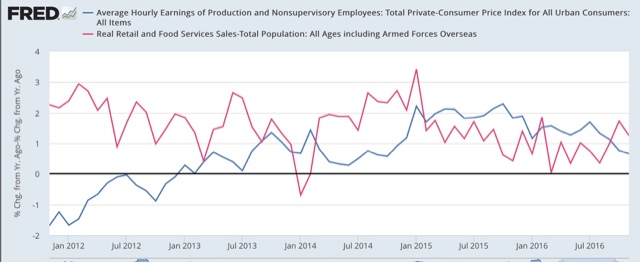
In the absence of special factors, like spouses entering the workforce in the 1980s, or the housing bubble of the early 2000s, when real wages stagnate, so does real consumer spending (as expressed by real retail sales per capita) with a bit of a lag (red).

Here is the long-term look through 2000 using the former retail sales series (first graph) and the new retail sales series which began in the early 1990s (second graph): 


Here are the same two graphs expressed as a YoY%:


When not just one but both stagnate, that is a signal for an oncoming consumer recession.

During this entire expansion, nominal wages for nonsupervisory employees have not grown faster than 2.6% YoY. Since we are still adding jobs faster than the labor force is growing, there ought to be at least a little further improvement than that.  But in the last 9 months alone consumer prices have increased by 1.9%, causing real wages to stagnate (blue in the graph below).

For 2017 I don't see any special factor at play, unless there is a tax cut that applies to middle and working class earners enough to boost spending.

So the #1 graph for 2017 is real wages and real conusmer spending:


Here is the same graph YoY:


I will be following this to see whether real wages stagnate or decline, and if so, does real spending follow suit, laying the groundwork for the next recession.  

Saturday, January 7, 2017

Weekly Indicators for January 2 - 6 at XE.com


 - by New Deal democrat

My Weekly Indicators post is up at XE.com.

The indications for the first half of 2017 are really strong, but out on the horizon mortgage applications just turned negative.

Friday, January 6, 2017

December jobs report: a positive report to close Obama's Presidency


- by New Deal democrat

HEADLINES:
  • +156,000 jobs added
  • U3 unemployment rate up +0.1% from 4.6% to 4.7%
  • U6 underemployment rate down -0.1% from 9.3% to 9.2%
Here are the headlines on wages and the chronic heightened underemployment:

Wages and participation rates
  • Not in Labor Force, but Want a Job Now: down -176,000 from 5.876 million to 5.662 million  
  • Part time for economic reasons: down -64,000 from 5.662 million to 5.598 million
  • Employment/population ratio ages 25-54: up +0.1% from 78.1% to 78.2% 
  • Average Weekly Earnings for Production and Nonsupervisory Personnel: up $.07 from $21.73 to $21.80,  up +2.5% YoY.  (Note: you may be reading different information about wages elsewhere. They are citing average wages for all private workers. I use wages for nonsupervisory personnel, to come closer to the situation for ordinary workers.)
October was revised downward by -7,000, but November was revised upward by +26,000, for a net change of +19,000. 

The more leading numbers in the report tell us about where the economy is likely to be a few months from now. These were mainly positive.
  • the average manufacturing workweek rose 0.1 from 40.6 to 40.7 hours.  This is one of the 10 components of the LEI, and is a positive.
  •  
  • construction jobs decreased by -3,000 YoY construction jobs are up +102,000.  
  •  
  • manufacturing jobs increased by +17,000, but are down -45,000 YoY
  • temporary jobs decreased by -15,500.

  • the number of people unemployed for 5 weeks or less decreased by -36,000 from 2,415,000 to 2,379,000.  The post-recession low was set over 1 year ago at 2,095,000.
Other important coincident indicators help  us paint a more complete picture of the present:
  • Overtime rose +0.1 from 3.2 to 3.3 hours.
  • Professional and business employment (generally higher- paying jobs) increased by +15,000 and are up 522,000 YoY.

  • the index of aggregate hours worked in the economy rose by 0.2  from  105.8 to 106.0 
  •  the index of aggregate payrolls rose by 0.7 from 131.0 to 103.7. 
Other news included:         
  • the alternate jobs number contained  in the more volatile household survey increased by  +63,000 jobs.  This represents an increase  of 2,811,000  jobs YoY vs. 2,157,000 in the establishment survey.    
  •    
  • Government jobs rose by +12,000.     
  • the overall employment  to  population ratio for all ages 16 and up was unchanged at  59.7%  m/m  and is up +0.1% YoY.   
  • The  labor force participation  rate was unchanged at  62.7% and is also unchanged YoY (remember, this includes droves of retiring Bsoomers).     
 SUMMARY 

This was a nearly uniformly positive report. While the headline unemployment rate rose slightly, and there were some downward revisions to last month's strongly positive household survey numbers, the broader underemployment rate continued its recent strong decline.  Hours and wages increased.

As Barack Obama closes out his Presidency, his record on jobs (as a share of the prime working age population)  and aggregate wage creation is nearly that of Ronald Reagan's.  The weak points remain a participation rate for the working age population that never made it back more than 2/3's of the way to last 2007 high, and wages that never increased more than 2.6% YoY.  Since wages gains YoY typically fall by about that percentage during recessions, I continue to fear that the next recession will include actual wage deflation, with the possibility of a wage/price deflationary spiral.


Jazz Shaw, the Frank Burns of Policy Analysis, Once Again Demonstrates His Ineptitude

     I grew up on MASH.  During one episode, someone asks Hawkeye what Frank Burns knows on a topic.  Hawkeye responded, "there's so little Frank knows, it's difficult to keep up with what he doesn't know." 

     That statement encapsulates Jazz Shaw of Hot Air in a nutshell.  For several years now, he has sided with those who oppose a minimum wage hike, arguing that an increase in the minimum wage causes unemployment.  This argument was neutered by Alan Kreuger in the early 1990s -- as anyone who pays attention to silly things like facts and data will tell you.  The recent experience of Seattle and it's minimum wage increase confirmed Kreuger's analysis and rebutted Mr Shaw's position.  However, Kreuger's literature and economic data have the added feature of being complex and nuanced, immediately placing it outside Mr. Shaw's intellectual capabilities.  Rather than reevaluate his position, Mr. Shaw has done what most conservative bloggers do: stop writing about the topic on which reality has shown him to be wrong and move onto another topic.  

     Yesterday we had this beauty from Mr. Shaw:

We had a functional, if highly problematic health care system in this country before the Affordable Care Act was passed and we will still have one when it’s gone. Far more to the point, Obamacare did not “fix” the healthcare system in this country. It blew it up in several significant ways, not least of which was the exponential increases in premium costs and the large number of healthcare providers who wound up kicking out their satisfied patients because they wouldn’t accept Obamacare coverage.

     As with all of Mr. Shaw's policy writing, data, facts and references are completely absent.  Instead, he offers his position and, because it jibes with that of his readers, it goes unchallenged until now.  

     Let's first note that insurance premiums were a huge problem before the ACA.  The following is from the Economic Policy Institute and Kaiser Family Health:


Insurance premiums increased at alarming rates before the ACA resulting in health care premiums taking an increasing percentage of median family income.  As a matter of fact, premium increases were far lower after the ACA:


As for Mr. Shaw's contention that the pre-ACA health system was functional, we have this:

The Blue Cross Blue Shield Association released a widely publicized report last month that said new enrollees under ObamaCare had 22 percent higher medical costs than people who received coverage from employers.

.....

The Aetna CEO noted concerns about the “risk pool,” which refers to the balance of healthy and sick enrollees in a plan. The makeup of the ObamaCare risk pools has been sicker and costlier than insurers hoped. 

One of the ACA's biggest problems is that far more sick people signed up than anticipated by insurers.  This indicates that before the ACA, there was a very serious problem: people weren't going to the doctor.  And the reason is simple: they lacked insurance.  


For a long amount of time (~35 years) a significant percentage of Americans didn't have insurance.  Therefore, they didn't get routine problems taken care of.  When they finally got insurance, they had a lot of problems that had morphed into huge issues because they hadn't gotten them taken care of.  This problem could have been avoided with broadened insurance coverage.

     And if the U.S.' system was "the best: why did it cost so much more than other countries' health care?


     I could go, but you get the point.  As usual, Mr. Shaw cites no data nor evidence to back-up his primary assertion.  This is standard for Mr. Shaw, because he lacks any formal training in policy analysis, economics or even basic logic.  He does, however, excel at stupidity, which he routinely displays.  He also clearly lacks a sense of shame, because someone who has been as consistently incorrect as Mr. Shaw usually has the good sense to shut up.  He does not.   So, we can expect to see more articles from him as he defends his new master, Mr. Trump.  


Thursday, January 5, 2017

Five graphs for 2017: #2, inflation and the Fed funds rate


 - by New Deal democrat

This is the fourth of five metrics I'll be paying particular attention to this year.

The first three are the "troika" of issues that could lay the basis for the next recession: higher gas prices (#5), a surge in the value of the US$ (#4), and higher interest rates (#3).

At least 2 of the above 3 metrics are connected to the inflation rate.  For the last 16 years, the waxing and waning of consumer inflation has primarily been driven by gas prices.  Further, the spike in interest rates appears to reflect a belief that the actions taken by the incoming Administration in Washington will be inflationary.

Against that backdrop, we have a Fed that officially has a "target" of 2% inflation, but in practice appears to treat 2% as a ceiling.  It did not appear concerned at all by the nonexistent inflation of 2015, but since 2014 at least has been talking of calibrating interest rates to achieve a"gliding into" the 2% inflation target.

So graph #2 for 2017 is YoY CPI and the Fed Funds rate.  Here it is for the last 50 years:


Typically the Fed has chased late cycle inflation higher.

Here's a close-up of the last 5 years:


If consumer inflation, driven by an increase in gas prices, goes over 2% in the next few months (which I consider likely), the Fed certainly sounds like it will chase it, and raise interest rates multiple times.  If so, that will set the stage for the narrowing of the currently relatively steep yield curve.

[Note:  since tomorrow is the jobs report, I will post the #1 graph next week.]

Wednesday, January 4, 2017

Five graphs for 2017: #3, interest rates vs. residential construction


 - by New Deal democrat

For the last few years, I have picked out five metrics that particularly bear watching at the outset of the year.  This year, there is a troika of factors that could bring about the next recession: a big increase in gas prices (#5 on this year's list), a surge in the US$ (#4), and -- today's installment -- a spike in interest rates

In 2013 as the result of the "taper tantrum," Treasury yields went from just under 1.5% to just over 3%.  Mortgage rates rose similarly, leading to a near stall in the housing market.  The pent-up demand from the large Millennial generation kept the market from an outright downturn.

Since the US presidential election, Treasury yields similarly spiked, so far to a high of just over 2.6%.  In response, finally this week, mortgage applications turned negative YoY.

So graph number 3 is mortgage rates (inverted) vs. residential construction (shown YoY below):


Although residential construction is a little less leading than permits, housing starts, or new home sales, it has the advantage of being a much less noisy series (shown in comparison with permits below):


Private residential construction has gone basically sideways since September 2015 (and thus is flat YoY in the first graph above), although post-Brexit there has been some improvement.  I expect this series to continue to improve until sometime next spring when the post-election spike catches up with it.

The issue this year will be whether mortgage interest rates continue to rise, and if so, do they rise enough to cause an outright downturn in the housing market.  That's what I'll watch in this graph.

Tuesday, January 3, 2017

Will Inflation Be the Story of 2017?

From Bloomberg:

While the ISM sub-indexes can be volatile, the jump in prices caught the eye of factory managers and analysts, with survey chairman Bradley Holcomb noting it was “clearly something to watch” at the beginning of the year. A broad-based increase in costs of inputs for production corroborates signs of higher consumer inflation. The personal consumption expenditures price index -- the Federal Reserve’s preferred gauge -- is up 1.4 percent on a year-over-year basis, the fastest gain since 2014.

Even with the increase in the ISM price index, it’s far below levels from times associated with rapid inflation. The gauge averaged a 73.7 reading in 1980, when the consumer-price index averaged a 13.6 percent rise. The ISM price index reached a post-recession high of 85.5 in 2011, coinciding with a post-recession high in crude oil and faster gains in the Fed’s preferred index.

From the Financial Times

Germany’s annual inflation rate has surged to its highest level in more than three years, defying economist forecasts to hit 1.7 per cent in December in a release that is likely to embolden German critics of stimulative monetary policy in the eurozone.

From Bloomberg:

A barrel of West Texas Intermediate traded above $55 this morning, the highest level for the contract since July 2015. The rise comes after local media in Kuwait reported that the country has cut output by 130,000 barrels a day, a sign that the OPEC deal to reduce production may be implemented successfully. In the U.S., drillers added rigs for the ninth week, boosting the number to the highest in about a year. 

From Wednesday's Eurostate Release: note energy prices


Chart of the 5 and 10-year Breakeven Inflation Rates


1- year Chart of10 and 30-year CMTs


Fiive graphs for 2017: #4, the US$


 - by New Deal democrat

This is the second of five graphs that bear watching in 2017.  

The first was gas prices.

The second part of the troika that may lay the basis for the next recession is the US$. Almost 100 years ago, economist Irving Fisher identified the strength/weakness of the currency as being an indicator that led the economy by about 7 months (in the below paragraph, P' is the YoY change in prices, and T is the currency value):


In 2015 we saw how the surge in the US$ depressed commerce even as lower gas prices helped consumer spending.  Since the US presidential election, the US$ has had a lesser surge (so far) based on fears that a trade war particularly with China may be in the offing.  Typically negative effects have not been felt until the US$ is up at least 5% YoY against other currencies:


As of last week the US$ was up 5% globally, although not against major currencies.


Needless to say, if both gas prices and the US$ spike, unlike 2015 both consumers and producers will take a hit.

Monday, January 2, 2017

Five graphs for 2017: #5, gas prices


 - by New Deal democrat

In the last couple of years, I have identified a few relationships that I thought were particularly worthy of being followed over the next 12 months.  Usually these have been metrics that had been at near extremes, or showed signs of approaching a turning or inflection point. 

The first such important metric for 2017 is gas prices, one of a troika that together may set the stage for the next recession.

After the "great recession," these quickly returned to nearly $4 per gallon for several years, acting like a "choke collar" on growth.  Every time the economy looked like it was taking off, gas prices would rein in other consumer spending.

In 2014 gas prices fell precipitously, to as low as about $1.69 at the beginning of 2016.  Throughout last year, it appeared gas prices (which tend to show lots of seasonality) were bottoming -- and they finally turned positive YoY late in the year, as shown in red in the graph below (actual prices per gallon are shown in blue):


Normally gas prices have had to increase 40% or more YoY to create any kind of "shock."  As of now, they are only up about 15% YoY.

I'll be keeping tabs on this metric to see if prices go up near $4/gallon again, and if they are up more than 40% YoY.

An Absolute Must Read on Foreign Policy

From Politico.  This article is the first I've seen (there, of course, may be others) that explains Putin's game.  It's scary as hell, but one that we all should read.

Putin's Long Game

Saturday, December 31, 2016

Weekly Indicators for December 26 - 30 at XE.com


 - by New Deal democrat

My Weekly Indicators post is Up at XE.com.

Interest came down off recent highs to end the year.

See you again in 2017!

Friday, December 30, 2016

Marking my 2016 forecast to market

(Plus a pyrrhic political presidential prediction)

 - by New Deal democrat

How did my economic forecast for2016, made one year ago, pan out?  The result is Up at XE.com.

While it wasn't an economic forecast, I did use economic data to make a forecast the 2016 presidential election, that the candidate of the incumbent party would eke out a narrow victory.

Just before the election, my final personal forecast was

Clinton 49.5%
Trump 46.0%
Third parties 4.5%

According to the Cook Political Report, the final result was

Clinton 48.2%
Trump 46.1%
Third parties 5.7%

So my prediction was pretty darn close, but of no use whatsoever because of the state by state distribution of that result.

Will the Energy Sector Outperform in 2017?


Business activity continued to increase in the fourth quarter, according to oil and gas executives responding to the Dallas Fed Energy Survey. The business activity index—the survey’s broadest measure of conditions facing Eleventh District energy firms—rose to 40.1 from last quarter’s 26.7 reading. Several indicators expanded on a quarterly basis for the first time in 2016, including employment and production. Outlooks also improved, despite some skepticism about recent oil producer agreements, which respondents commented on in this quarter’s special questions.


Oil and gas production stopped declining this quarter after falling throughout the year, according to executives at exploration and production (E&P) firms. The oil production index surged nearly 20 points to 9.0, and the natural gas production index was 3.1, up from -20.6 last quarter.


Among oilfield services firms, the equipment utilization index rose again, posting at 35.9. The index of prices received for services jumped from -23.4 to 6.8, its first positive reading in 2016.


Measures of oil and gas labor market conditions turned positive for the first time all year, although the majority of respondents continued to report unchanged headcounts. The employment index came in at 3.4, with 18 percent of firms noting net hiring and 15 percent noting net layoffs. Indexes of wages and benefits and of employee hours also turned positive at 10.3 and 13.7, respectively


With improved oil prices, banks are more willing to extend credit lines to leveraged hydraulic fracturing or fracking companies that are looking to boost market share for the first time in two years, reports Swetha Gopinath for Reuters.


Raymond James calculated that North America-focused oil and gas producers could raise capital investment by 30% in 2017. A number of companies, like Pioneer Natural Resources (NYSE: PXD), Diamondback Energy (NasdaqGS: FANG) and RSP Permian (NYSE: RSPP), have projected larger budgets and increased output next year.


Through the latest calculation in the value of reserves in the ground with bank creditors, 34 oil and gas producers had their available credit lines raised an average of 5%, or over $1.3 billion, with a combined credit for the companies at $30.3 billion, compared to $28.9 billion at the end of spring 2016.


“The ‘animal spirits,’ seem to be coming back to the exploration and production market, albeit slowly,” Reorg Research analyst Kyle Owusu, referring to the human emotion that drives confidence, told Reuters.


Consequently, with more robust credit lines, fracking companies are set to expand operations and increase capital spending. Consequently, the oil services industry that caters toward these producers could also reap the benefits as well.


The energy sector has been the best performing S&P 500 sector so far in 2016, rising 24.3%, but investors should proceed with caution in 2017. Keith Bliss, senior vice president with Cuttone & Co., said the 2016 growth comes amid a stabilization in oil prices after the sector was slammed in 2015. According to Bliss, oil companies must get used to $50 to $60 oil. Plus, should OPEC fail to adhere to its proposed production cuts, which take effect in January, that may ding energy stocks, which are banking on higher oil prices, according to Bliss. 


The XLE has a bit more upside room to run.  While the RSI is high, this indicator can remain at overvalued levels for long periods of time.  The MACD has some upside room.  

Thursday, December 29, 2016

Year end look at housing 2016


 - by New Deal democrat

I have the latest updated look at this leading economic sector Up at XE.com.

Wednesday, December 28, 2016

Potential Risks to the U.S. Economy in 2017

This is up at XE.com

Is A Housing Slowdown Coming?

From Reuters:

Contracts to buy previously owned U.S. homes fell in November to their lowest level in nearly a year, a sign rising interest rates could be weighing on the housing market, the National Association of Realtors said on Wednesday.

The group said its pending home sales index, based on contracts signed in November, dropped 2.5 percent to 107.3.

"The brisk upswing in mortgage rates and not enough inventory dispirited some would-be buyers," the NAR said in a statement accompanying the figures.

Consider that above with the following interest rate information:


Since the election, 15 and 30-year mortgage rates have increased over 50 basis points.  That means that means the  XHBs may be a possible short:


Tuesday, December 27, 2016

Post-Election Consumer and Business Confidence Increase

The following is from the Conference Board:

Consumers’ assessment of current conditions declined in December. Those saying business conditions are “good” decreased slightly from 29.7 percent to 29.2 percent, while those saying business conditions are “bad” increased from 15.2 percent to 17.3 percent. Consumers’ appraisal of the labor market was less positive than last month. Those stating jobs are “plentiful” declined from 27.8 percent to 26.9 percent, while those claiming jobs are “hard to get” increased from 21.2 percent to 22.5 percent.

Consumers’ short-term outlook improved considerably in December. Those expecting business conditions to improve over the next six months increased from 16.4 percent to 23.6 percent, while those expecting business conditions to worsen declined from 9.
9 percent to 8.7 percent.

Consumers’ outlook for the labor market also improved markedly. The proportion expecting more jobs in the months ahead increased from 16.1 to 21.0 percent. However, those anticipating fewer jobs also increased, from 13.5 percent to 14.0 percent. The percentage of consumers expecting their incomes to increase rose from 17.4 percent to 21.0 percent, while the proportion expecting a decrease fell moderately, from 9.2 percent to 8.6 percent.

The following chart and commentary is from the National Federation of Independent Business:

The Index of Small Business Optimism rose 3.5 points to 98.4, a substantial gain to just above the 42-year average of 98. Eight of the 10 Index components posted a gain, one declined and one was unchanged.  Expectations for real sales gains and outlook for business conditions accounted for 69 percent of the gain. The two employment components added 20 percent of the gain. The remaining six components were little changed. 


Analysis: For the consumer, this will probably lead to increased retail sales and personal consumption expenditures -- a confident consumer is more likely to increase expenditures.  This could lead to upside surprises in holiday sales and could also translate into an increase in auto and light truck purchases (these types of expenditures require financing which consumers don't take out unless they believe they can afford the payments over an extended time horizon).  

As for business, an increase in confidence naturally leads to increased risk-taking.  I still think business will be a bit conservative; they may need to see more action from Congressional Republicans before making major changes.  I think the real issue here will be tax reform, especially a lowering of corporate and personal tax rates. 


Saturday, December 24, 2016

Weekly Indicators for December 19 - 23 at XE.com


 - by New Deal democrat

My Weekly Indicators column is up at XE.com.

There has really been a shift in much of the data since the presidential election.  On the one hand, interest rates have spiked, as has to some extent the US$ and at least one measure of risk in bank lending rates. Gas prices continue to trend in the direction of becoming a headwind.

Interestingly, for the last several weeks holiday consumer spending as measured by Gallup has also weakened -- which is completely at variance from the surge since the election in consumer sentiment as measured both by Gallup and monthly by the University of Michigan.

This negativity is also at odds with the surge in the stock market.

It may be that the fortunes of producers and consumers are about to diverge in a big way.

How Long Until John Hinderaker Writes Similar Praise of Trump?

     Merriam-Webster offers the following definition and example of the word Sycophant:

1.) a servile self-seeking flatterer

Parasite, sycophant, toady, leech, sponge mean a usually obsequious flatterer or self-seeker. parasite applies to one who clings to a person of wealth, power, or influence or is useless to society . sycophant adds to this a strong suggestion of fawning, flattery, or adulation . toady emphasizes the servility and snobbery of the self-seeker . leech stresses persistence in clinging to or bleeding another for one's own advantage . sponge stresses the parasitic laziness, dependence, and opportunism of the cadger .

The connotation is clearly negative; a sycophant is someone who eventually becomes a pure apologist for the worst sorts of behavior.

Hinderaker has unfailingly towed the conservative Republican party line, regardless of how ridiculous.  He is a proud member of the flat earth society, denying the idea of human-caused global warming (this, despite the fact that Hinderaker has no formal scientific qualifications).  He believed that the Fed's 2008 policy would lead to hyper-inflation (interestingly enough, Hinderaker has written nothing about the post-election jump in inflation expectations).  Other examples abound.

     In 2005, Hinderaker penned a post, titled, "A Stroke of Genius?"  It contains this bootlicking paragraph:

It must be very strange to be President Bush. A man of extraordinary vision and brilliance approaching to genius, he can’t get anyone to notice. He is like a great painter or musician who is ahead of his time, and who unveils one masterpiece after another to a reception that, when not bored, is hostile.

After receiving a large amount of well-deserved ridicule, Hinderker added the following to the post:

UPDATE: Of all the thousands of posts we have done over the years, this one seems to most outrage the Left, I suppose because it is so at odds with liberals’ cherished illusions about President Bush. The tone of the post is obviously tongue in cheek, but liberals never seem to notice. They are, to put it charitably, not big on nuance. More important, I’ve never seen a liberal respond to, let alone rebut, the point of the post: that President Bush’s proposal to share pollution control technology with the countries where carbon emissions are rising most rapidly made far more sense than the Kyoto approach, which combined ineffectiveness with economic disaster. That, too, is a sign of the intellectual vacuity of modern liberalism.

He obviously tried to walk back his obsequious statement, but to little avail.

Given that Hinderaker is a Republican toady, how long until he pens a similar defense of Trump?

Wednesday, December 21, 2016

The post-election interest rate spike isn't signaling a recession -- yet


 - by New Deal democrat

This post is up over at XE.com .

XE is currently having a problem posting images.  So here are the three images that go with that post:

Treasury yields vs. 30 year mortgage rates:


Mortgage rates (inverted) vs. housing permits since the Great Recession:


Morrtgage rates (inverted) vs. housing permits in the 1970s and 1980s:


Thoughts on Post-Election Industry Movement


The above table from Stockcharts.com shows the post-election percentage change in the largest sector ETFs.  Here are some thoughts on why certain sectors have rallied or sold off.

1.) There has been talk of repealing or scaling back Dodd-Frank, which could potentially be a huge boon to the financial industry.  In addition, the Fed is now raising interest rates, which increases the interest rate spread, which should increase bank earnings. 

2.) Industrials and basic materials are rallying in hopes of a large infrastructure bill.

3.) Trump has appointed a very pro-oil cabinet: Perry at the Department of Energy and Rex Tillerson as Secretary of State.  In addition, OPEC has agreed to limit production.  Both these facts explain the XLE's recent rally.   

4.) There is a great deal of concern underlying health-care policy.  The pending ACA repeal will put the insurance markets on very tenuous footing.  In addition, there is growing concern that Congress will become more aggressive about drug prices (see this story from today's NYTimes).   

5.) Rising interest rates are a net negative for utilities.

6.) The 10 largest consumer staple stocks are multi-national companies.  The strong dollar and Trump's anti-trade talk would be a net negative for this sector.


Monday, December 19, 2016

Energy Inflation Is Increasing and May Place the Fed in a Policy Bind Next year

Energy Inflation is increasing:


Saudi Arabia's massive production cut in 2014 sent oil prices lower, causing a large economic boost to consumer spending.  Earlier this month, OPEC reversed course, signing a deal that cut production. This was the primary reason for the latest rally in the oil market.  According to Bloomberg, bullish oil bets are currently at a 2-year high.  

All of these factors will cause an increase in energy inflation, which may place the Fed in a policy bind.  Overall CPI is hovering around 2%: core is 2.1% while overall is 1.7%.  But as the chart above shows, energy prices are starting to accelerate, which will push overall CPI closer to the Fed's 2% target.    

Sunday, December 18, 2016

"Those who cannot see must feel"


 - by New Deal democrat

That's the translation of an old German saying that I used to hear from my grandmother when I misbehaved.  It is pretty clear that, over the next four years, the American public is going to do a lot of feeling (including, unfortunately the plurality of voters who *did* see).  The results will range somewhere in between bad, disastrous, catastrophic, and cataclysmic, depending on how badly foreign affairs are bungled and how much basic norms of republican government irreversibly give way to despotism.  

I have some hope as to the former because both China and Russia are smart enough to figure out that they can get what they want by bribing Trump without resorting to armed conflict.  As to the latter, unfortunately, I hold out little hope.  Already North Carolina has crossed the line into Banana Republic-dom, and there is not the slightest reason to believe Trump will allow himself to be constrained by, well, anything.

On my to-do list is to go through a list I have been given of every country in the world which has a Madisonian presidential system, to see if any of them have not somewhere along the line fallen into despotism.  I believe that the answer until now has been that the US is the only country which had not succumbed. Someday if and when the Second American Republic is assembled, diluting or eliminating the powers of the Presidency are essential.

In the meantime the autocrat will have his day.  After all, no fascist ever was overthrown so long as they were winning.

But ... this is a good time to repeat that my view of economics dictates my politics, not the other way around.  Libertarians and neoliberal economists fail by not taking into account bargaining power.  They take contracts as a given, to be neutrally enforced by Solomonic courts. But contracts - and their enforcement - have everything to do with bargaining power, and left to their own devices, as the saying goes, "Thims that has, gits." Thus, over time, without a countervaling force, economies tend towards oligopolies and polities to oligarchies.

And all of that gets revealed in the numbers over time.  So my view is, all I have to do is faithfully report the economic numbers, and the political argument follows.  Go back 100 years and compare the economic records of Democratic and Republican administrations, and the record speaks for itself.  Most Democratic administration beat most Republican administrations.  Outside of the high inflation era of the late 1970s early 80s, where a  supply-side stimulus was helpful and non-inflationary, demand side economics which target ordinary Americans works better to improve their lot.  In simple terms, give a wealthy man money and he will hoard most of it.  Give an ordinary person money and they will spend it. Spending has a bigger multiplier effect than hoarding.

I have no illusion that we can do anything to prevent what is now directly in front of us.  But its results will be in the numbers -- particularly in wages, income, and employment.  I will continue to report them faithfully, and continue to tell you based on the numbers how I expect the next months and several years to unfold.

For now, I see no recession in the next 9 months.  If anything, I expect pretty good numbers over the next 3 to 6 months.  But the next recession is out there somewhere, its stage beginning to be set in the long leading indicators. There is every reason to believe it will feature outright wage deflation (i.e., carrying debt into the recession will be unusually toxic), and there is no reason to believe that the new regime will pursue any means that will help ameliorate it.

I will report the numbers as straightforwardly as I can to help you brace yourself.