Thursday, December 12, 2019

Initial claims turn neutral on seasonality, but no red flag


 - by New Deal democrat

As you know, I’ve been monitoring initial jobless claims closely for the past several months, to see if there are any signs of a slowdown turning into something worse. Simply put, if businesses aren’t laying employees off, those same people are consumers who are going to continue to spend, which is 70% of the total economy. So the lack of any such increase has been the best argument that no recession is imminent.
This morning’s report of 252,000 initial claims is enough to signal a caution, but historically has more often coincided with slowdowns rather than recessions.

To reiterate, my two thresholds for initial claims are:

1. If the four week average on claims is more than 10% above its expansion low.
2. If the YoY% change in the monthly average turns higher. 
I’ve also added a threshold for the less leading, but also much less volatile 4 week average of continuing claims at 5% higher YoY.

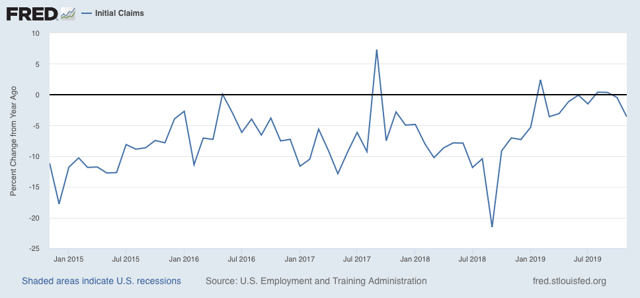
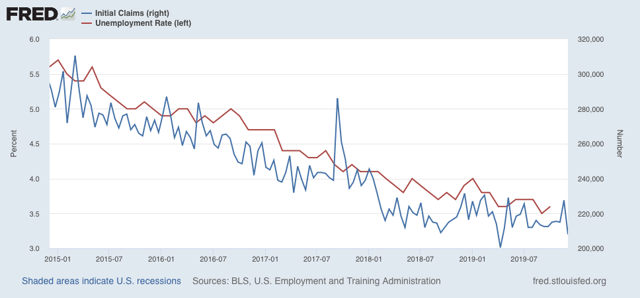
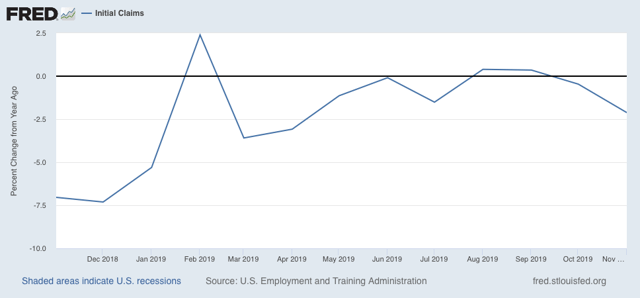
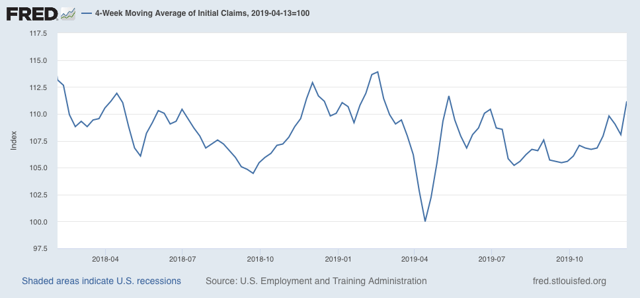
This week’s reading of 252,000 was the weakest since September of 2017. As a result, the 4 week moving average of claims has risen to 224,000, is 11.2% above the lowest reading of this expansion, which occurred back in April: 


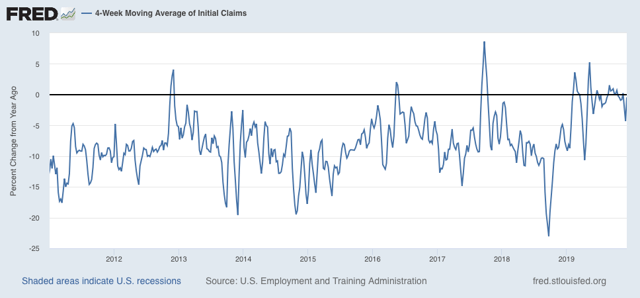
Nevertheless, on a YoY% change basis, the 4 week average is still slightly below, as in by 1,000 or -0.5%, its level one year ago:


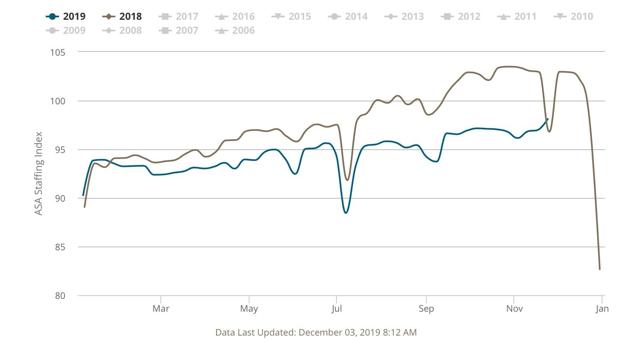
For the first two weeks of December (blue in the graph below), the average is 226,000 vs. 223,200 for the entire month of December last year (red), or higher by 1.3%, while on direct comparison with the first two weeks of last December, they are higher by 4.4%:
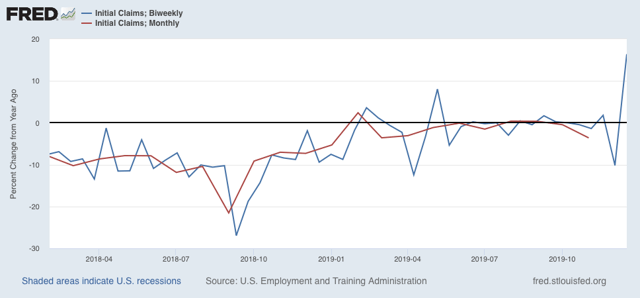


Both thresholds for concern - extra watchfulness - have been met. 

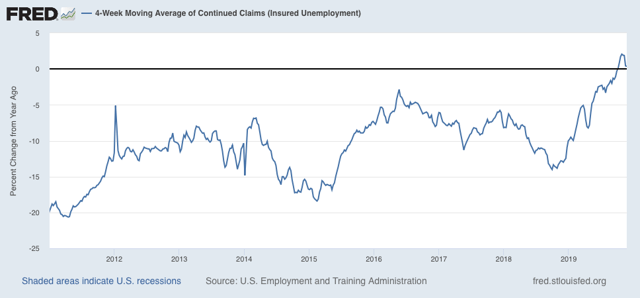
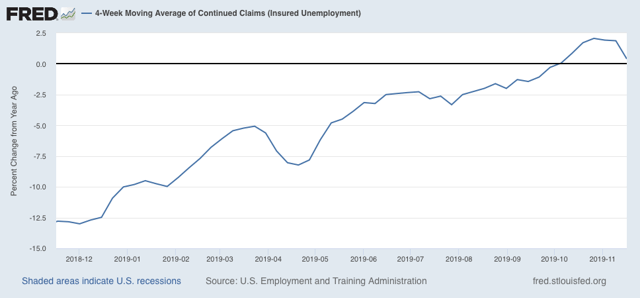
Meanwhile, the less volatile 4 week average of continuing claims is 0.2% above where it was a year ago:
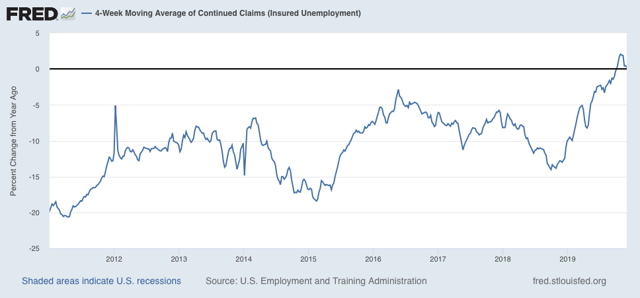

Here is the longer term graph:
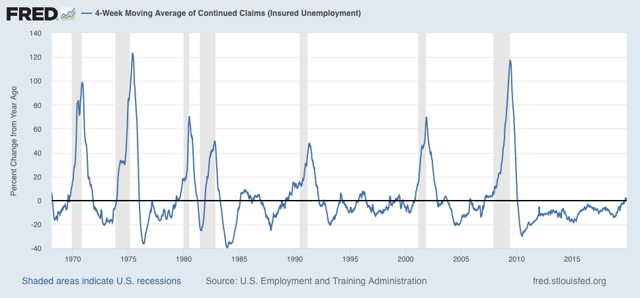


Again, this certainly is cautionary, and is consistent with a significant slowdown. But there have been similar readings in 1967, 1985-6, 3 times in the 1990s, and briefly in 2003 and 2005, all without a recession following. So the threshold for continuing claims being a negative (vs. neutral) has not been met either.
  
Several weeks ago I wrote that “unless initial claims start to be reported in the 230’s, and continuing claims continue to trend  higher, into the 1.770 million range (by mid-December, after which the YoY comparisons for continuing claims get much easier), no interim recession will be signaled.” Last year we also saw some seasonal weakness in initial claims, even before the government shutdown, so one bad week is not enough reason for a fundamental change of opinion beyond turning neutral. So it will take several more weak weeks of readings in the 230’s or worse for initial claims to raise a red flag.

Wednesday, December 11, 2019

November average real wage growth stable, but aggregate growth now puts expansion in second place behind 1990s


 - by New Deal democrat

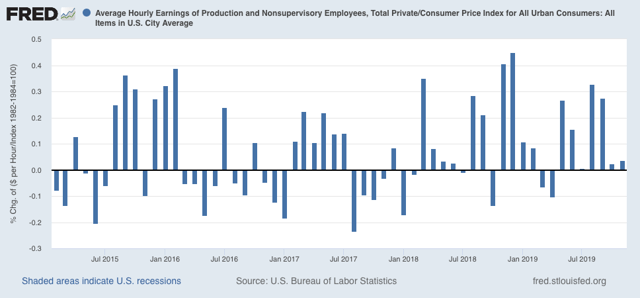
November consumer inflation came in at +0.3%. Since in last Friday’s jobs report average hourly earnings also increased +0.3%, real average hourly earnings were unchanged:   


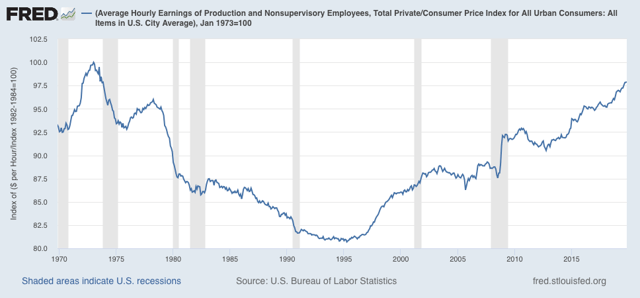
In a longer term perspective, this means that real wages remain at 97.9% of their all time high in January 1973:


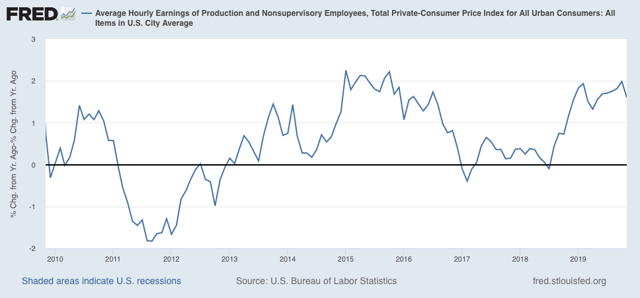
Since in November 2018 consumer inflation came in a 0%, the YoY measure of real average wages declined from +2.0% to +1.6%: 


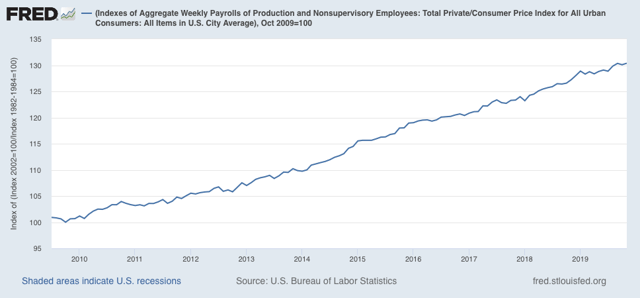
Aggregate hours and payrolls have improved significantly since July, so even though they declined -0.1% in October, real aggregate wages - the total amount of real pay taken home by the middle and working classes - are up 30.4%  from their October 2009 trough at the beginning of this expansion:


As of this month, in terms of total wage growth, this expansion rises to second place, ahead of the 1960s (dated from January 1964 when record-keeping began) but still below the 1990s peak of +33.9%. Nevertheless the *pace* of wage growth has been the slowest except for the 2000s expansion.

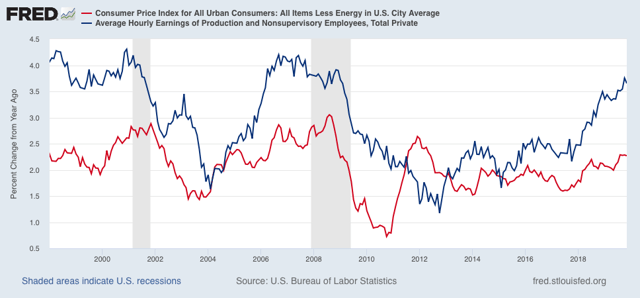
This year, 2019, has really been a boon for labor. Labor force participation has increased, undemployment and underemployment have made new lows, and somnolent gas prices combined with accelerating nominal wage growth have meant that real average and aggregate wages have risen strongly. I suspect this will mark the “sweet spot” for average middle and working class Americans from this expansion, as YoY consumer inflation ex-gas has risen back to +2.3% YoY (red in the graph below):   


Should this rising inflation trend continue, along with strong nominal non-managerial wage increases (blue), the Fed is going to want to raise rates again.

Tuesday, December 10, 2019

Live-blogging the Fifteenth Amendment: December 10, 1868


 - by New Deal democrat

In the Senate, the two proposals for a Fifteenth Amendment to the Constitution were referred to the Judiciary Committee.

In the House of Representatives, Rep. James G. Blaine made the following speech (in relevant part):

And now that victory, complete and unsullied, has been won [in the elections of 1868], ... it may not be unprofitable . . . to make a brief summary of the points that have been solemnly adjudicated and permanently settled by the American people in the election of General Grant to the presidency.
.... The election of 1868 is the last in which the lately rebellious section, even if it could be wholly controlled by rebels, will have sufficient power in the electoral vote in the country to make it the object either of hope or fear on the part of political organizations striving for the government of the nation. . . . . The withdrawal of northern Democratic support for these [ten rebel] States will give to the loyal inhabitants, who are a clear majority in each of them, the power of governing them in the interest of loyalty . . . .  The Union was actually saved by General Grant’s actions in the field. The menace of its destruction ceases with his victory at the polls.
[ ] The reconstruction laws of Congress have been vindicated and sustained by General Grant’s election. The State governments created under those laws will be upheld and the basis of impartial loyal suffrage, without regard to race or color, will be accepted as the permanent rule in the lately rebellious States, as it will be at no distant day throughout the entire Union. This result is certain to be achieved either through the amelioration of prejudice and the conquering force of justice in the individual States or by the comprehensive influence of a constitutional amendment which shall affect all the States equally and alike. . . .  The rebellious element in those States, seeing the hopeless folly of longer resisting the mandate of the nation, will acquiesce in the decision, if with no better grace than merely accepting the inevitable. .... The better minds even among the rebel leaders recognize and admit that as a question of practical statesmanship it is too late to discuss negro suffrage; for having been granted it is impossible to recall it. Between originally withholding a franchise from large masses of people and annulling it after it has been conceded, wise men can see a vast difference . . . . So that even excluding from the case the abstract and unchanging element of justice which underlies it, it is demonstrably impracticable to withhold suffrage from the southern negroes now that they have exercised it, without involving consequences which would would destroy all security for life or property in that section for generations to come. Negro suffrage then [has] be[en]  of necessity conceded . . . .
[Source: Congressional Globe, 40th Congress, 3rd Session, pp. 43, 57-58

With the hindsight of 150 years, Congressman Blaine’s triumphalism can be seen as wildly overoptimistic to say the least. But he was hardly alone. The writings of Frederic Douglass at the time have the same triumphal tenor. As it turned out “Negro suffrage” wasn’t conceded at all, as the low level guerrilla insurgency by the KKK and others in the South ultimately wore down northern Republicans, most of whom may have abhorred slavery but did *not* believe in actual racial equality.

Note also, however, that Blaine’s speech completely cuts the feet out from beneath Chief Justice Roberts’ holding in Shelby County that there is some amorphous and inchoate requirement in the Constitution that all States be treated equally. As Blaine pointed out, States undergoing reconstruction were treated far differently than the others, including other slave States, as it was mandatory that their constitutions enshrine black suffrage, whereas, e.g., the loyal slave States of Maryland, Kentucky, and Missouri faced no such obligation.

Previously: December 7, 1868

Scenes from the November jobs report 2: participation and wages


 - by New Deal democrat

Yesterday I looked at the leading sectors of employment from the establishment jobs report. Today let’s look at labor force participation and wage growth.

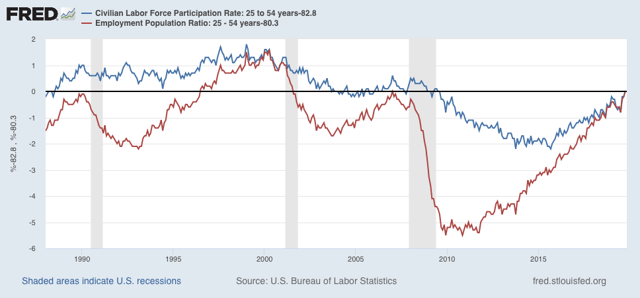
There was no significant change in either prime age labor force participation or employment from October to November. In the below graph, both November readings are normed to zero so that only better rates of participation and employment show as positives. The graph dates from the end of the 1980s, when women’s entry into the labor force was close to completion:  


The prime age employment to population ratio for prime age workers is better than either the 1990 or 2007 peaks, but about 1.6% lower than the late 1990s boom. But participation still lags all three peaks.

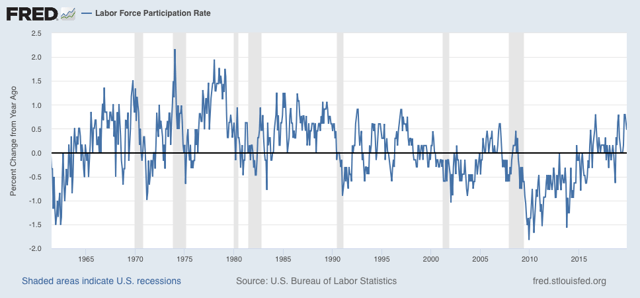
On the other hand, the *YoY growth* in participation for November was +0.5%, among the strongest rates sine the mid-1990s:


Note the huge bulge in the 1960s and 1970s as the baby boom, and women, entered the work force in droves. Some of the strong growth in this metric that has appeared over the past 5 years is the result of the equally large Millennial generation entering the market and offsetting retiring Boomers.
 
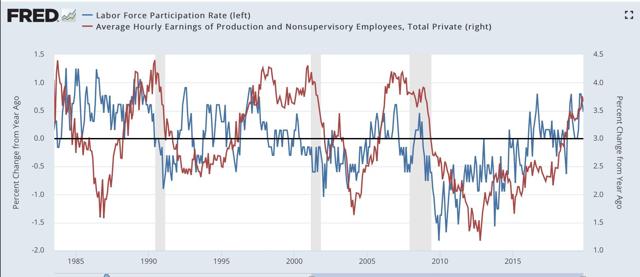
As shown in the next graph below,  YoY wage growth lags YoY participation growth. On a more “micro” scale, large bumps in participation (e.g., the mid-1980s, early 1990s, and 2016) have frequently (not always!) tended to be associated with lags in wage growth, as short term increased competition for employment openings eases wage demand.

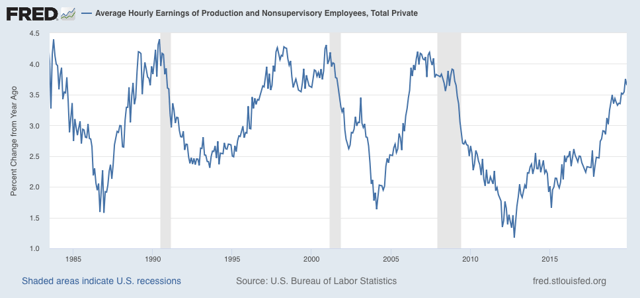
But on a cyclical and secular scales, another part of the story of the lag in participation is the deceleration in wage growth. Nominal wage growth is one of the very few *long lagging* indicators, I.e., it does not bottom out until the U6 underemployment rate falls to about 8% (not shown):


In the past 40 years, wage growth has tended to peak in the 4.0%-4.5% range for each expansion. So far non-supervisory wages have increased at most 3.8% YoY in this expansion:


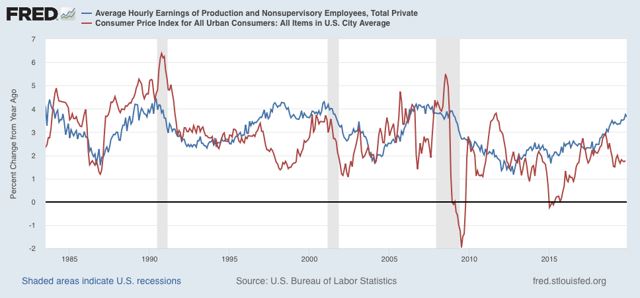
Finally, let’s compare nominal non-supervisory wage growth YoY (blue) with consumer inflation (red):


Both slowdowns and recessions have typically occurred in the past 40 years when inflation is nearly equal to or exceeds nominal wage growth. We briefly had that in 2018, due to an increase in gas prices, but 2019 has been a rare occasion of accelerating nominal wage growth an decreasing inflation (again, due to somnolent gas prices).

[Aside: stories you are reading about how wage growth has subsided are citing wages that include supervisors and managers. The slowdown in growth there has everything to do with managerial employees, and not non-supervisory employees.]

Tomorrow we will get November inflation data. The signs are that gas prices are picking up again, so I expect an uptick in inflation as well.


Monday, December 9, 2019

Scenes from the November jobs report


 - by New Deal democrat

Let’s take a more detailed look at last Friday’s November jobs report, in particular a discussion of the more leading sectors.

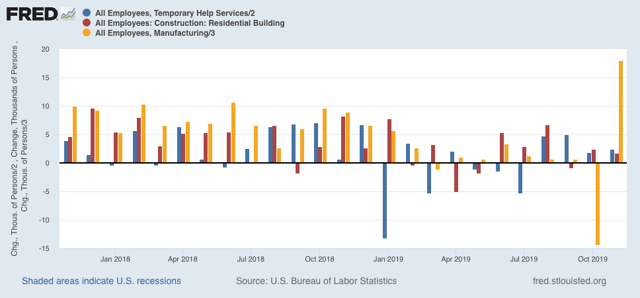
First, let’s update the three leading sectors of employment that I have been tracking: temporary help (blue in the graph below), manufacturing (gold), and residential construction (red). Here’s what they look like compared with 2018, showing the slowdown this year (Note: the big decline in manufacturing in October was the GM strike, which as expected was reversed in November):   


Residential construction looks like it has rebounded from its losses earlier this year, more confirmation of the rebound in the long leading housing sector.

As for temporary help, it continues to defy the gloomy weekly statistics that have been worsening this year in the American Staffing Association report. On the other hand, the pattern of downward revisions has persisted. This year there have been almost relentless downward revisions in that number. That pattern was mixed for September and October, as the downward revisions in the first were almost exactly matched by the upward first revision to the latter. Below are the original number for the last four months on the left, followed by the first and then final revisions to the right:

JUL +2200 -7300* -10,500
AUG +15,400 +14,500 +9,500
SEP +10,200 +20,100 +9,900
OCT -8100 +3800*
NOV +4800
*1st revision only


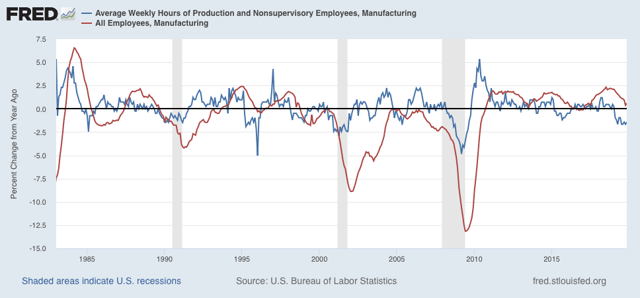
Next, the average manufacturing workweek remains down 0.9 hours per week YoY from its peak. Although I only show data from 1983 onward below, going back 70 years there have only been 2 occasions where such a decline lasted longer than one month without a recession happening (1953 and 1966). In the modern era shown, only in 1985 and 1995 for one month apiece were there 1 hour declines without a recession following. A look at the YoY% change in manufacturing hours for the past 35 years also shows that such losses have *always* led to actual YoY losses in manufacturing jobs:


So, despite the rebound in November, we should expect more and significant actual losses in manufacturing jobs going forward. And, like temporary help, the revisions for manufacturing employment have all been downward for six of the past seven months:

APR +4. +3 (-1)
MAY +3 +2 (-1)
JUN +17 +10 (-7)
JUL +16 +4 (-12)
AUG +3 +2 (-1)
SEP -2  +2  (+4)
OCT -36 -43 (-7)*
NOV +54 
*1st revision only

For the first 11 months of 2019, manufacturing has only added 34,000 jobs.

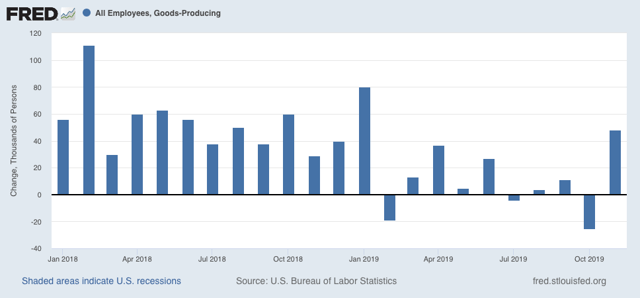
More broadly,  since January of  this year, only 97,000 jobs have been added in the entire goods-producing sector:


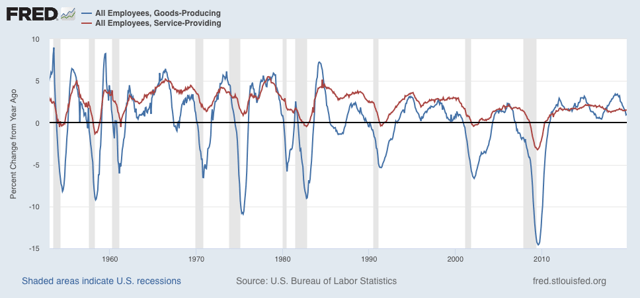
Further,there have been YoY losses in goods-producing jobs before all of the past 3 recessions, and going back 70 years, counting 12 recessions, in all but 3 there has been steep deceleration before and actual losses no later than two months into the recession, with only 2 false positives (1966 and 1985). This is consistent with at very least a severe slowdown.

Where there has not been a slowdown is in the (non-leading) services sector, which remains at roughly 1.5% growth YoY:


To sum up with regard to the leading sectors, Friday’s report was indeed good, but given the revisions, not quite as good as it appeared at first blush.

Finally, I wrote on Friday that the blowout good report negatived recession in the immediate short term. On Saturday Mike Sherlock took issue with many such similar claims

Pointing to the ISM manufacturing slowdown, a slowdown in small firms’ hiring, the manufacturing workweek, and the narrowness of the 2015-16 slowdown, concluding “people ought to discuss the actual data instead of making baseless claims.”

So I thought I would go back and take a look at the actual 70 years of data.

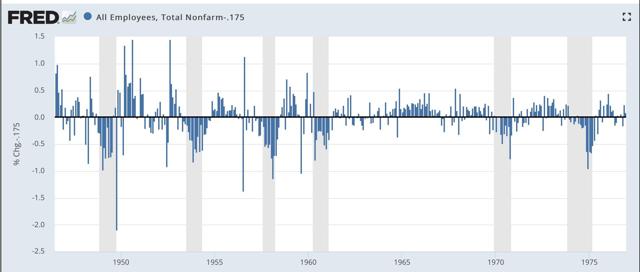
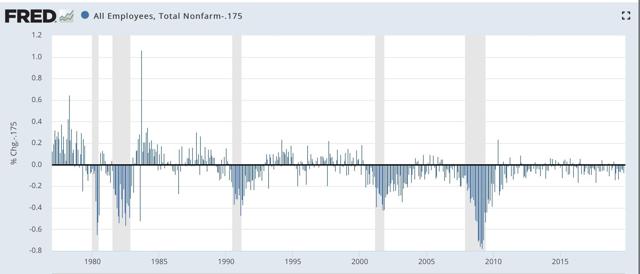
Since Friday’s report showed a m/m gain of 0.175%, I made a two graphs together showing the m/m% gain for the last 80 years, from which I subtracted -0.175%, so that any showing equal to November’s would be at the zero line, and only those showings better than November would be positive.

Here’s what I got:  


The two time periods are significantly different. During the post-war boom through 1974, it wasn’t uncommon at all to have readings equal to or better than November’s right before a recession began. In fact it happened just prior to every recession except for 1955 and 1957. Since 1974, though, it is a different story. Only in 1981, when the Fed raised rates sharply, was there a reading as good as November’s within 3 months of the onset of a recession. Prior to the last two recessions the lag was much, much greater. In either time frame, the three month rolling average was less than 0.175%/month leading up to recession - but of course it is now as well.

So, credit to Mish for raising a fair point. But I think the data from the modern era, where manufacturing is much less a component of the jobs picture is the most applicable. So I still think the November report is strong evidence against a recession before February.


Sunday, December 8, 2019

The endowment effect and the taxation of wealth


 - by New Deal democrat

As you may recall, I am reading the histories of a number of past Republics which have had various levels of success. Without getting too far ahead of myself, it appears that one constant is that, once plutocratic oligarchies are entrenched, they will refuse to yield power or money, even to the point of destroying democratic or republican institutions.  In other words, David Frum‘s observation that "If conservatives become convinced that they can not win democratically, they will not abandon conservatism. They will reject democracy" is true not just at the present, but across history.

I raise this in the context of Elizabeth Warren’s proposal for a “wealth tax.” Leaving aside its practicality or even Constitutionality, the above historical observation is probably at the root of the apoplexy with which plutocrats have reacted against it.

A further context to consider this issue is what psychologists and behavioral economists call “the endowment effect.” The endowment effect describes the consistent result that people would rather retain something that they have acquired - even if by charity, chance, or gift - than earn the  same thing when they do not own it. Put another way, people's maximum willingness to pay to acquire something is typically lower than the least amount they are willing to accept to give it up, even when there is no cause for attachment, or even if the item was only obtained minutes ago, and was not in any way “earned.”

This paradigm is applicable to taxation. Consider payroll tax withholding. Suppose a person’s income tax liability were $10,000. In strictly economic terms, they should be indifferent to paying that lump sum at the end of the tax year, or having it withheld at $385 per biweekly paycheck. But it is almost certain that the former situation would lead to a lot of anger at the end of the year, while the latter once started would be barely noticed. In the former case, the government is trying to take away the “endowed” $10,000, while in the latter case the taxpayer never even receives the money.

A “wealth tax” is like the former situation, and is likely to engender the strongest angry reaction. And it certainly appears to be the case from several thousand years of history that it oligarchs will be willing to trash everything else in order to keep their “endowment.”

Obviously this points to the importance of equitable interception of income before it vests in the recipient, I.e., withholding taxes. But in a case such as the US, where that horse has long ago left the barn, it argues for a recapture that at least minimizes the endowment effect. 

That, I think, is the estate or inheritance tax. I prefer the latter, because it emphasizes the fact that the heir has not “earned” the wealth, vs. the former which has been demogogued as a “death tax.” And it does make a difference. One of the Koch brothers, for example, could leave either $250 to every American household, or $40 Billion to their sole surviving heir. The estate tax would be identical, but the inheritance taxes would be very much different!

By no means am I suggesting that the wealthy would roll over for a robust inheritance tax. But I am suggesting that the reaction would be much less intense than for a “wealth tax.” That means a much better chance of the tax “sticking,” and a much better chance that the wealthy would not destroy our representative democracy to avoid it.

Saturday, December 7, 2019

Live-blogging the Fifteenth Amendment: December 7, 1868


 - by New Deal democrat

In the Senate: 

“Mr. Craving asked, and by unanimous consent obtained, leave to introduce a joint resolution proposing an amendment to the Constitution of the United States: . . .

“No State shall deny the right of suffrage or abridge the same to any male citizens of the United States twenty-one years of age or upwards except for participation in rebellion or other crime and also excepting Indians not taxed; but any State may exact of such citizen a specific term of residence as a condition of voting therein, the condition being the same for all classes.”
. . . .   

“Mr. Pomeroy asked and by unanimous consent obtained, leave to introduce a joint resolution proposing an amendment to the Constitution of the United States: . . . 

“The basis of suffrage in the United States shall be that of citizenship, and all native or naturalized citizens shall enjoy the same rights and privileges of the elective franchise; but each State shall determine by law the age of the citizen and the time of residence required for the exercise of the right of suffrage, which shall apply equally to all citizens, and also shall make all laws concerning the time, places, and manner of holding elections.”
——

In the House of Representatives:

“Mr. Kelley introduced a joint resolution proposing an amendment to the Constitution of the United States . . .

“No State shall deny to or exclude from the exercise of any of the rights or privileges of an elector any citizen of the United States by reason of race or color.”
. . . . 

“Mr. Broomall introduced a joint resolution proposing an amendment to the Constitution of the United States . . .

“Neither Congress nor any State by its constitution or laws shall deny or restrict the right of suffrage to citizens of the United States on account of race or parentage of such citizens; and all qualifications or limitations of the right of suffrage in the constitution or laws of any State based upon race or parentage, are, and are hereby, declared to be, void.”
. . . . 

“Mr. Stokes introduced a joint resolution proposing an amendment to the Constitution of the United States . . .
 
“No State shall make or enforce any law which shall deprive any citizen of the right of the elective franchise on account of race or color.”

[Source: Congressional Globe, 40th Congress, 3rd Session, pp. 6, 9, 11.] 
  
In view of the gutting of portions of the Voting Rights Act in the Shelby County case, and the subsequent passage of numerous voter suppression laws, and also the ongoing crisis of extreme gerrymandering, for several years I have wanted to write a series examining those issues from the viewpoint of the Congress that passed the Fifteenth Amendment 150+1 years ago. Finding the debates in the record of Congress proved diabolically hard, which is why I didn’t undertake this task one year ago. Recently the index in Prof. Eric Foner’s book “The Second Founding,” which discussed the post-Civil War Amendments in great detail, proved very helpful in locating many (although not all!) of those debates in the record.

So - no promises, because this involves reading about 1000 pages of tiny script in the Congressional Globe (the forerunner to the Congressional Record)! - I hope to follow this post up with day-by-day highlights of that debate, on the dates the statements were made, many of which clearly set forth the Congressional intent, and anticipated many of the issues we face now, 150 years later.

Notice the difference between the two Senate proposals and the three House proposals. The Senate proposals would codify a broad right to vote, and allow certain exceptions or qualifications to that right. The House proposals, on the other hand, narrowly prohibit racial discrimination in the right to vote, while being silent on other qualifications and notably not conferring a Constitutional “right to vote.” 

Of course, we know which version ultimately was enacted. The reasons why will become apparent as we watch the debates progress.

Weekly Indicators for December 2 - 6 at Seeking Alpha


 - by New Deal democrat

My Weekly Indicators post is up at Seeking Alpha.

After a spell where all of the time frames were positive, there is a little darkening in the long and short term forecasts.

As usual, clicking over and reading helps reward me with a penny or two for my efforts it bringing you up to the moment information.

Friday, December 6, 2019

November jobs report: an excellent report for ordinary working households that takes recession off the table for now


 - by New Deal democrat

HEADLINES
  • +266,000 jobs added
  • U3 unemployment rate down -0.1% from 3.6% to 3.5%
  • U6 underemployment rate down -0.1% from 7.0% to 6.9%
Leading employment indicators of a slowdown or recession

I am highlighting these because many leading indicators overall have strongly suggested that an employment slowdown is here. The following more leading numbers in the report tell us about where the economy is likely to be a few months from now. These were positive:
  • the average manufacturing workweek rose 0.1 hour  from 40.4 hours to 40.5 hours. This is one of the 10 components of the LEI and is positive.
  • Manufacturing jobs rose by 54,000 (but would have risen by 13,000 were it not for workers returning from the GM strike). YoY manufacturing is up 76,000, a sharp deceleration from 2018’s pace.
  • construction jobs rose by 1,000. YoY construction jobs are up 146,000, also a deceleration from summer 2018. Residential construction jobs, which are even more leading, rose by 1800.
  • temporary jobs rose by 4800. 
  • the number of people unemployed for 5 weeks or less increased by 52,000 from 1,968,000 to 2,020,000.

Wages and participation rates

Here are the headlines on wages and the broader measures of underemployment:
  • Not in Labor Force, but Want a Job Now: increased by 78,000 from 4.753 million to 4.831 million 
  • Part time for economic reasons: decreased by -16,000 from 4.438 million to 4.322 million 
  • Employment/population ratio ages 25-54: unchanged at 80.3%
  • Average Hourly Earnings for Production and Nonsupervisory Personnel: rose $.07 to $23.84, up +3.7% YoY. Last month was revised higher with a YoY rate of +3.8% a new expansion high. (Note: you may be reading different information about wages elsewhere. They are citing average wages for all private workers. I use wages for nonsupervisory personnel, to come closer to the situation for ordinary workers.)  

Holding Trump accountable on manufacturing and mining jobs

 Trump specifically campaigned on bringing back manufacturing and mining jobs.  Is he keeping this promise?  
  • Manufacturing jobs rose an average of +6,300/month in the past year vs. the last seven years of Obama's presidency in which an average of +10,300 manufacturing jobs were added each month.   
  • Coal mining jobs increased by 300, an average of 100 jobs/month in the past year vs. the last seven years of Obama's presidency in which an average of -300 jobs were lost each month
September was revised upward by 13,000. October was also revised upward by 28,000, for a net change of 41,000.

Other important coincident indicators help  us paint a more complete picture of the present:
  • Overtime declined -0.1 hour from 3.2  hours to 3.1 hours
  • Professional and business employment (generally higher-paying jobs) rose by 38,000 and  is up +417,000 YoY. 
  • the index of aggregate hours worked for non-managerial workers rose by 0.2%
  •  the index of aggregate payrolls for non-managerial workers rose by 0.5%  
Other news included:            
  • the alternate jobs number contained  in the more volatile household survey rose by 83,000  jobs.  This represents an increase of 1,790 000 jobs YoY vs. 2,204,000 in the establishment survey. 
  • Government jobs rose by 12,000.
  • the overall employment to population ratio for all ages 16 and up was unchanged at 61.0% and is up 0.4% YoY.    
  • The labor force participation rate declined -0.1% from 63.3% to 63.2% and is up 0.3% YoY.

SUMMARY

Obviously this was an excellent report, which it has to be said was completely at odds with the manufacturing and consumption data that has been reported in the past month.

There were very few weak spots: short term unemployment rose slightly, as did those not even in the labor force who nonetheless want a job, and overtime.

Everything else was positive to strongly positive. Aside from the headline employment number, the standout was non-supervisory wages, which rose 3.7% in November after a revised 3.8% YoY rate in October, a new expansion high. Almost all of the leading indicators in employment were also positive. In particular temporary jobs, completely contradicting private data, have risen strongly in 3 of the past 4 months. Involuntary part time employment also fell to a new expansion low. Aggregate hours and payrolls also rose strongly. Revisions were positive.

Bottom line: this report completely takes recession out of the picture for the next several months, and was good news for ordinary working households.

Thursday, December 5, 2019

Initial jobless claims still a positive; what I’ll be watching for tomorrow


 - by New Deal democrat

As I’ve said a number of times over the past few months, the lack of an increase in initial jobless claims is the best argument against any oncoming recession. If businesses aren’t laying employees off, those same people are consumers who are going to continue to spend, which is 70% of the total economy.

This morning’s initial jobless claims report continues the streak. At 203,000, it is the lowest since April. Averaging it with last week, due to the change in Thanksgiving this year gives us 215,000 for the two weeks - right in line with the average for over the past year.

The four week moving average is 217,750, only 7.9% higher than April’s low of 201,500 - and below my 10% threshold for concern. The monthly average for November was 216,400, which is -3.7% below last November’s, also a positive:


Even the less leading but less volatile 4 week average of continuing claims is only +0.4% higher than one year ago, well below my +5% YoY threshold for concern:

Since initial claims leads the unemployment rate, my anticipation is that tomorrow’s jobs report will see unemployment remain at 3.6% +/-0.1%:


Tomorrow I will also again be particularly interested in manufacturing, residential construction, and temporary employment, the markers for all of which indicated contraction in the past month. Here is the update on temporary jobs from the American Staffing Association:


The pattern has been that the initial estimate for all has been positive, with substantial downward revisions in both temporary jobs and manufacturing. So I will be paying extra attention to the revisions in these, and to the goods producing sector in general, tomorrow.

Wednesday, December 4, 2019

November vehicle sales: the consumer is alright, producers not contracting


 - by New Deal democrat

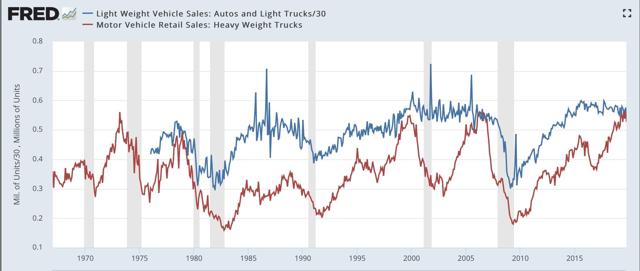
Vehicle sales are a significant short leading indicator. They tend to react after housing, but before broader consumer sales. Although domestic vehicle manufacturers are now reporting only quarterly rather than monthly, this metric is still an important one to watch.

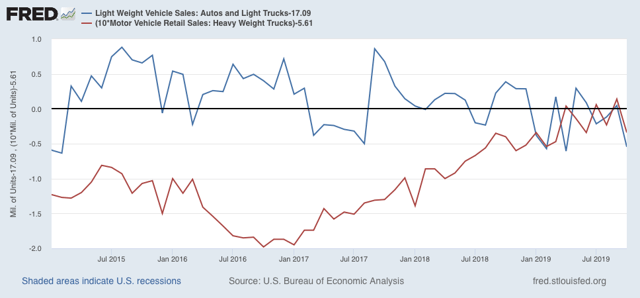
Yesterday car and light truck sales were reported at 17.09 million units annualized for November (blue in the graphs below). Heavy trucks were reported at .561 million annualized (red):


Note that heavy truck sales are a much clearer indicator, declining typically by about -20% a number of months before the onset of a recession (with 1969 being the exception). Car sales typically have declined by more than -10% on a three month rolling average, and it is much more difficult to distill signal from noise.

With that in mind, here is the last five years, including the 2015 peak for car sales. Since FRED carries the data with a one month delay, I have subtracted the November reading from each, so that the respective November numbers if shown would be zero:


While heavy truck sales have turned flattish this year, November is still extremely close to the peak readings. Car sales averaged for the past three months are only a little more than -5% off peak.

As I’ve been saying a lot recently, the consumer is still alright. Meanwhile businesses may not be expanding, but they’re not meaningfully contracting either.

Tuesday, December 3, 2019

Forecasting the 2020 election: the economic baseline (or, don’t count on a recession)


 - by New Deal democrat

Four years ago, I decided to use my set of “long leading indicators” to forecast the 2016 election. The indicators were very weakly positive, and pointed to a narrow popular vote win for the incumbent party one year out. This prompted Nate Silver to huff and puff that nobody knew anything about what the economy would look like so far off. One year later, the economy was very weak, the downward move in the unemployment rate had stalled, and the incumbent won the popular vote narrowly (but obviously not the Electoral College vote).  

Well, the 2020 election is 11 months away. So it’s time to do the impossible again.

As I wrote four years ago, going back 160 years, roughly 3/4 of all US Presidential election results have correlated positively with whether or not at the time of the election campaign, the US was in a recession or not. More than 2/3 of the time, it accurately predicted the Electoral College winner, and 80% of the time, it accurately showed the winner of the populat vote.  In fact, if we simply go by the metric of whether or not the US was in recession during the 3rd Quarter of the election year, then 84% of the time the winner of the popular vote was from the incumbent party if the economy was expanding, and from the opposition party if the economy was in recession. (The list of all of the elections, the economic status, and the victor in each election, is available at the link above).

In only 3 of the 11 cases where there has been a recession in the 3rd or 4th Quarter of the election year has the incumbent party been successful maintaining control of the White House. Contrarily, of the 29 times the economy has been expanding during the 3rd and 4th Quarter of an election year, the incumbent party has retained control of the White House nearly 3/4 of the time. If we go by popular vote rather than electoral college result, that average increases to over 80% (Both the 2000 and 2016 elections fall into this category, where there was no recession, the incumbent party won the popular vote, but the electoral college resulted in the opposition candidate being declared the winner). 

So, with the election one year off, let’s take a look at “Will there be a recession on  Election Day? The simple answer is, left to its own devices, almost certainly not.

Several months ago, analyzing the long leading indicators, I wrote that economic conditions would start to improve by about midyear 2020. Although there has been some deterioration in several long leading metrics since then, that result has remained the same. Below I go through all of the same indicators (7 in all) and their status now. Remember that they suggest how the economy will be 12+ months out.

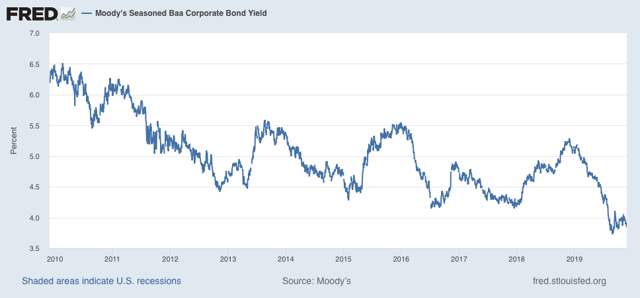
1. Corporate bond yields fell to new expansion lows a few months ago:


This is a positive.

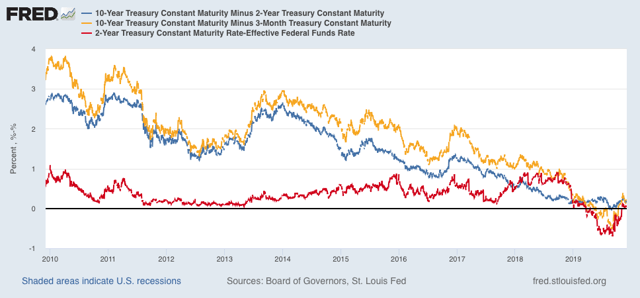
2. The yield curve has in-inverted. When  a recession has begun after an un-inversion, it has been within the next eight months (for our purposes, by the end of Q2 next year). Further, the Two year minus Fed funds metric never inverted enough to be consistent with a recession: 


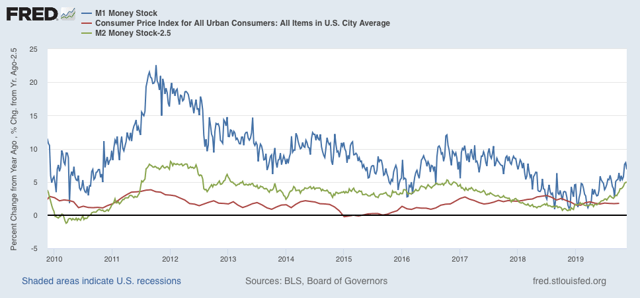
3.  Real money supply has turned back to very positive:


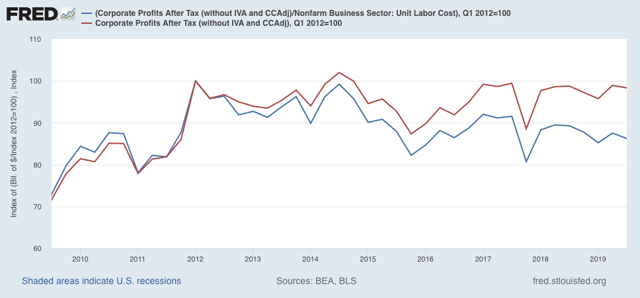
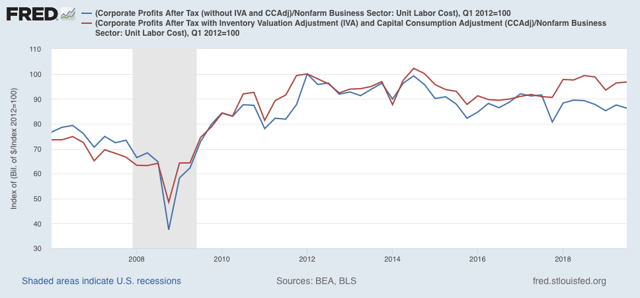
4.  Corporate profits adjusted by unit labor costs give a mixed result. Both are lower then their peak, from way back in 2012. But only one version has declined enough to be consistent with an oncoming recession:


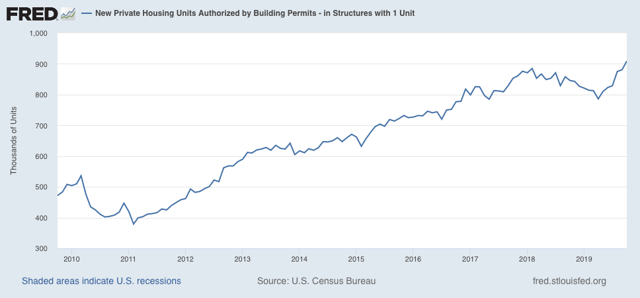
5.  Housing permits have rebounded sharply in recent months:


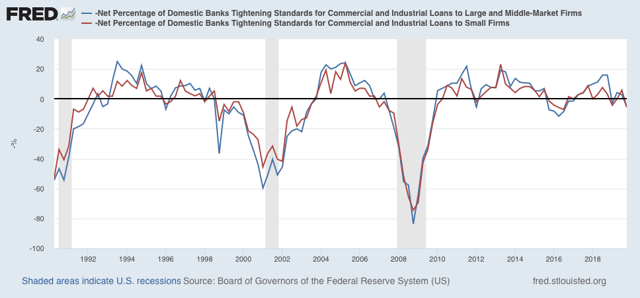
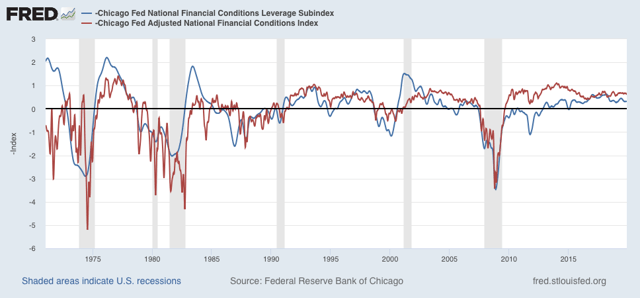
6.  Credit conditions are mixed. The Senior Loan Officer Survey has turned negative, although not by much:


While the Chicago Adjusted National Financial Conditions Index remains positive:


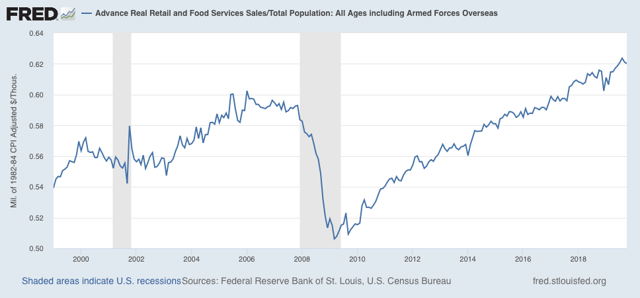
7.  Real retail sales per capita have been flat for a couple of months, but recently increased sharply and peaked in August:


To  summarize, three of the seven indicators are unequivocally positive: corporate bond yields, housing permits, and real money supply; three are mixed: the yield curve, credit conditions, and corporate profits (with the period of overlap among the negative iterations being limited to the 3rd Quarter); and one is negative, but only slightly compared with its recent 3rd Quarter peak: real retail sales per capita. 

So, while it is possible that a recession could be upon us in the 3rd or 4th Quarter of next year, if the economy is left to its own devices it is unlikely. (although Tarriff Man will do his best to undermine this). 

Obviously, this is an argument for an incumbent party popular vote victory. But there have been 10 cases where the economy has been in expansion and the incumbent party’s nominee still lost. One was the “jobless recovery” of 1992. Almost all the others have involved war (1952, 1968), civil discord or scandal (1968 again, 1976, 2000), or a disliked incumbent party candidate and/or a party split (1912, 1992, 2016).  

In short, the overall economic picture is a baseline. Non-economic factors having to do with the President’s personality or record do come into play as well (as will be explored by several other models). And it’s already quite clear that 2020 is going to include both civil discord and scandal.

Monday, December 2, 2019

December starts out with a thud


 - by New Deal democrat

The first reports in December are in, and both were negative.

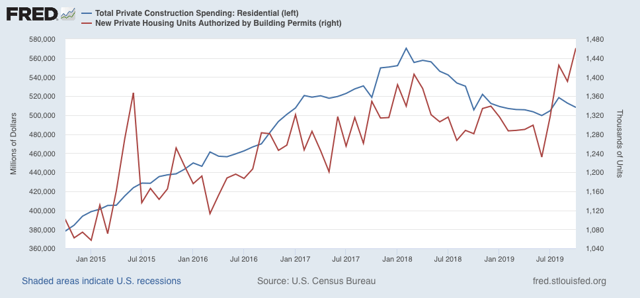
Let’s start with construction spending. Overall construction spending declined -0.8% in October. The more leading residential construction spending declined -0.9%, the second decline in a row (blue in the graph below):


Since actual spending on residential construction doesn’t take place until the house is started, it lags building permits (red in the graph above). So given the strong rebound in permits, I’m not concerned at this point about a renewed decline in construction, as I expect it will follow permits as well.

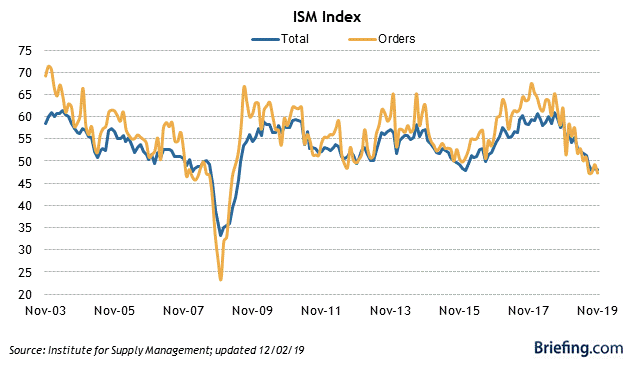
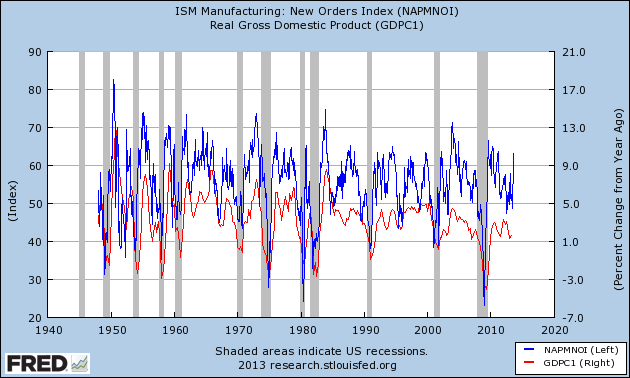
The same can’t be said for the second negative piece of news this morning, in the ISM manufacturing index. The overall index came in at 48.1, while the more leading new orders index came in at 47.2:


In the past it has typically taken at least two readings below 48 for the overall ISM manufacturing index to indicate recession, so the main indication here is that manufacturing may be in a shallow recession, but the economy as a whole is close to flat.

On the other hand, the new orders index is already at a level which has been consistent over the past 70 years with a recession in the very near future - although it is also consistent, as for example in 1966, with a slowdown only (note: ISM doesn’t allow FRED to publish its new data, so the below is a long term historical graph that ends in 2013):

Since the manufacturing sector in the economy is a smaller segment now than at any point since these series were started almost 75 years ago, the shallow  downturn there will have less repercussions than in the past.

A year ago I pointed to this quarter as being the epicenter of when I expected the downturn in the long leading indicators to have the most impact. That certainly appears to be the case. As the same time, I think the economy as a whole is more likely to remain in a slowdown than an outright contraction.

Saturday, November 30, 2019

Weekly Indicators for November 25 - 29 at Seeking Alpha


 - by New Deal democrat

My Weekly Indicators post is up at Seeking Alpha.

The short term forecast has been the most volatile portion for the past few months. And it got volatile again this week.

As usual, clicking over and reading should bring you fully up to date, and it rewards me a little for my efforts.

Friday, November 29, 2019

A few thoughts while you are digesting Thanksgiving dinner


 - by New Deal democrat

There was a bunch of data released Wednesday, while yours truly was on the road along with everybody else. So here are a couple of thoughts for you as you sit there with your loosened belt figuring out what leftovers you’re going to be eating for the next few days . . . 

Initial jobless claims declined back to their recent baseline last week, so the four week average declined slightly, further back into its normal range. The YoY% change averaged monthly also is lower:


And the four week average of continuing claims, while slightly higher YoY, is also well below the point where it would be a serious concern:


Bottom line: the economy is simply not going to be in recession this quarter.

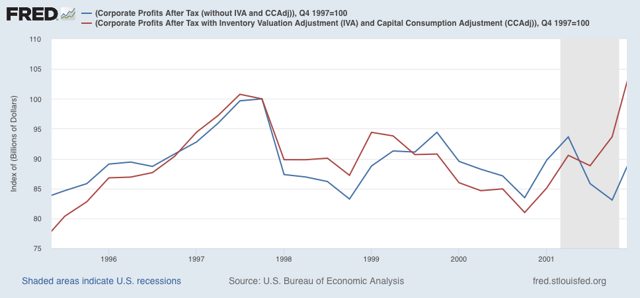
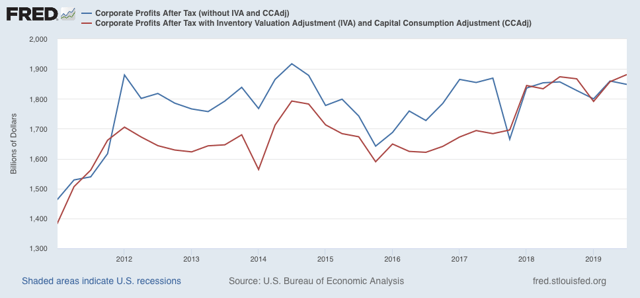
Corporate profits for the third quarter were also released as part of the second estimate of Q3 GDP. Depending on whether you include inventories and capital consumption or not, they either slightly increased or decreased:


Adjusted by unit labor costs, they are either slightly (-3.3%) or significantly (-13.8%) below their peak for this expansion:


Before the last producer-led recession in 2001, both were off more than -15%:


This is a mixed signal for the economy in the second half of next year.

Tuesday, November 26, 2019

Housing rebound continues; price appreciation stabilizes


 - by New Deal democrat

Just a quick note, as I am traveling today.

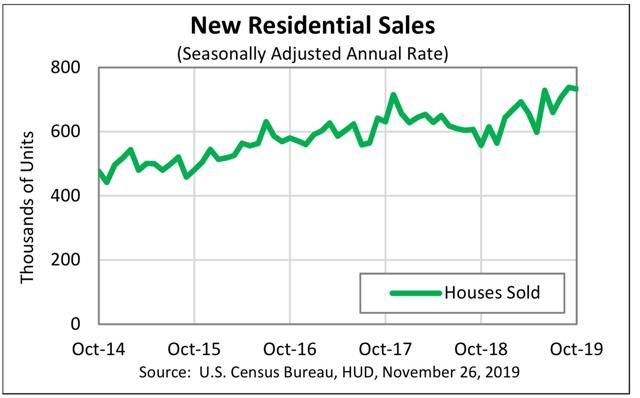
New home sales declined slightly in October from September, but remain at the high end of this expansion. The renewed uptrend in housing sales, due to lower mortgage rates, is clearly intact:


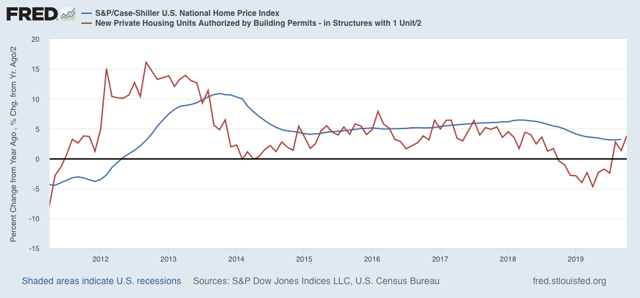
Meanwhile house prices, as measured by the Case Shiller index, also increased at a slightly faster YoY rate, 3.2% for September vs. 3.1% in August (blue):


As I have said many times, sales (permits, red in the graph above) lead prices. Now that the sales rebound is firmly intact, price appreciation has stabilized and is likely to begin accelerating again.

Monday, November 25, 2019

The consumer is still alright, November 2019 edition


 - by New Deal democrat

I have a new post up at Seeking Alpha.

A few months ago I took a look at the order in which I would expect the dominoes to fall if there were to be a consumer-led recession. One more domino has fallen, but several important ones are still upright.

As usual, clicking over and reading puts a couple of pennies in my pocket, and should be educational for you.

Sunday, November 24, 2019

Live-blogging the End of the Republic


 - by New Deal democrat

The title of this piece is increasingly my feeling about the times we are living in. Almost everywhere it has been implemented, the Madisonian system has ultimately failed, ending in presidential autocracy. All of the tools are now in place for the US to fail as well. If Trump doesn’t succeed in a second term, then the Sulla or Caesar who ends our republican experiment is alive now and has learned the necessary lessons. All that is missing is their competent and strategic implementation.

The bottom line is: provided a President has 34 Senators and a majority of the Supreme Court who will back him, he can do anything he wants. And I’m not even sure the Supreme Court majority is necessary. If Trump were to defy the Supreme Court about, e.g., his tax returns, who exactly is going to force him to obey?

I’ve made this point before, and Matt Yglesias immediately picked up on it. A couple of days ago, Chris Hayes came around to the same conclusion:

One way to understand the constitutional grant of powers to the president is that the president can do *literally* whatever he wants as long as he can hold onto the votes of 35 [sic*] senators in his party.
* Greater than 1/3rd = 34. Math, bitches!

Meanwhile conservative columnist Rich Lowry has flat-out stated, in essence, that he would prefer a Trump who tramples on the Constitution but appoints judges who will outlaw abortion to a presidential candidate who believes in the rule of law.  Which proves, as my Sibling Unit pointed out to me, David Frum‘s point that "If conservatives become convinced that they can not win democratically, they will not abandon conservatism. The will reject democracy."

While winning in 2020 is essential, simply going back to “normal” isn’t going to do the trick. The Constitutional fabric of a President being constrained by the law has been rent. Shoring up and repairing the weak points via updating the Constitution about things like the Presidential veto, emergency powers, appointments to legislative bureaucracies, lame duck sessions of Congress, gerrymandering, and the right to vote are all necessary, even if they appear to be a superhuman lift.

In the meantime, I’ve been reading about the Republics of Venice and Genoa, and the book about the Dutch Republic is in queue. It does seem that there are some strong points of Republics that can lead them to last a very long time. I’ll update once my reading is further along. I’ve also concluded Eric Foner’s “The Second Founding,” about the post-Civil War Amendments, which not only sets forth a compelling rebuttal to the Federalist Society’s cramped and dismissive constitutional theory, but also specifically suggests a completely effective Congressional solution for gerrymandering. Finally, I’ve gone back and re-read my 2015-16 articles on forecasting the presidential election, so that I can update those for 2020. Hopefully I’ll have time to do some of this starting this week.