Sunday, February 9, 2020

Live-blogging the Fifteenth Amendment: February 9, 1869 (1)


 - by New Deal democrat

The Senate continued its debate on the proposed amendment for a second long day after only a one hour break. Ninety percent of the debate centered on four topics: whether and how to exclude Asians in general and Chinese in particular from voting; whether of not to extend the amendment’s prohibitions to other preconditions from voting; extending the amendment to include State office-holding conditions as well; and de facto abolition of the Electoral College.

Because the debate was so important and voluminous, I am breaking it down by subject. What follow deals only with the issue of Chinese immigration.

By way of background, in the 20 years since the end of the Mexican War, tens of thousands (one Senator said 100,000) Chinese had emigrated to the West coast. Senators representing the West Coast States were fearful that the “yellow hordes” would come to outnumber the white settlers and take control of the State governments. Here is a sample of the debate, that came to the fore when an amendment was offered to remove the words “of citizens of the United States” from the amendment which as proposed read “The right of citizens of the United States to vote”. 

Mr. Morton: ... [T]he gist of th[is] amendment ... would make the Chinese eligible to vote and to hold office. As the amendment is presented by the Committee on the Judiciary it provides that the right of citizens of the United States to vote and hold office shall not be denied or abridged by the United States nor any State on account of race or color. That does not admit the Chinese, because the Chinese are not citizens of the United States and cannot be naturalized under the law as it now stands, because the naturalization laws contain the word “white.” This will not enfranchise the Chinese, because the Chinese are not citizens of the United States; but if you strike out these words, then you make the Chinese, without being citizens, eligible to office and to vote.

Mr. Doolittle: ... [T]here is no restriction upon Congress over the laws of naturalization; and they may, and judging by all the history of the past, they probably will, strike the word “white” out of the naturalization laws.... and our friends from California and Nevada and Oregon may just as well understand it now as understand it one, two, three, or five years hence. The thing is coming. 

I suppose it will not be gainsayed by any person who is acquainted with the Chinese character and population that not one in ten thousand of them has any capacity whatsoever for American citizenship.

There can be no question that the right will be granted when the demand is made. But then there may be a deluge of Chinese upon the Pacific coast. I think there must be some words of exclusion for the Chinese. The negro race in our midst, having lived here for generations, know no other civilization other than our own. The Chinese belong to another civilization, one that can never unite or assimilate with ours. They can never become Americans in heart and feeling. They can never fuse with us.... and I doubt whether their children born in this country can or will assimilate with our civilization.

... the time may come when they will find out their power, and then they will desire to become American citizens. They are now treated most brutally .... Their personal and civil rights are not regarded. ... [but] in the next ten or twenty years they may outnumber all other populations on that coast; and then they will come to understand their power, and then the cruelties and brutalities that they now suffer and have suffered ... may drive them to seize the political power into their hands.

.... The authorities in China might send over hundreds of thousands of Chinamen to the Pacific coast instructed to become citizens for the purpose of securing in every possible way the productions of that vast and rich country for the benefit of the Chinese empire.

So vehement was the opposition that the sponsor of the amendment, Sen. Sumner, finally said:

I say that this country has the absolute power to protect itself from Chinamen or any other sort of foreigners by such legislation as in its judgment is necessary for the purposes of  protection. 
... I find that I have opened an immense debate, and therefore I withdraw the amendment.

But not to leave you totally downhearted, here is Sen. Cameron:

I must express my surprise about all this talk about the poor Chinaman. I never heard of his doing any harm to anybody in America. He has enriched the Pacific slope by his toil. He  has made that great railroad which is the miracle of the world by his patient industry. Who ever heard before of a people doing so much work in so short a space of time and getting so little reward for it as they have done.... [T]heir children, who remain here, will after awhile imitate our people, adopt our institutions, and become citizens of our country, and by their toil add to the wealth of the country. 

Source: Congressional Globe, 40th Congress, 3rd Session, pp. 1028-42
———-
Note that the “progressive” position in 1869 was that Chinese could be excluded via naturalization laws, so that the amendment would not affect their lack of ability to vote.

But perhaps most striking is how close the debate is to the current right-wing paroxysms of fear and anger as to Mexicans, Muslims and others immigrating from “sh*thole countries.”

Saturday, February 8, 2020

Live-blogging the Fifteenth Amendment: February 8 - 9, 1869


 - by New Deal democrat

Note: I fell a little behind on this project. I hope to be fully up to date by the end of this weekend.

On February 8 and 9, 1869, the Senate did something I daresay it would never consider now: it pulled an all-nighter! Despite numerous requests to adjourn, the session ran nearly 24 hours straight, only ending at about 11:30 AM on the 9th (and picked up again at 1 pm).

The text goes on for close to 100 pages, so I can only hope to hit a few highlights here. Numerous subjects were addressed.

Several members, e.g., Sen. Hendricks again posited that the Congress did not have authority even to amend the Constitution if it impinged on the ability of States to pass laws with regard to suffrage: 

There is a particular proposition in the Constitution of the United States that it may be amended. Where ... does the power of amendment stop? I say the power of amendment is limited to the correction of defects that might appear in the practical operations of the Government; but the power of amendment does not carry with it the power to destroy one form of overnment and establish another.

This was a small minority opinion, which was quite sensibly met with the Supremacy Clause. For example, here is Sen. Freylinghuysen:

All that is proposed by this amendment is to permit the people of this country to determine whether suffrage as to this numerous class [African Americans] be destroyed. It does not take away from the States the right to regulate. It leaves the States to declare in favor of or against female suffrage; to declare that a man shall vote when he is eighteen or when he is thirty-five; to declare that he shall not vote unless possessed of a freehold, or that he shall not vote unless he has an education and can read the Constitution.

A few members also declaimed on the inferiority of black people:

I think they are the only normal conditions that the negro, as a race, can ever occupy. I have known him as an ignorant savage from Africa with only the faintest lights of reason and intelligence; I have known him as a comparatively intelligent and contented slave, and I have known him as a political vagabond hovering under the shadow of the Freedman’s Bureau [i.e., Frederick Douglass].... He is inferior in physical condition, in mental and moral endowment, to the white race or to the yellow race. Every ethnologist knows it. Every man who is acquainted with the negro practically and from experience knows it.

This argument too went nowhere. The overwhelming sense was that intellect was distributed widely among all races of people, and if lack of intelligence were to be a disqualification, then millions of whites should also be disqualified:

Intelligence and virtue are not the distinctive characterizations of races; they are not peculiar to any race; they are not monopolized by nor wholly excluded from any people on the round earth. Intelligence and virtue are individual possessions, inconstant qualities  varying ad infinitum among the individuals of every people ....

Nearly hysterical rants that heathen Chinese immigrants to the West Coast States should not be allowed to vote were made:

Another amendment ... is to make this amendment inapplicable to persons of foreign birth. The reasons for this proposition, doubtless, is that those States which are on or near the Pacific Coast dread the immigration of Asiatics.... I am not in favor of giving the rights of citizenship or the right of suffrage to either pagans or heathens. I believe that the history of this country, and its laws as well as the spirit of its people, declare just as clearly that this is a Christian as well as a free country; and I am not in favor of taking steps backward into the slough of ignorance and of vice, even under the cry of progress.

These were also met with arguments of equality, and that if anything, the Chinese were far more intellectually capable of voting than uneducated slaves:

[H]ow can you contend in favor of giving this power to the African race if you deny it to the Chinese? You know that the Chinese are far in advance of the African in point of civilization. You know that, in comparison with the Chinaman, the African is inferior. You know that in point of industry the testimony of all men upon the western coast in relation to the Chinaman is that he loves industry; that he loves to labor. He is trained to labor and habits of industry and habits of frugality and economy that are most remarkable.

Relatedly, a proposed change to limit the amendment’s applications to Africans was made, by Senator Howard of Nevada. His proposed amendment read:

Citizens of the United States of African descent shall have the same right to vote and hold office in States and Territories as other citizens, electors of the most numerous branch of their respective Legislatures.

This was defeated. Among other things, how much African blood was necessary to qualify one as of African descent was seen as a stumbling block.

Reminiscent of the argument for 18 year olds’ voting 100 years later, the fact that 1000s of slaves had volunteered to fight for, and died for, the union cause was a potent argument that they had earned the right to protect their equality via the power of the vote:

During the war we were all very glad to witness the alacrity with which the negroes flocked to our standard. He was deemed good enough to stand shoulder to shoulder with us on the bloody field, but now that the time of trial is past too many are prone to forget the lesson learned in the hour of danger, and to conclude that the negro, though good enough to die for liberty, is far too inferior a being to enjoy its full blessings now that it is permanently won.

Perhaps the primary argument made was that embraced by Frederick Douglass, that the right to vote was the “completion” of the eradication of slavery, that would enable the freed slaves to prevent the rollback of their rights by the States:

No class, no race is truly free until it is clothed with political power sufficient to make it the peer of its kindred class or race and enable it to resist the contingencies of popular emotion.
——
It is of ...[the] great[est] importance to have our liberties and our rights secured, guarantied, chartered, and written in the Constitution, so that we can maintain them and leave them to our posterity. Therefore I desire to see that the important measure which we are now considering made a part of the fundamental law of the land.
—-
[I]t is certain that this Government was founded on the idea that all political power was vested in the people; not a third of a half or a fraction, but all of the people.
—-
Black men are denied the right to hold office now; the next step will be to take from him the ballot; and the next his freedom. 
...[T]his question [must] be definitely and permanently settled .... Certainly no one here can desire to see repeated the issue then presented, of the naked sword, or a repudiation of the act of emancipation, and of all the guarantees of protection which the Government had vouchsafed to its friends in the late rebellious States. 
The only sure protection of this nation against the ultimate re-establishment of that institution, is by the adoption and rigid maintenance in all the States of the doctrine of impartial suffrage.

Source: Congressional Globe, 4oth Congress, 3rd Session, pp. 978-1014

I will update this post with identifying information as to the speakers and some further comment tomorrow.

Weekly Indicators for February 3 - 7 at Seeking Alpha


 - by New Deal democrat

My Weekly Indicators post is up at Seeking Alpha.

There were some changes in all of the timeframes this week. Of particular note, the coincident indicators of rail and steel, which were negative for almost all of 2019, have switched over to positive.

As usual, clicking over and reading helps reward me a little bit for my efforts, as well as bringing you up to date about the economy.

Friday, February 7, 2020

January jobs report: why I am discounting the headline strong jobs number


 - by New Deal democrat


HEADLINES
  • +225,000 jobs added
  • U3 unemployment rate up +0.1% to 3.6%
  • U6 underemployment rate up +0.2% from 6.7% to 6.9%
Leading employment indicators of a slowdown or recession

I am highlighting these because many leading indicators overall have strongly suggested that an employment slowdown is here. The following more leading numbers in the report tell us about where the economy is likely to be a few months from now. These were mixed to slightly negative: 
  • the average manufacturing workweek was unchanged  at 40.4 hours. This is one of the 10 components of the LEI.
  • Manufacturing jobs declined by -12,000. Manufacturing gained only 26,000 jobs in the past 12 months.
  • construction jobs rose by 44,000. In the past 12 months construction jobs are up 142,000, a deceleration from 207,000 in 2018. Residential construction jobs, which are even more leading, rose by 2400.
  • temporary jobs declined by -1500. Last months initial +6400 was revised downward to +5900.. 
  • the number of people unemployed for 5 weeks or less declined by -6,000 from 2,065,000 to 2,059,000.

Wages and participation rates

Here are the headlines on wages and the broader measures of underemployment:
  • Not in Labor Force, but Want a Job Now: increased by 72,000 to 4.904 million
  • Part time for economic reasons: increased by 34,000 to 4.182 million 
  • Employment/population ratio ages 25-54: rose +0.2% from 80.4% to 80.6%
  • Average Hourly Earnings for Production and Nonsupervisory Personnel: rose $.03 to $23.87 (while December was revised upward), up +3.3% YoY - a deceleration from recent YoY growth. (Note: you may be reading different information about wages elsewhere. They are citing average wages for all private workers. I use wages for nonsupervisory personnel, to come closer to the situation for ordinary workers.)  

Holding Trump accountable on manufacturing and mining jobs

 Trump specifically campaigned on bringing back manufacturing and mining jobs.  Is he keeping this promise?  
  • Manufacturing jobs rose an average of +2200/month in the past 12 months vs. the last seven years of Obama's presidency in which an average of +10,300 manufacturing jobs were added each month. This is a sharp deceleration.
  • Coal mining jobs increased by +200, and an average of -67 jobs/month in the past year vs. the last seven years of Obama's presidency in which an average of -300 jobs were lost each month
November was revised upward by 5,000. December was also revised upward by 2,000, for a net change of +7,000.

Other important coincident indicators help  us paint a more complete picture of the present:
  • Overtime declined -0.1 hour to 3.1  hours
  • Professional and business employment (generally higher-paying jobs) rose by 21,000 and is up 390,000 YoY, a deceleration from 561,000 in 2018. 
  • the index of aggregate hours worked for non-managerial workers rose by 0.5%
  •  the index of aggregate payrolls for non-managerial workers rose by 0.6%  
Other news included:            
  • the alternate jobs number contained  in the more volatile household survey declined by -679,000  jobs.  This represents an increase of 2,087,000 jobs YoY vs. 2,052,000 in the establishment survey. [Note: I originally reported a much lower number in error]
  • Government jobs rose by 19,000.
  • the overall employment to population ratio for all ages 16 and up rose +0.2% to  61.2% and is up 0.5% YoY.    
  • The labor force participation rate rose +0.2% to 63.4% and is up 0.2% YoY.

SPECIAL NOTE ABOUT ANNUAL REVISIONS: Both the establishment and household survey had major annual revisions this month. In the establishment survey, the first four months of 2019 were revised downward by -110,000. But the last 8 months were revised higher by +98,000. The population control for the household survey subtracted over -800,000 from population growth in 2019. Thus the January household employment number of -89,000 represents a monthly gain of 418,000 overcome by a -507,000 population adjustment. Note this does not change the YoY number in the household report.


SUMMARY

This report was very mixed. The headline jobs gain in the establishment survey masked continued declines in several leading components. Meanwhile the headline unemployment numbers in the household survey masked strong participation gains, once the annual population adjustments were made.

Because participation is a lagging part of the report, while the leading components were neutral to negative, I am taking the headline strength in the jobs number with a grain of salt. I have a strong feeling that the improved numbers for the last 8 months of last year are going to get revised downward once we have more information. 

Thursday, February 6, 2020

Live-blogging the Fifteenth Amendment: January 29, 1869 (3)


- by New Deal democrat

Later in the evening debate, Representatives Boutwell (who supported the narrow 15th Amendment language) and Shellabarger (Republican from Ohio) (who supported broader “right to vote” language similar to that espoused by Bingham) had the following exchange on the issue of State voter registration laws:
Boutwell [discussing the narrow non-discrimination based on race proposal]: I am not sure that it will not go so far as to put it out of the power of States to establish a registration law. It certainly does abolish those qualifications in some States which require the voter to pay a small capitation tax .... I think that by arraying against this proposition all the peculiarities of the different States we put the proposition itself in danger. I think it better, therefore, as a matter of practical wisdom, to address ourselves exclusively to those great evils which have existed [already].
....
Shellabarger: [T]he [braoder, right-to-vote] proposition which I submit is not amenable to the objection ... that by it the States would be deprived of the power of passing registration or election laws. Plainly that cannot be so. The Constitution itself in express terms provides that ‘The powers not delegated to the United States by the Constitution, nor prohibited by it to the States, are reserved to the States respectively or to the people.’ 
Hence, ... if the power to regulate elections or registrations resides with the States under the Constitution in its present form, then my proposition will not take it away.... 

Boutwell: The difficulty, in one word, is that the gentleman’s amendment, if made a part of the Constitution, vests the right of suffrage absolutely in every person covered by the amendment; and if any State should provide that the voters shall be registered ten days before the election it will be in the teeth of the provisions of the gentleman’s amendment as I understand it....
_________
Source: Congressional Globe, 40th Congress, 3rd Session, p. 727


As we know, the broad “right to vote” language was rejected by the Congress. We also know that, contrary to Boutwell’s opinion, the Supreme Court upheld “poll taxes” until they were specifically outlawed as to Federal elections only  by the 24th Amendment, passed in 1964.

I have highlighted the above exchange because the members of Congress debating the proposed amendment were not unaware of the complications that could ensue. Bingham and Shellabarger were worried that a narrow amendment focused on race would leave the States free to discriminate on other grounds; while Boutwell and others were worried that a broad mandate would throw out the proverbial baby with the bath water, and that States would recoil from ratifying the amendment.

Jobless claims continue to show a healthy economy


 - by New Deal democrat

I’ll keep this brief. This morning’s weekly report on initial jobless claims continues to show no danger of any imminent downturn.

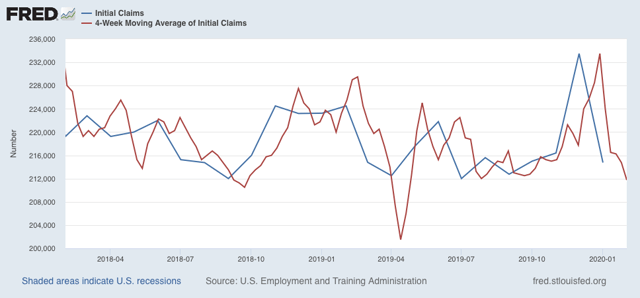
The weekly number was 202,000, close to its 50 year lows last year. The 4 week average was 211,750, also close to its recent 50 year lows. Below are the monthly (blue) and moving 4 week averages (red):


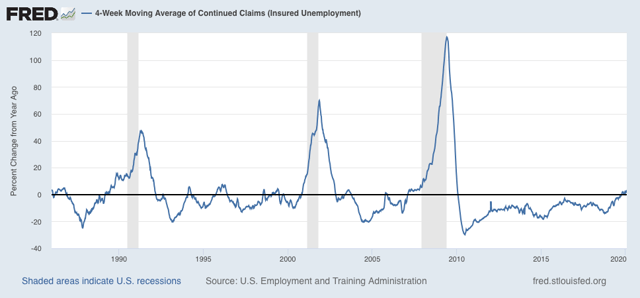
The less leading but also less noisy 4 week average of continuing claims was 1.3% higher YoY, which shows weakness, but as the below 35 year graph indicates, is not near the 5% higher threshold which has typically been exceeded before recessions:


That this metric has refused to turn negative, and the stock market continues to make new highs, are the two biggest reasons why I have never gone on “recession warning” (vs. “watch”) in the past year.

Wednesday, February 5, 2020

Live-blogging the Fifteenth Amendment: January 29, 1869 (2)


 - by New Deal democrat

Rep. John A. Bingham, Republican of Ohio, among the most ardent reconstructionists, wanted a more broadly inclusive amendment:
I concur with my colleague ... [regarding] the objectionable features of the amendment as presented .... [T]he only limitation that the amendment imposes upon the original powers now in the several States of this Union is the limitation that they shall not restrict the elective franchise in the persons of citizens by reason of race, color, or previous condition of slavery.... [H]ence it is manifestly clear that this power remaining in the States, in no other manner fettered by the proposed amendment, may be exercised to the end that an aristocracy of property may be established, an aristocracy of intellect may be established, an aristocracy of sect may be established .... [T]he amendment presented to the people for their approval will inform them that upon its adoption these abuses by States will hereafter be impossible. To that end I have proposed an amendment [as follows:] 
‘No State shall make or enforce any law which shall abridge or deny to any male citizen of the United States of sound mind and twenty-one years of age or upward the equal exercise of the elective franchise, subject to such registration laws as the State may establish, at all elections in the State wherein he shall have actually resided for a period of one year next preceding such election, except such of said citizens as shall hereafter have engaged in  rebellion or insurrection, or who may have been or shall be duly convicted of treason or other infamous crime.’

——
Congressional Globe, 40th Congress, 3rd Session, p. 723.

Note that even this broad formulation included a right to vote for women; and more to the point for our current situation, would not prohibit the identification laws that are presently being used for voter suppression. States most likely would also attempt to define as many crimes as possible that might be disproportionately committed by poor blacks, as “infamous.” 

Live-blogging the Fifteenth Amendment: January 29, 1869 (1)


 - by New Deal democrat

I am trying to catch up with this endeavor. Hopefully I’ll be fully caught up by early next week. This is the third entry which is particularly important in the context of our present-day crisis due to gerrymandering and voter suppression. 

On January 29, 1869, the House of Representatives dedicated time to discussing the Civil Rights bill under the 14th Amendment, and the proposed 15th Amendment.

Rep. William R. Kelley, Republican from Pennsylvania, first discussed the powers of Congress pursuant to the Federal constitutional guarantee of a “republican form of government” to the States:
I hold that all of the power that this amendment will give is already in the Constitution. I admit that it has lain dormant .... [but] I am persuaded that it will yet be quickened and called into action. The aroused people will demand that all of the powers of the Constitution be exercised so that each State shall be guaranteed a republican government, and that the citizens of each State shall enjoy peaceably the privileges and immunities of citizenship in the respective States .... 
How was this power to be exercised? How was the guarantee to be carried into effect? .... I turned to the recorded views of James Madison, the leader of that convention, and who is known to history as its father because of the influence he exercised in its counsels and in molding its conclusions. I found that on the 18th of June, 1788, in the Virginia convention, Mr. Madison, in his response to Mr. Monroe, [said:] ... 
‘Some States might regulate the elections on the principles of equality, and others might regulate them otherwise. This diversity would be obviously unjust. Elections are regulated now unequally in some States, particularly in South Carolina, with respect to Charleston, which has a representation of thirty members. Should the people of any State be deprived of the right of suffrage, it was judged proper that it should be remedied by the General Government.’
Turning to the Congressional authority over the “time, place, and manner” of Congressional elections, he quoted the remarks of Theophilus Parsons during the ratification debates in Massachusetts:
‘But a State Legislature, ... when faction and party sprit ran high, would introduce such regulations as would render the right of the people insecure or of little value. They might make an unequal and partial division of the States into districts for the election of Representatives .... Without these powers in Congress, the people can have no remedy. But the fourth section [of Article I of the Constitution] provides a remedy.’
....
The power is not, I freely admit, one to be exercised by Congress in the first instance. The regulation of the suffrage is left primarily to the States. If they regulate it according to the principles of justice then their action stands; but if not, Congress is required to exercise its supervisory power.
(Emphasis mine)
——-
Source: Congressional Globe, 40th Congress, 3rd Session, pp. 721-22.
 
The situation I have bolded in the remarks of Theophilus Parsons from the Massachusetts ratifying convention, quoted by Kelley, almost exactly describe our situation today. Kelley is quite clear that he interprets the Constitution to mean that Congress has the explicit power under its authority to regulated the “time, place, and manner” of Congressional elections to remedy this situation.

Further, the quotation from Madison certainly indicates his belief that Congress has the authority, under the Constitutional guarantee of a “republican form of government” to the States, to remedy unjust abridgments of the right to vote including inequality, even in State legislative elections.

The long leading forecast up to 12 months


 - by New Deal democrat

Last week I posted my short term forecast through midyear. This morning my long term forecast through the 2nd half of 2020 was also posted at Seeking Alpha.

As usual, clicking through and reading will help you see the longer term trends, and also rewards me a little bit for my efforts.

Tuesday, February 4, 2020

Live-blogging Congressional power to ensure fair federal elections: January 28, 1869


 - by New Deal democrat

As I described in my earlier post today, the power of Congress to determine the manner in which Congressional elections are to be conducted, including power over the districting process, came up in a speech by Rep. Stewart on January 28, 1869. Since this is of critical importance as to Congress’s ability to prohibit gerrymandering of at least Federal elections, below are selections from another important speech.

James B. Beck, Democrat from Kentucky, discussing the proposed Civil Rights Act, addressed the issue of Congress having the power to set the “time, place, and manner” of voting for Representatives. After declaiming at length about the States having the right to determine who formed their electorate, and to determine the times, places, and manner for elections to the State legislatures, he turned to the issue of elections for the US Congress:

If the State legislatures refuse to fix a time for holding such elections [for US Congress], or fix an improper time; if they fail to designate places or to authorize them to be designated, or if they are unsuitable or inadequate, or if they fail to appoint or cause to be appointed suitable persons to conduct and determine the result of such election, or in any regard fail to conduct them in a proper manner, I take it to be not only the right but the duty of Congress by proper laws to provide the proper times, places, and manner of conducting such elections, which, when complied with by the electors in the States, will entitle the Representatives chosen by them in conformity thereto to take their seats in Congress .... That seems to me to be the whole scope, intent, and meaning of the constitutional provision [i.e., Article I, Section 4]. 

This is a much more cramped reading than that given by Congressman Stewart earlier that same day. To the point, it is unclear to say the least whether the reforms of 1842 which outlawed Statewide general ticket elections for Congress and replaced them with individual districts, would fit within the confines of Beck’s reasoning.

But even Beck agreed that if the states “fail to designate places ... or if they are unsuitable or inadequate” for Congressional elections, Congress could and indeed ought to intervene.

Since one form of modern voter suppression is to provide inadequate numbers of polling places, or put them in places difficult to reach, or to provide inadequate equipment at those places where “undesired” voters will cast votes, Congressional action to remove these impediments under Congress’s Article I, Section 4 power is squarely within even Beck’s interpretation.

Source: Congressional Globe, 4oth Congress, 3rd Session, p. 689

Live-blogging the Fifteenth Amendment: January 28, 1869


 - by New Deal democrat

Note: I have fallen a little behind, due to traveling. My apologies! I am making a concerted effort to catch up. Today’s installment is particularly important on the issue of gerrymandering.

On January 28, Rep. Charles Stewart, a Republican from New York, spoke with reference to the proposed Amendment that had been voted out of the Judiciary Committee, which had been amended from:
No State shall deny or abridge the right of its citizens to vote, and hold office, on account of race, color, or previous condition of servitude.
to read:
The right of citizens of the United States to vote, and hold office, shall not be denied or abridged by the United States or any State on account of race, color, or previous condition of servitude.
Here is a brief excerpt from his speech:

[T]his great question ... is the culmination of a contest which has lasted for thirty years. It is the logical result of the rebellion, and the abolition of slavery.... and now we are to place the grand result, I hope, in the Constitution of the United States.... This question can never rest until it is finally disposed of. This amendment is a declaration to make all men, without regard to race or color, equal before the law. The arguments in favor of it are so numerous, so convincing, that they carry conviction to every mind.... 
It must be done. It is the only measure that will really abolish slavery. It is the only guarantee against peon laws and against oppression.... You may put this in the form of legislative enactment; you may empower Congress to legislate; you may empower the States to legislate, and they will agitate the question. Let it be made the immutable law of the land; let it be fixed; and then we shall have peace.

Probably much more significantly, he addressed an issue *directly* relevant to the present crisis caused by extreme gerrymandering, in connection with a proposed second section of the amendment which would extended Congressional power to mandate the manner that Electors in Presidential elections also be determined.

He proceeded form Article I, Section 4 of the US Constitution, which provides: 
 
The Times, Places and Manner of holding Elections for Senators and Representatives, shall be prescribed in each State by the Legislature thereof; but the Congress may at any time by Law make or alter such Regulations, except as to the Place of Chusing Senators.

Relying on that power, he noted:
Many years ago the Congress of the United States abolished the general ticket system in the States for choosing Representatives in the lower house of Congress, because it was seen to be attended with great evils, inconveniences, and mischiefs which required the hand of reform. Fortunately the power existed in Congress to apply reform, and Congress did. It required that each State electing more than one Member of the House of Representatives should divide itself into single districts, and that one Member should be elected from each. It was only because that power existed in Congress that that reform was possible at the time it was secured. Some of the States in fact resisted it.  I believe two or three States continued to elect by general ticket in spite of the act of Congress; but they were finally compelled to conform themselves to the new and improved system which was established by Federal law; and we now have, therefore, in the election of Representatives in the other branch of Congress, a single district system established and enforced by congressional power.
—————-
Source: Congressional Globe, 40th Congress, 3rd Session, p. 668.

As we know from 150 years of history, even a straightforward Constitutional amendment cannot survive a Supreme Court majority that is determined to eviscerate it.

More compelling is Stewart’s point that it is within Congress’s power to determine the manner in which States can elect Representatives to Congress.  The “general ticket” system allocated *all* Representatives to the party which won the most votes. Thus if, e.g., Jacksonian Democrats got 51% of the vote, they got 100% of the elected Representatives. The individual district system was designed to be much closer to the actual will of the electorate. 

In our day, there is much wailing and gnashing of teeth about the US Supreme Court’s unwillingness to deal with extreme gerrymandering. Stewart crucially points out that, at least as to federal Representatives, it is within Congress’s power itself to determine the manner of elections. Congress could, e.g., mandate that the percentage of winners from each party be proportionate to that party’s statewide vote. Or it could mandate the methods (such as compactness and avoidance of “wasted” votes) by which districts are shaped. This is a crucial and absolutely vital lesson.

Mixed results from January vehicle sales, consumer durable goods orders


 - by New Deal democrat

This morning we got two important data points on consumer durable goods. Typically, after housing turns, consumer purchases of vehicles and then other durable goods (like major appliances) turn down. Broader consumer purchases are the last to turn down before a recession.

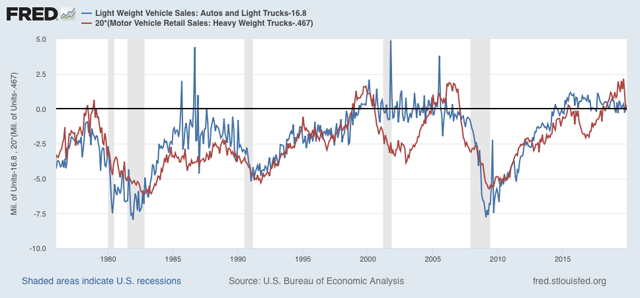
Light vehicle sales in January were estimated by the BEA at 16.8 million annualized (blue in the graph below). This is a little soft, but not nearly so much as would presage a recession. For that I would expect to see a number below 16.25 million:


Meanwhile heavy truck sales came in at 0.467 million annualized (red). This is the third poor reading in a row, and demonstrates the producer downturn - although it is consistent with previous slowdowns and is not quite as severe as before the last two recessions. Note also that in the graph above I have normed the January numbers to zero, better to show the recent trend.

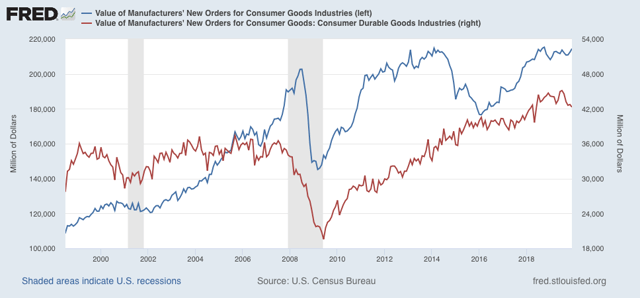
Secondly, new orders for consumer goods were also reported. While the broad measure is holding up, new orders for consumer durable goods declined:


The decline in consumer durable new orders is on par with that before the Great Recession, but not with that before the producer-led 2001 recession.

In sum, yet more evidence of weakness, but most consistent with a slowdown.

Monday, February 3, 2020

Live-blogging the Fifteenth Amendment: January 27, 1869 (2)


 - by New Deal democrat

On January 27, Shelby M. Cullom, a Republican from Illinois, spoke with reference to the proposed Fifteenth Amendment:

The rebellion destroyed the [rebel] State governments .... This condition of things in the rebel States created the necessity for the work of reconstruction. This work did not consist alone of getting the States back into the enjoyment of representation in Congress; .... Reconstruction [also] consisted in ... ‘the establishment of civil governments which should be republican in form, and a guarantee of protection to all of the people.’  
.... The country began to feel not only that the rebellious States needed reconstruction, but that the whole country needed it; that justice demanded that constitutions should be amended, that laws should be enacted securing to all the people in the land an equality of civil rights.... After the civil rights bill came the fourteenth amendment to the Constitution .....  
But, Mr. Speaker, it did not answer as a basis of reconstruction. ... a portion of the amendment should never have been adopted if, as alleged by some, it recognizes the right of each State to abridge or deny to any portion of its people without cause the exercise of the elective franchise. A State has the right to disenfranchise its felons, but it has no right to disenfranchise its citizens on account of race, color, or previous condition of slavery. 
The [fourteenth] amendment was the best that could be done, but I would be much better satisfied with it if it could be clearer on that point. To-day, sir, we are at work to patch up the work that we failed at that time to do correctly, as we should. 
...[I]n the work of reconstruction, and in our efforts to establish the government upon just principles, a constitutional amendment regulating the question of suffrage throughout the land should be passed and sent to the States for their consideration without delay. 
———

Source: Congressional Globe, 40th Congress, 3rd Session, pp. 650-53

This speech was a full-throated response to speeches like those of Rep. Eldridge  reported earlier, and another by Rep. Michael G. Kerr, Democrat from Indiana, which was similar to Eldridge‘s and followed that of Cullom.

Note, however, that an open-ended “right to vote” is not being defended here. By this time only “equality” of the right to vote based on race was being proposed.

January ISM manufacturing, December residential construction both positive


 - by New Deal democrat

As earlier mentioned, this morning we got our first read on January data, and the news was positive on both fronts.

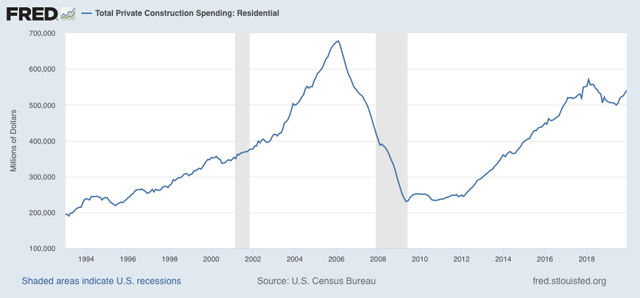
First of all, residential construction spending increased:


This is the latest indication that the rebound in housing, which began with sales and permits at about midyear last year, has continued into actual construction. This is a positive for the economy in the second half of this year.

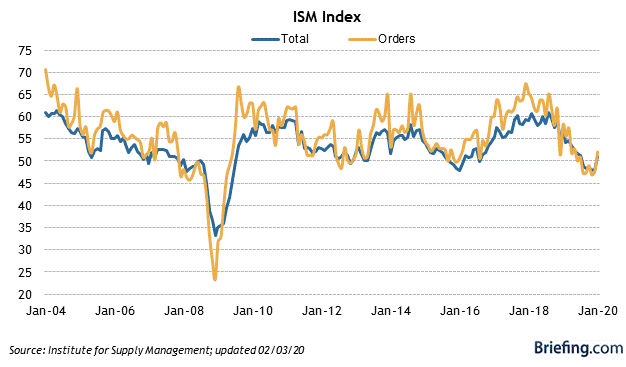
Secondly, as telegraphed by improvements in the regional Fed new orders indexes, the ISM manufacturing index for January rebounded into slight expansion, and the new orders component increased into expansion as well (h/t Briefing.com):


This is a short leading indicator, and suggests that manufacturing may be beginning to rebound after truces in the trade wars.

We are still waiting for vehicle sales to see if past producer weakness is spreading into consumer, and further into producer, durable goods purchases.

The Philly Fed state-by-state diffusion index of economic expansion


 - by New Deal democrat

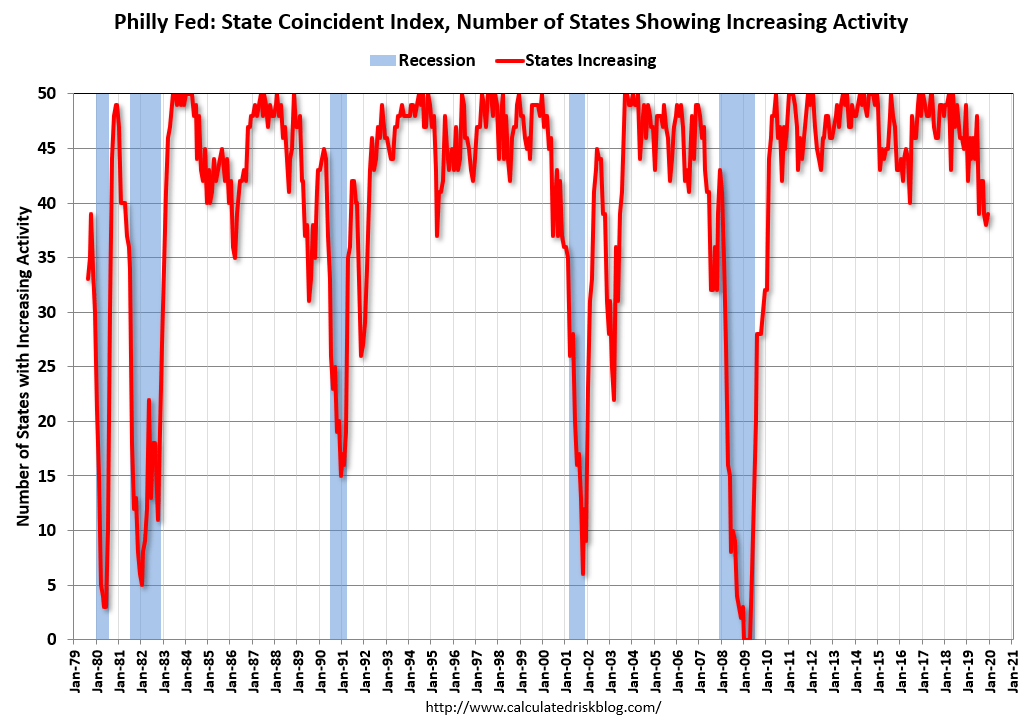
This comes from the Philly Fed’s state-by-state coincident index, via Bill McBride. The graph below shows the number of states showing increasing economic activity:

In December the number of states in expansion was 39. Historically over the past 40 years, that number dropping to 35 or below has (with the exception of one month in 1986) been the marker of the onset of a recession.
Note the number is below the lowest level from 2015-16, in which weakness was generally confined to the Oil patch. It is yet another marker of a slowdown, but not of a recession.
Later this morning we’ll get the January ISM manufacturing report, and over the next 48 hours we’ll get reports on January auto and truck sales. Both of these will help tell us if the weakness in the production sector has been spreading or not.

Saturday, February 1, 2020

Weekly Indicators for January 27 - 31 at Seeking Alpha


 - by New Deal democrat

My Weekly Indicator post is up at Seeking Alpha.

Due to panic (warranted or not) about a coronavirus, the yield curve almost completely inverted by close of business Friday.

As usual, clicking over and reading puts a penny or two in my pocket, and should bring you right up to the moment on the economy.

Friday, January 31, 2020

December 2019 real personal income and spending


  - by New Deal democrat

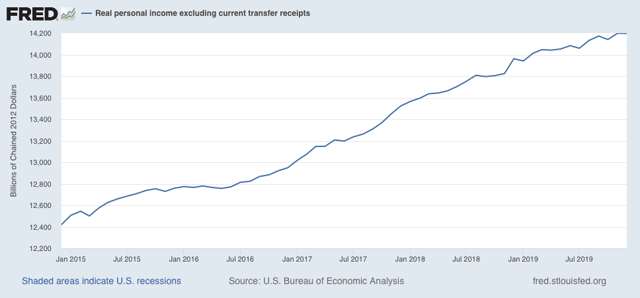
Real personal income and spending are both coincident indicators. They don’t tell us where the economy is going, but they do give us a snapshot of how ordinary Americans are doing.

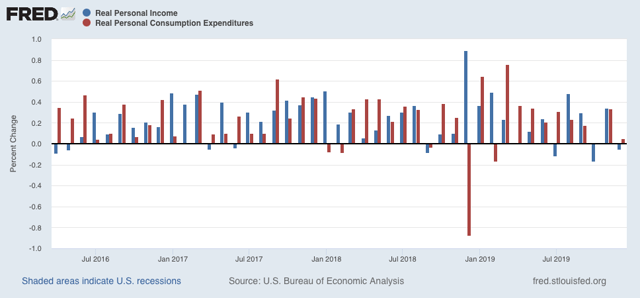
In December, real income declined by less than -0.1%. Real spending rose by less than +0.1%:


Real personal spending excluding government transfer payments is one of the four indicators used by the NBER to determine if the economy is in recession or not. In December this was flat. Overall in 2019 there was a slow uptrend:


This is one indication that as of one month ago the economy was not in a recession.

Thursday, January 30, 2020

Live-blogging the Fifteenth Amendment: January 27, 1869 (1)


 - by New Deal democrat

I have gotten a little behind in this project. Congressional activity picked up considerably in the last week of January 1869. 

Rep. Charles A.Eldridge (D-Wisconsin) addressed a civil rights bill by Massachusetts Representative Buckalew under the 14th Amendment as well as the proposed 15th Amendment:

I have not the vanity to suppose that anything I say will cause them to hesitate or consider. Party ends must be accomplished, party purposes must be carried out even though it should revolutionize the Government, overthrow the Constitution, and destroy the Republic.
....

Hamilton on the same subject in No. 59 of the Federalist ... [said], ’Suppose an Article had been introduced into the Constitution empowering the United States to regulate the elections for the particular States, would any men have hesitated to condemn it, both as an unwarranted imposition of power and as a premeditated engine for the destruction of State governments?’
In those days no man would have hesitated to condemn it. The Constitution could never have been adopted if it had contained the grant of power to Congress to determine the qualification of voters for officers of the States. Such a work is left for these days of revolution and usurpation — to the mad fanatics who for particular ends would destroy our Republic of States.
....

The power to determine the qualifications of electors was, in the States conferred ... by the people of the States.... All the powers of the Federal Government come up from the States and people, and it never had and never can have the rightful authority to exercise any power not granted in and by the Constitution. The exercise of any other is rank usurpation.

[I]t seems to me that this bill and resolution for the amendment of the Constitution ... for the evils which exist in his judgment with reference to the persons who ought to exercise the right to suffrage, is a filo de se [crime of suicide].  If the power exists in the Federal government to pass this bill, ... then I admit that Congress has the right to control the whole question of suffrage and the qualification of electors of all officers ....
....

Sir, I do not think the gentleman from Massachusetts gave a proper consideration to the fourteenth amendment, as it is called. I will not consider the question of whether this amendment is part of the Constitution; for myself I do not believe that it is....
____________________
Source: Congressional Globe,  40th Congress, Third Seeking, pp. 642-45 

 What is remarkable about this speech is that Eldridge is not just addressing the Civil Rights bill proposed by Buckalew, but also claims that the even Constitutional amendments are invalid to alter Federal vs. State powers. He considers the power of suffrage in the States to be beyond the control of any proposed revisions to the Constitution itself. Even Chief Justice Roberts, who in the Shelby County case found a right of States to be treated equally in all legislation out in the Constitutional ether, did not go this far.

Mixed signals in Q4 2019 GDP


 - by New Deal democrat

This morning’s Q4 2019 GDP gave us mixed signals. As per my usual practice, I am less interested in what happened in the rear view mirror, which was an annualized gain of +2.1%, than what the number tells us about what lies ahead.

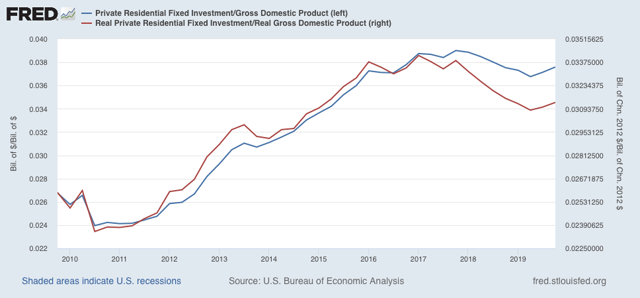
The two forward-looking components of GDP are (1) private fixed residential investment, and (2) corporate profits. Both of these are long leading indicators, i.e., giving us an idea about where the overall economy will be a year or more out from here.

In that regard, the news was mixed.

Private residential fixed investment increased +1.4% q/q. This is in keeping with the rebound in housing construction that we have seen in the monthly data since last spring. Note that residential investment as a share of GDP increased in both nominal (blue) and real (red) terms:


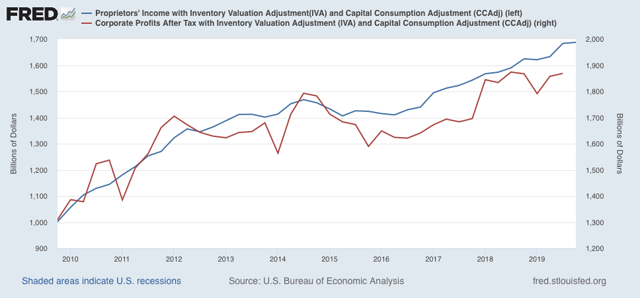
Meanwhile, while corporate profits won’t be reported until the final revision in GDP two months from now, proprietors’ income was. While it does not always move in the same direction as corporate profits, and sometimes lags, it a good placeholder.  Here the news was negative, as nominally proprietors’ income rose a mere +0.2% q/q:


Since the GDP price deflator rose +0.4% during the quarter, the “real” measure declined slightly.

In sum, one long leading indicators increased, and one decreased. So, while
 in the rear view mirror, there was no recession in Q4 2019, there is more evidence of at best a stall in the producer side of the economy.

Wednesday, January 29, 2020

My “official” first half forecast for 2020


 - by New Deal democrat

My short term 6 month forecast has been posted at Seeking Alpha.

As usual, clicking over and reading should be educational for you, and puts un poco dinero in my pocket.

Tuesday, January 28, 2020

More on house prices


 - by New Deal democrat

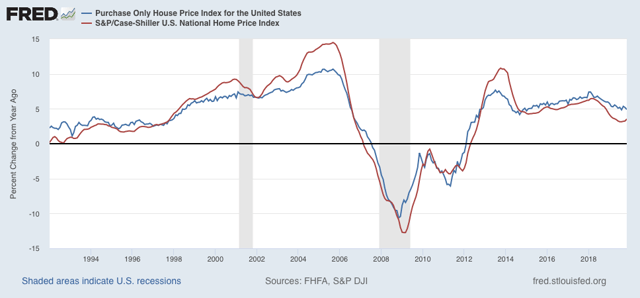
The Case Shiller housing indexes for the three month period ending in November were reported this morning. The YoY% change in the national index increased to 3.5% from 3.2% last month (red in graph below). This is in line with the FHFA purchase price index (blue), and continues the slight acceleration in each from a trough in August: 


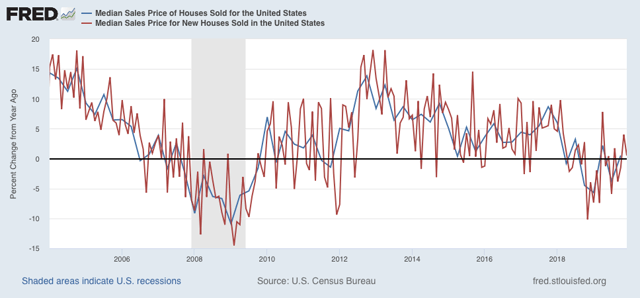
As I mentioned yesterday, the YoY% change in new home prices has also started to rebound (red in the graph below), as does the change in total home prices (blue):


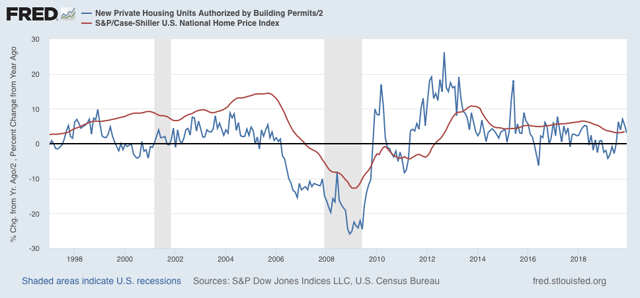
That price appreciation has begun to rebound is not a surprise, as they follow permits (blue in the graph below) with a lag:


So long as permits, sales, and starts continue to increase, we can expect further acceleration in price growth - which is already running ahead of wage growth.  

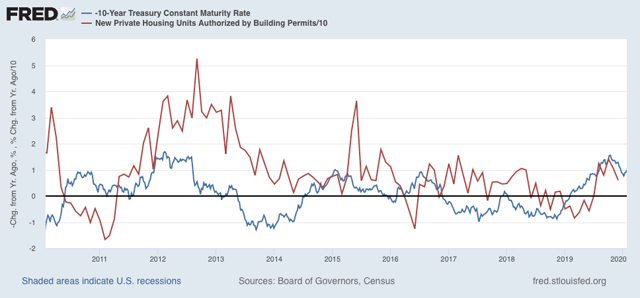
Permits, in turn, follow interest rates. Since interest rates are lower than they were a year ago (inverted, blue, in the graph below), it looks like permits will continue to increase for awhile:


Monday, January 27, 2020

Is the “housing choke collar” kicking in?


 - by New Deal democrat

This morning’s December new home sales report raises the question: is the “housing choke collar” kicking in?

The idea of a “housing choke collar” is that house prices are at such a high multiple of the average household’s ability to pay that even with lower interest rates, there is not much room for the housing market to withstand housing price increases.

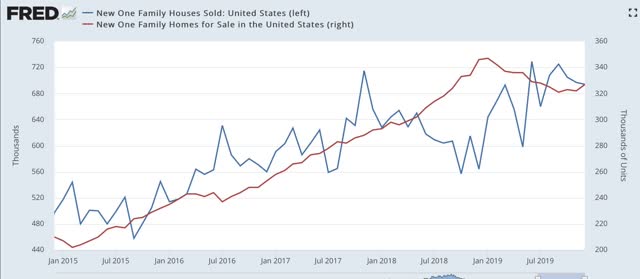
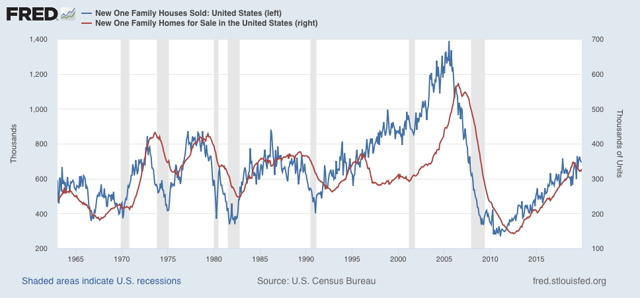
First, to the data: new home sales declined slightly from a downwardly revised November. This data series is very volatile, and heavily revised, but it remains the case that there has been no new high established since last 6 months (blue) (inventory is in red):


In the long term view, note that new home sales have peaked well before the beginning of recessions. Inventory has reliably followed, and with the exception of the shallow 1970 and 2001 recessions, continued to decline throughout the next downturn:


That inventory turned up slightly in December therefore suggests (slightly) that housing is not on a recession trajectory. Also remember that last week housing permits made a new expansion high (sales do typically peak or trough even before permits, but as pointed out above, are much more volatile).

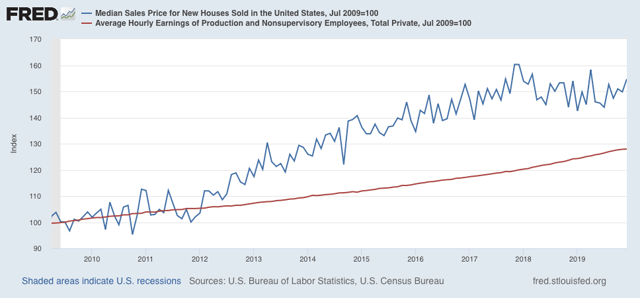
That brings us to median new home prices, which increased sharply, and have been on a pronounced uptrend in the past few months (blue):


The red line represents average hourly wages for non-supervisory personnel. It’s pretty easy to see that, after declining relative to wages in 2018, prices are now outpacing wage growth again.

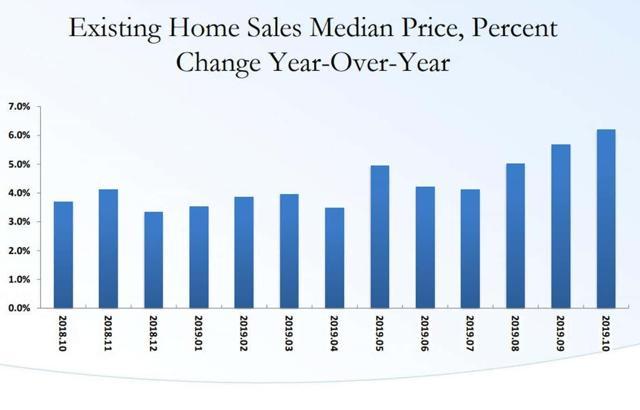
Remember that last week we saw that existing home prices had increased by more than 9% in 2019.

If I am right, then there is very limited upside for sales growth. Since sales lead prices, new home sales may be telling us that we are reaching the limit of affordability without even lower mortgage interest rates.

Sunday, January 26, 2020

Weekly Indicators for January 20 - 24 at Seeking Alpha


 - by New Deal democrat

I neglected to post this yesterday....

My Weekly Indicators post is up at Seeking Alpha.  The forecasts remain as they have been recently, but there are several developments in the long leading range.

As usual, clicking over and reading brings you fully up to date, and rewards me a little bit for my efforts.

Friday, January 24, 2020

The producer vs. consumer sectors of the economy: a comparison


 - by New Deal democrat

I have a post up at Seeking Alpha, comparing current conditions on the producer side of the economy vs. the consumer side.

As usual, clicking over and reading should bring you up to date on the “nowcast,” and helps put a $ or two in my pocket.

Thursday, January 23, 2020

On the road


 - by New Deal democrat

Today is a traveling day, so no detailed posting.

This morning’s initial jobless claims were in line with the range over the past two years. There has been virtually no change YoY. This negatives any imminent recession fears.

Yesterday’s existing home sales, though touted as “the best in nearly two years,” just continue the baseline that this metric has been in since late 2015, with the exception of the 2018 decline. Of more interest is that (1) inventory is at a cycle low, and - not coincidentally - YoY price increases, up 7.8%, show a continuing acceleration:


A few months ago I offered up the idea that housing now had its own “choke collar,” where prices were bumping up against the limit of what buyers in the aggregate could afford, even with lower interest rates. We’ll get much more information on whether that is the case when new home sales and prices are reported next week.

Wednesday, January 22, 2020

Why negative transportation indexes don’t support a recession call


 - by New Deal democrat

Every month for at least the past half year there is a spate of bearish economic commentary that relies upon one or both of two metrics: AAR rail carloads and/or the Cass Freight Index.

I have a post up at Seeking Alpha showing why the first measure is not a representative slice of transport as a whole, and the second has a history of being very volatile and with a slew of negative readings in the teeth of continuing expansions.

As usual, clicking on the link and reading helps reward me with a $ or two for my efforts.

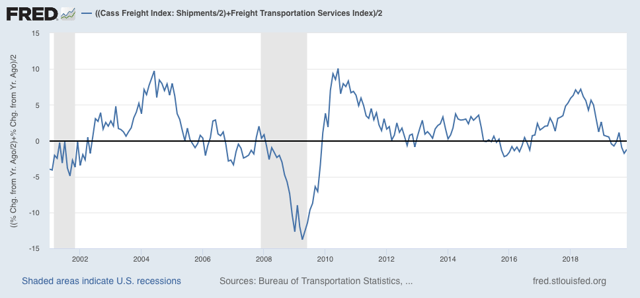
Addendum: after I put together and posted the article, I came up with the idea of averaging the Cass Freight Index and the Dept. of Transportation’s Freight Index after adjusting for the former’s volatility (shown below). It gives us an even less noisy overview of the transportation sector, although it still does go negative during slowdowns without there being a recession. In any event, none of the current negative readings are sufficiently below zero to accord with recessionary readings over the indexes’ short history:


Tuesday, January 21, 2020

Catching up: November JOLTS report


 - by New Deal democrat

Let me catch up on some data I didn’t examine last week: the November JOLTS report.

It decomposes the jobs numbers into a number of metrics, but is less than 20 years old, so only covers one full business cycle, so is of limited forecasting use.

To reiterate, here is the order in which the JOLTS series peaked during the 2000s expansion:

  • Hires peaked first, from December 2004 through September 2005
  • Quits peaked next, in September 2005
  • Layoffs and Discharges peaked next, from October 2005 through September 2006
  • Openings peaked last, in April 2007 

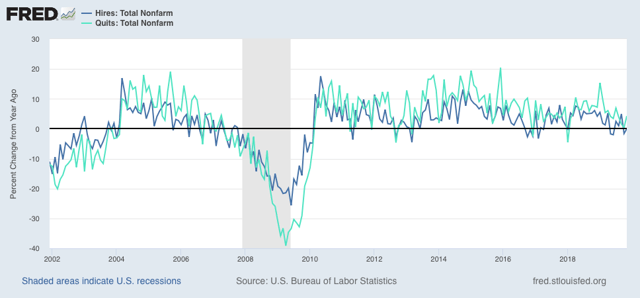
So to start, here are YoY hires and quits for the entirety of the series, measured YoY:


Hires has turned negative for some months in the past year, while quits remain positive YoY.

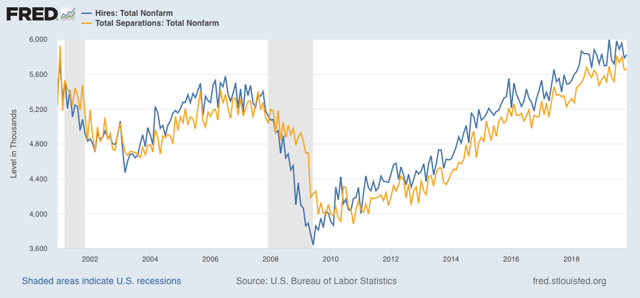
Next, as I have often said, hiring leads firing (actually, total separations). Here’s what that looks like for the entire series, first measured absolutely:


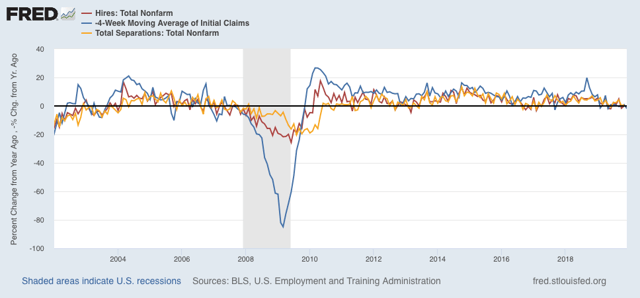
And here is the YoY change, plus the 4 week average of initial jobless claims (inverted) in red:


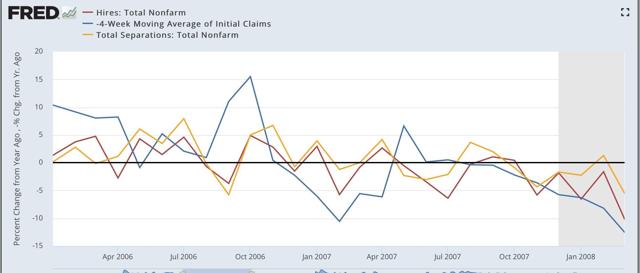
These aren’t as negative as prior to the 2007 recession, as compared in the two graphs below:

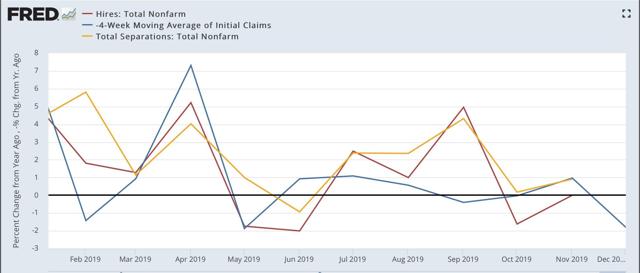
Present:

2007:

In 2007, both hires and initial jobless claims (inverted) were negative by as much as -5% YoY. In 2019, they’ve only been negative by about -2% at the worst.

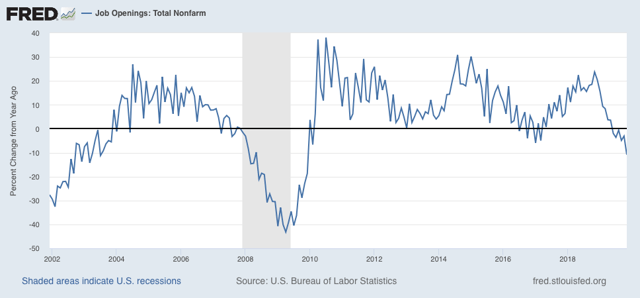
The biggest difference between this cycle and the last has been in job openings, which I consider “soft data.” But because the difference is noteworthy, here it is, again shown YoY:


This series is consistent with its 2008 recessionary readings.

Again, analyzing with lots of caution, my take remains: slowdown, not recession at this point.

Monday, January 20, 2020

For MLK Day: unemployment by race


 - by New Deal democrat

In observance of Martin Luther King’s birthday, almost all US markets are closed and there is no economic data.

So on this day let’s see the extent to which economic opportunity in several neutral metrics has improved since the passage of the Civil Rights Acts in the 1960s.

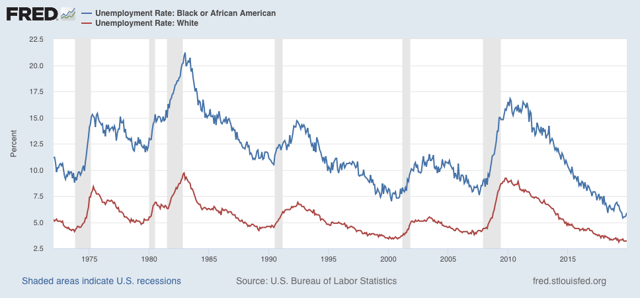
Here in unemployment for African Americans (blue) vs. whites (red) since the former began to be measured in 1972 (white unemployment had been measured since the 1950s - interesting that black unemployment wasn’t even deemed worthy of being separately measured before the 1970s!): 


Unemployment for whites made a 50 year low at 3.1% earlier in 2019. It was only lower, at 3.0%, in 1969 (not shown). African American unemployment made its all time low, at 5.4%, in August of last year.

To get a clearer picture how the two measures compare, here are two other ways to look at the same data.

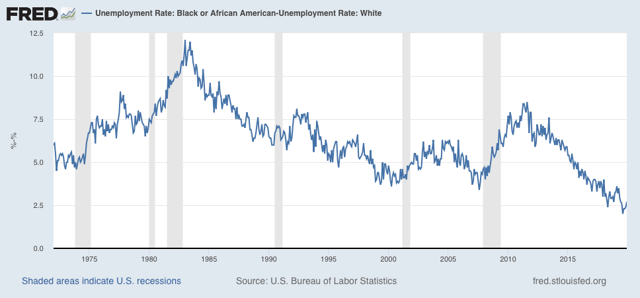
First, here is the % by which the black unemployment rate has exceeded the white unemployment rate:


At the worst of the 1970s and 1980s, while white unemployment was bad, black unemployment exceeded it by over 10%! There has been general improvement in each expansion since, with black unemployment exceeding white unemployment by only 2% by last year.

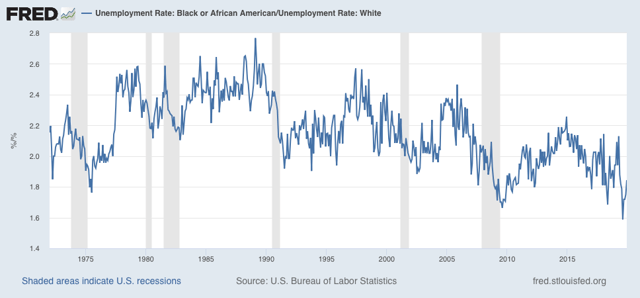
Another good way to look at this is the black unemployment rate as a multiple of that for whites:


At its worst, black unemployment was more than 2.6x that of whites. The multiple has gradually improved so that last year it was only 1.6x that of whites.

The bottom line here is: progress over the past 50 years, but still a long way to go. At their rates of improvement over the past 40 years, the former measure will reach parity in about another 30 years; but at its historical rate of improvement the latter multiple would require about another 80 years.

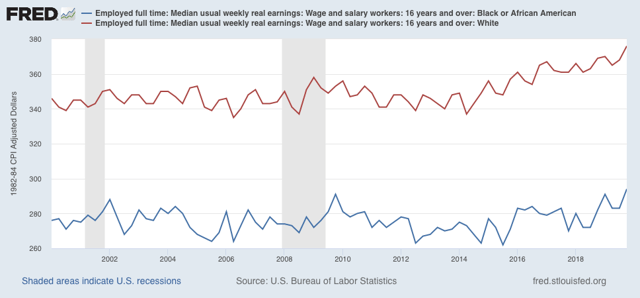
Finally, when it comes to wages, these have only been measured since 2000, and there is still roughly a 25% gap in average weekly wages: