Thursday, December 23, 2021

Income, spending, layoffs, and new home sales all point to a continuing expansion in 2022


 - by New Deal democrat

We got our last batch of data before Christmas this morning. Almost all of the news was positive. I will be very brief.


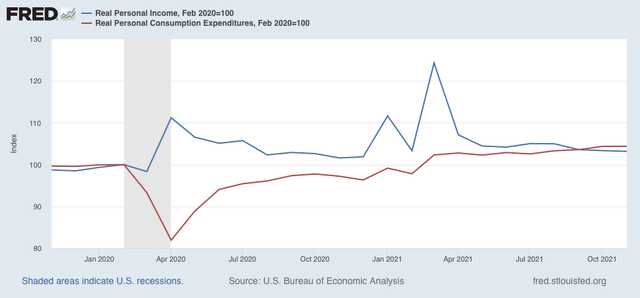
In the “coincident indicators” department, real personal income declined -0.2%, while real personal consumption expenditures increased less than 0.1%, although both remain well above their pre-pandemic levels: 


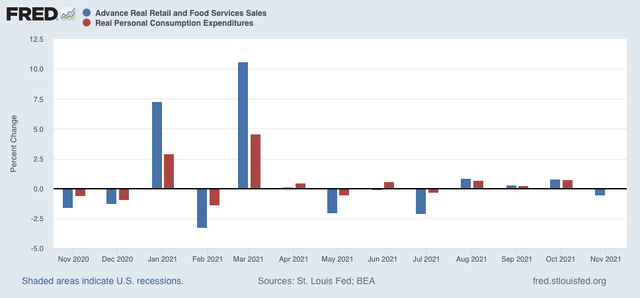
Comparing real personal consumption expenditures with real retail sales for November (essentially, both sides of the consumption coin) reveals both faltered, but not in any way worth being worried about:


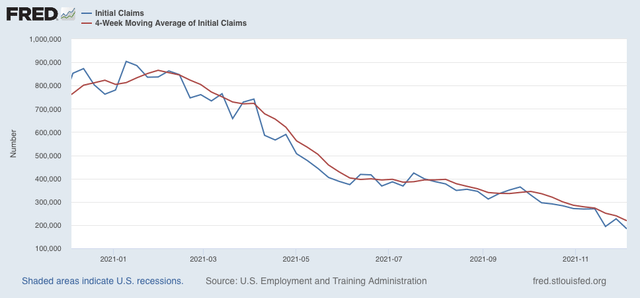
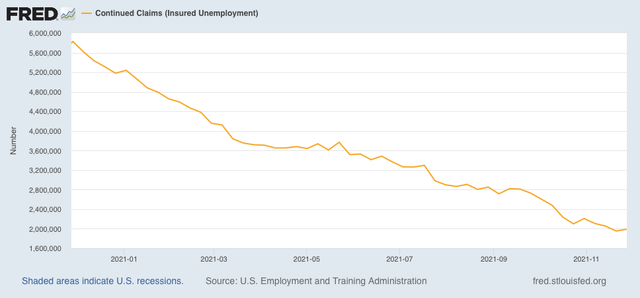
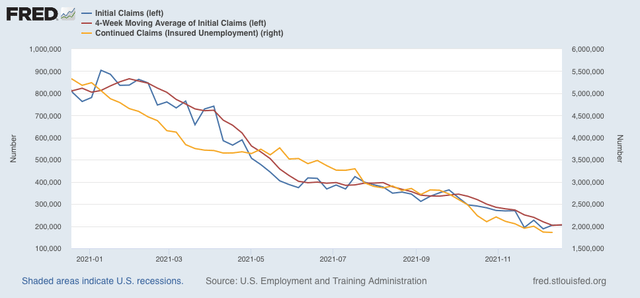
In the “short leading indicators” department, nobody continues to get laid off. Initial claims were unchanged for the week at 206,000, while the 4 week average rose slightly to 206,250. Continuing claims (right scale) declined to yet another pandemic low of 1,859,000:


The employment economy continues to be very “hot.” This is a very good sign for the next few months.

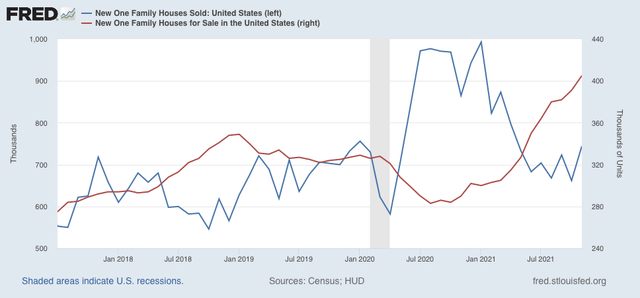
Finally, in the “long leading indicators” department, new home sales rose to a 6 month high, while the inventory of new homes for sale (which lag) rose to a 13 year high:


At least when it come to new house, the imbalance of inventory is being worked out, while the trough in sales from summertime is almost certainly behind us.

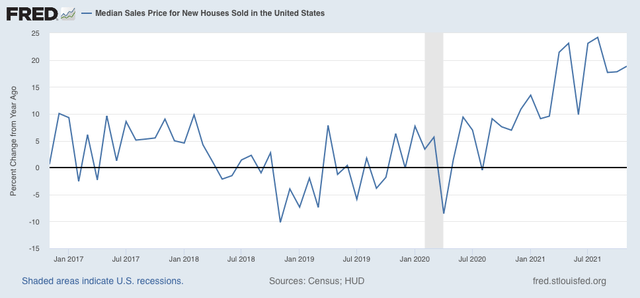
Meanwhile the YoY growth in house prices continued to abate - a little - from late spring and summer highs:


The housing market, which had been a negative this summer, has turned back into a positive for year-end 2022.

In summary, the expansion should continue.

Wednesday, December 22, 2021

Final existing home sales report of 2021 is positive


 - by New Deal democrat

As we wind down the year, most of the remaining data will be from the housing sector. Tomorrow we get new home sales, then next week one final round of house price indexes. 

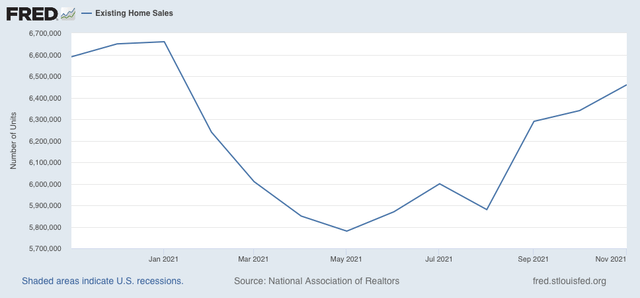
Two months ago I wrote that “I suspect new home sales will increase, since interest rates stabilized at very low rates earlier this year, and the increase in existing home sales is some confirmatory evidence.” Since then, sales increased in October by 0.8%, and today existing home sales for November were reported, and the news continued positive, as sales increased another 1.9%, from 6,340,000 annualized to 6,460,000. This is the highest number since January of this year, and aside from the period from September last year through January, the highest since 2007 (note the NAR only permits FRED to publish the last year of numbers:


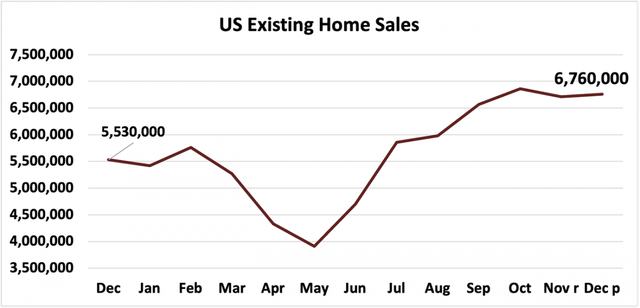
Here is the graph from exactly one year ago, covering 2020:


As CNBC said at the time, “Pandemic-driven demand sent total 2020 home sales to the highest level since 2006.”

On a YoY basis, sales are only down 2%, the best comparison in months.

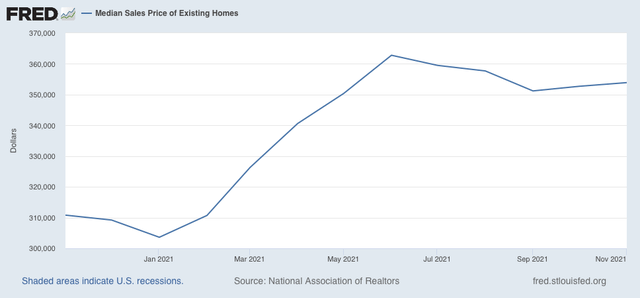
Median prices of existing homes are not seasonally adjusted. On a YoY basis, they were  up 13.9%:


Since the “the cure for high prices is, high prices,” I have been tracking YoY median price gains over the last 6 months:

Jun +23% (YoY high)
Jul +20%
Aug +15%
Sep +13%
Oct +13%
Nov +14%

While these are not seasonally adjusted either, my rule of thumb is that a deceleration of 50% typically marks the top for any such statistic. Since we have stabilized at above 12.5%, this is evidence that, on a seasonally adjusted basis, prices have continued to increase, although at a less dizzying pace.

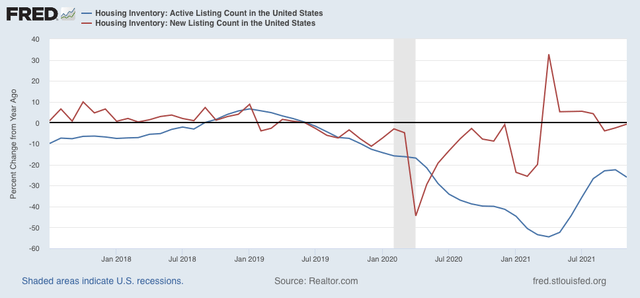
Finally, Realtor.com does provide FRED with both new and total (“active”) listing counts for the past 5+ years. Since these are also not seasonally adjusted, here is the YoY look at both:


New listings declined precipitously in late 2019 even before the pandemic - and the pandemic certainly hasn’t helped. But new listings have almost completely recovered YoY, now down less than -1% since last November; while total listings have continued to decline, albeit less precipitously.

This is not a market that is about to roll over. I suspect new inventory will go positive YoY shortly, and price gains will moderate, although not disappear. If new home sales similarly advance tomorrow, that will augur well for 2022.


Tuesday, December 21, 2021

Coronavirus dashboard for December 21: exponential spread is here


 - by New Deal democrat

As I warned you on Saturday, there might be some hooky-playing this week; and as I also said, that was “Omicron permitting.”


Well, Omicron warrants an update today. Because exponential spread is underway especially in those parts of the country most exposed to international visitors.

But first, in the spirit of leading indicators, let’s take a look at South Africa, where Omicron was first reported, and which has an excellent reporting system.

Here are deaths (solid line) vs. cases (dotted line) per capita for the whole country (note differences in scale) for the past year. In all previous waves of infection, including a previous wave during summer 2020 not shown, deaths followed cases by one month or less:
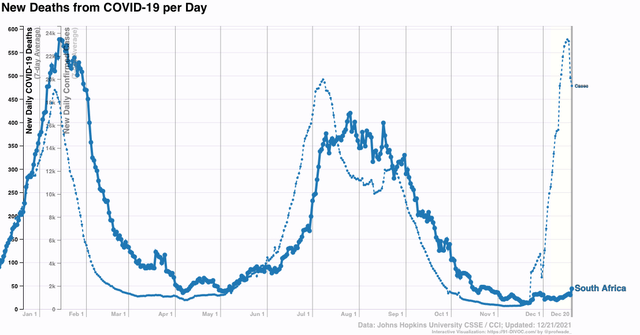


Cases began to rise almost exactly 5 weeks ago, from just under 300 to over 23,000 three days ago - and have already fallen back to 19,400. Meanwhile deaths have risen from 13 four weeks ago to 44. Undoubtedly deaths will continue to rise. The question is, how much?

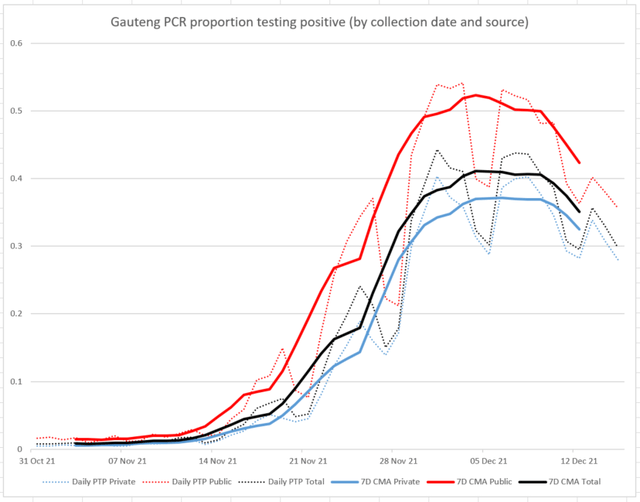
For some help, here is a look by Conor Kelly at cases, hospitalizations, and deaths in Gauteng, the first area of South Africa to be hit:
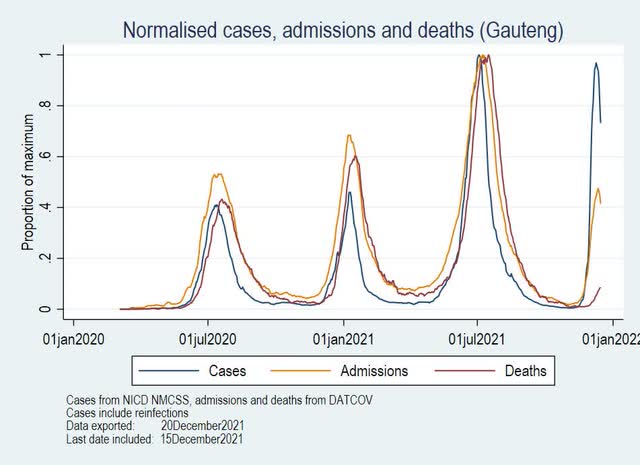

Note that hospitalizations and deaths rose comparably in the three previous waves. This time around, hospitalizations appear to have peaked at only half the level of cases, as normalized in the graph. This is really good news. Meanwhile deaths have clearly started to rise, but there is some indication that they have stayed low longer after the onset of this wave than for previous waves. This appears to be confirmed by the following graph comparing deaths in the first two weeks of the present Omicron wave, with previous waves:
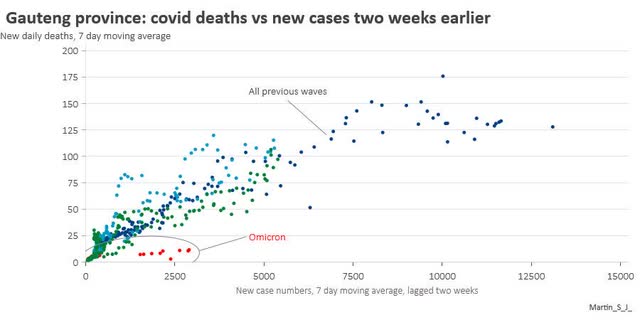

In other words, our “leading indicator” example of South Africa lends credence to the idea that hospitalizations and deaths will not be so severe, on a per capita basis, as a result of Omicron than with Delta or other prior waves.

This is good news.

Turning to the US, the CDC made a splash yesterday by announcing that its model suggests that 73% of all cases in the US now are Omicron. Here’s their graph:
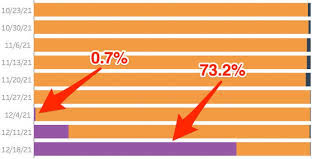

But take the CDC’s announcement with a shaker full of salt. In a footnote at its “Nowcast” site, it advises that the graph is bases on four weeks of data *ending November 27,* i.e., four weeks ago! It’s confidence interval includes about 2/3’s of all possible percentages. And it made very major revisions to last week’s estimate, increasing that from 2% to about 30%. In short, the CDC’s number is *very* unreliable.

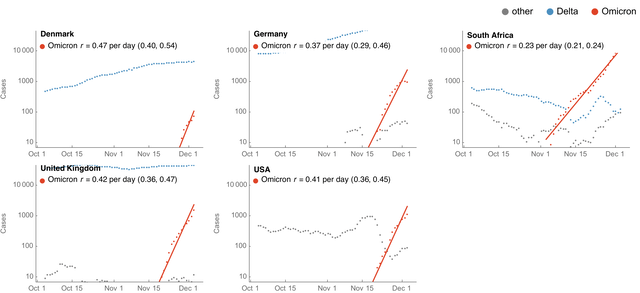
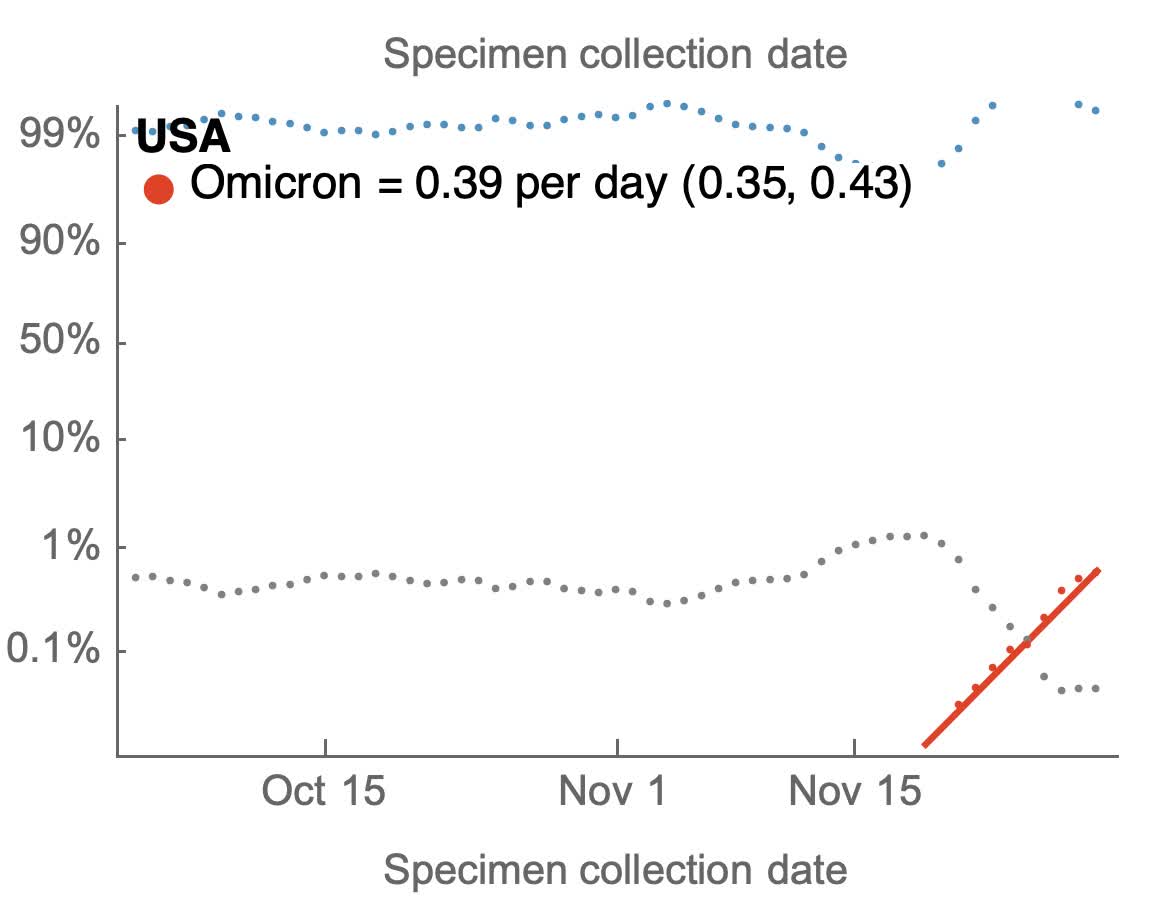
By contrast, here is Trevor Bedford’s log scale *actual* data, through 12 days ago, of cases in the US and 8 other countries:
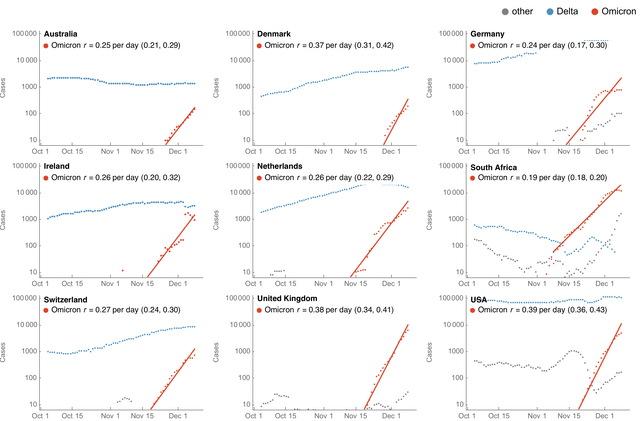

Projecting Bedford’s trendline forward 12 days suggests that right now about 33% of all cases in the US are Omicron.

That’s a very major difference, not just because of the numbers, but because in the CDC’s version, Delta has been knocked back to about 35,000 cases, whereas in Bedford’s Delta’s number is about constant at 80-90,000 cases. In other words, the CDC has Omicron supplanting Delta, but Bedford does not, at least in the US - although his graph for South Africa does indeed suggest that Delta cases have declined by about 2/3’s since Omicron emerged at the beginning of November.

There is another intriguing trend in Bedford’s graphs, because most countries also provide a record for “other” variants in addition to Omicron and Delta.  Looking at South Africa, “other” cases have risen even faster than Omicron since one month ago, and are responsible for about 10% of all cases there now. A similar trend appears to have started in Germany, the UK, and the US as well. I have not read of any explanation of this from any expert.

Finally, let’s look at where we have exponential spread in the US. Here are NY, NJ, and RI:
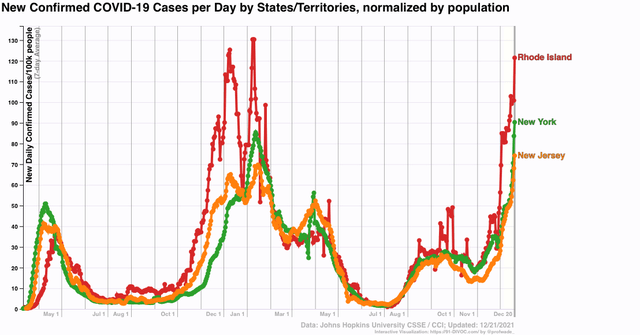

NY and NJ both set new records as of today. RI is not far behind.

Next, here are OH, DC, HI, and PR:
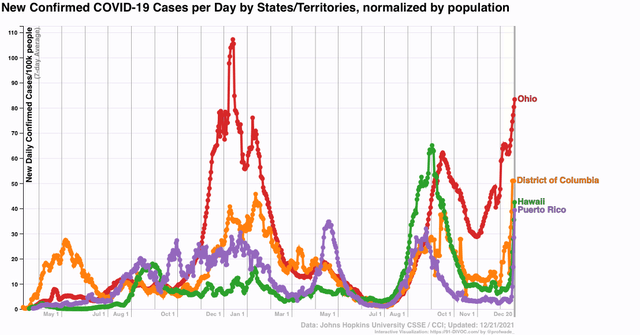

HI and PR are two tropical island oases that had been doing extremely well. Both are 80% or more vaccinated, and PR in particular recently had as few as 2 cases per 100,000 daily. This week PR shot up to 40 cases per 100,000 in *four days!*

Of course, HI and PR are tourist destinations, and have heavy international travel as does the NYC area.

And of course we all know one other State that has a similar profile: FL. Here is FL’s official case count, which they are still only updating once a week:
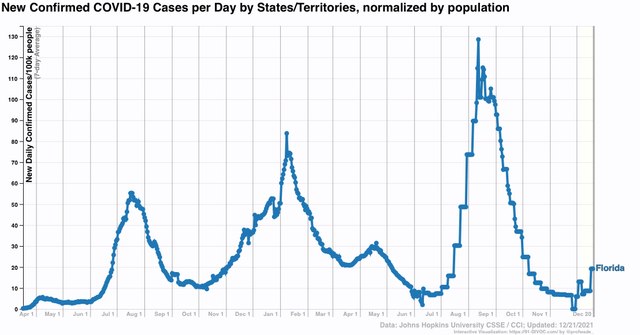

Rising, but still very low.

Except when you bypass the State, and get reports directly from counties and hospitals, here is what the daily total looks like (from the NYT):
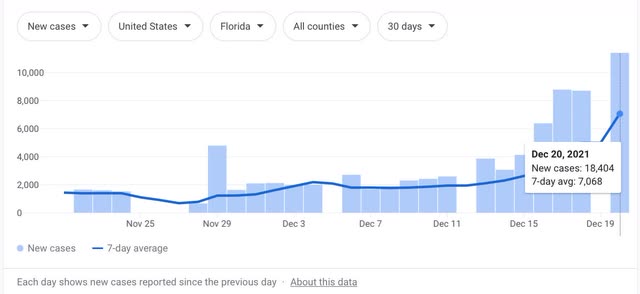

As of yesterday, cases in FL were *triple* what they were just one week prior. Expect a huge increase in FL’s next weekly report this Friday.

I expect the exponential outbreak to grow both in terms of numbers and to spread throughout the entire country in the next week or two. We can hope that in the US, as in SA (and apparently in London in the UK as well), cases will peak about 30 to 40 days after the onset of the wave, and decline rapidly thereafter. And we can pray that, as appears increasingly likely in SA, the burden of hospitalizations and deaths does not grow at the same rate as cases.
Saturday, December 18, 2021

Weekly Indicators for December 13 - 17 at Seeking Alpha


 - by New Deal democrat

[Brief programming note: this coming week will only see existing home sales on Wednesday, and new home sales plus jobless claims on Thursday. In other words - don’t be surprised if I take a couple of days off. Omicron permitting]

My Weekly Indicators post is up at Seeking Alpha.

While the large majority of the strictly economic data continues positive in all time frames, it can be trumped at a moment’s notice by Omicron.

I expect the comments on this week’s post at that site to be “interesting,” but not in an intellectually challenging way, if you catch my drift and I think you do.

In any event, clicking over and reading will bring you up to the virtual economic moment and pay for my postage to send out all my Christmas gifts.

Friday, December 17, 2021

Coronavirus dashboard: an urgent warning about Omicron’s exponential spread


 - by New Deal democrat

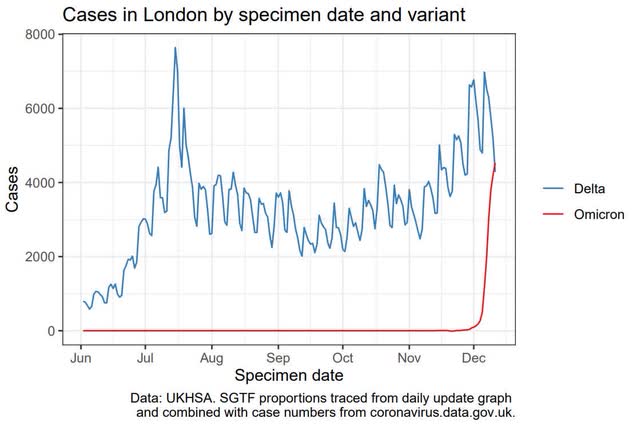
Here is a graph of the growth in Omicron vs. Delta cases in London from 2 days ago:


Shocking, isn’t it?

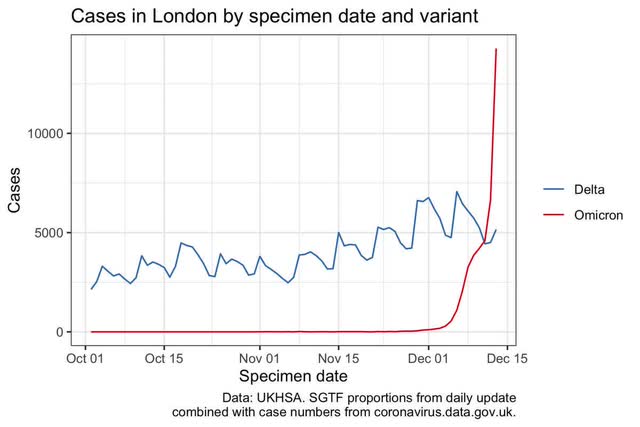
Now here is the same data, updated yesterday, just one day later:


Do I have your attention? In one day, the number of Omicron cases literally went through the top of the previous graph.

Dr. Trevor Bedford, a geneticist who was the first to demonstrate that there was community spread of Covid-19 in the US back in late February 2020, is now tracking the daily exponential growth of Omicron, with a 10 day lag because that is how long it takes for reliable testing data to be accumulated. Here are his current graph of 5 countries including South Africa, the UK, and the US:

https://github.com/blab/rt-from-frequency-dynamics/tree/master/results/omicron-countries

Depending on the country, the number of Omicron cases is doubling every 2 to 3 days. 

As of 10 days ago, he estimates about 1000 cases per day in the US were Omicron. If we use 3 days as the doubling time, that is close to 10,000 cases today.

Projecting that rate of growth forward, here is what we get:

- about 100,000 cases a day by December 27 

- 1 million cases a day by January 6

-10 million cases a day by January 16.

This in a health system where many hospitals have already reached their limit.

Will it get that bad? Exponential growth keeps going until, well, it doesn’t (see, e.g., Delta during July and August, peaking quickly just before Labor Day).

In that regard, in South Africa, Omicron May have peaked a few days ago, see:


If Delta burned through the dry tinder in about 2 to 3 months, in South Africa Omicron sped that up to about 30 to 45 days.

In South Africa, cases went from 400 to 24,000 in 4 weeks, an 60-fold increase.

Two other countries with major Omicron spread, Denmark and Norway, went from 400 cases each to 8000 and 4000, respectively, a 20-fold and 10-fold increase. Interestingly (although I won’t bother with the graph, in Norway cases seem to have peaked in the last few days after 12 weeks of increase). The good news is, if South Africa and Norway are the templates, then like Delta there is a certain subset of the population that is uniquely susceptible, and once Omicron infects those people, it runs out of fuel.

Consistent with, and maybe because of this, here is Dr. Andy Slavitt:
https://mobile.twitter.com/Porter_Anderson/status/1471683867304206337

“We’re in store for a quick, fast-spreading, and hopefully soon-to-be-over wave that’s going to overwhelm hospitals. All of us who take advantage of the science will be in good shape. For the country as a whole, this is going to be a rough January.”

As cases rise, when could they peak? He says: “I talked to a dozen scientists or so in the last couple of days and the consensus seems to be forming around the third week in January.”

In the US, the post-Delta trough was about 75,000 cases per day about 6 weeks ago. A 10-fold increase like Norway would be 750,000 cases per day. A 50-fold increase, like South Africa, would be 3,750,000 cases per day.

Since the consensus spoken of by Dr. Slavitt is late in January, that appears to be consistent with the worst-case scenario.

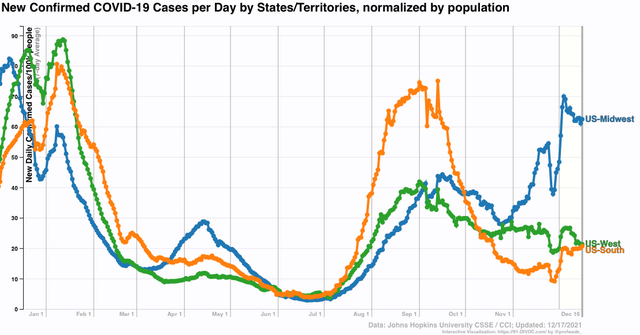
While cases in the South, West, and Midwest are generally still much better than they were one year ago at this point:


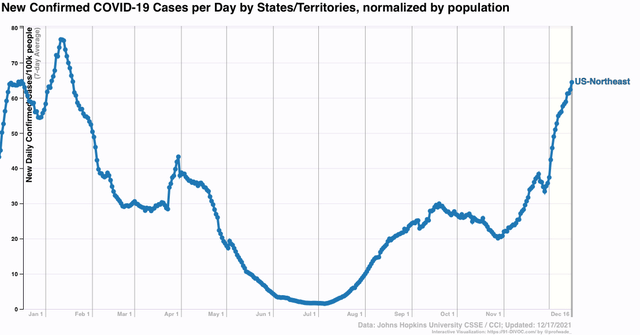
In the Northeast, where there is evidence Omicron is already a significant share of total infections, cases are already close to their all-time daily highs, and look to exceed those numbers by Monday or Tuesday:


I am afraid this is what the US as a whole is looking at within a week or two, if not within days.

If the above is true, at some point between now and New Year’s Day there is going to be a March 2020 style nearly instant crash in public and economic activity.

Please use extra caution, even if you are fully vaccinated and boostered. Stay safe!

Thursday, December 16, 2021

Production, layoffs, housing hit the positive trifecta in November


 - by New Deal democrat

We got a blizzard of November and December data this morning across all three - coincident, short leading, and long leading - timeframes: industrial production, jobless claims, and housing permits and starts. All three were positive.

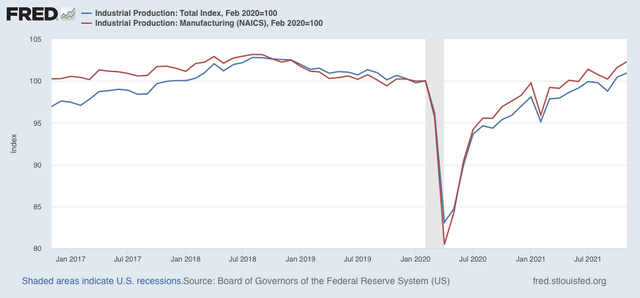
Let’s start with the King of Coincident Indicators, industrial production, which rose 0.5% in November. Manufacturing production rose 0.7%. They are 2.3% and 0.6% above where they were before the pandemic:


Both also are at 2.5 year highs, although below their peak levels during the last expansion. At this point the *only* important metric which has not exceeded its pre-pandemic level is employment, which as I explained last week, has a persistent 4,000,000 shortfall compared with job openings, which will only be closed once the pandemic is past (or at least mainly past).

Let’s turn now to the short leading indicator of initial and continuing jobless claims, which continue at or near their best levels in the past half-century.

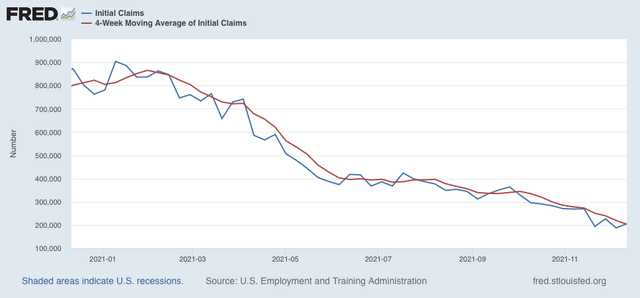
Initial claims rose 18,000 to 206,000 from last week’s 50 year low, while the 4 week average declined 16,000 to 203,750, which is not just a new pandemic low, but a new 50 year low:


Once again, virtually nobody is getting laid off.

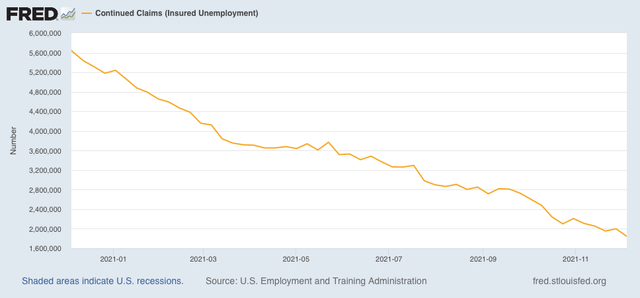
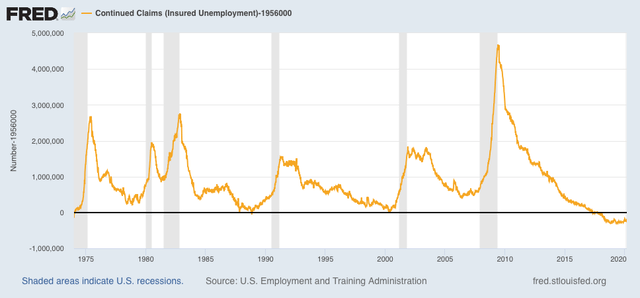
Continuing claims also declined 154,000 to 1,845,000 to another pandemic low, which in the past 45 years was only bettered during the 2 year period from March 2018 through March 2020:


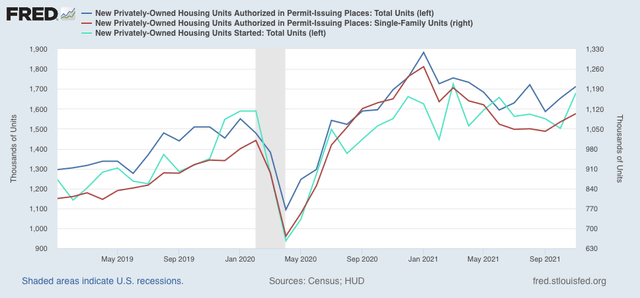
Finally, let’s look at the long leading indicator of housing permits and starts, which also improved across the board in November. Total permits increased 3.6% from October, and the less volatile single family permits increased 2.7%. Housing starts increased 11.8%:


Total permits are in the upper part of their range for the past year, while both the less volatile single family permits and the 3 month average of the more volatile housing starts are solidly off their bottoms. This has been expected, since mortgage rates moderated over the summer, and permits and starts follow typically with a 3 to 6 month lag. 

In summary, the economy right now continues to hit on all cylinders except for a shortfall in employment. Over the next few months the outlook continues very positive, and looking out a full year the evidence continues to be on net, on the plus side as well.

Wednesday, December 15, 2021

Real retail sales declined in November, but continue to auger well for strong jobs growth


 - by New Deal democrat


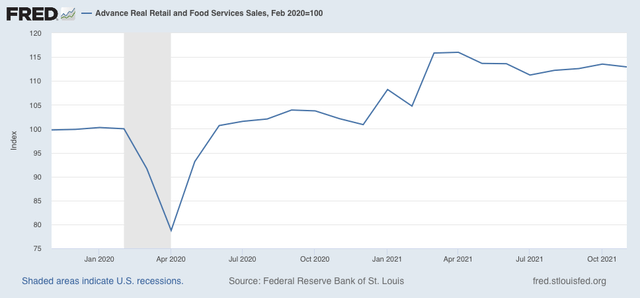
Retail sales, one of my favorite “real” economic indicators, were reported this morning for November. They increased 0.3% for the month, and October’s blockbuster report was revised 0.1% higher, to +1.8%. After inflation, though, “real” retail sales declined  -0.5%. 

Although real retail sales are down -2.6% from their April peak, they are +12.9% higher than they were just before the pandemic hit, and are also 4.4%  higher than January of this year: 


They are also up 10.6% YoY. 

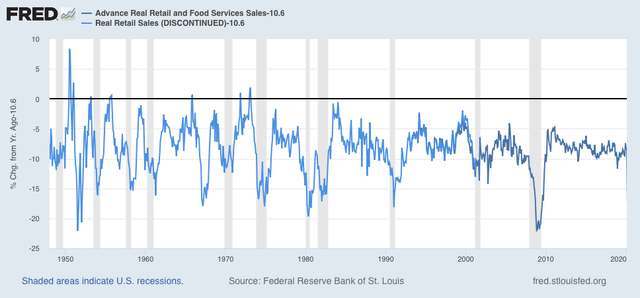
How extreme is that? The below graph subtracts 10.6% YoY growth from retail sales from 1948 through 2019:


In the past 70+ years before the pandemic, real retail sales have only been higher for about 16 months, all in the 1940s, 50s, and 60s - over half a century ago. Which, not coincidentally, is the last time the US had a very worker-strong economy. As I pointed out last month, this kind of explosive sales growth is a very important - perhaps *the* most important - driver of the transportation bottleneck, since our “just-in-time” global networks cannot handle such a sudden increase. 

Now let’s turn to employment, because real retail sales are also a good short leading indicator for jobs.

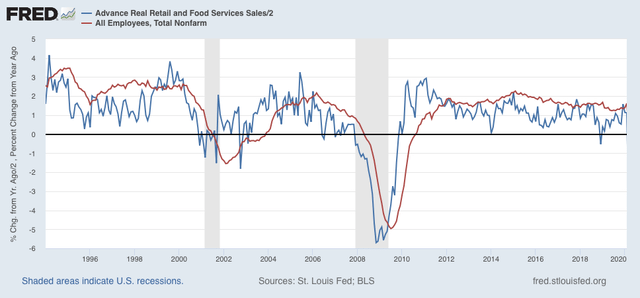
As I have written many times over the past 10+ years, real retail sales YoY/2 has a good record of leading jobs YoY with a lead time of about 3 to 6 months. That’s because demand for goods and services leads for the need to hire employees to fill that demand.  The exceptions have been right after the 2001 and 2008 recessions, when it took jobs longer to catch up, as shown in the graph below, which takes us up to February 2020:


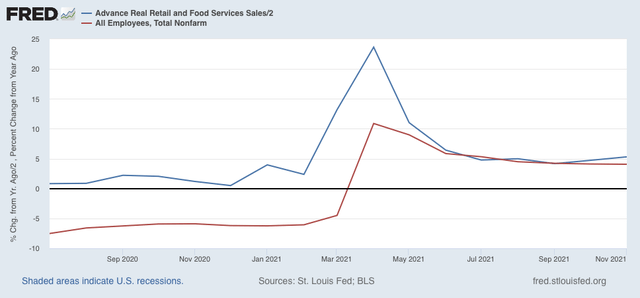
Now here is the same graph since July 2020:


Several months ago, despite two lackluster initial jobs reports, I wrote that this “argues that we can expect jobs reports in the next few months to average out about even with those from one year ago, which averaged about 500,000 per month.”

Those months were revised well higher, which means that job growth indeed has continued to average about 500,000 per month. I fully expect the “relatively” poor November jobs report to be revised higher, and that the next few months’ jobs reports  should continue to average about 500,000 as well.

Tuesday, December 14, 2021

The state of the American consumer


 - by New Deal democrat

Yesterday I updated my alternative “consumer nowcast” fundamentals-based model of the economy, which serves as a check on my other models, and posted it over at Seeking Alpha.

Hard to believe that I first wrote up that model over 15 years ago way back when I was a fledgling diarist at Daily Kos. The one surprise has been that, back then, I didn’t think interest rates could decline further in any meaningful way. Silly me!

Anyway, for a review of the economy based on the state of the average American household, go over and take a look. Any my lunch money will thank you.

Monday, December 13, 2021

How to track the Omicron variant in close to real time


 - by New Deal democrat

No economic data today, and Covid information is pretty useless because of lack of reporting over the weekend. I drafted a long piece about the state of the American consumer, which I’ve decided to put up at Seeking Alpha, since, hey!, why shouldn’t I earn some lunch money for it? I’ll post a link when one is available.

But in the meantime let me drop this link by Dr. Trevor Bedford, an expert in the genetic evolution of viruses. He is tracking the number and percentage of all cases that are the Omicron variant in several countries, including the US, from daily reporting. Here is what today’s graph for the US shows:


Note that this is in log scale, and the data lags by 10 to 14 days. What we can say is that IF the trend has continued, by now about 10% or more (10,000 or higher) of all cases in the US are Omicron, and one week from now, about 50% will be. 

Checking this daily for the next few weeks will keep you well ahead of the punditry you are reading in most media.

Saturday, December 11, 2021

Weekly Indicators for December 6 - 10 at Seeking Alpha


 - by New Deal democrat

My Weekly Indicators post is up at Seeking Alpha.

While stock prices made a new record yesterday, the more significant change this week was that Omicron most likely has already put a dent in peoples’ dining plans, as restaurant reservations declined significantly.

Also, the weekly measure of consumer spending continues to be strong, even though real wages have declined in recent months.

As usual, clicking over and reading will bring you up to the virtual moment as to the state of the economy, and will bring me my lunch money for the coming week.

Friday, December 10, 2021

Real average and aggregate wages continue decline in November; a sharp deceleration in the consumer sector now appears likely


 - by New Deal democrat

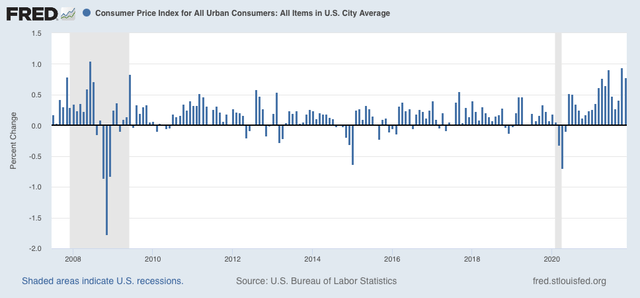
As you may already know, consumer prices increased 0.8% in November. In the past two months, there has been a re-acceleration in CPI, with the monthly numbers equal to earlier this year and the worst since the Great Recession: 


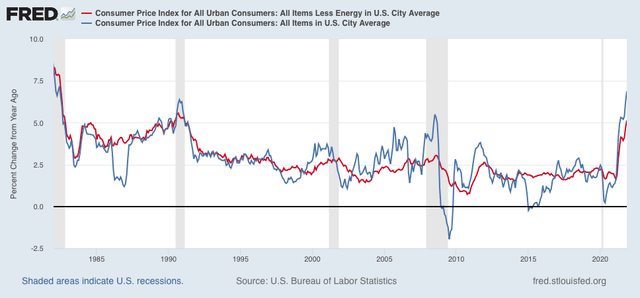
On a YoY basis, consumer inflation is now the highest since the big Reagan recession of 1981-82. My favorite measure, CPI ex energy, is also up 5.1% YoY, the worst in 30 years:


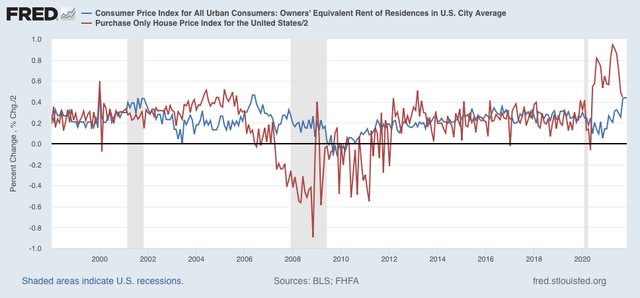
Inflation has shown up in all the wrong places: houses, cars, and gasoline. And remember that house prices are only indirectly reflected via owners’ equivalent rent, which has also started to increase:


Aside from the fact that “real” wage income has indeed actually declined this year (as I’ll discuss immediately below), the impact of house prices on consumers’ inflation concerns is an important factor that among others even Paul Krugman is missing (because he’s looking at only the “official” CPI stats, which do not include house prices).

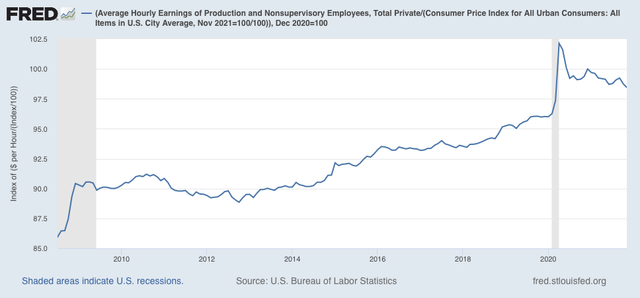
Average real hourly wages also declined again, down another -0.3% at -1.6% below their recent peak last December and about 3% below their peak in spring 2020:


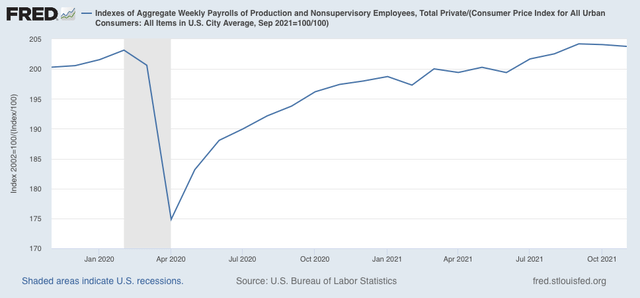
Further, real aggregate payrolls, an overall measure of consumer health, also declined -0.1%, and are -0.2% below their peak in September:


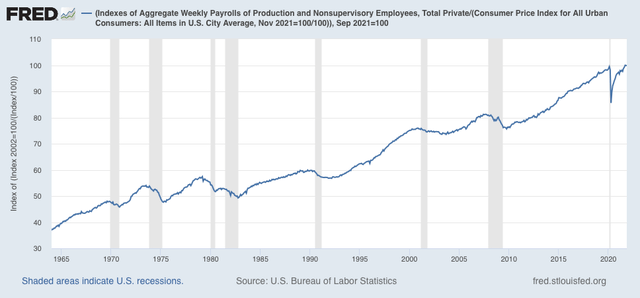
This is significant, because for the past 50+ years, when aggregate real wages have retreated from peak for 3 to 9 months, a recession has typically followed:


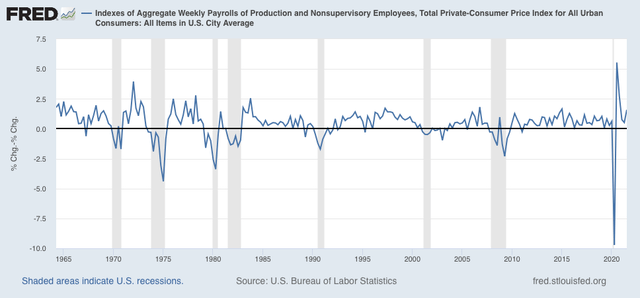
Measured quarterly, a -0.3% decline in real aggregate wages from the previous quarter has more often than not signaled a recession, and even when a recession has been avoided (e.g., 1967 and 1995) GDP growth has typically slowed dramatically (note: graph ends with September data):


Last month I wrote that inflation was “a Big Deal,” because it showed that consumers were already under pressure, and because, via owners’ equivalent rent, we could expect higher inflation to continue next year. Today’s report only reinforced that concern. While we haven’t crossed a threshold at this point into a downturn consistent with a recession, we certainly are at a point where a sharp deceleration beginning with the consumer sector of the economy is more likely than not.

Thursday, December 9, 2021

The Great Resignation and jobless claims


 - by New Deal democrat

Initial and continuing jobless claims continue at or near their best levels in the past half-century.

Initial claims declined 43,000 to 184,000, a new 50 year low, while the 4 week average declined 21,250 to 218,750, also a new pandemic low, and in the past 50 years only bettered by the period from late 2018 until February 2020:


For all intents and purposes, nobody is getting laid off.

Continuing claims rose 38,000 to 1,992,000 from last week’s pandemic low:


Still, since 1974, aside from last week, only two weeks in the late 1980s, and the last 3 years of the last expansion were below this number:


This is further confirmation of what was reported yesterday in the JOLTS report for October, where layoffs and discharges were a hair above their all time low set in May.

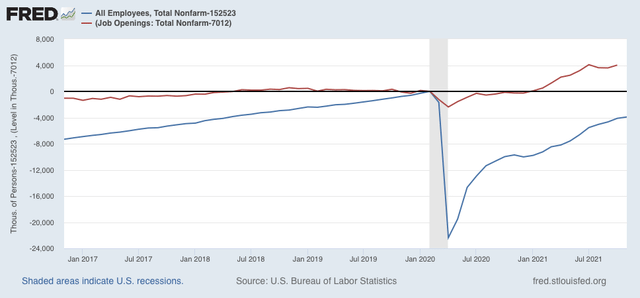
Below is a comparison of total jobs from the monthly jobs report, vs. job openings from the JOLTS report, both set to 0 as of February 2020 just before the pandemic:


Note that since autumn one year ago, the two have been running in parallel, with job openings roughly 8,000 to 10,000 above the level of workers compared with just before the pandemic.

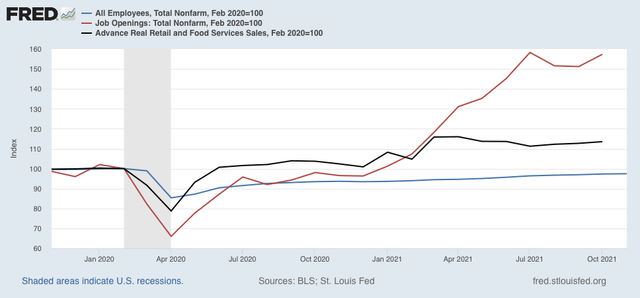
Adding in real retail sales (black in the graph below) helps put the two series in perspective:


Before the pandemic hit, job openings were running at approximately 7 million a month. They returned to that level by January of this year, and have since increased to about 11 million per month.

Similarly, real retail sales returned to their pre-pandemic level in June of 2020, and began taking off from that level in January of this year.

In other words, we have had a persistent situation going back at least 12 months where the level of sales in the economy justified a level of employment in the aggregate equal to that just before the pandemic hit, but there was a huge shortfall in the number of employees actually hired to perform that work.

The imbalance really took off with the arrival of vaccines at the beginning of this year, together with further Congressional stimulus.

Right now we still have roughly a 4 million shortfall in employees compared with just before the pandemic, and about 4 million new job openings over and above that which existed just before the pandemic. Over and above that, sales are running over 10% higher than they were just before the pandemic.

Most importantly, it is the pandemic dangers themselves, and their secondary effects, which are responsible for this shortfall. Jobs which require face to face interactions with unvaccinated Covidiots are going to go unfilled unless there is a very big $$$ premium to undertake that risk. The shortage or unavailability of child care for other potential workers is keeping them from the workplace. 

The shortfall in available workers has, unsurprisingly, led to a competition for workers, which means wages are going up sharply, as the employer paying the least is having their jobs unfilled.

Take care of the pandemic, and the shortfall in jobs, both in payrolls and in openings, will be resolved. Until then, it will persist.

Wednesday, December 8, 2021

October JOLTS report: at least the jobs market isn’t getting any worse in disequilibrium


 - by New Deal democrat

The JOLTS report for October was released this morning. While it did not indicate any significant progress towards a new labor equilibrium, at least the trends did not get any more destabilized.


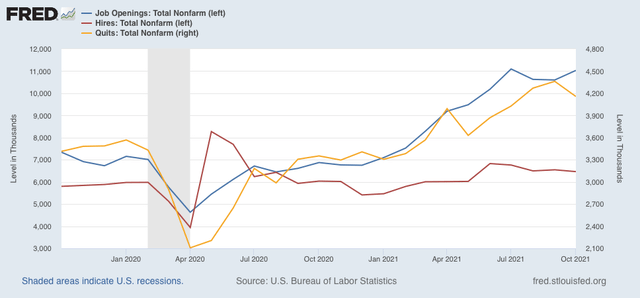
Job openings (blue in the graph below) increased to 11.033 million, which remains below the July peak of 11.098 million. Voluntary quits (the “great resignation,” gold, right scale) decreased to 4.157 million, a decline of over 200,000 from last month’s peak. Actual hires (red) decreased slightly to 6.464 million, in line with the past few months, and better than the early part of this year:


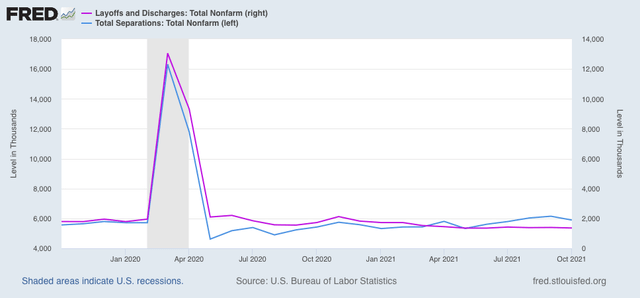
Layoffs and discharges (violet, right scale in the graph below) decreased to 1.361 million, slightly above the May all-time low of 1.353 million. Total separations (blue) decreased to 5.892 million, a three-month low:


So, we have near-record (but not record) job openings, layoffs, and quits, with still-strong hiring and a normal level of total separations.

The situation is not getting any more out of sync, but on the other hand progress towards a new equilibrium has been very limited, to say the least.

So, what am I looking for going forward? The JOLTS data has only been around for 20 years, and neither jobs recovery after the two last recessions were very strong. In other words, we are in terra incognito for this series.
In order for the situation to resolve, the first thing I want or expect to see is a further increase in monthly hiring. At the same time, or shortly thereafter, I would expect to see a significant decline in voluntary quits. Only after these two things have occurred would I expect to see a substantial downturn in job openings, and I would not expect to see any significant increase in layoffs until all of those other trends are in place.
Tuesday, December 7, 2021

Coronavirus dashboard for December 7: since further mass vaccination could only happen at gunpoint, the Biden Administration had better come up with a ‘Plan B’


 - by New Deal democrat

No significant economic news today, so let’s catch up a little bit with Covid.


There are still distortions in the 7 day average data, as States did data dumps of deaths and new cases throughout last week, after not reporting over the long Thanksgiving holiday. That should finally disappear over the next few days.

But since the same sort of Thanksgiving distortions occurred one year ago, it’s useful to take a YoY look at the data, which the below graph shows by US Census Region plus nationwide:


The South and West regions have less than half as many cases as they did one year ago right after the Thanksgiving weekend, while the Northeast and Midwest have between 80% to 90% of the case they did one year ago.  This is particularly interesting since the South, of all the regions, has the lowest vaccination rate. It partially suggests the importance of weather, and partially recent outbreaks rushing through the susceptible part of the population.

A close-up of the last 8 weeks shows that the waves in the Northeast and Midwest started building near the end of October. Since the Delta wave from trough to peak in the South and West took about 2 months (similar to what happened in India, the UK, and now in the EU), this may mean that, except for the effect of Christmas gatherings, the peak in the colder regions is only a few weeks away:


Additionally, if we average the most recent 7 day average, with the 7 day average one week ago, and compare that with the 7 day average 14 days ago, we probably get closer to a true picture of the pandemic. And there, the news is better. In the South, West, and even the Midwest, the average of the past 2 weeks is about the same as the 7 day average 2 weeks ago. Only in the Northeast has there been an unambiguous increase.

But now, some pessimistic news.

Vaccinations among adults have slowed to a crawl.

Here is the graph of full vaccinations per capita for the entire US population:


40% of the entire US population was fully vaccinated on May 16.
50% was fully vaccinated on July 22.
60% was fully vaccinated on December 4.

It took 67 days to go from 40% to 50%.
It took another 135 days to go from 50% to 60%.

Even worse, some of those new vaccinations were for teens and a few for children under age 12.

When we confine the data to only US adults, here’s what we get (note: no graph; data is from my “Weekly Indicators” compilations from the last 6 months):

50% of all US adults were fully vaccinated by May 30.
60% were fully vaccinated by July 30.
Two more months later, by October 1, only 66.6% were fully vaccinated.
70% of all US adults were finally fully vaccinated by December 3.

In other words, the pace of vaccinations fell by 50% between late spring and the onset of winter - despite the Delta wave occurring in late summer.

At the current pace of the slowdown, it would take another 8 months to go from 70% to 80% of all adults, and to go from 60% to 70% of the entire US population. And because we are running up against the hard core refusers, we may *never* get there.

Needless to say, this takes the prospect of beating Covid via vaccination alone in the US completely off the table.

And, as far as I can tell, the Biden Administration has no other plan. It has refused to enact mandatory vaccination requirements for air and train travel. Yesterday Jen Psaki actually sneered at the idea of mailing test kits to everybody (which has in fact been done both in the UK and Singapore). Rapid testing at pharmacies for free - available in many other Western countries - is a figment of the imagination here. Seroprevalence studies appear to have been largely suspended. Even the publication of infection statistics by vaccination vs. non-vaccination status by the CDC has never been implemented.

Since mass vaccination of the remaining US population could only happen essentially at gunpoint, the Biden Administration had better come up with a decent “Plan B” and fast.