Friday, March 19, 2021

Coronavirus dashboard for March 19: yes, vaccinations are working


 - by New Deal democrat

The three big Western standouts for vaccination progress have been Israel, the UK, and the US, respectively. And in all three, there have been dramatic declines in both cases and deaths.


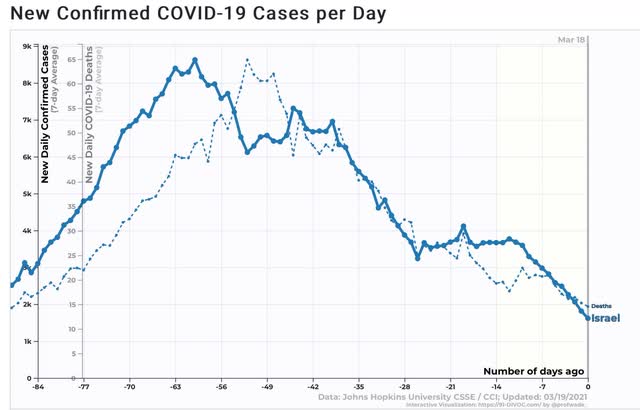
Let’s look at them in order. First, Israel:


56% of all Israelis have had at least one dose of the Pfizer vaccine. 50% have been fully vaccinated.

Cases have declined 81%. Deaths have declined 77%.

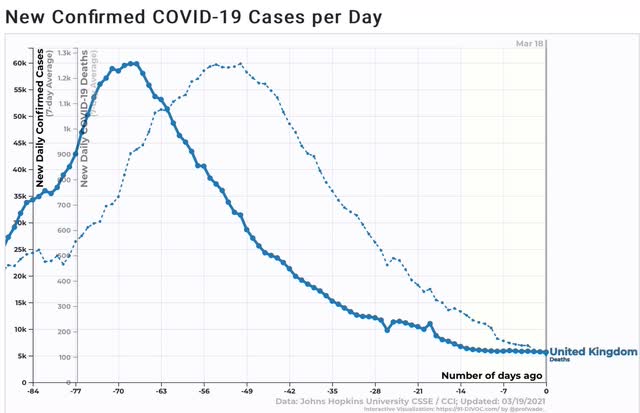
The UK’s vaccination program has coincided with a partial lockdown that began on January 4:


40% of the population has had at least one dose. 30% is fully vaccinated.

Both cases and deaths have declined by 91%.

The US is in 3rd place:


23% of the US population has received at least one dose. 12.5% has been fully vaccinated.

Cases have declined by 78%. Deaths have declined by 65%.

Vaccinations are working. Hopefully as those opposed to taking the vaccine see their family, friends, and neighbors returning to close to normal lives without contracting the virus, they will lose their hesitancy and do the obvious, rational, and easy thing.

P.S.: Here is an updated graph on hospitalizations in the US:

This is more evidence that serious illness and death among the institutionalized elderly from COVID has all but disappeared.

Thursday, March 18, 2021

Disappointing weekly increase in new jobless claims, but monthly trend improves; expect a 200,000+ number of new jobs in next Employment Report


 - by New Deal democrat

New jobless claims are likely to the most important weekly economic data for the next 3 to 6 months. They are going to tell us whether my suspicion is correct that, as a critical mass of those vaccinated is reached, there will be a veritable surge in renewed commercial and social activities and attendant consumer spending, leading in turn to a strong rebound in monthly employment gains.

More specifically, now that further COVID relief has also been passed by Congress, last week I set a few objective targets: I am looking for new claims to be under 500,000 by Memorial Day, and below 400,000 by Labor Day. 

This morning’s data didn’t help. On a unadjusted basis, new jobless claims rose by 424,318 to 746,796. Seasonally adjusted claims rose by 45,000 to 770,000, the highest level in 4 weeks. The 4 week moving average, however, declined by 16,000 to 746,250.  

Here is the close up since the end of July (these numbers were in the range of 5 to 7 million at their worst in early April): 
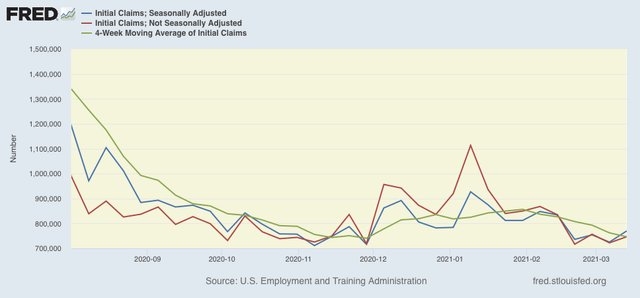
While both adjusted and unadjusted claims remain above their worst levels at the depths of the Great Recession, the outbreak-related wintertime surge has abated.

Because of the huge weekly swings caused by the scale of the pandemic, a few months ago I began posting the YoY% change in the numbers as well, since they are much less affected by scale, so there is less noise in the numbers, and the trend can be seen more clearly:
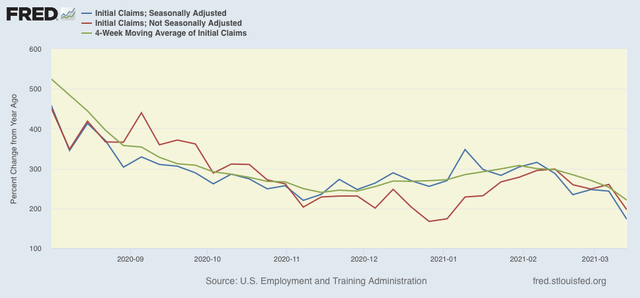
This is at levels last seen in November and December, and confirms that the recent increase in new claims has reversed. In fact, all 3 metrics are at pandemic lows of increases of 175%-225%. An important caveat is that YoY numbers are starting to be compared with the horrific initial pandemic losses of last March and April, so I will probably discontinue this metric in the next several weeks.

Meanwhile continuing claims, which historically lag initial claims typically by a few weeks to several months, made new pandemic lows yet again this week. Seasonally adjusted continuing claims declined by 18,000 to 4,124,000, while the unadjusted number declined by 95,541 to 4,486,389:
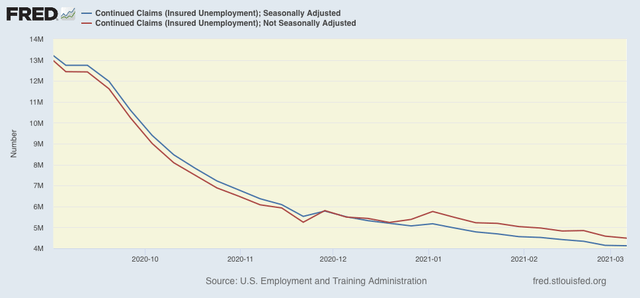

Nevertheless seasonally adjusted continued claims remain at levels last seen at the end of 2010.

Bottom line: although this week’s number of new jobless claims was disappointing, I remain bullish that the ever-increasing pool of fully vaccinated adults - 40,000,000 as of yesterday, or 15.5% of the adult population - together with a seasonal shift from indoor to outdoor activities, is going to result in new pandemic lows well below the existing low of 711,000.

Further, the monthly change in the 4 week average of initial claims ending last week is the best we have seen since November, when 264,000 jobs were added to the economy. As a result, I am looking for a similar number in the March jobs report which will be released at the beginning of April.
Wednesday, March 17, 2021

February declines in housing permits and starts: another likely effect of the Big Texas Freeze


 - by New Deal democrat

Housing is an important long leading indicator. What we see now in mortgage applications, new home sales, permits and starts is informative of what the economy will be like 12+ months from now in 2022.


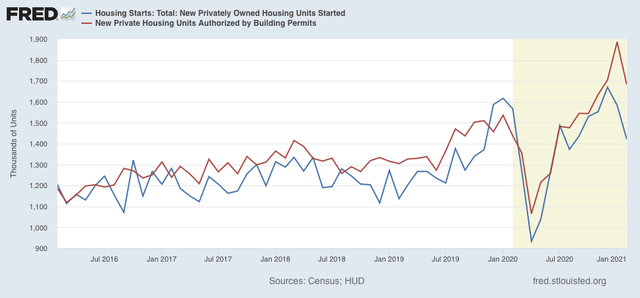
The headline numbers for both permits and starts for February, released this morning, were both poor, off -10.8% and -10.3%, respectively. The temptation is to say, “higher interest rates, We’re DOOOMED!!!” Not so fast. In context, the declines were well within normal month to month variation, and at least some of the declines looks like more fallout from the Big Texas Freeze that we saw yesterday in industrial production and retail sales.

Here is the headline graph covering the last 5 years for both starts (blue) and permits (red):


Two things are of interest here: (1) note that starts fell much more than permits, similar to what happened in the last two winters; and (2) while typically permits lead starts by a month or two, this decline in starts began *before* permits. Neither of these facts are conclusive, of course, but they do suggest an external reason for the pattern - e.g., an outsized winter “event” in February.

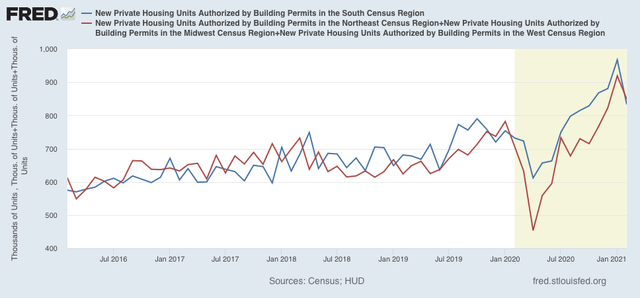
I’ve also separated out the South Census Region that includes Texas from both permits and starts in the other three Census Regions (Northeast, Midwest, West) combined in the below two graphs. First, here’s permits:


Note that while both declined, the Southern region had the bigger one.

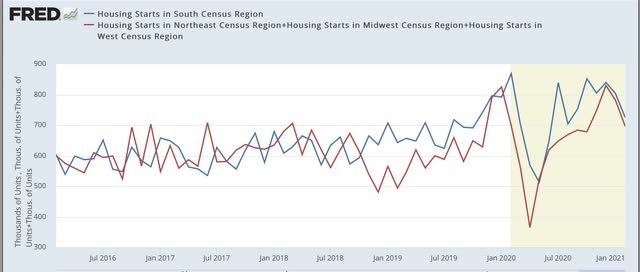
Now, here’s starts:


Again, note the outsized declines in the other three regions including both northern ones in the last two winters, that hasn’t occurred this year. Put another way, the decline in the South, including Texas, was a *relatively* outsized one.

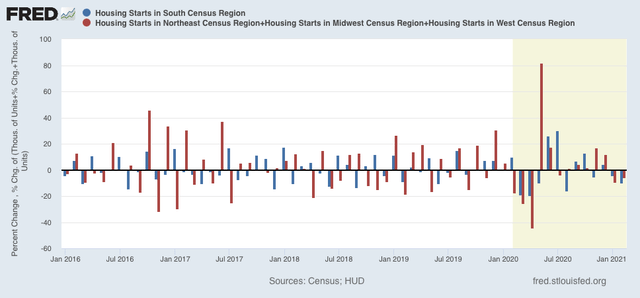
Finally, here is the above regional data for starts shown as a month over month % change:


As I wrote above, February’s declines are hardly noteworthy as monthly declines from the perspective of monthly changes in the past five years. And the February decline in starts in the South this year is bigger than that of the other three regions combined, unlike the last several winters.

I don’t want to oversell this, because the above information is hardly conclusive. But all of this information suggests that, while interest rates most likely did affect at least permits in February, the bigger reason for the relatively big declines in permits and starts was the closure of government offices and inability to undertake new construction in Texas and other nearby areas affected by the Big Freeze.

Tuesday, March 16, 2021

Big (weather related) declines in February production and sales


 - by New Deal democrat


This morning we got the most important single metrics for both the consumer and producer side of the economy for February, respectively, retail sales and industrial production. Both were big misses, one explicitly and the other likely due to the big freeze in Texas and neighboring States.

Let’s turn to production first.

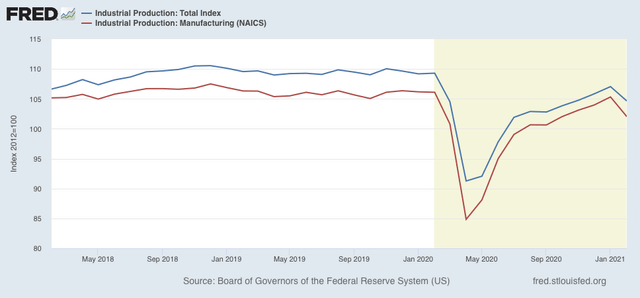
Total industrial production declined by -2.2% in February, while manufacturing production declined -3.1%. Both of these were the first declines of any significance since last April:


Before the DOOOMERS go screaming, “Double-dip!” however, here is the what the Fed itself had to say about this report:

The severe winter weather in the south central region of the country in mid-February accounted for the bulk of the declines in output for the month. Most notably, some petroleum refineries, petrochemical facilities, and plastic resin plants suffered damage from the deep freeze and were offline for the rest of the month. Excluding the effects of the winter weather would have resulted in an index for manufacturing that fell about 1/2 percent and in an index for mining that rose about 1/2 percent.

Because manufacturing is the biggest component of the report, even without the Big Texas Freeze the total index probably would have declined, but by something less than -0.5%. Since in January the total index rose a revised 1.1%, the combined January-February number would still be positive, and the highest since the onset of the pandemic last March.

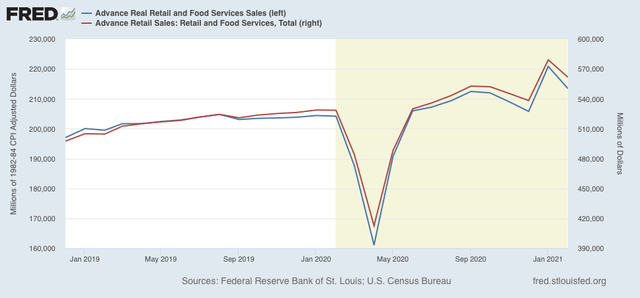
A similar dynamic was present in the retail sales report, although the Census Bureau explicitly does not take weather into account. Nominal retail sales declined -3.0%. After adjusting by the CPI, real retail sales declined -3.4%. Here’s what the last 2.5 years including February look like:


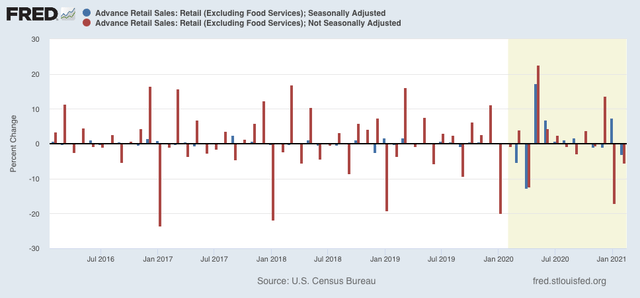
Of course winter occurs every year, but if and when a particularly bad stretch happens might be in December one year, January another, and February still another. So the below graph shows the unadjusted as well as the seasonally adjusted percentage change each month for the same time period. Note that January and February each year, combined, show the steepest month over month decline:


If you look at the unadjusted numbers, it’s pretty clear that January this year had the least decline of the last 5 years, while February’s was the worst. So the below lists the combined January + February declines for the previous 5 years and compares them with this year:

2016: -21.8%
2017: -24.3%
2018: -23.6%
2019: -22.1%
2020: -20.6%
2021: -21.6%

Of the 5 previous years, only 2020 was better than this year. On a seasonally adjusted basis, the combined January-February period this year still showed a gain of 3.7% from December, which would be the highest total since the pandemic started.

In conclusion, don’t sweat these two declines. Ex-the Big Texas Freeze, both production and sales probably did decline, but only slightly, and real retail sales for the two month period combined absolutely rose. 

Monday, March 15, 2021

Coronavirus dashboard for March 15: good news, and cause for concern


 - by New Deal democrat

A year ago today I wrote about the accuracy of Jim Bianco’s forecast of exponential spread of COVID-19. At that time there were exactly 2952 cases, but increasing at 30% each day, and I wrote, “I have not seen any government action significant enough to stop this exponential projection being correct.” 

As of yesterday, there have been 29,438,775 *confirmed* cases - 9% of the total US population. There have certainly been many more cases which have never been confirmed by testing, primarily but not always because they were mild or asymptomatic.


The good news is that vaccinations in the US are making better and better progress. In the past week, about 2.5 million doses were administered each day. At this rate the entire adult population could be vaccinated by the end of June.   

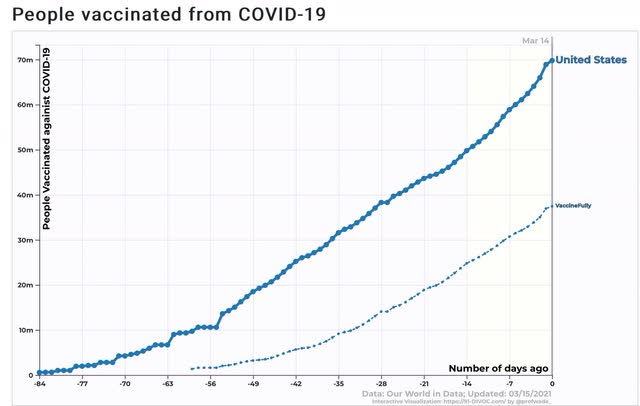
Here’s the total number of people who have received at least one dose (just shy of 70 million), and those who are fully vaccinated (about 37.5 million):


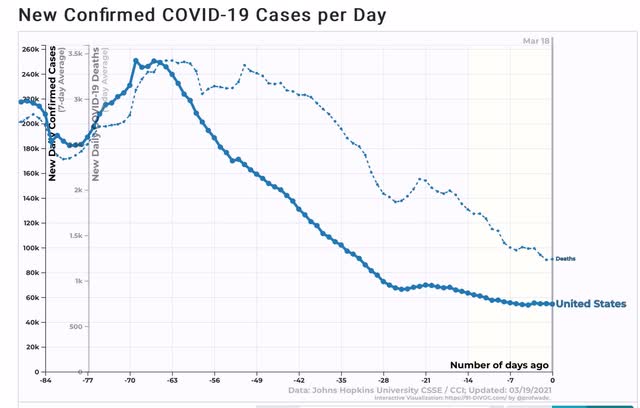
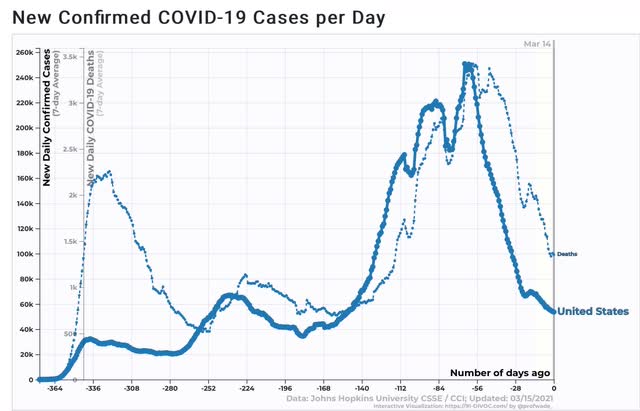
At least partly as a result, both new cases and deaths have declined by over 75% and 60%, respectively, since their wintertime peaks:


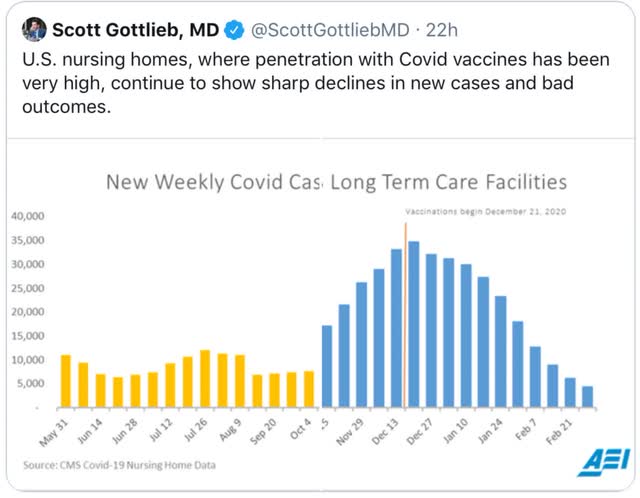
And new cases in long term care facilities have declined by about 90% to the lowest level in at least 10 months:


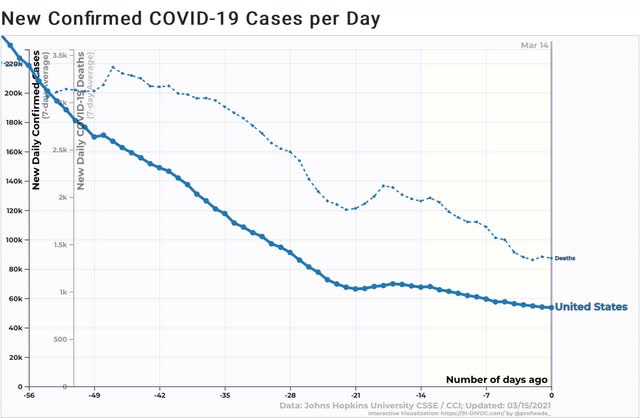
But the bad news, as Dr. Fauci has repeatedly pointed out in recent days, is that the declined are plateauing, as shown in this close-up of the past 8 weeks:


Incredibly reckless behavior by the usual government suspects, particularly the governors of Texas and Florida, is almost certainly contributing to this plateau.

This is particularly of concern because there is at least some evidence that one of the new variants of COVID may not be inhibited by either of the two primary vaccines:


Declaring premature victory, as the governors in those two States have done, is a recipe for emergence of a mutation which evades the effectiveness of the vaccines. If this becomes a real issue, I hope Biden will not hesitate to quarantine those two States and any others (e.g., Mississippi) which are similarly reckless.