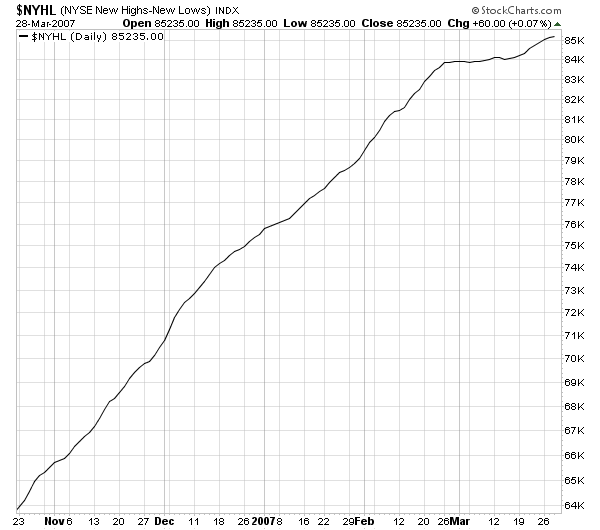
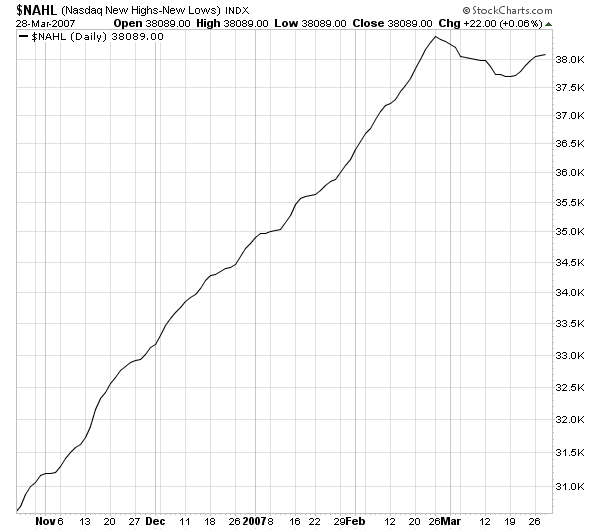
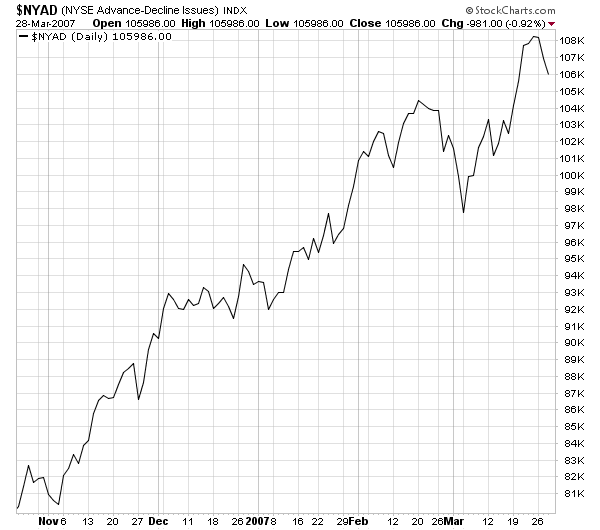
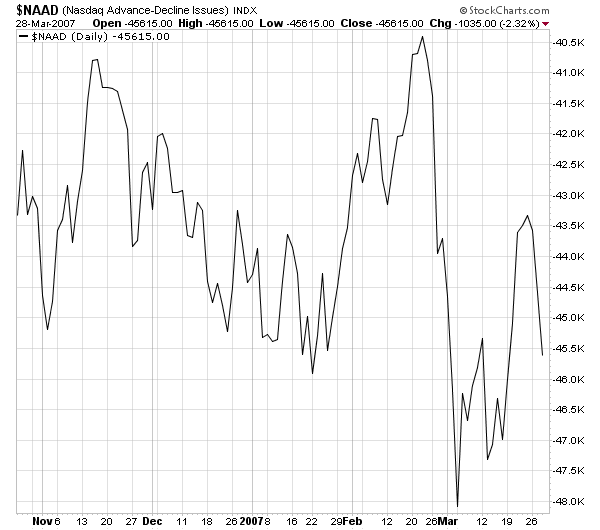
These charts are from Stockcharts. They show a market that is moving away from a bullish sentiment.
Fewer new highs means there is less of an upward pull in trading.
A moderating advance/decline line also means a moving away from bullish sentiment.
1 comment:
ndd
said...
The NYSE advance/decline line has been the most bullish signal around for months (as lots of other signs indicated weakness). Notice that the a/d line has continued to increase even after the Feb. 27 pullback.
The a/d line is actually overly sensitive to the downside, signalling the proverbial 9 of the last 5 recessions. It turned decisively lower in 1998, 2 years before the S&P high, and almost 3 years before the 2001 recession.
As you know, I think recession is close, but the a/d line is contrary to my analysis. It will be interesting to see if its long trendline is broken.
My tax practice is centered around captive insurance. I'm the author of the book U.S. Captive Insurance Law (which is also available on Kindle), the leading book in the field. You can learn more about captive insurance at my website.
I'm on Linked In and Twitter (@captivelawyer). Silver Oz's Linked In name is @silver_oz. NDD is a fossil and may be reached by etching a picture in stone on the wall of a cave.
The Bonddad Economic History Project
At the beginning of 2012, I decided to start looking at the actual, statistical history of the US economy starting in 1950. The reason is simple: to find out what really happened. So, when you see title of a post that begins with a year such as 1957, followed by "employment" or "Fed policy: you know what it's for. You can also access the information by typing in BE for Bonddad econ and a year to find information on a particular year.
Here is a link to pages that contain links to all the posts on the years listed.
This blog contains opinions and observations. It is not professional advice in any way, shape or form and should not be construed that way. In other words, buyer beware.
1 comment:
The NYSE advance/decline line has been the most bullish signal around for months (as lots of other signs indicated weakness). Notice that the a/d line has continued to increase even after the Feb. 27 pullback.
The a/d line is actually overly sensitive to the downside, signalling the proverbial 9 of the last 5 recessions. It turned decisively lower in 1998, 2 years before the S&P high, and almost 3 years before the 2001 recession.
As you know, I think recession is close, but the a/d line is contrary to my analysis. It will be interesting to see if its long trendline is broken.
Post a Comment