Tuesday, April 1, 2008

Today's Markets

So -- why was the market rallying today? I think Briefing.com summed it up best:

The mostly negative news has caused a surge of buying interest, with the thrifts & mortgages (+8.7%), diversified financials (+7.0%), and consumer finance (+6.7%) groups posting steep gains. However, there were similar rallies on negative news as early as October on hopes that the worst of the subprime mess was over--which clearly was not the case. Whether this really ends up being the turning point remains to be seen, but as of now there is a bullish bias prevalent within the market.


There are also some other points to consider. First, this is the beginning of the second quarter, so managers are putting money to work. There is also talk of a Federal bail-out of the mortgage market that might be boosting sentiment. The ISM number came in better than expected (although it was still below 50 indicating we're in a contraction) which may have helped as well.

But I have to wonder about the fundamental backdrop. I think it's possible the Fed has removed downside risk from the market by allowing a broader group of firms to borrow at the discount window. But that doesn't mean things are rosy either. Construction spending was terrible. Lehman had to raise cash, UBS said it has massive writedowns (as does Deutsche Bank) and car sales were terrible. All in all, things just aren't that great which leads me to question the long term viability of this rally. I should add -- I've been wrong before.

I'm going to use the daily charts because they really illustrate the market's overall situation better right now.
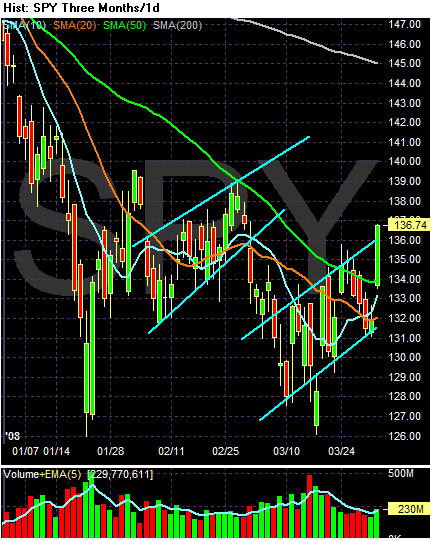


On the SPYs, notice the formation of two bear market flags. Also notice that today's price action takes prices above the upper trend line for on of those flag patterns. Finally, notice the SPYs could be forming a double bottom with the first occurring mid-January and the second occurring in mid-March.
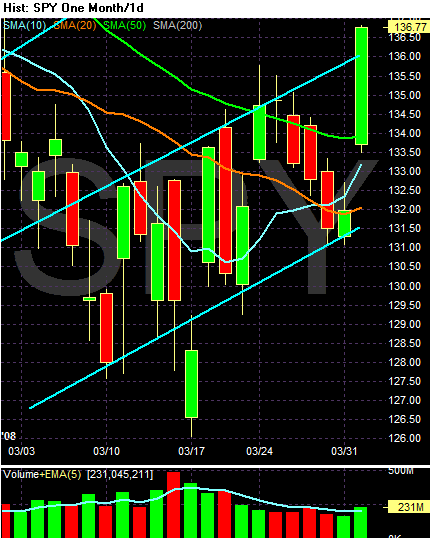


Above is just a closer look at the indexes move today.
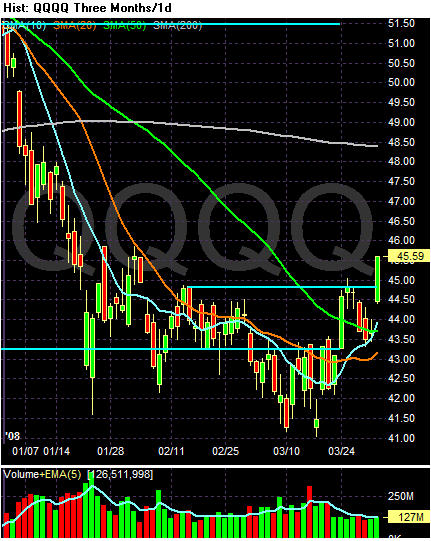


The QQQQs offer the most positive chart. Notice the following:

-- Prices have moved through resistance levels with a great deal of strength.

-- The 10 day SMA crossed the 50 day SMA and is moving higher.

-- The 20 day SMA is about to cross the 50 day SMA and is about to turn positive.

-- Prices bounced off the 10 day SMA and moved higher.
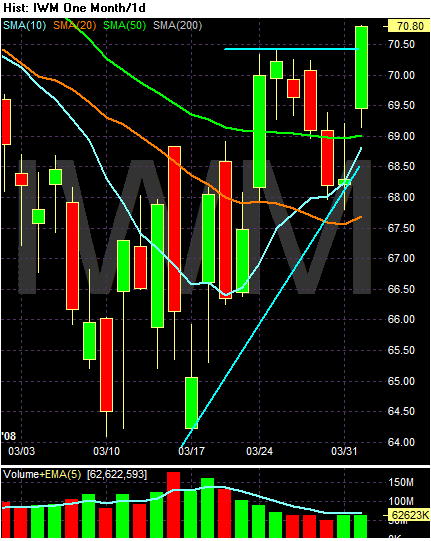


Above is a month-long look at the IWMs. Notice the following:

-- The 50 day SMA has smoothed out.

-- The 10 day SMA is about to move through the 50 day SMA

-- Prices have moved through all the SMAs

-- Prices are in a clear uptrend

1 comment:

pft said...

The current crisis is related to the implementation of fair value accounting on Class 3 assets that had to be brought onto the companies balance sheets. These have been accounted for and are on the balance sheets now, for the most part anyways.

The downside is it caused some massive writedown that created a capital cruch as they were moved ontto the balance sheets.

The upside, is the models used to estimate valuations are so complex and will not be able to be challenged by accountants, as they have no market. As such, they will be able to manipulate these on the upside, much like Enron did.

http://www.nysscpa.org/cpajournal/2006/1106/infocus/p14.htm

"Accounting theory is undergoing a major conceptual change, and the most recent manifestation—the application of Level 3 fair value accounting under SFAS 157—has the potential for widespread deception of investors."

"...the SEC handed Enron the tools to abandon traditional principles and introduce the bookkeeping analogue of financial engineering into nonfinancial companies. Enron eagerly applied the tools and soon began discounting to present value as much as 29 years of income from customer contracts. The result, after considerable manipulation, was instantaneous increases in assets and offsetting equity and, of course, income"

"What [accounting authorities (SEC, FASB, IASB)] do not appear to recognize sufficiently is that numbers that are likely to be manipulated by opportunistic or overoptimistic managers are considerably worse for investors than numbers that are not current. Consequently, the authorities have required fair values, at least for financial assets, even when they are not based on reliable market values.” "

Unless the companies designated accountants are "subjective valuation specialists", how will they be able to audit and contest the companies "models" of an assets worth when there is no market. They won't, and will just have to accept whatever garbage is given them.

Basically, the economy is in the pits, but creative accounting will be able to lure some investors in and perhaps induce an equity bubble
that will eventually be popped.

Sir Bubbles says, "bubble popping is fun! Must make new bubble, pop new bubble, goody!" We have bubble economy, it's all we can make now, just bubbles from the financial services industry.