Two years ago when gasoline prices in the U.S. surged to the then-lofty level of $2 a gallon, the Organization of Petroleum Exporting Countries sprang into action, seeking to provide relief by pledging to boost oil production.
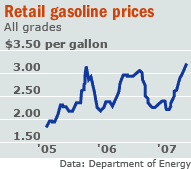
Now, with gasoline topping an average of $3.20 a gallon nationwide, OPEC officials say they see no reason to open the oil spigot wider.
OPEC's new attitude reflects a tug of war in the global oil patch over how the profits from a barrel of oil are divvied up between the world's producers -- which develop oil deposits and pump oil -- and its refiners -- which process it into fuels like gasoline.
In recent years, the balance in the world's oil-supply system has shifted, giving the refining industry more power and more profit.
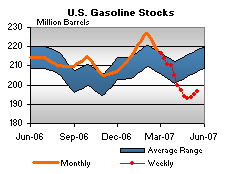
This time, OPEC says, the world has ample oil supplies. The cartel's members contend gasoline prices have climbed particularly fast in the U.S. because refining capacity is tight, imports from Europe are down, and U.S. inventories have tumbled.
This article highlights an interesting economic situation. The oil market (raw material) and the production market (refining) have "decoupled."
Let's review the US situation.
Gas prices have spiked over $3.00/gallon before the beginning of the summer driving season. Prices usually increase during the summer because of increased demand. However, this year we have high prices before the summer begins.
Supplies are down
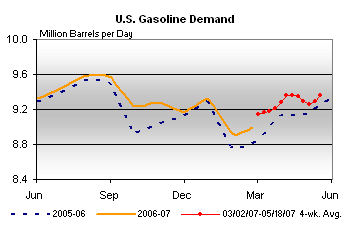
Demand is up:
This is a very bullish fundamental scenario. In addition, a few weeks ago we had a very strong technical picture in the oil market. Prices were in a three month long up-trend and prices had formed an ascending triangle formation -- a formation of higher lows indicating upward pressure building on prices.
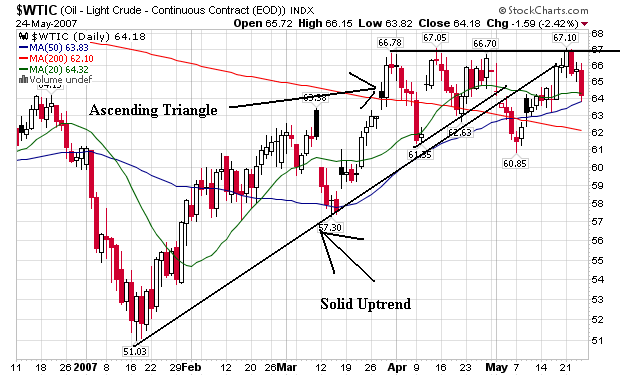
Yet oil prices dropped a few weeks ago and have again approached $67/barrel only to meet price resistance again.
The raw material of gasoline -- oil -- had two very strong reasons to rally higher yet didn't. Now -- it's possible oil will go higher. That is always a possibility. And prices have not crashed either. However, this statement appears to be very true now.
The cartel's members contend gasoline prices have climbed particularly fast in the U.S. because refining capacity is tight, imports from Europe are down, and U.S. inventories have tumbled.

