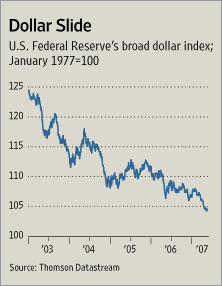
In what sense is that not a pretty picture? That's our best hope for avoiding a recession this summer ...
... and if we have a recession when bank balance sheets are vulnerable in the middle of the bursting of the mortgage bubble, that could be very painful indeed.
If we are going to have a recession, I would very much prefer it hold off as long as possible ... a recession in the middle of 2008 will not do as much damage as a recession this summer.
Why no little inflation? Actually, core inflation above 2% is one of the main things keeping the Fed from cutting interest rates to cushion the blow of the burst of the housing bubble.
And that inflation is not driven by wage-cost inflation ... with unemployed labor hours certainly in excess of 7%, there are almost stagnant real wages, so with any productivity gains at all, average wage costs will be falling. Imported cost inflation is one source of that core inflation.
Flipping that chart over into a direct exchange rate, that is an effective foreign cost inflation of about 4.2% annually ... with imports representing about 1/5 of the economy, that could easily account for about 0.9% inflation annually.
My tax practice is centered around captive insurance. I'm the author of the book U.S. Captive Insurance Law (which is also available on Kindle), the leading book in the field. You can learn more about captive insurance at my website.
I'm on Linked In and Twitter (@captivelawyer). Silver Oz's Linked In name is @silver_oz. NDD is a fossil and may be reached by etching a picture in stone on the wall of a cave.
The Bonddad Economic History Project
At the beginning of 2012, I decided to start looking at the actual, statistical history of the US economy starting in 1950. The reason is simple: to find out what really happened. So, when you see title of a post that begins with a year such as 1957, followed by "employment" or "Fed policy: you know what it's for. You can also access the information by typing in BE for Bonddad econ and a year to find information on a particular year.
Here is a link to pages that contain links to all the posts on the years listed.
This blog contains opinions and observations. It is not professional advice in any way, shape or form and should not be construed that way. In other words, buyer beware.
5 comments:
In what sense is that not a pretty picture? That's our best hope for avoiding a recession this summer ...
... and if we have a recession when bank balance sheets are vulnerable in the middle of the bursting of the mortgage bubble, that could be very painful indeed.
If we are going to have a recession, I would very much prefer it hold off as long as possible ... a recession in the middle of 2008 will not do as much damage as a recession this summer.
If you are a manufacturer, selling product overseas and competing in the US market with foreign competitors, that graph looks like a god-send.
Question - why no inflation?
(I mean on the things they call inflation -- not the health care, housing and gas prices that are eating people alive.)
Actually, that chart has been very nice to those of us who are heavily invested in Europe!
Why no little inflation? Actually, core inflation above 2% is one of the main things keeping the Fed from cutting interest rates to cushion the blow of the burst of the housing bubble.
And that inflation is not driven by wage-cost inflation ... with unemployed labor hours certainly in excess of 7%, there are almost stagnant real wages, so with any productivity gains at all, average wage costs will be falling. Imported cost inflation is one source of that core inflation.
Flipping that chart over into a direct exchange rate, that is an effective foreign cost inflation of about 4.2% annually ... with imports representing about 1/5 of the economy, that could easily account for about 0.9% inflation annually.
Post a Comment