Friday, April 6, 2007

Dallas Fed Report On the Economy

The Dallas Fed has released a report called National Economic Update. I think it's a very good piece on the economy's current status.

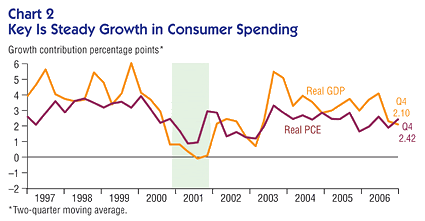
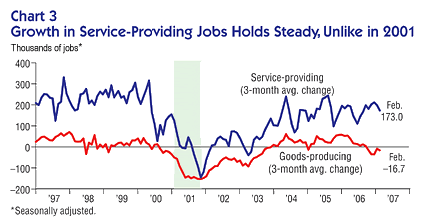
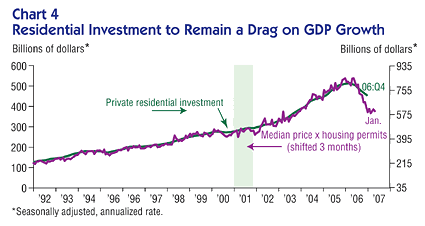
Here's the short version. Overall investment is down. Yet job growth in service industries is providing the consumer with enough money to continue spending. So long as job growth and wages continue to increase, the chances of a recession are low.

However, we don't know if the drop in investment and mortgage market problems will spill over into the larger economy.

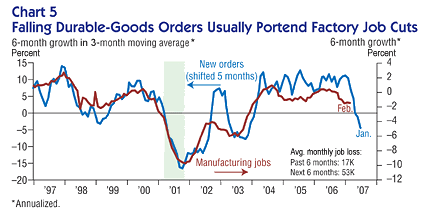
The last chart deals with manufacturing jobs and whether the drop in durable goods orders will lead to cuts in manufacturing jobs. Here is a counter-argument. Manufacturing employment hasn't grown during this expansion. That could mean there just isn't that much fat to cut from manufacturing payrolls. Here's a chart of seasonally adjusted manufacturing employment for the last 7 years.
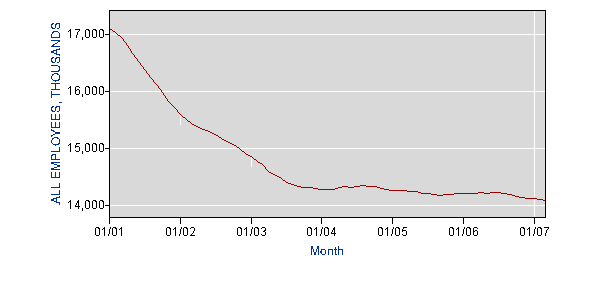
Photo Sharing and Video Hosting at Photobucket

The following charts detail the Dallas Feds report.
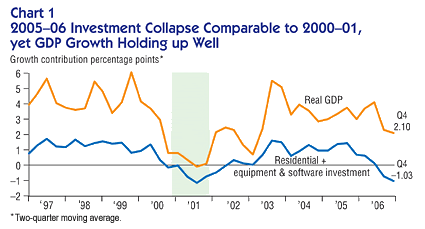
Photo Sharing and Video Hosting at Photobucket

Photo Sharing and Video Hosting at Photobucket

Photo Sharing and Video Hosting at Photobucket

Photo Sharing and Video Hosting at Photobucket

Photo Sharing and Video Hosting at Photobucket

2 comments:

VizierVic said...

Looking at all of those charts in total does not present a pretty picture looking forward. All of the signals, except service industry hiring, portend recession - in fact a severe recession. What saved the economy from the 2000-2002 downturn was the reflation in the economy provided by the Fed. That's not gonna happen this time. So, what happens now - with a sagging real estate market, the albatross of a war around the nation's neck, and oil prices headed higher? It looks like it's time to invest in sin stocks.

BruceMcF said...

Saying "so long as job growth continues, recession is unlikely" is like saying, "so long as we stay on the road, we are unlikely to hit a tree".

That is, for the vast majority of trees that are not in the road, you have to leave the road first, in order for the tree to collide with your car.

Unemployment leads recession, but they are both caused by the same things. And with the leading economic indicators down for the second month in a row, if we get a third negative reading, then we can expect first unemployment to rise and then recession to follow.

And, after all, one of the limited number of indicators rising was non-defense capital investment, and is one of the most volatile sources of economic growth that we have. If a sufficiently large number of firms experience "temporary lags" in demand that cause them to postpone investment spending in a "wait and see" attitude, that in an of itself will increase the slack in other industries and push more of them into a "wait and see".

"Make no major changes, wait and see" on the consumer side means a slowdown but not a collapse in consumer spending. On the business side, going ahead with a major investment project is a major change, and "Make no major changes, wait and see" means a collapse in business investment in productive plant and equipment.

If the leading economic indicators firm up in pointing to a recession, we can expect that business investment in productive plant and equipment will decline. In that case, the only thing that will keep the economy out of a slump will be a strong positive intervention from another major growth driver. However:
* with government deficits already high, and much of that deficit being spent overseas, further stimulus from that direction seems unlikely;
* the main consumer investment in productive plant and equipment is residential investment, and that is in the middle of a post-bubble collapse;
* so exports are the only remaining growth driver in view.

Of course, with such heavy reliance on imported industrial inputs such as energy, any substantial and rapid reduction in the value of the dollar will have the short term effect of making the current account deficit worse, since costs of imports will rise more rapidly than volume of exports expands and volume of imports contracts.

So it would require a slow, steady decline in the value of the dollar ... in the parlance, a "measured" decline ... to a substantially discounted level to generate positive impacts during the decline and then more substantial positive impacts after the decline is completed. And with the current state of the White House and executive branch in general, it seems highly unlikely that a measured decline in the value of the dollar can even be identified as the means to short-circuit a threatened recession ... let alone that if they identify that as a desireable policy that they could actually pull it off.