Showing posts with label savings. Show all posts

Tuesday, March 8, 2011

An update on savings and growth

- by New Deal democrat

Early last week January savings and spending were reported. I haven't updated those graphs in awhile, so this is a good opportunity to do so.

To begin with, on a real, inflation adjusted basis, Americans saved more money at the bottom of the Great Recession than at any time since World War 2:
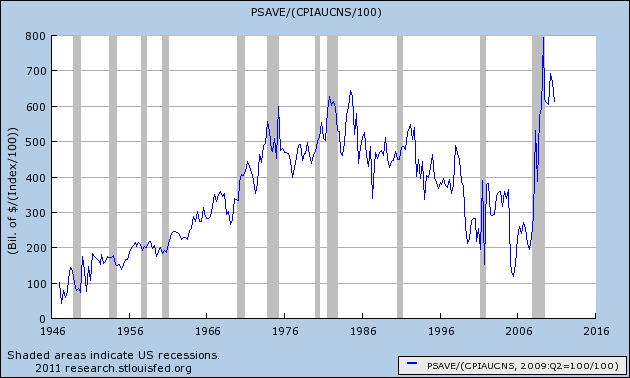


As you can see, some of that savings has been spent to fuel the recovery so far, but most of the accumulated savings - as much as at the end of the 1980-82 recession - is still available.

Amercians' relative newfound frugality can be seen in this update graph of the savings rate as well:
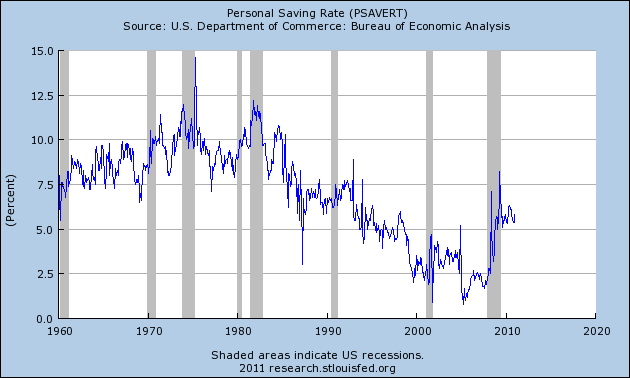


This has been trending sideways for over a year and a half, and from the longer term point of view, is a good thing.

Yesterday I pointed out that job growth in 2010 tracked real GDP growth (red) more closely than real retail sales (blue). Which means that the two series have diverged more than usual, as you can see here:
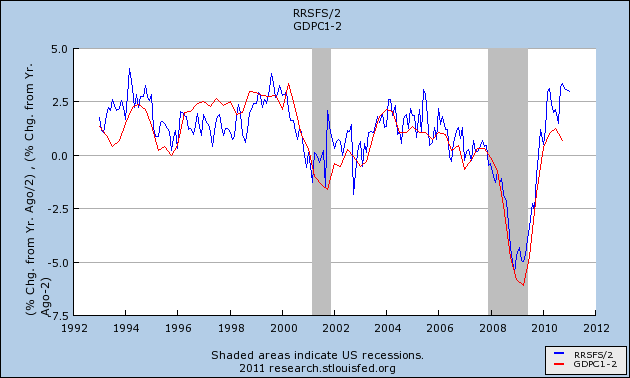


So, how will the divergeance get resolved? Back in August of last year I began keeping track of the real, inflation adjusted personal savings rate, and updated that view in November. Here is how the relationship between the real personal savings rate (blue) and real GDP (red) stands now:
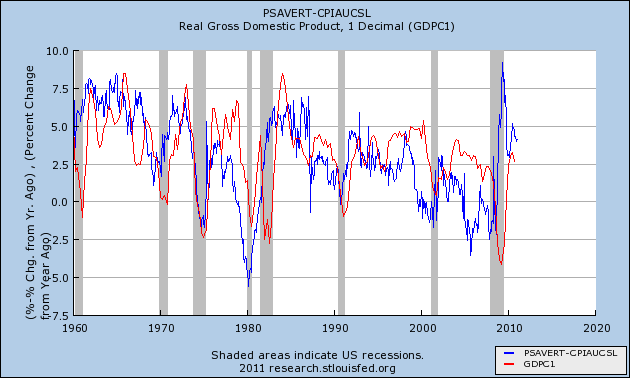


As I said then, the reason for keeping track of the relationship is that as can be seen in the above graph, a substantial change in the real personal savings rate is mirrored by a similar substantial change in real GDP about 6 to 18 months later. Subtract 2% from that change in real GDP, and you have a reliable prediction of the change in jobs growth and the unemployment rate another 6-12 months after that. The logic of this isn't hard to follow: increased savings serve as the "tinder" that ignites subsequent spending. That spending leads to growth, and then that growth leads to the creation of jobs.

Thus an increase in savings is a "long leading indicator" for employment in a range of 18 to 30 months later. We are now about 21 months past that peak increase in savings, so this relationship predicts further increases in YoY job growth in 2011. As I pointed out back in November, "subsequent GDP increases are generally similar to the precursor real personal savings rate -- which has been above 5% for much of the last 18 months. Which means that an unemployment rate significantly under 9% by the end of 2011 is quite doable."

The dramatic drop in the unemployment rate in the last three months bears that out. Put another way, the high "real personal savings rate" argues that the divergence between real GDP and real retail sales will be resolved towards the higher indicator - which also suggests continued robust jobs growth.

Tuesday, January 6, 2009

The "Paradox of Savings"


This is a video I did for a show called "Meet the Bloggers." It highlights one of the central problems of the US economy: we consume at massive rates at the expense of savings.

Here is a chart from the St. Louis Federal Reserve of the personal savings rate:


Click for a larger image

Notice it has been declining since the early 1980s. Let's coordinate that data with this chart of household debt:


Click for a larger image

This chart has been increasing for some time.

And finally, here is a chart of consumer debt payments as a percent of disposable income:


Click for a larger image

This number has been increasing since the early 1990s.

Usually an increase in the savings rate is a good thing. But not now:

Usually, frugality is good for individuals and for the economy. Savings serve as a reservoir of capital that can be used to finance investment, which helps raise a nation's standard of living. But in a recession, increased saving -- or its flip side, decreased spending -- can exacerbate the economy's woes. It's what economists call the "paradox of thrift."

U.S. household debt, which has been growing steadily since the Federal Reserve began tracking it in 1952, declined for the first time in the third quarter of 2008. In the same quarter, U.S. consumer spending growth declined for the first time in 17 years.

That has resulted in a rise in the personal saving rate, which the government calculates as the difference between earnings and expenditures. In recent years, as Americans spent more than they earned, the personal saving rate dipped below zero. Economists now expect the rate to rebound to 3% to 5%, or even higher, in 2009, among the sharpest reversals since World War II. Goldman Sachs last week predicted the 2009 saving rate could be as high as 6% to 10%.

As savings increase, economists say, spending is likely to contract further. They expect gross domestic product to decline at an annualized rate of at least 5% in the fourth quarter, the biggest drop in a quarter-century.

"The idea that the American family will quickly spend us out of this recession is a fantasy. It won't happen," said Elizabeth Warren, a professor of law at Harvard University who last month was named chair of the Congressional oversight panel tasked with overseeing the distribution of the government's Troubled Asset Relief Program funds.


BUT consider this:

The flaw of looking at savings as undercutting spending and deepening a recession is that it looks at the beginning of the down cycle and not what helps bring about the end.

As prices of everything from cars to housing fall, the money which has been taken out of wages and put into savings to reduce credit balances is available for purchases. Items get so inexpensive that consumers are drawn back into the market. But, drawing them in depends on their ability to capitalize on weak demand and falling prices. A tax cut and stimulus package will increase that ability geometrically.

The trend toward savings may be bad this year, but it may be a salvation in 2010.