Except that we had the exact same sudden and significant increase in first time jobless claims during the exact same two weeks last year, as is shown in the below graph which highlights April through June last year and claims since April 1 of this year in red:
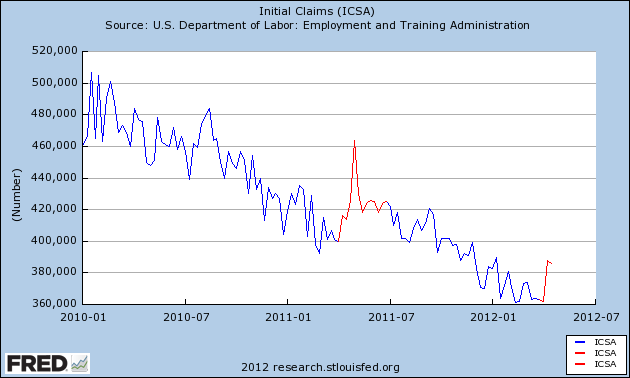
That suggests that the our recent non-winter winter is not the reason for the difference.
Another suggestion has been that the BLS's seasonal adjustments were thrown off by the pattern during the severe recession, causing first quarter adjustments to bee too low, and second quarter too high. While that may be true, the BLS just a few weeks ago revised the entire series back several years to deal with that exact issue. Also, as the above graph shows, there was no significant increase in Q2 2010.
I propose another explanation. It may well be that the seasonal increase in gasoline prices from January through May or June of both last year and this year to nearly $4 per gallon, thereby tightening the choke collar on the economy, is reflected in an increase in layoffs. In other words, this is a new seasonal pattern that is only showing up in those years where the seasonal increase in gas prices sufficiently tightens the Oil choke collar -- as in 2008, 2011, and 2012.
If my speculation is correct, we will see a pattern very much like last year. Once gasoline prices begin to decline seasonally after midyear, the Oil choke collar will be loosened again, and layoffs will again decline.


4 comments:
Do we have such short memories?
The big spike last year was caused by supply chain disruptions from the Japanese earthquake. And this was not just in the auto industry, the disruptions were felt across many industries.
Well that's why it was so much bigger than this year's
"Do we have such short memories?
The big spike last year was caused by supply chain disruptions from the Japanese earthquake. And this was not just in the auto industry, the disruptions were felt across many industries."
No sh*t. Except most people have vivid memories of the seasonal market collapses of the last two springs...So that means that May must/is guaranteed to be a down month, no way around that, right?
I agree with NDD's description of the overall trend. The specifics will depend on (a) how long this oil price spike continues for, and (b) how much damage it does. The latter question will be answered in part in the next BLS jobs report early next month. As for the former, it's tentatively looking like gas prices are declining now, but too early to say. We may already be at the point where speculators are selling off, so there's cause for at least cautious optimism.
Overall, I'm leaning towards predicting that the oil damage this year will be somewhat less than last year. I'll reserve judgement on this until we've seen the BLS report in early May. However, I'm tentatively optimistic that the economic recovery may be more resilient against oil damage this time around.
Post a Comment