Tuesday, July 7, 2009

Today's Markets

Take a look at all the charts. The short version is the correction is now here. Prices on all the indexes have fallen through important technical levels. The only thing preventing a serious fall is the QQQQs which are at the 200 day EMA. And frankly, I don't expect that level to hold.


More on Umployment

There was more good and bad news in Friday's employment report.

First the good news


The number of people unemployed for less then five weeks is clearly on a downward path. That's good. However


The 5-14 weeks number is still increasing as is


The 15-26 weeks and


The 27 and greater weeks.

Here's what I think is happening. The longer unemployment times are structural issues. For example, construction workers who are going to out of work for some time because of the low level of housing starts etc... But the decrease in the shorter time is a very good development and indicates the longer term unemployment picture may approaching its worst level.

ISM Up

From the Institute for Supply Management:

The NMI (Non-Manufacturing Index) registered 47 percent in June, 3 percentage points higher than the 44 percent registered in May, indicating contraction in the non-manufacturing sector for the ninth consecutive month, but at a slower rate. The Non-Manufacturing Business Activity Index increased 7.4 percentage points to 49.8 percent. The New Orders Index increased 4.2 percentage points to 48.6 percent, and the Employment Index increased 4.4 percentage points to 43.4 percent. The Prices Index increased 6.8 percentage points to 53.7 percent in June, indicating an increase in prices paid from May. This is the first time the index has registered above 50 percent since October 2008. According to the NMI, six non-manufacturing industries reported growth in June. Respondents' comments continue to be mixed and tend to be industry- and company-specific about business conditions."


Here's a chart:


Notice the index has been in an uptrend since October of last year. While the number is still below 50 and therefore still in a contraction it has been slowly inching its way into positive territory.

Here are the anecdotal comments from the same report:


  • "Business has improved and holding steady." (Arts, Entertainment & Recreation)
  • "Activity level is flat. Clients are delaying capital spending decisions." (Professional, Scientific & Technical Services)
  • "Economy may be stabilizing. Second half looks more positive than first half." (Information)
  • "Have begun spending government stimulus funding, and expect conditions to gradually improve in the near future." (Public Administration)
  • "Occupancy levels continue to increase at a slow pace." (Accommodation & Food Services)
  • "Activity is still slow and little has changed since last month." (Wholesale Trade)


Simply put, this is an improving series and adds further evidence that the worst is over.

Rail traffic update

- by New Deal democrat

Several weeks ago I took a very prominent blogger to task for making use of a 13 week moving year-over-year average of rail traffic data, comparing data from mid-March to mid-June 2009, to that of mid-March to mid-June 2008, to claim that rail traffic was "horrible" and "13-week moving averages are still moving lower, with no apparent end in sight."

In other words, this blogger was taking a very lagging trend and using it to predict worse coincident data in the future.

I countered that the 4 week moving averages of present traffic were a far more reliable statement of the present, and could portend a rise in the future, saying "It is certainly too soon to say that is a trend, but it could be the beginning of one, and if that is the case, then the lagging indicator of the 13 week year-over-year average cited by that prominent blogger will abruptly begin to rise - a couple of months from now."

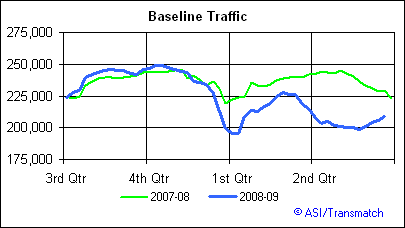
Well, the present trend has continued. Look at the following graph of baseline rail traffic (all graphs reposted from Railfax), showing a clear increase in the last couple of months (note to gloomsters, this is not a second derivative "less worse" statistic, it is an absolute "better" number):


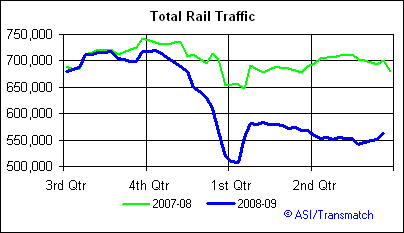
and here is the same 4 week moving average for total traffic (which also includes cyclical and intermodal cars):


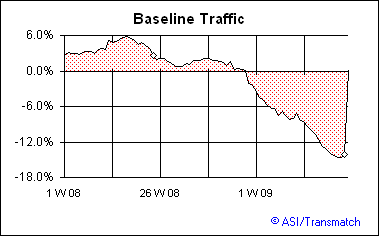
And lo and behold, look what has just happened to the 13 week year over year moving average of baseline rail traffic: it has just started to rise.


No guarantees of course, but if leading indicators are correct, the coincident indicator of rail traffic should continue to improve, and in that case not only will the 4-week moving average continue to improve, but baseline rail traffic this year could actually surpass last year's activity in a couple of months.

The use of badly lagging data to project trends into the future is endemic in the economic blogosphere. Just yesterday I read another very prominent economic post that consisted almost entirely of projecting year-over-year percentage changes into the future to foretell economic Armageddon -- a classic case of driving by looking in the rear view mirror.

Treasury Tuesdays

Click on all images for a larger image


The longer end of the curve has been rallying for about a month. However, prices are just now starting to cross the upward sloping trend line. Also note that prices ran into upside resistance at the 50 day EMA. Also note the declining volume as the rally progressed -- which is not a good sign. However, the 10 and 20 day EMA are still rising and prices are still above the shorter EMAs.
The shorter end of the curve is (so far) consolidating gains below the the 50 day EMA. But like the TLTs, prices are getting squeezed between the shorter and longer EMAs, indicating something will have to give soon.

Monday, July 6, 2009

Today's Markets

Click for a larger image


The head and shoulders is about done. It is possible the right shoulder could continue for a bit. However, the most obvious direction from here is down. Not good.

About the Jobs Report

There was a lot of ink spilled about Friday's jobs report. According to most it was a sign the economy isn't getting better and that we're all going to hell. However, let's take a look at a few points.


The trend of job losses was positive until Friday's report -- we had four consecutive months of decreasing losses. That makes Friday's report an outlier.


The 4-week moving average of initial jobless claims is still declining (although from high levels)


The Challenger job cuts report is still moving lower and


The rate of seasonally adjusted mass lay-off events and initial claimants is decreasing.

So, so far Friday's report looks like an outlier. Now, if we have a few more reports like that then we have an issue. But not until then.

Just "Shoot" Me Part II

This is from Invictus

Those who may have followed my work over at Blah3.com for the past few years know that I have the utmost respect for ex-Merrill Lynch economist David Rosenberg. The reasons are twofold – Rosie always calls it as he sees it and he peels the onion many layers – not just one or two – to expose data and trends that aren’t apparent to the casual analyst or economist (the analogy’s a good one, since what he uncovers often does make me cry). Therein lies Rosie’s true genius. You can expect that I will continue to make reference to his outstanding work as I participate here with Bonddad.

His recent work continues that pattern, and much of what appears below is based on some of Rosie’s recent writings.

First, let’s look at a stat that has gotten widespread attention (not a lot of sleuthing required to uncover this one): the savings rate (as percent of Personal Disposable Income).


The repair of Americans’ balance sheets (following unprecedented wealth destruction via stock market and real estate declines) is going to require ongoing increases in the savings rate. This trend is underway, and will continue for some time to come.

In addition to replenishing their diminished savings, Americans seem to have concluded that, at least for the time being, less debt is better than more debt, as this chart attests:


(Data: St. Louis Fed, Series TDSP)
While Americans are saving and paying down debt, it appears they will likely be spending less. Here is a graph of Personal Consumption Expenditures (PCE) on a year-over-year percentage basis:


Year-over-year PCE has gone negative for the first time ever.

So consumers are truly hunkering down, saving more and spending less. If they are to spend more at some point (and not just tread water on essentials), either incomes will likely have to rise or balance sheets will have to be sufficiently repaired through continued savings. (Those who argue that the government should similarly tighten its belt always seem at a loss to explain how the economy will grow if no one – consumers, states, municipalities, federal government – is spending money, but that’s another story, I guess.)

So how does income look? Here is one component of BEA’s Personal Income release – Line 3 of Table 2.6, Wage and Salary Disbursements (shown in YoY Pct change):


The bottom line is that wage deflation is no longer something to be feared down the road – it’s here right now.

Well, you ask, if wages and salaries aren’t rising (which they aren’t), is there a component of Personal Income that is rising? Yes, there is – it’s Government Transfer Receipts (shown as a Pct of Income):


Wages and salaries going down. Government transfer receipts going up. Is this a recipe for renewed consumer spending growth? Are the people who are earning less going to be spending more? Are people who are receiving assistance from the government going to be using said assistance for discretionary purposes? I think the answer to all three questions is a resounding “no.”

Perhaps the most interesting piece of work Rosie produced recently was an analysis of how many unemployed individuals we currently have for each job opening. Rosie looked at the Job Openings and Labor Turnover Survey (JOLTS) data from the BLS and the number of unemployed (also via the BLS). Here’s what that ratio looks like:


Rosie refers to this as “The Truest Picture of Excess Labor Supply,” and it’s hard to argue with that description. The Household Survey reports about 14 million unemployed, and the JOLTS reports about 2.5 million current job openings. Scary stuff.

There are many secular – not cyclical – cross-currents rippling through the United States right now. Much of what is happening is going to have long-lasting effects on what our economy looks like (see the July 5th NY Times for a story titled “Say Hello To Underachieving,” a cautionary tale about how even summer internships have dried up).

I mentioned previously that I hope to do some work on how our demographics will continue to have a negative influence on what our economy looks like going forward. Stay tuned for more on that.

Market Mondays

Welcome back from a long weekend. I wish I had better news. However, the market looks poised for a correction. Consider the following:


The MACD has been falling as the SPYs made new highs. That is never a good technical development. And, notice the SPYs are in a clear head and shoulders trading pattern -- and that we are in the middle of the right shoulder.


Also note that as the market made new highs the on balance volume didn't increase at all. That tells is that the new highs were made on less than strong volume.

Consider these charts of the other large averages:


On both charts the MACD was declining as the markets were making new highs. These types of technical divergences tell us the probability of a lower market is pretty high.

According to Stockcharts performance analysis, the two best performing market sectors over the last half year were the XLBs and XLKs. Consider these charts:


Like all the major averages, the XLBs have seen a declining MACD. In addition, we also have a declining RSI.


And the XLKs also have (you guessed it) a declining MACD.

There are a lot of big technical divergenses in the market right now -- not only in the averages but in the biggest moving sectors of the year. That tells us the probability of trouble ahead it pretty high.

Saturday, July 4, 2009

The State of the Economy, Independence Day 2009 (II. and III.)


- by New Deal democrat
In this "Big Picture" look at the economy as of Independence Day 2009, I argue that:

1. Right now, production and consumption in the economy are stabilizing, but job losses and unemployment continue to accumulate at an alarming level, with wages perilously poised to enter deflation soon if matters don't turn around quickly.

2. Three out of the five long term imbalances in the economy have made great strides toward an improved equilibrium, completing most of the necessary adjustment. On of the other two is improving temporarily, but probably not in the long term yet. The final one is as bad or worse than before the Recession began.

3. Despite much bad current news, and in particular the poor jobs report on Friday, Leading Economic Indicators will most likely have their third month in a row of substantial gains for June when reported later this month, suggesting that the Recession will bottom around Labor Day, give or take 2 months. A second long-established and highly-regarded private source suggests recovery is imminent, while a Third suggests renewed weakness.

4. The biggest threat to the beginning of GDP growth and a decrease in the misery of average Americans is the "Fifty Little Hoovers" of balanced state budgets, and in particular the disaster that is California. There is one specific policy that I believe the Obama Administration should enact and implement immediately.


Parts I and IV of this series can be read at The Economic Populist

II. The Recession is at least bringing about the necessary readjustment in 3 of the 5 long-term economic imbalances

We are going through a very painful period. But at very least there is the silver lining that usual market forces are working to rectify some very long-term unsustainable imbalances about which many have warned for several decades.

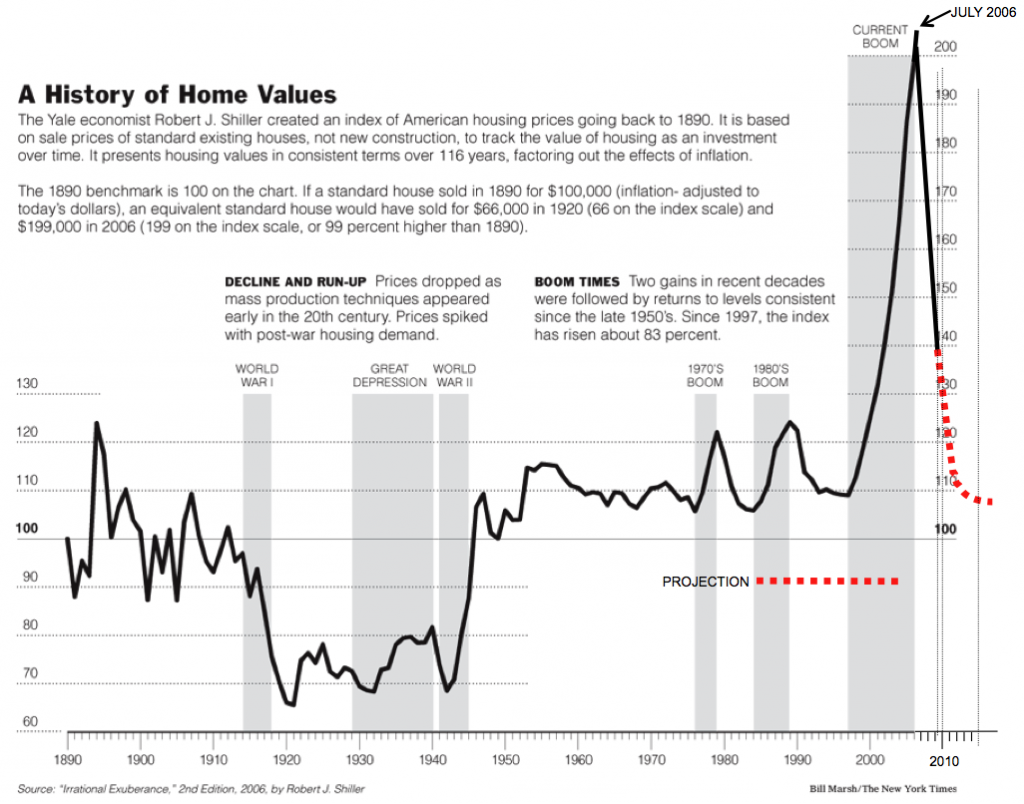
1. Housing prices are returning to their normal long-term equilibrium as indicated in this update graph covering 100+ years of home prices (h/t Stever Barry via Barry Ritholtz):

Affordability metrics have never been more favorable. The "Housing Affordability Index divides the price of the median house with that of a regular 20% down mortgage available to a household with the median income):

As Bonddad says, "Housing is Nowhere Near a Bottom" at least in price, but the bust is working through the problem.

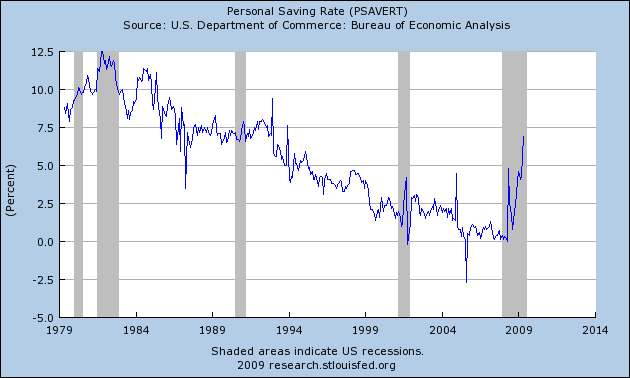
2. The mirror image for the declines of consumption graphed in Part I above is the household savings rate. This had been at 0% during the last few years, but has abruptly increased to nearly 7% as of last month:

This is about 3/4 of the way to the normal, pre-bubble rate of 8%-9%. There is undoubtedly some further rebalancing to go, but most of the adjustment here has already been made by consumers. This bodes well for a pick-up of consumption if it is sustained and if consumers gain more confidence about the future.

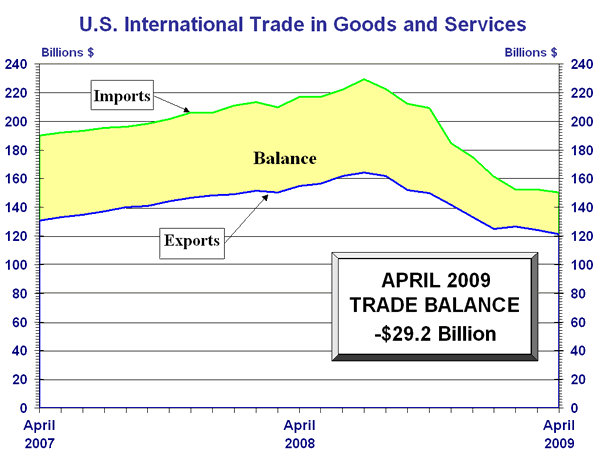
3. The trade deficit has shrunk dramatically. The two biggest imbalances in the deficit have been Oil and China. Both of these still exist, but both have shrunk, as shown by this graph:

Of all of the deficits, the trade deficit is the one that is most crucial, as it acts as a drain on the entire US economy, transfering wealth from us to China and Petrosheikhdoms. Much more needs to be done here, but at least market forces are working the way they are supposed to.

If the above three imbalances are shrinking, two others are problematical, and one of them has been exacerbated in a way that is dangerous to our future if not properly addressed as soon as circumstances permit:

4. In 2006 the Congressional Budget Office reported record disparity in incomes:
Typically in a recession, the stock and housing portfolios of the wealthy have been hard hit, temporarily reducing that inequality as shown in the below graph showing the effects of the 2001 recession:

There is every reason to believe that the same reduction has taken place in this recession -- a dreary reduction of inequality solely because wealth across the board has declined, but relatively moreso for the wealthiest -- but as recent record payouts at Goldman Sachs demonstrate, CEO and financial sector pay continues to be a blight of inequity on our society.


5. Finally, the deficit and the national debt have exploded.

While this may be a temporary necessity as a response to near-depression like circumstances, we are running out of room, as the Chinese attempts to relegate the dollar to former reserve currency status are showing. If all of the stimulus and bailout money goes to waste, or to Wall Street, we will have spent our way into a long-term spiral of Latin American style decline. Paul Krugman has argued that it is important not to return to balanced budgets too soon, but certainly once the danger has passed, this must be a very high priority. If it is not done, the next 30 years will likely see a slow inexorable climb in interest rates choking off any meaningful economic growth.


III. Despite the continued gloomy employment and unemployment data, Leading Economic Indicators still look poised for expansion

The Index of Leading Economic Indicators, with a 5 decade history, was formerly kept by the Commerce Department until its computation and makeup was outsourced to the Conference Board about a decade ago. The 10 indicators, with the weights given each indicator, are as follows:

- real money supply (35%)
- average weekly manufacturing hours (25%)
- interest rate spread (10%)
- manufacturers' new orders for consumer goods (8%)
- supplier deliveries (7%)
- stock prices (4%)
- consumer expectations (3%)
- building permits (3%)
- average weekly initial claims for unemployment insurance (inverted) (3%)
- manufacturers' new orders for durable goods (2%)

In April and May, the LEI surged more than 1% a month, coming within striking distance of breaking even year over year.
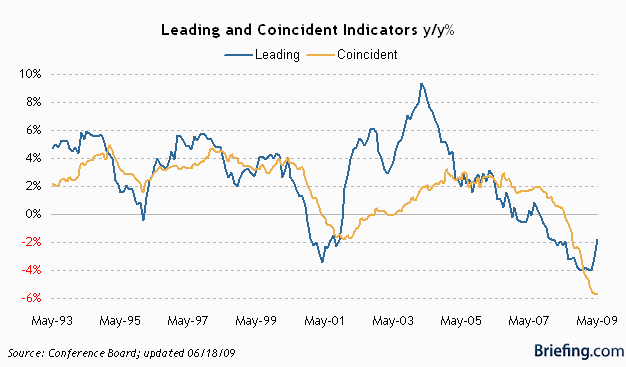
Although June's number won't be reported for several more weeks, we already know what by weight over 90% of the above will be! Real money supply was very strong at the end of last year, and generally has continued to grow slowly as the Fed continues to re-liquify (or re-solvenc-fy) the banking system. We won't know for sure until June's inflation report is in, but most likely this will be slightly positive. Given the uncertainty, I will count this as a neutral. Average weekly manufacturing hours, which had been dropping like a lead weight earlier this year, as reported above in Part I have stabilized and actually went up slightly in June. The yield curve is even more strongly positive than before, due to the backup in long term rates while short term rates are still essentially 0%. Manufacturers' new orders for non-consumer goods increased significantly as of the last report (which will actually revise May's report higher). Supplier deliveries as measured by the ISM continued to increase slightly. Stock prices (over the last 90 days) are still up, although not as strongly as last month. Consumer expectations about the future as measured by the U. of Michigan sentiment survey have gone sideways, decreasing slightly in June. Average initial claims for unemployment insurance were basically flat for the month, but the June average was a slight decline since May (fewer new claims is good). Manufacturers' new orders for durable goods were reported as surprisingly and sharply higher a couple of weeks ago (which should also revise May's report higher).

By weight, that's 55% positive, 35% neutral, and 7% negative. (Building permits, at 3%, haven't been reported). If I had to guess, right now it looks like June's LEI will be reported at ~ +0.8%. That will be three straight months of positive LEI, the traditional signal that GDP growth is very near at hand. If LEI simply go sideways for the next couple of months, the very bad readings of July and August 2008 will be replaced and year-over-year LEI will be positive. For that reason I believe that it remains the most likely outcome that the Recession will officially have hit bottom at about Labor Day (give or take a couple of months).

There are two other Indeces of future business condition indicators. On of them, the Economic Cycle Research Institute, has a history and database of over 100 years (meaning their reports cover the Great Depression and other deflationary busts before it). Here is their most recent report, as of last week:

A gauge of future U.S. economic growth stood unchanged in the latest week but its yearly growth rate climbed to an almost two-year high, reaffirming hopes that the grips of deep recession are loosening, a research group said on Friday.

The Economic Cycle Research Institute['s] ... annualized growth rate, which finally entered positive territory last week, spiked to just under a two-year high of 4.0 percent from its previous rate of 2.1 percent.

It was the growth rate gauge's highest yearly reading since the week ended Aug. 3, 2007, when it stood at 4.3 percent, bringing a solid end to its 22-month stretch in the red.

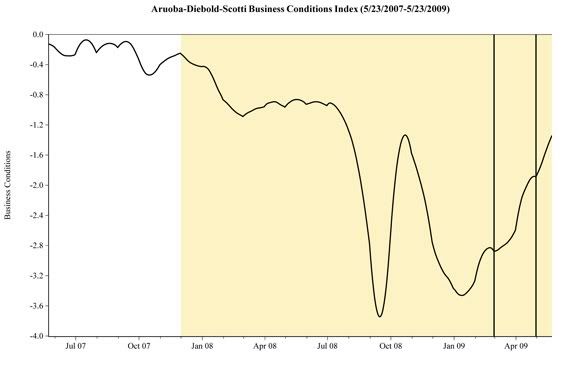
The other report, from the Philadelphia Fed, ijs a mixed leading/coincident index meant to reflect on-the-ground business conditions. This index was sharply revised, not just for the last week or month, but almost 4 months (which doesn't really make it "leading" anymore) based primarily on the July payroll data:

Here is how it looked as of Friday:
Per the Philly Fed, the Friday payroll number was entirely responsible for the downturn at the end.

Here is how it looked only a week before:
Needless to say, Friday's jobs report and the continuing new jobless claims are weighing heavy on this index. It is impossible to imagine any upturn beginning with 600,000 new unemployment claims week after week and 400,000 job losses a month. Which brings us to the concluding Part IV of this series.

Thursday, July 2, 2009

Weekend Weimaer and Beagle

The markets are closed tomorrow and I'm on vacation in New Orleans. I and the rest of the crew will be back on Monday. Until then -- have a safe weekend.

Oh yeah -- I'm using another computer so I don't have pictures of the kids for you.

Just "Shoot" Me

This post is from Invictus

David Rosenberg, ex of Merrill Lynch, now of Gluskin Sheff, really crystallized what the “green shoot” crowd is missing in his daily memo of June 29 (all emphasis mine):

Most pundits who crow about green shoots and about an inventory restocking in the third quarter giving way towards some sustainable economic expansion live in the old paradigm. They don’t realize, for whatever reason, that the deflationary aftershocks that follow a post-bubble credit collapse typically last for 5 to 10 years. Businesses understand better than the typical Wall Street or Bay Street economist and strategist that everything from order books, to output, to staffing have to now be restructured to adequately reflect a permanently lower level of leverage in the economy.

He followed that up with this comment on the 30th:

I still find that most sell-side analysts live in the old paradigm of a classic manufacturing inventory cycle as opposed to a deleveraging credit contraction cycle, which typically takes years to resolve in terms of transitioning to the next sustainable expansion and bull market. Many economists are excited because auto sales seem on the verge of testing 10 million units, on an annual rate, when replacement demand is closer to 12 million — nobody is making money at that level of auto sales.

Rosenberg is making a key point: This is not the type of recession we have become accustomed to in the post-war era, and consequently will not play out as others have. Compounding that fact – and on a topic I hope to explore further soon – our demographics, frankly, suck. The “baby-boom” generation – those born between 1946 and 1964, the “pig in the python” – now has a median age of around 52 and is not in a position to consume as they did in the 2001 recession (median age: 44) or the 1990 recession (median age: 33). This is why all the hoopla over the last ISM print –“Every time it’s passed ~42 on the upside, recessions have ended” – is misguided.

Okay. Having gotten that out of the way, I want to focus a bit on the “green shoots” – those tidbits of data indicating a slower rate of descent – versus the reality of what the National Bureau of Economic Research’s Business Cycle Dating Committee actually look at.

In its most recent recession announcement (Dec. 2008), the NBER laid out – very specifically – some of the metrics they look at, where they’re found, and in some instances how they’re calculated. So, without further ado, here’s what they are and what they look like (commentary follows):


FRB index B50001


BEA Table 1.1.6, line 1


BEA Table 1.10, line 1, divided by BEA Table 1.1.9, line 1


BEA Table 2.6, line 1 less line 14, both deflated by a monthly interpolation of BEA Table 1.1.9, line 1 (Note: I used a different method of deflation – the NBER’s “interpolation” is cumbersome – that is used by the St. Louis Fed, and I spoke to one of their reps prior to doing the calculation.)


BLS Series CES0000000001


BLS Series LNS12000000


Census series tbtsla, adjusted, total business, deflated by monthly interpolation of BEA Table 1.1.9, line 1 (Note: This was also deflated differently, but in keeping with the St. Louis Fed’s work.)


AWHI, though not specifically mentioned by the NBER, is watched closely by BCDC member professor Jeff Frankel. He has written about it several times at his blog. (Hours typically precede bodies, both to the upside and to the downside.)

In a nutshell, one metric – Personal Income less Transfer Payments (adjusted for inflation) – is flatlining. Not rising, just flatlining. That’s it. So, for all the “green shoots” and “less bad” releases we’ve seen of late, I don’t see much in the world of NBER data that’s cause for celebration. The NBER is interested in peaks and troughs, not flatlines. Until we start seeing some clear signs of troughs (i.e. metrics actually improve and don’t just flatline), I’m dubious of any claims that the recession has ended.