The stock market is trading right where it was nine years ago. Stocks, long touted as the best investment for the long term, have been one of the worst investments over the nine-year period, trounced even by lowly Treasury bonds.
The Standard & Poor's 500-stock index, the basis for about half of the $1 trillion invested in U.S. index funds, finished at 1352.99 on Tuesday, below the 1362.80 it hit in April 1999. When dividends and inflation are factored into returns, the S&P 500 has risen an average of just 1.3% a year over the past 10 years, well below the historical norm, according to Morningstar Inc. For the past nine years, it has fallen 0.37% a year, and for the past eight, it is off 1.4% a year. In light of the current wobbly market, some economists and market analysts worry that the era of disappointing returns may not be over.
Until last fall, many investors had viewed the bursting of the tech-stock bubble as a nasty but short-term setback. The market had resumed its upward march, reaching new highs in October. Then the credit crisis began weighing on stocks, as did the possibility of a recession. By March 10, the S&P 500 was down 18.6% from its Oct. 9 record close, nearing the 20% decline that signals a bear market. It has rebounded since then amid the Federal Reserve's efforts to stabilize the financial system, but it remains 13.3% below its October record.
Conventional stock-market wisdom holds that if investors buy a broad range of stocks and hold them, they will do better than they would in other investments. But that rule hasn't held up for stocks bought in the late 1990s or 2000.
Over the past nine years, the S&P 500 is the worst-performing of nine different investment vehicles tracked by Morningstar, including commodities, real-estate investment trusts, gold and foreign stocks. Big U.S. stocks were outrun even by Treasury bonds, which historically perform much less well than stocks. Adjusted for inflation, Treasurys are up 4.7% a year over the past nine years, and up 5.8% a year since the March 2000 stock peak. An index of commodities has shown about twice the annual gains of bonds, as have real-estate investment trusts.
This is a really good observation and it raises many troubling questions for the next 5-10 years.
While no one has a crystal ball that sees perfectly (or imperfectly for that matter) there is no denying that current economic conditions are terrible. Our current problems started with a massive real estate glut. Supply and demand are still massively out of whack (see this article) and will be for some time. Anyone who is calling a bottom in housing that occurs before the 4th quarter of this year is engaging in spin rather than analysis.
The real estate problems have infested the US financial system. Simply put, everyone jumped on the real estate bandwagon with the end result being that now everyone is hurting. And there is no reason to think this won't continue for some time. Economic problems are at the heart of the financial systems problems as more and more homeowners stop paying their mortgages or simply walk away because their home's price is now horribly below the total value of the mortgage.
And this is before we get to to heavily indebted consumer who is literally drowning in debt payments. The national government isn't doing much better and state governments are quickly making up for lost time.
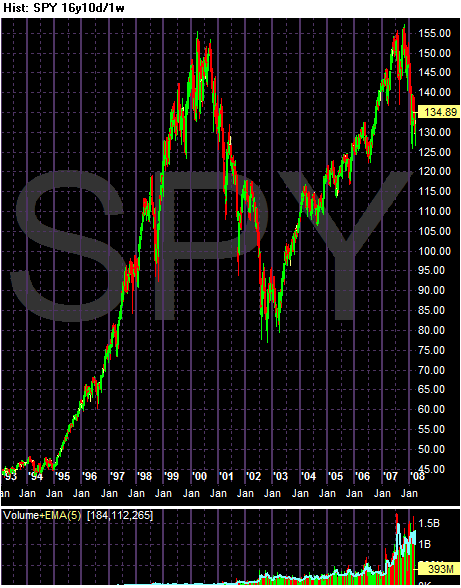
There are two charts the bolster the WSJ's points. Here is a 15 year chart of the SPYs. Notice we are clearly on the downside of a possible double top formation with the first top occurring in 2000 and the second occurring in 2007:
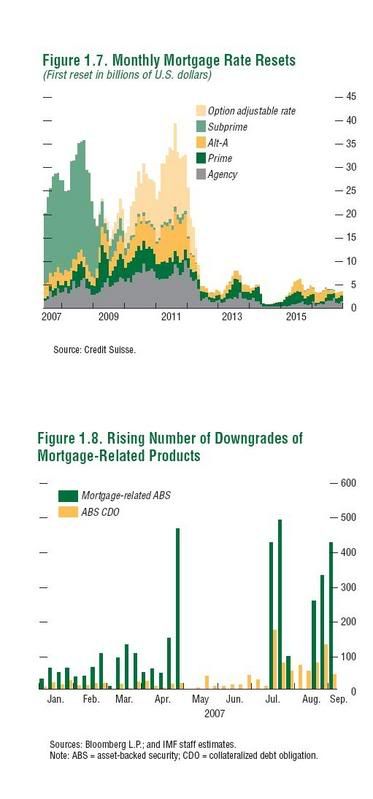
The second chart is the reset chart for the mortgage industry. Notice that we have a second wave of resets that starts in 2010! This means we could experience the exact same situation today that we're experiencing now.
I want to caution -- no one has a crystal ball and the above analysis is largely an extrapolation of current events to the future. But it's also important to remember the long-term chart formation of the SPYs is not good and the underlying fundamental economic backdrop is poor right now with very little positive news filtering through. In short -- things ain't that good right now.
5 comments:
Simply put, everyone jumped on the real estate bandwagon with the end result being that now everyone is hurting. And there is no reason to think this won't continue for some time.
This reminds me very much of 1988-89 in Phoenix (at the time of the infamous Barron's article, "Phoenix Descending" (December 1988)), when the Phoenix real estate market had completely crashed... and it took a couple years for that economy to work its way out of the darkness.
The important thing to note about ARM resets is that the rate cuts and reduction in LIBOR will save the ARM borrowers as the new rate will be very similar to the teaser rate. The Option Arm loans though cannot be saved by rate cuts. When the option arm loans reset, all of the options go away and the borrower must pay down the loan over the next 25 years. If borrowers were only making IO payments or minimum (neg-am) payments, they're in for major payment shocks that the fed cannot prevent.
WIth regard to the Option ARM resets on the chart, my understanding is that an Option ARM can reset a) at the date specified in the loan documents (usually 5 years) or b) when the limit to negative amortization is reached (which will happen in less than 5 years if the borrower makes only the minimum payment). I assume the charts are showing the scheduled reset, but I have read that most people using Option ARMs are only making the minimum payment. If that is the case the reset tsunami may be more like one really big wave rather than two big waves as shown in the chart. The downside of that scenario is the pain in the near term would be more intense, the upside is it might pass through the system a little sooner.
This article is technically discussing all the areas of current scenario in stock market following the recession in US and i want to add some more points into it.
What is 'Recession Proof'?
You can almost hear the wallets snapping shut. Folks are cutting back on their spending every way they can. According to those who know, we are either in a recession, or are about to be. I would hate to be trying to sell real estate or new cars right now. Talk about hitting your head against the wall. Ouch!
That got me to thinking of what businesses make sense during a recession. Certainly health care does. Baby boomers are going to need every kind of health care
imaginable. For all I know, economic bad times makes people sick too.
Other types of businesses that should be recession proof include vital home repairs, like plumbing, electrical, and roofing. Folks can't put off fixing a clogged toilet or a leaking roof just because they're a little short on cash.
And you know what they say about death and t.ax.es. A well-run funeral home or a tax consulting business shouldn't be hurt by an economic downturn.
But all these jobs require training, and even certification. And that takes time.
By the time you've learned one of these trades, the recession may well be over.
That got me to thinking about one business that's truly recession-proof, and you can get started almost immediately: Day Trading.
Day Trading refers to the buying and selling of stocks within the same trading day. I know what you're thinking: how can a day trader be successful when the stock market is down, day after day? Well, day traders profit from volatility - when there are big swings in stock prices, there is money to be made.
It used to be that Day Trading was only done by financial institutions with access to technology and information. Now, almost anyone with Internet access can become a day trader, if they know what to do.
Manny Backus
P.S. Learn a 'sleazy' trading technique used by a select group of traders to bank lucrative, net stock returns of $223.00, $476.10, $790.25 or more -- not in days or
weeks -- but in one easy hour or less! Click here:
http://www.firsthourtrading.com/
情趣用品,情趣用品,情趣用品,情趣用品,情趣用品,情趣,情趣,情趣,情趣,情趣,按摩棒,跳蛋,充氣娃娃,情境坊歡愉用品,情趣用品,情人節禮物,情惑用品性易購
免費A片,AV女優,美女視訊,情色交友,免費AV,色情網站,辣妹視訊,美女交友,色情影片,成人影片,成人網站,A片,H漫,18成人,成人圖片,成人漫畫,情色網,日本A片,免費A片下載,性愛
A片,色情,成人,做愛,情色文學,A片下載,色情遊戲,色情影片,色情聊天室,情色電影,免費視訊,免費視訊聊天,免費視訊聊天室,一葉情貼圖片區,情色,情色視訊,免費成人影片,視訊交友,視訊聊天,視訊聊天室,言情小說,愛情小說,AIO,AV片,A漫,av dvd,聊天室,自拍,情色論壇,視訊美女,AV成人網,色情A片,SEX
情趣用品,A片,免費A片,AV女優,美女視訊,情色交友,色情網站,免費AV,辣妹視訊,美女交友,色情影片,成人網站,H漫,18成人,成人圖片,成人漫畫,成人影片,情色網
情趣用品,A片,免費A片,日本A片,A片下載,線上A片,成人電影,嘟嘟成人網,成人,成人貼圖,成人交友,成人圖片,18成人,成人小說,成人圖片區,微風成人區,成人文章,成人影城,情色,情色貼圖,色情聊天室,情色視訊,情色文學,色情小說,情色小說,臺灣情色網,色情,情色電影,色情遊戲,嘟嘟情人色網,麗的色遊戲,情色論壇,色情網站,一葉情貼圖片區,做愛,性愛,美女視訊,辣妹視訊,視訊聊天室,視訊交友網,免費視訊聊天,美女交友,做愛影片
av,情趣用品,a片,成人電影,微風成人,嘟嘟成人網,成人,成人貼圖,成人交友,成人圖片,18成人,成人小說,成人圖片區,成人文章,成人影城,愛情公寓,情色,情色貼圖,色情聊天室,情色視訊,情色文學,色情小說,情色小說,色情,寄情築園小遊戲,情色電影,aio,av女優,AV,免費A片,日本a片,美女視訊,辣妹視訊,聊天室,美女交友,成人光碟
情趣用品.A片,情色,情色貼圖,色情聊天室,情色視訊,情色文學,色情小說,情色小說,色情,寄情築園小遊戲,情色電影,色情遊戲,色情網站,聊天室,ut聊天室,豆豆聊天室,美女視訊,辣妹視訊,視訊聊天室,視訊交友網,免費視訊聊天,免費A片,日本a片,a片下載,線上a片,av女優,av,成人電影,成人,成人貼圖,成人交友,成人圖片,18成人,成人小說,成人圖片區,成人文章,成人影城,成人網站,自拍,尋夢園聊天室
Post a Comment