Tuesday, May 29, 2007

Is This Really A Goldilocks Economy?

From IBD:

"This points to improving prospects for the economy in the second half," said Lakshman Achuthan, ECRI's managing director. He called the possibility of a recession this year "minuscule."

The index's rise stems from some healing in sickly manufacturing.

"Services were always holding up. But the industrial side is (improving) where it used to be a drag on the economy," he said.

Durable goods orders rose 0.6% in April, the third straight monthly gain. Core capital goods orders, a proxy for business investment, are turning higher again as well.

The ISM manufacturing index and industrial production also signal a factory rebound.

Achuthan characterized the current economy as "Goldilocks with blemishes," or one marked by moderate growth and expectations for moderate inflation.


Business investment has been slow for the last two quarters, coming in at a seasonally adjusted annual rate of -3.1% and 2%. While durable goods orders have increased, they are still at low levels. Here is a durable goods chart from Martin Capital. Notice where orders are in the cycle. It is just as possible for orders to drop from here as go up.
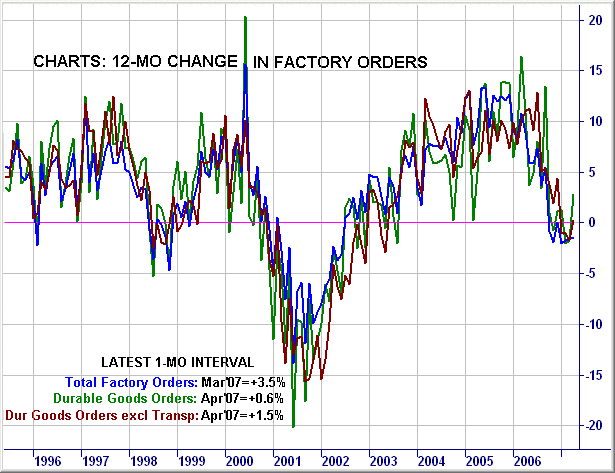
Photo Sharing and Video Hosting at Photobucket

Later in the article, the author makes the following observations:

Gasoline prices are already at record highs as the summer driving season kicks off.

But wages, a bigger factor for inflation, have risen less than expected for much of the year. Sustained productivity growth has kept anticipated inflationary increases mostly at bay, though efficiency gains are slowing


So far, consumer spending has been very strong. However, decreasing wages and increasing gas prices are a recipe for a slowdown in consumer spending. While we haven't seen a slowdown in consumer spending establish a trend, we saw a really bad April. And there is also the housing slump to contend with.

I am not a fan of the "Goldilocks" description. I think a better description is the "hanging on" economy. There are just enough positive developments to keep us out of recession. The key right now is consumer spending, which represents 70% of GDP growth. As previously mentioned, consumer spending has been solid so far. But with gas prices spiking before summer it's possible the consumer will come under increasing pressure for the next three months. This may be just long enough for the consumer to reign in spending enough to really impact GDP.

2 comments:

BruceMcF said...

I do want to point out what, to the naked eye, appears to be a tendency in that chart ... that when durable goods orders including transport move sharply away from durable goods orders excluding transport, the tendency is to reverse within a quarter.

This happens repeatedly, for both upticks and downticks, and when both are moving in the same direction as well as when they are moving in opposing directions or durable goods excluding transport is basically stable.

This is, after all, which durable goods excluding transport is the indicator to focus on, and it is almost exactly at +0% change ... additional confirmation of the "hanging on" thesis, especially with total factory orders 0 to negative for the past two quarters.

And as I would remind repeatedly, just because the possible growth drivers to avoid recession are few does not mean that they will not appear ... when I was in Australia, I saw the Australian economy "rescued" from recession three times within five years ... once due to a preceding loosening of consumer credit regulations, once due to a collapse in the Ozzie dollar exchange rate giving rise to a (relatively short lived) boom in non-traditional exports (for example, that was when the last two "Matrix" movies and one of the Mission Impossible movies were scheduled for filming in Sydney, at the same time as wine exports boomed), and once through a housing bubble in the capital cities, fueled by political competition between Labor at the state level and the Coalition at the federal level.

So it may be that only the external sector can step in to avoid recession ... but with a falling US dollar, it may well step in.

VizierVic said...

"...So it may be that only the external sector can step in to avoid recession ... but with a falling US dollar, it may well step in."

Brucemf, I agree with your basic premise that only an external sector could possibly salvage the US economy, but I don't see any sector (or even sectors) large enough to buttress the economy's slide. Most of the positive swings in US external sales revolve around transportation - big transportation - like aircraft. What the US economy can do to boost aircraft exports in the near term is already baked in the cake - the production slots are spoken for one way or another. Unless the US domestic auto manufacturers can spike export sales through creative finance or desperation, I don't see many domestic manufacturers who can significantly propel the US figures.