Powerline's writers suffer from the Dunning-Kruger effect: they are too stupid to know that they are, well, stupid when it comes to economics. If you search this blog for the word "Powerline" you'll see ample documentation that clearly demonstrates their economic incompetence. But two stand out for special mention.
1.) Powerline's entire economic analysis for 2014 was wrong. And I mean 100% wrong. That level of incompetence has to be developed and nurtured.
2.) A big reason why they're wrong? They rely on conspiracy websites for their economic numbers and analysis.
Now we have Steven Hayword stepping up to the plate with this deep thought on Brexit:
Likewise I think Britain will survive just fine or likely prosper (just as California boomed immediately after Prop. 13), and the EU might even consider laying off some of the 1,750 linguists, 600 full-time interpreters and 3,000 freelancers it uses to facilitate its meetings in Brussels and Strasbourg (because what good is a European parliament if you can’t have multiple locations), or even eliminating some of the many mid-level Eurocrats who have salaries higher than Prime Minister Cameron
Does Mr. Hayword offer any analysis -- as in numbers, facts or figures? No. It's all going to be better now because the UK has thrown off the yoke of their oppressive EU overlords.
So, given that Powerline is a great contrary indicator, I'm going to reassert my argument that Brexit is a colossal blunder of epic proportions. You can read my reasoning here. But, that article does have facts and figures, so it's probably way beyond what Powerline's writers could understand.
Monday, June 27, 2016
Bonddad Monday Linkfest

Daily Chart of the Europe ETF

Performance of US Equity Sectors for the Last Week and Month (FINVIZ)

Interestingly, this will help both Bank of England (BoE) Governor Mark Carney and European Central Bank (ECB) President Mario Draghi in their efforts to reach their inflation targets. A weak euro and a weak pound may also assist the terms of trade for Europe. But Brexit certainly has the potential to increase the friction of transacting with and within the United Kingdom and the EU, offsetting any benefit from a cheap currency.
5-year Chart of the Pound/Dollar

5-Year Chart f the Pound/Euro

5-Year Chart of the Euro/Dollar

The uncertainty of the situation and what comes next hit all markets in the wake of the vote, and emerging markets were not exempt, with the MSCI Emerging Markets Index experiencing a sharp decline. However, I believe once the initial shock wears off, the longer-term impact should be more limited since emerging markets’ trade and investment are widely diversified; the amount of trade with the United Kingdom is relatively small for most emerging market countries.
However, some specific emerging markets have greater ties to the United Kingdom, and the impact could be felt more acutely in those countries. Some of the Southeast Asian nations with historic ties to the United Kingdom could be negatively impacted. Specific companies with operations in the United Kingdom could be impacted—banks, for example, that have property investments in the United Kingdom (or branches there) that help fund their projects.
1-Year Chart of the EEM ETF

Existing home sales increased 1.8 percent month-over-month in May from the prior month to a seasonally adjusted annual rate of 5.53 million, the National Association of Realtors (NAR) said on Wednesday. That was the strongest pace since February 2007. NAR flagged support from low rates and accumulated equity (driving trade-ups). The number of new homes sold fell -6 percent in May, better than the -9.5 percent slump anticipated by economists polled by Bloomberg. The rejuvenated housing market has provided a boost to the economy, helping offset a slowdown in business spending and a downturn in the energy sector
1-Year Chart of the XHB


Sunday, June 26, 2016
Brexit: A Colossal Blunder
Instead of writing my three weekly articles, this week I've written a longer piece on the international implications of Brexit.
Here's a quick summary: there are no good ramifications.
Here's a link to the article at XE.com
Here's a quick summary: there are no good ramifications.
Here's a link to the article at XE.com
A thought for Sunday: as they peer into an abyss, the EU and UK should look to the example of Abraham Lincoln
- by New Deal democrat
In 1914, the combined Empires of Europe bestrode the entire world like a colossus. With deep interconnectedness of trade, and breathtaking industrial innovations, a future of plenty beckoned.
Just over 30 years later, Europe largely lay in ruins and ashes. If it were not for outside intervention, much of its surviving population would have starved to death.
From that cataclysm arose the European Project, which at its heart was a vow that by ever increasing unification the demon of War that had stalked the continent for many centuries would be vanquished.
Whatever the flaws of the Euro - and they appear to be fundamental - and whatever the lack of accountability of the Eurocrats, the fact remains that the underlying European Project is probably the single best political event to have occurred on that continent in centuries.
For nearly 70 years, the arc of history bent towards the "ever closer union" that was the heart of the enterprise. Until Thursday.
Now that a major country has voted to leave the EU, the question becomes just how much centrifugal force has been unleashed.
Let me be a blunt as possible: the demise of the European Project would be an unmitigated disaster for all humankind. A return to pre-1945 nationalism ought to be unthinkable.
At one level this shows that MInsky's economic insight -- that periods of stability breed instability -- applies to politics as well. Put another way, humanity is most at risk of dangers that have not been seen during the present generation's lifespan, as those who remember the relevant past and vow not to repeat its mistakes, pass away from the scene.
It is worth noting that in neither the UK nor Greece nor any other of the EU nations clamoring for some sort of exit, has there been any clamoring for ending NATO. That transatlantic alliance that binds European nation states to each other and to North America now resumes renewed importance.
In the meantime, European elites need to take to heart the complaints of the many millions who have seen nothing but privation and unaccountability out of the EU for the last decade. Soul-searching about the Euro, about the limits to immigration both within and from without, and about the toixc fruit of doctrinaireausterity, need to be a first-order priority. Abraham Lincoln's words to the devasted South in his second inaugural address in 1965 seem particularly apt:
With malice toward none, with charity for all, with firmness in the right as God gives us to see the right, let us strive on to finish the work we are in, to bind up the nation's wounds, ... to do all which may achieve and cherish a just and lasting peace among ourselves and with all nations.
If Lincoln could say that to the defeated slave States, then surely after EU soul-searching takes place, the resulting reforms should placed before the UK with an invitation to remain or to rejoin freely and without penalty.
Saturday, June 25, 2016
Weekly Indicators for June 20 -24 at XE.com
- by New Deal democrat
My Weekly Indicator post is up at XE.com.
There were some Brexit-related moves on Friday, but the overall picture remains the same.
Friday, June 24, 2016
The Fire Across the River Could Spread
I'd like to offer a rebuttal to NDDs post about the potential impact of Brexit on the US. To that end, consider these points from Fed President Lael Brainard:
The notable effects of recent crosscurrents from abroad should lay to rest any remaining lore that the United States is a closed economy. Financial linkages between the United States and foreign economies are immediate and extensive. Equity prices, long-term interest rates and risk spreads, and exchange rates show strong reactions to developments abroad, and, in recent months, foreign developments have at times been the dominant factor driving U.S. financial conditions. Weak foreign aggregate demand, as well as accompanying accommodative monetary policies in the euro area and Japan, and diverging expectations have been key among the factors causing a significant 10 percent appreciation of the dollar since last June. To the extent that exchange rate appreciation exerts a tightening force on financial conditions in the United States, it delays the return of U.S. interest rates to more normal levels
While trade is a smaller share of the U.S. economy than in many other economies, exchange rate changes of the magnitude seen recently can have large effects on aggregate demand. We have already seen a large negative contribution of net exports to U.S. GDP growth in the past two quarters. In addition, because some models estimate that exchange rates’ effect on net exports can last up to three years, it is possible that the drag from net exports will persist for some time.
Downgrades to foreign growth affect the U.S. outlook through several channels. First, weak growth abroad reduces demand for U.S. exports. Second, the expected divergence in U.S. growth increases demand for U.S. assets, putting upward pressure on the dollar, which, in turn, weighs on net exports. The estimated effect of dollar appreciation on net exports has been shown to be substantial and to persist for several years. Weak demand weighs on global commodity prices, which, together with the effects on the dollar, restrains U.S. inflation. Finally, the anticipation of weaker global growth can make market participants more attuned to downside risks, which can reduce prices for risky assets, both abroad and in the United States--as we saw in late August--with attendant effects on consumption and investment
Over the past year, a feedback loop has transmitted market expectations of policy divergence between the United States and our major trade partners into financial tightening in the U.S. through exchange rate and financial market channels. Thus, even as liftoff is coming into clearer view ahead, by some estimates, the substantial financial tightening that has already taken place has been comparable in its effect to the equivalent of a couple of rate increases.
To Brainard's comments, here's a 5-year chart of the dollar:

While the overall value was moving lower, expect it to catch a strong bid thanks to the Brexit vote.
All of this is occurring when future US growth is slowing. Consider this chart of the LEIs from Doug Short:

While the Atlanta Fed's GDP nowcast is predicting 2Q growth of 2.8%, the NY Fed's is lower at slightly over 2%. And the long leading indicators are mixed: corporate profits are lower while building permits at moving sideways. The only strong long leading indicators are M2 and Baa yields.
I certainly hope that NDD is right about this. But personally, I'm more concerned about the potential negative global feedback loops that exist.
"A Fire Across the River"
- by New Deal democrat
I see where Bonddad has already waded in with his opinion re Brexit, so I thought I would add a few words.
1. The title of this post is the english translation of a Japanese proverb, which succinctly describes a crisis that does not much affect the locals. Earlier this morning the stock market futures in the US were off 5%. Does anyone really think that the UK potentially leaving the EU means that the US economy is suddenly worth 5% than it was yesterday? If Wall Street insists on putting US corporate stocks on sale, well . . . . .
2. The British had the cajones to do what the Greeks did not. The EU has all - or at least the lion's share - of the negotiating power, until the weaker player gets up and actually leaves the negotiating table. The Greek government and via polling its people made clear they were never going to leave the Euro, hence they were squashed like bugs. Now that the Brits have actually pulled the trigger, it is the EU which has the most to lose.
3. Which means that it is premature to assume that this is "Game Over" for the UK's participation in the EU. In the US there is a high bar to enacting a Constitutional Amendment -- 51.9% support ain't nearly enough. Apparently the actual Parliament, which must approve Brexit, is opposed. Meanwhile if Brexit moves forward, it appears likely the UK itself will see Scexit and Noirexit. Which leaves lots of room for Parliament to delay carrying out the results of the referendum to see if the EU can come up with a package of reforms that will satisfy the British while keeping them inside the fold. If that were to happen, a second referendum might well have a different result.
4. If Brexit does occur, it will certainly be a shame for Europe. The EU is perhaps the best thing to happen to Europe for peace in 100s of years, and anything that unravels that is a big loss. But the fact remains, from the North American point of view, it is a fire across the river (or Pond).
Bonddad Friday Linkfest

1-Year Chart of the Colombian ETF

New Orders are Dropping Due to Weak International Demand

Daily Chart of Japanese ETF

Chinese bankruptcies have surged this year as the government uses the legal system to deal with “zombie” companies and reduce industrial overcapacity as part of a broader effort to restructure the economy.
Courts in China accepted 1,028 bankruptcy cases in the first quarter of 2016, up 52.5 per cent from a year earlier, according to the Supreme People’s Court. Just under 20,000 cases were accepted in total between 2008 and 2015.
China’s legislature approved a modern bankruptcy law in 2007 but for years it was little used, with debt disputes often handled through backroom negotiations involving local governments.
Two of Donald Trump’s economic advisers, Lawrence Kudlow and Stephen Moore, have revived an idea about the source of the financial crisis that really should have been put to rest long ago.
In a column published and rebroadcast by many politically sympathetic sites, they lay the blame for the credit crisis and Great Recession on the Community Reinvestment Act, a 1977 law designed in part to prevent banks from engaging in a racially discriminatory lending practice known as redlining. The reality is, of course, that the CRA wasn’t a factor in the crisis.
Thursday, June 23, 2016
Major good news on housing
- by New Deal democrat
I have a new piece up at XE.com. We have received 4 separate pieces of good news on housing this month, all of which show new post-recession highs.
Bonddad Thursday Linkfest
The Chemical Activity Barometer, published monthly by the American Chemistry Council since 1919, has jumped 3% in the past 3 months, and is up 2.5% in the past year. This strongly suggests that industrial production—which has been quite weak for the past year or so (due in part to the big slowdown in oil drilling and exploration)—will pick up in coming months. This should go hand in hand with stronger GDP numbers over the course of the year as well. Definitely good news.


Daily Chart of XLIs

3 Year Chart of the XLIs/SPYs

Truck tonnage, shown in the chart above, has also picked up this year. The February spike had looked a bit anomalous, but the May reading confirms that activity has picked up over the course of the year. Chemical activity and truck tonnage both track actual physical activity in the economy, and both are pointing to improvement.
1-Year Chart of the IYTs


Wednesday, June 22, 2016
Bonddad Wednesday Linkfest

1-Year Chart of India ETF

5-Year Chart of Annualized India Growth

Readers of the latest edition of the Federal Reserve Bank of Dallas's quarterly southwest economy publication might want to keep that quote in mind. News from the oil patch — the 11th Fed district that encompasses the shale heartland — is not encouraging, as it reveals a sharper rise in souring energy-related loans.
"The persistence of relatively low oil prices has begun taking a toll on district bank customers," the Dallas Fed said in its report. "Oil-price hedges become less effective the longer prices stay low, and the cushion built by energy firms during the good times gets thinner. Cash flow becomes stretched and collateral loses its value, further pressuring borrowers." That forces them closer to default unless banks are able to keep their lending spigots open.
Chart of Southwest Regional Banks From FINVIZ.com


Biotechnology-related exchange traded funds are stuck in a malaise, with the underlying biotech sector declining for the ninth consecutive session, its longest selloff in a twenty years.
Since June 6, the iShares Nasdaq Biotechnology ETF (NasdaqGS: IBB), which tracks the Nasdaq Biotechnology Index, declined 10.3%.
The underlying Nasdaq Biotechnology benchmark dropped 10% since June 6 as Biogen (NasdaqGS: BIIB) dragged on the index after plunging 18% in response to a failed mid-stage trial of its experiment drug for multiple sclerosis, Bloomberg reports.

Tuesday, June 21, 2016
The Council of Economic Advisoers on the Labor Force Participation Rate
- by New Deal democrat
The White House's Council of Economic Advisors has put out a report on the decline in labor participation by prime age males. Here's the link:
https://www.whitehouse.gov/sites/default/files/page/files/20160620_primeage_male_lfp_cea.pdf
The prose is somewhat dense, but the report is well worth reading. They generally dismiss increases in people collecting disability and household responsibilities as drivers, and focus on low wages and the burgeoning incarceration rate as drivers.
The importance of incarceration is a major contribution (generally, that men who have been incarcerated find it nearly impossible to get a decent job thereafter). I'm not sure I buy into the remainder of the analysis. For example, the increase in household responsibilities is found to be inconsistent with responses to the Time Use Survey. But that is, in turn, inconsistent with what men are telling the Census Bureau in the monthly CLS. Why is one result from a different survey accepted over the result from the very same survey giving rise to the labor force participation rate itself? The CEA doesn't explain.
Anyway, lots of grist of the mill. Once I've taken a deeper look, I will probably post more in detail.
Bonddad Tuesday Linkfest
Economists Zarek Brot-Goldberg, Amitabh Chandra, Benjamin Handel, and Jonathan Kolstad studied a firm that, in 2013, shifted tens of thousands of workers into high-deductible insurance plans. This was a perfect moment to look at how their patterns of care changed — whether they did, in fact, use the new shopping tools their employer gave them to compare prices.
Turns out they didn't. The new paper shows that when faced with a higher deductible, patients did not price shop for a better deal. Instead, both healthy and sick patients simply used way less health care.
"I am a little bit surprised at just how poorly patients were able to do when looking at very similar products, like MRI scans, and with a shopping tool," says Kolstad, an economist at University of California Berkeley and one of the study's co-author. "Two years in, and there's still no evidence they're price shopping."
This raises a scary possibility: Perhaps higher deductibles don't lead to smarter shoppers but rather, in the long run, sicker patients.


1-Year Chart of Coal ETF

1-Year Chart of Wind Power ETF

Chart Comparing Coal and Wind ETF Performance


Monday, June 20, 2016
Bonddad Monday Linkfest
A note from Bonddad: my apologies for the lack of linkfests over the last few weeks. I have to admit that the presidential race, particularly the "Trump" situation, has been absolutely fascinating and terrifying. Never in my life have I seen a likely nominee this incompetent, incoherent and nutty. Nor have I ever seen someone who is so inept and terrifying from a policy perspective. And to top it off, he's splitting the Republican party in a fundamental way.


I have written many times for over a year that the Fed will have a period when they start soul-searching. They will realize that the business cycle got away from them and they will not be able to normalize rates. They just got too far behind the curve.
.....
There is hardly any spare capacity left. Profit rates and top line revenue peaked at the end of 2014. The Fed rate is too far behind the curve. The Fed will not be able to raise rates going forward without triggering a contraction.
The Fed is frustrated. They want to normalize rates, but won’t be able to.
The soul-searching has begun.
The 10-2 Year Spread Points to Slow Growth

The 30-20 Year Spread Points to Slow Growth

Corporate Profits Have Been Moving Sideways Since 2012

The IEFs Are Still Rallying

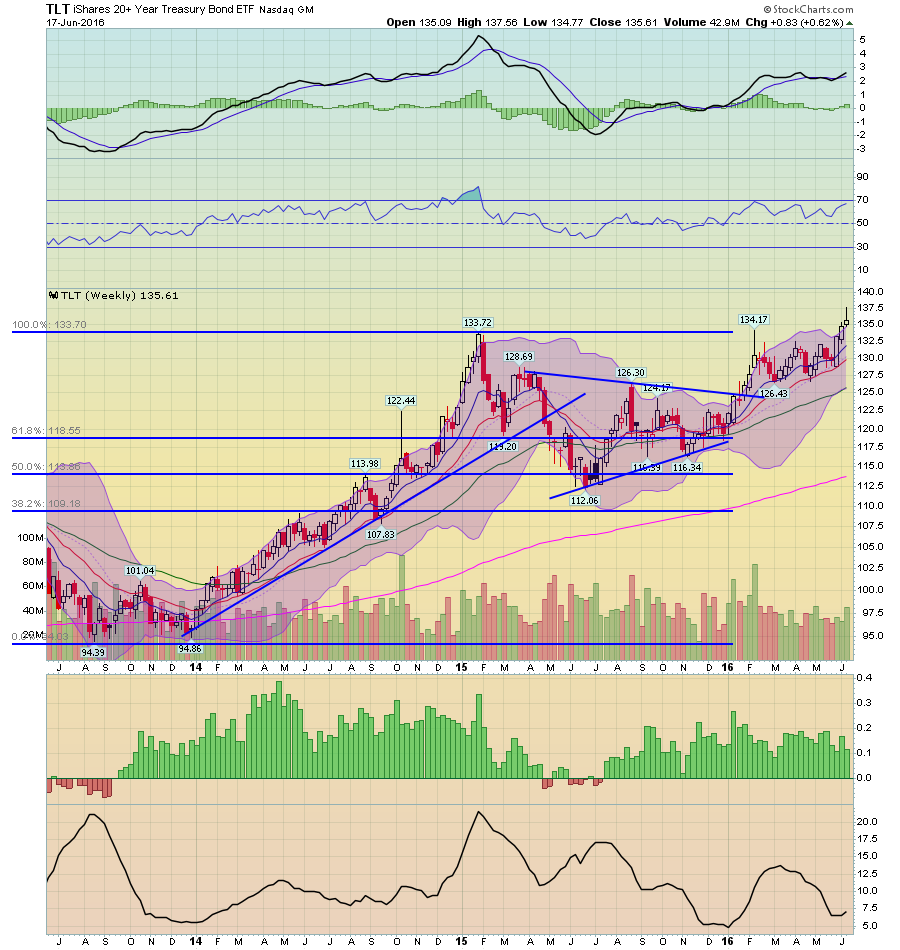
The TLTs Are Near Multi-Year Highs
Recession chatter is on the rise lately. “After seven years of expansion, the U.S. economy appears to be headed for a recession,” writes an economics lecturer at Yale. Meanwhile, Bloomberg this week advised that US recession odds increased to 55% due to a flattening yield curve. And a survey of 400 real estate professionals shows that a majority expect a recession within the next 18 months. The dark forecasts may be right—or wrong. Based on the available data to date, however, the probability is still low that the US economy has fallen into an NBER-defined recession in the recent past.

Notice how the dollar's rise negatively impacted manufacturing employment:

This downward march of safe yields is a consequence of the safe asset shortage problem. What we are seeing in Germany is just the latest manifestation of it. What the above figure should make clear is that this safe asset shortage problem has been going on outside of QE programs and before central banks started doing negative interest rates. So don't blame central banks for the low interest rates.1
This downward march of safe yields across the globe is a big deal. It indicates the global economy needs more safe assets and lower interest rates to clear. However, at some point, the effective lower bound (ELB) will kick in and prevent rates from going lower. When that happens something else will have to adjust--output--and there will be a global race to the ELB. Here is Caballero, Fahri, and Gourinchas (2016) making this point...

Sunday, June 19, 2016
Saturday, June 18, 2016
Weekly Indicators for June 13 - 17 at XE.com
- by New Deal democrat
My Weekly Indicators post is up at XE.com. A few things deteriorated slightly this weei, and several improved slightly.
Friday, June 17, 2016
The consumer is still all right
- by New Deal democrat
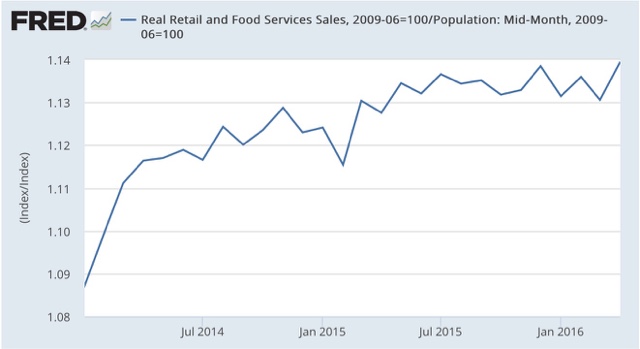
With May's CPI reported, I can now update real retail sales and real retail sales per capita. The former is a short leading indicator, the latter a longer leading indicator. To cut to the chase, here they are:

Both have set new highs.
While there are lots of production-side metrics that are consistent with recession, like industrial production, manufacturer's sales, and the inventory to sales ratio, the consumer side of the economy continues to be doing OK.
Wednesday, June 15, 2016
Whither the shallow industrial recession?
- by New Deal democrat
I have a new post up at XE.com, examining yesterday and today's manufacturing and production data. The bad news is, industrial production manufacturing stunk. The good news is, it is still above March's low, and every other piece of data is pointing the shallow industrial recessioin ending.
Tuesday, June 14, 2016
Final business and retail sales add to evidence suggesting shallow industrial recession has bottomed
- by New Deal democrat
Today began a 3 day blizzard of manufacturing and sales data spanning April to June. This morning we got total business sales for April and retail sales for May. Tomorrow we get May industrial production and the June Empire State Index. On Thursday the June Philly Fed Index will be reported.
I'll just briefly note that we need to wait for tomorrow's inflation report before we know what May real retail sales were. *If* the CPI is in line with +0.3% expectations, then real retail sales for May will set another record -- another indication that the consumer economy is OK and we are not on the cusp of any recession. Here are real retail sales per capita through April:
I'll just briefly note that we need to wait for tomorrow's inflation report before we know what May real retail sales were. *If* the CPI is in line with +0.3% expectations, then real retail sales for May will set another record -- another indication that the consumer economy is OK and we are not on the cusp of any recession. Here are real retail sales per capita through April:
This morning's April business sales report showed that total Business inventories rose +0.1%, but sales grew a strong 0.9%. Sales at all levels -- Retail, wholesale and manufacturing -- grew, and only wholesale inventories increased, while retail and manufacturing inventories shrank, as shown in the table below:

As a result, the total business inventory to sales ratio declined:

This pattern of increased sales and decreasing inventories is what happens just after a recovery from a recession starts. It adds to the evidence that March was the bottom of the shallow industrial recession. But the acid test will be the industrial production report tomorrow.
Bonddad Tuesday Linkfest
The Yield Curve Spread Points to Slow Growth
The 30-2 year spread is Near a 5-Year Low

The 10-2 year spread is Near a 5 Year Low

The productivity slowdown has often been called a “puzzle”, because it has coincided with a period of rapid technological change in the internet sector. I am not sure that this is really a “puzzle”. Many of the obvious benefits of the internet revolution appear to increase human welfare without leading to increases in market transactions and nominal GDP [1]. Furthermore, there are several other plausible reasons for the productivity slowdown, including low business investment and a loss of economic dynamism since the financial crash [2].

Monday, June 13, 2016
A note on personal withholding taxes
- by New Deal democrat
Last Friday I wrote a piece dissecting the latest graph in Doomer porn, which purported to show that personal withholding taxes paid had fallen to a meager +0.1% YoY. Since both the Daily and Monthly Treasury Reports are public and online, it didn't take long to debunk that claim.
But just to be sure, I asked Matt Trivisonno, who at his blog Daily Jobs Update has tracked withholding tax payments for the last decade, to double-check my work.
Normally, Matt charges for a subscription to the most current reports, but in this case he didn't simply verify my calculations, he sent me a graph that is completely up to date, and gave me permission to post it. So here it is:

Measured on a rolling basis YoY, withholding taxes paid over a 3 month period have generally decelerated since midyear 2015, but have remained relentlessly positive -- and have rebounded to 4.11% by Matt's calculation as of last week.
I can only assume -- since the source of the graph, Evercore, hasn't published any links to or descriptions of their data -- that somewhere in the Monthly Treasury Report is some series that is only up +0.1% YoY. But what I can say with great confidence that it isn't personal withholding taxes paid.
Bonddad Monday Linkfest
I don't remember the source, but several years ago I remember reading that a Chinese official stated he only looked at the growth of Chinese electricity demand to determine the country's "real" growth rate. Assuming that's an accurate statement, then China's growing far slower than the official statistics suggest:


Subscribe to:
Posts (Atom)