But are there investment opportunities amid the wreckage? Some investors think so. They're diving right in and gobbling up shares of the financial houses at the center of the maelstrom, including Bank of America (BAC), Citigroup, American International Group (AIG), JPMorgan Chase (JPM), Merrill Lynch, and Morgan Stanley (MS). "We are buying them all," says David Katz, chief investment officer at Matrix Asset Management, a New York money management firm with assets of $1.6 billion.
Are Katz and other money managers playing with fire? There certainly are risks. But the rewards to confronting the risks look compelling, given the financial firms' steep fall. As of Nov. 19, Citigroup is down to $32.50 a share from its 52-week high of $57 on Dec. 28, 2006. Bank of America is at $43.15, down from $55.08 on Nov. 20, 2006. AIG is at $55, down from $72.97 on May 11. JPMorgan is at $42, off from its high of $53.25 on May 9. Merrill Lynch tumbled to $53.50, from $98.68 on Jan. 18. And Morgan Stanley dropped to $51.16 from $75.50 on June 15.
The Case for Buying
The argument for buying is not that these companies won't have more problems. Perhaps some of them will. But Katz and others believe that, as a group, these giant finance companies play such a central role in the economy that they'll continue to have bright prospects. "We aren't playing with fire, because these companies are the biggest and the best players in finance and investments, with tremendous, diverse resources and clean balance sheets," says Katz.
I've been making a great deal of fun of this philosophy, and frankly will continue to do so. This is stupid beyond belief. Anybody who us making this move is making a classic investment mistake. They are assuming that:
1.) Because something is cheap relative to a another price at a certain time it is time to buy something,
2.) There is only so far a large stock can fall, and
3.) There won't be anymore major damage to the financial section of the market.
Let's rebut these argument one at a time.
1.) Because something is cheap relative to a another price at a certain time it is time to buy something:
There are two kinds of cheap. The first kind is an undiscovered gem -- a company who's book value is higher than it's stock value. This is classic "value investing" (for more on this, read the Graham and Dodd book Securities Analysis.) This is not what we're talking about here.
What we are talking about with financial stocks are securities which are cheap because they are crap. There have been over $50 billion in writedowns over the last quarter. And we're just getting started. Take a look at this chart from the IMF:
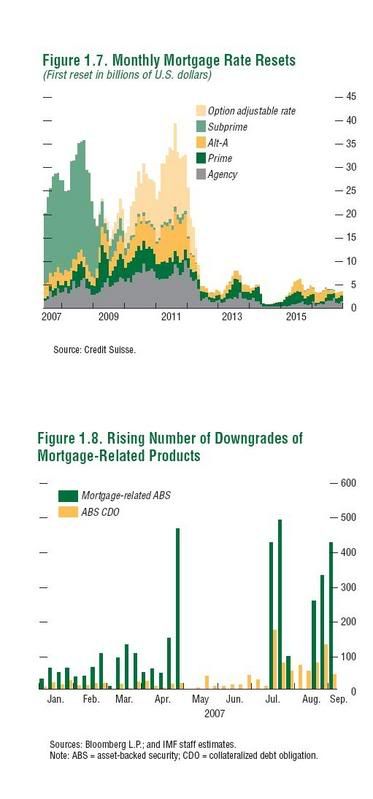
There are three more years of resets out there. Do you really think this is the only quarter when we're going to have writedowns?
The above chart is the reason these companies are cheap because they're crap.
2.) There is only so far a large stock can fall,
Right. A great company -- or a necessary company -- won't go below value x because it's so necessary too the economy. Take a look at (Fannie Mae) FNM or (Freddie Mac) FRE and ask yourself if that proposition still holds up.
3.) There won't be anymore major damage to the financial section of the market.
See the chart above. There is a ton of crap out there in financial-land. We don't know who owns how much of what -- and we won't know for some time. Companies are doing everything they can to not tell us, holding onto the pipe dream that somehow this whole mess will turn around.
So -- if anyone is telling you financial stocks are a great buy right now show them the door. The only good thing about financial stocks is they are great targets for shorting. That's it.


5 comments:
...
What's incredibly depressing is that there is absolutely no way to disagree with your last two sentences, unless you're willing to take a substantial loss in order to have the stock a few years from now when(if) it rises above its current levels. If that corporation still exists.
A questionable* decision like that would be remarkably similar to massive buy-ins on "securities" comprised of of bundled sub-prime loans made in a lax regulatory environment.
Which would go a long way toward explaining why there are people out there buying into financials right now, no?
* I'm trying to be civil.
CFC looked cheap to BAC when it invested $2b, stock was $18 at the time.
I'm still short the builders. What a long strange trip it has been.
A question for Bonddad --
You posted a diary a few days back on DailyKos which explained why it was a natural phenomenon that so much of America's manufacturing industry has been moving out of the country to places where labor inputs are cheaper. I've been thinking about this in relation to the rapidly-sinking dollar.
If the U.S. were entirely self-sustaining, then we'd all sink together and no one would be the wiser as the dollar was devalued. However, given that so many of our raw materials and consumer goods are produced outside of the country and then imported, doesn't that make the dollars rapid decline that much more impactful on our economic viability?
In other words, it's not just the cost of materials and supplies produced here going up because of oil cost increases, but also the cost of materials and supplies from elsewhere going up because our currency is losing its value.
Your thoughts?
I guess people don't read the classics anymore...
...
"In the autumn of 1929 the New York Stock Exchange, under roughly its present constitution, was 112 years old. During this lifetime it had seen some difficult days. On 18 September 1873, the firm of Jay Cooke and Company failed, and, as a more or less direct result, so did fifty-seven other Stock Exchange firms in the next few weeks. On 23 October 1907, call money rates reached one hundred and twenty-five per cent in the panic of that year. On 16 September 1922 - the autumn months are the off-season in Wall Street - a bomb exploded in front of Morgan's next door, killing thirty people and injuring a hundred more.
A common feature of all these earlier troubles was that, having happened, they were over. The worst was reasonably recognizable as such. The singular feature of the great crash of 1929 was that the worst continued to worsen. What looked one day like the end proved on the next day to have been only the beginning. Nothing could have been more ingeniously designed to maximize the suffering, and also to ensure that as few as possible escaped the common misfortune. The fortunate speculator who had funds to answer the first margin call presently got another and equally urgent one, and if he met that there would still be another. In the end all the money he had was extracted from him and lost. The man with the smart money, who was safely out of the market when the first crash came, naturally went back in to pick up bargains. (Not only were a recorded 12,894,650 shares sold on 24 October; precisely the same number were bought.) The bargains then suffered a ruiness fall. Even the man who waited out all of October and all of November, who saw the volumne of trading return to normal and saw Wall Street become as placid as a produce market, and who then bought common stocks would see their value drop to a third or a fourth of the purchase price in the next twenty-four months. The Coolidge bull market was a remarkable phenonmemon. The ruthlessness of its liquidation was, in its own way, equally remarkable."
-- The Great Crash: 1929, JK Galbraith
Hey, there are a bunch of houses for sale in my neighborhood with "price reduced" signs! Maybe these guys will want to buy them, too!
Post a Comment