The major indexes have made moderate progress since the March 21 market follow-through, and the hunt for leading stocks near buy points isn't getting any easier.
Investors face a challenge common to other rallies: The best breakouts occur in the early days and weeks of a follow-through.
We're about six weeks past the rally confirmation, a stage where it gets harder to find top-notch stocks still in bases.
As rallies progress, it becomes harder to find stocks that have yet to participate. This makes it that much more difficult for the rally to continue.
Here's a chart of the NASDAQ cumulative advance/decline line. Notice that it is already trading at a lower point.
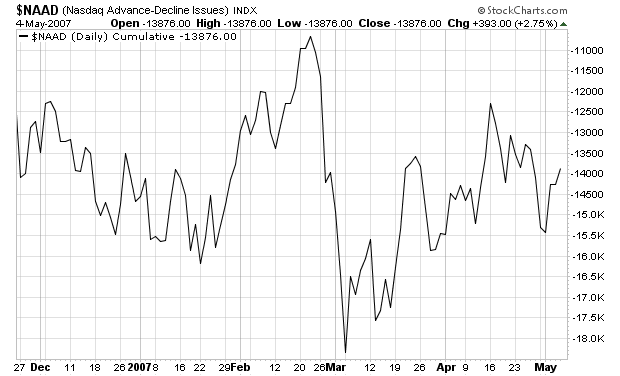
In contrast the NYSE advance/decline line looks like it is going to continue upward.
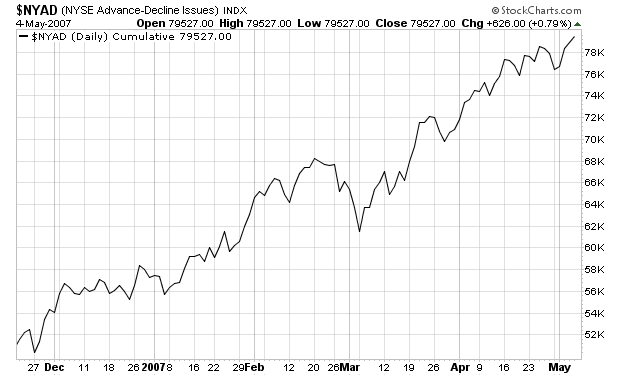
This divergence between the markets could indicate that traders are looking for less speculative issues (represented by the NASDAQ) and are instead moving money into larger more established companies (represented by the NYSE).
It also confirms what the article is talking about. It's getting harder to find stocks that haven't rallied.


5 comments:
Thanks for the analysis. Makes sense that folks are moving out of tech speculation and into blue chips. I think AAPL is looking really good, but maybe that's the exception. Looks like investors are taking on less risk across the board, and with good reason.
Frankly, I'm less worried about the business cycle and more worried about some serious shock to the global economy. There are too many sell programs primed and ready to fire. I'd love for you to write more about the prospects for a major crash, what the major risks are, what the contagion might be, etc.
Keep it up -- I don't comment much, but I check your blog every morning.
ditto -- I read this blog and comments daily, sorry for not commenting, but I'm a bit of a nooB at this and feel I have little to add.
Keep writing Bonddad, we're listening and furrowing our brows.
Perhaps there's a point of diminishing marginal utility in the rally itself? Question: Am I right in thinking that the stock market like employment is a lagging indicator rather than a leading one?
The trend lines are similar in the two charts, though - looks like the NYSE just hasn't been as bipolar.
And I AM worried about the business cycle. I think the housing crash is going to affect far more than many seem to think, as consumers cut back on spending. But then, being one of those who still has a ton of equity as well as cash, and a remodeling project on the way, maybe we'll be helping out (and getting some cheap labor!).
Now if the auto companies would just get my hybrid van on the market, we might help out auto sales, too. Oh well. I know a lot of us consumers are sick of cheap Chinese crap and more than willing to buy some good, well-designed, DURABLE products. SOmetimes I find myself hoping for a recession, just so quality of goods will go up....
> a lagging indicator rather than a leading one?
Snippet from ProgressingRailroading.com:
One-third of the way through 2007, U.S. railroads' traffic fortunes haven't begun to reverse. In April, the roads' originated carloads decreased 2.2 percent to 1.3 million units and intermodal loads declined 4.2 percent to 908,139 units compared with April 2006, according to the Association of American Railroads (AAR).
Post a Comment