Sunday, February 18, 2007

How Long Can This Trend Last?

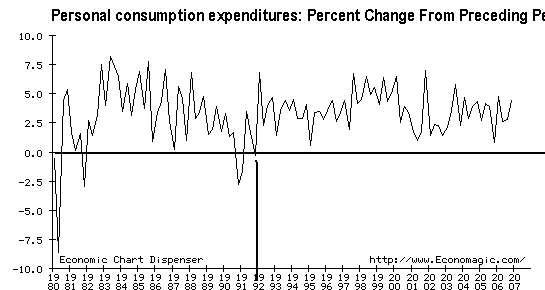
This is a chart of the percent change from the preceding quarter in personal consumption expenditures.

Photobucket - Video and Image Hosting

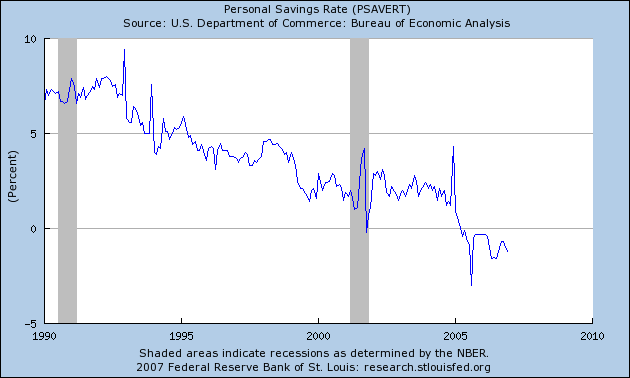
The last time this figure decreased was in 1992. That is 16 years ago. How long can this trend of positive growth continue? The US savings rate (income - expenditures) has been negative for the past 5 quarters.
Photobucket - Video and Image Hosting


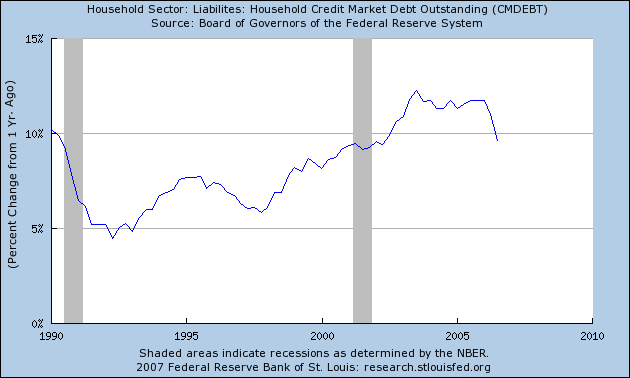
Household debt has increased to over 90% of GDP and 120% of disposable income. US households greatly increased debt acquisition over this expansion, as this chart of the year-over-year percent change in household debt indicates.
Photobucket - Video and Image Hosting

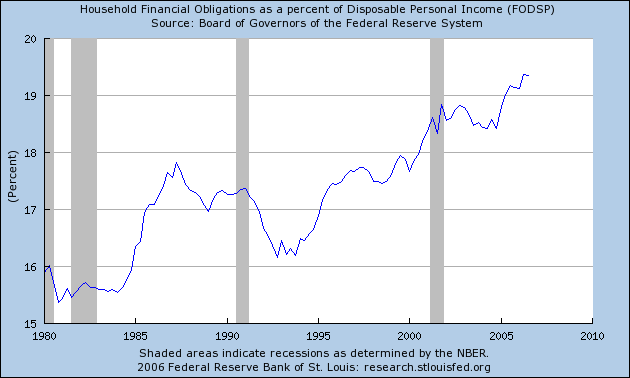
Debt payments now consume the largest amount of disposable income on record.
Photobucket - Video and Image Hosting

How much more can the US consumer purchase before he pulls in his wings?

8 comments:

Anonymous said...

Question. How much of this debt is interest? Or interest is not included?

Anonymous said...

I have asked myself this question, the question in the post, on numerous occasions.

It really seems to be a perpetual motion machine.

Speaking of Barron's, Alan Abelson is my favorite commentator. His penultimate column basically said that everyone is going to head for the exits at the same time. A chilling thought.

BruceMcF said...

To the first anonymous question, if someone borrows to pay interest, it gets added to the debt. If someone pays the debt out of current income, its not added.

In other words, this is debt outstanding ... the principle, not the total payments that will have to be made ... because getting the second figure requires going into the terms of each debt contract, and that's just beyond the ability of the people doing the national income accounting.

BruceMcF said...

For the question posed in the post, the answer in the aggregate is really the same as the answer in an individual case: it can continue as long as the credit continues to be extended.

The difference is that in the aggregate, we can tell, in general terms, tell where that credit is coming from.

If it was coming from domestic credit extended for the purchase of of real assets (factory buildings, office computers, etc.), then that would be reflected in positive private savings.

If it was coming from private accumulation of government liabilities from deficit spending ... that is, government bond issue ... that would be reflected in positive private savings.

And so it is coming from foreign capital inflows. It can therefore last as long as those foreign capital inflows continues ... and not one week longer.

We see the "and not one week longer" part all the time ... the Asian financial crisis, the Argentine currency melt-down, the last three Mexican debt crises, etc. So we can have a pretty good idea that if foreign capital inflows stop being available, that will not be a slow, incremental affair, but instead will be a stampede, as those holding assets in US dollars rush for the door.

It would, I suggest, be prudent policy to back away from reliance on this particular source of credit, but that would require, among other things, serious pursuit of Energy Independence, which would inconvenience too many corporate supporters of the Bush coalition.

Anonymous said...

Bonddad-
Government stats on "savings" are obsolete and thus useless. I believe you are a tax lawyer. If a closely held business sets up a defined benefit plan which provides big deductions for the company' owner employees, shouldn't that count as "savings"? I don't think they are counting something like this where the deduction is taken by the corporation on its return, rather than at the employee level. Also, my parents' generation felt it necessary to stuff more money in their low return "safe" investments in bank accounts, CDs, Series EE bonds, etc. (Safe, if you ignore loss of purchasing power due to inflation.) Today's investors can get double digit returns by diversifying into global equity, hedge funds, private equity funds, commodity ETFs, all at a mouse click.

Anonymous said...

Don't forget that the underground economy is big and getting bigger. Anyone can start an online business these daysand stay under the tax radar screen.

bonddad said...

Anon --

Even if you account for total market assets invested from the Feds Flow of Funds statement, total savings is at best 3% of GDP.

Anonymous said...

And not one day longer.

Like Abelson said. Everyone jumps for the exits at the same moment.

So, the end comes when the dollar collapses.

What a completely disgraceful ending!

I hope that ghoul Greenspan lives to see it.