Showing posts with label economy. Show all posts

Tuesday, October 13, 2009

Were the Luddites Just Too Early?

Introduction from Bonddad: I have asked Silver Oz to contribute to the site. I have known his work for the last few years and have always been impressed with the depth of his research and analysis. He has been posting here for the last year in the comments section and his points are always well-thought out and thought provoking. I will post the market wrap in the morning so you can enjoy this well written piece.


There seems to be more and more talk about our decline in manufacturing prominence and its relation to outsourcing/off-shoring, but these arguments always gloss over (or skip entirely) the relationship of technology/efficiency to the losses in manufacturing employment and every one of these arguments always begins with the assumption that we produce less than in the past (some usually undefined past, but most often refers to sometime between 1950 and 1973). I am going to use this essay to demonstrate how the infamous Luddites may very well have been correct in their fear of technology, but were almost two centuries too early in their conclusions.

First, I want to define that I am going to end my data in 2007 (ie before the recent recession), as the data dramatically skews during the “Great Recession” and it is difficult if not impossible to infer much through this period of time in the data (however, it is my belief that once we emerge from recession, nothing substantial will have changed economically that will alter my conclusions herein).

To begin, I want to state emphatically that industrial production (in actual units of stuff, not dollar value) has continued to increase in the post war period, right up until our most recent recession. We do in fact produce as much (actually quite a bit more) than we ever have and thus the “nothing is made in America anymore” argument is bunk. Remember, that a car or ton of steel counts a lot more than a toothbrush or My Little Pony in the industrial production equation (as it should).


So, now that we know industrial production (in units of stuff) was at an all-time high at the end of 2007 what do we know about jobs in goods producing industries (ie manufacturing)? Well, those jobs are at about the same level they were at the beginning of 1992, and although they saw a slight rise during the 90’s (about 11%), they fell again during the 2001 recession and remained around the 1992 level since then. During this same span of time we saw industrial production increase by 50% during the 90’s (so for every one percent rise in jobs we saw a 5% rise in industrial production) and after a shallow drop during the 2001 recession, industrial production moved back to all-time highs while jobs stagnated. Thus, industrial production at the end of 2007 was 65% higher than in 1992, while manufacturing jobs had essentially stagnated since then.

The gap between manufacturing jobs and industrial production is even more evident when we look at the time period between the start of the 2001 recession and the start of the 2007 recession, as manufacturing jobs declined by 10% while industrial production increased by about 10%.

The numbers are even more stark when we look at the value of goods through the personal consumption expenditures component of GDP (in chained 2005 dollars) and back out all imports (this is goods only for both). Doing the simple calculation (http://www.bea.gov/national/nipaweb/TableView.asp?SelectedTable=6&Freq=Qtr&FirstYear=2007&LastYear=2009) shows us that the difference in inferred domestic output between 2000 and 2007 was an increase of 24% (again during a period in which manufacturing jobs declined by 10%).


Concluding, the information above seems to imply that we have reached a point where industrial production can increase at a rate much faster than the need for jobs to produce the goods. In fact, during the period between the 2001 recession and the 2007 recession manufacturing jobs actually declined while industrial production increased substantially. Coupling this data with recent (and by recent I mean at least the last 10 years) productivity increases, which grew at an average annual pace of 3.71% between 2001-2007 (a total increase of 29% during that period) and we can see that perhaps we have indeed reached a point where our ability to improve output with technology is now increasing at a pace faster than new demand can create a need for new manufacturing jobs. If this conclusion is correct then not only were the Luddites right in their fears (albeit 200 years too early), but that we need to begin rethinking all of our economic policies, as they are not designed for a world in which technology can displace jobs faster than new innovation and demand can create them.

Thursday, May 8, 2008

Will "Main Street Spoil the Recovery?"

From CNBC:

"Main Street has just entered the act. The peak of the pain is not visible yet," said Asha Bangalore, an economist with Northern Trust in Chicago.

The consumer strains are well-documented. Aside from the credit contraction, gasoline and grocery prices are on the rise, the housing market remains distressed, and consumer confidence is at recessionary levels. Tax rebate checks are in the mail, but that alone cannot compensate for the credit clamp-down and inflation pressure.

"Given that households are strapped financially, it is far-fetched even with the stimulus checks to expect a sharp increase in consumer spending," Bangalore said. "You have seen auto sales numbers for April, they posted a sharp drop."

.....

To say that Wall Street is expecting a second-half recovery would be an understatement. According to Thomson Reuters research, analysts are expecting fourth-quarter earnings growth of 62 percent for the S&P 500. Granted, that is a comparison with a disastrous fourth quarter of 2007, when earnings were down some 25 percent. In the current quarter, S&P 500 earnings are expected to be down 6 percent.

Not only is the market anticipating a swift recovery, but the earnings forecasts suggest that they think it will be lasting. For next year, analysts think earnings will be up 18 percent, twice the growth they are predicting for 2008.

They see particularly strong growth for consumer discretionary companies, beginning with the next quarter. Earnings for that sector are expected to jump by 41 percent in the fourth quarter, and 24 percent next year.


The article focuses on the tightening credit situation in the market (which I dealt with here.) But I want to focus on a basic problem of the market rallying in the current economic environment.

Here's the fundamental question: will the economy rebound in the 2H 2008, proving the market right?" I have doubts for the following reasons.

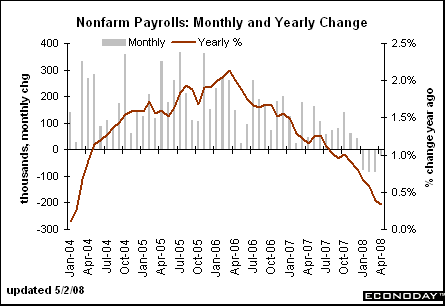
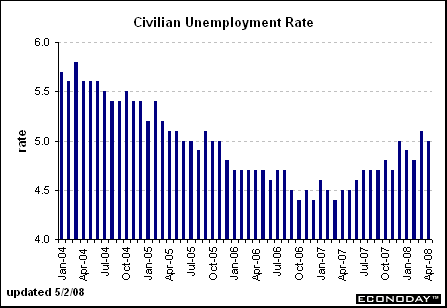
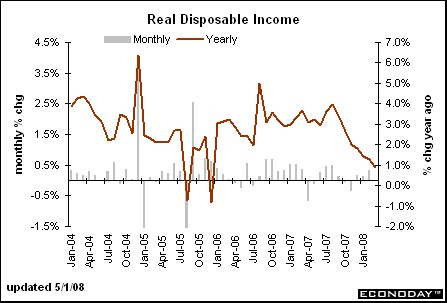
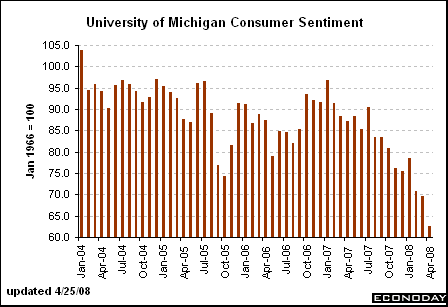
First, let's start with the following charts:


Job growth is still dropping from a year over year perspective, and


The unemployment rate is still increasing


Real disposable income is decreasing, which is


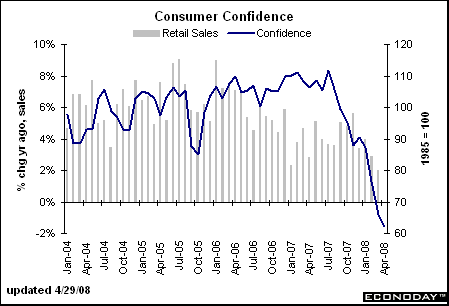
Lowering sentiment and


Confidence


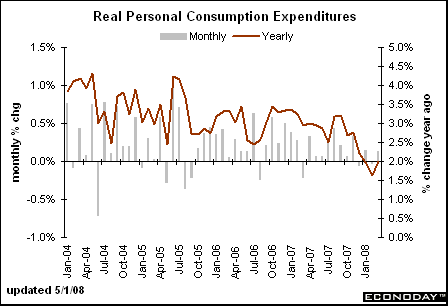
Year over year spending did increase in the latest report. However, note the following regarding that upturn.

-- in the latest GDP report, both durable and nondurable goods purchases decreased. The reason for the increase was an unseasonably high increase in service purchases.

-- One month does not a trend make especially in light of the preceding trend.

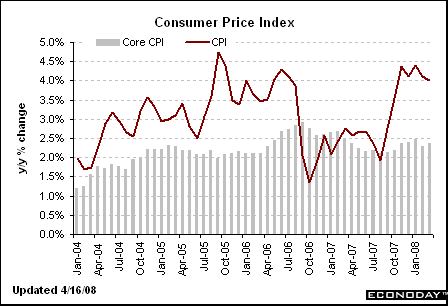
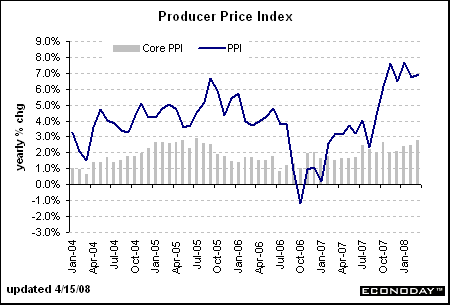
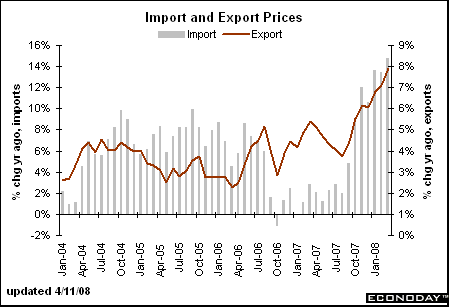
Also remember that inflation is high right now:


High inflation crimps consumer spending.

This is not to say that people won't increase their spending. But in light of declining job prospects, record oil and food prices and a slowing economy, it just doesn't seem like the consumer spending will increase in a big way anytime soon.

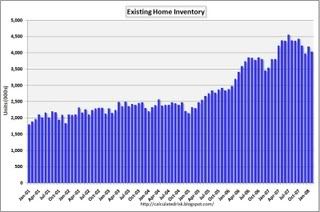
Then there is housing which started this mess. The inventory/demand situation is still horribly out-of-whack. From Calculated Risk, here is a chart of total existing homes on the market:


So -- we're at 4 million. And that number will increase because foreclosures are increasing in a big way -- they more than doubled in the first quarter. And it's not like we need all those homes -- not by a long shot. Home vacancies are now at a record.

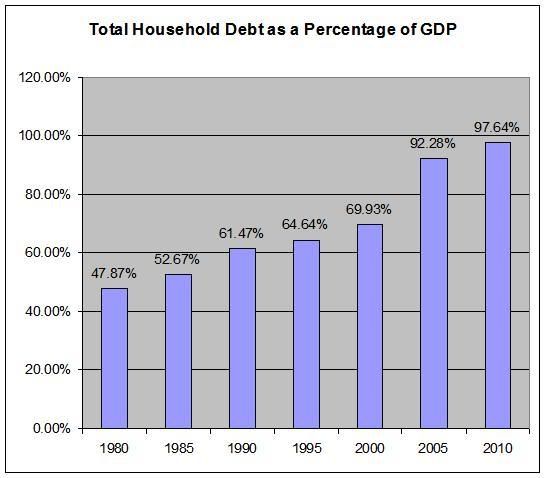
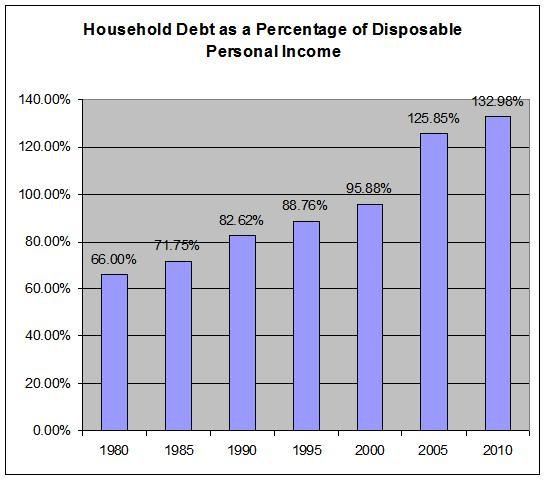
And who is going to buy these homes when credit conditions are tightening and consumers already have a record amount of debt?


So, according to the facts we have the following situation:

-- job growth is slowing

-- as is real income, which is

-- lowering consumer confidence and sentiment. In addition,

-- inflation is high, lowering spending.

-- Housing inventory is still high, and

-- rising foreclosures will increase that number.

-- Record levels of household debt and tightening lending standard will prevent a housing rebound.

Simply put, this is not a pretty picture for the second half of the year.