Tuesday, June 26, 2012

Case Shiller index shows more evidence housing prices have bottomed

  -  by New Deal democrat

This morning's Case Shiller report of repeat home sales is more evidence that housing prices have already bottomed.  Unlike most commentary, which inexplicably focuses on the non-seasonally adjusted index, I focus on the seasonally adjusted data.  So long as those adjustments are fair, the month over month seasonally adjusted index is going to show changes in trend well before the year-over-year measures turn.

For April (really an average of February, March, and April), the seasonally adjusted 20 city index rose for the third month in a row.  As the below graph shows, outside of the time period when the $8000 housing credit was in effect, this is the first time we have had house price increases for three months in a row since the peak of the  market in 2006. (Note: graph does not include this morning's increase):
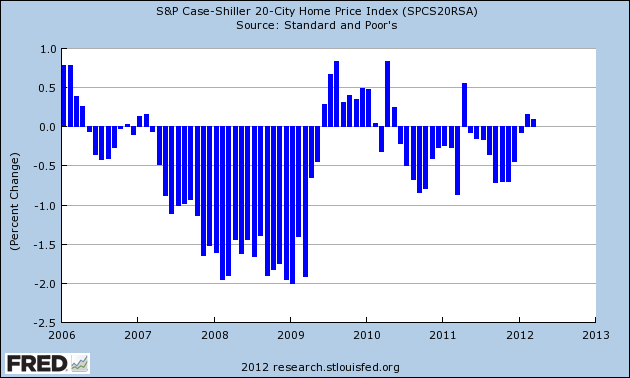


Beyond the aggregate number, the diffusion of the gains was also impressive.  Sixteen of 20 metropolitan areas in the index showed seasonally adjusted month over month gains - meaning the gains were not simply a factor of house prices typically going up in the spring, and were widespread.

On a YoY basis, the index declined only -1.9%.

A year ago, I said that I expected Housing Tracker's index of asking prices to turn positive YoY by early this year.  It did, at the end of November of last year.  I also said I expected it to lead the Case Shiller index.  It did that too.  The only caveat I have now, as I had a year ago, is that the turn has been in nominal prices, rather than real, inflation-adjusted prices, which may still be a long way off.  At this point the only argument the housing bears have left is waiting for the long-fabled foreclosure tsunami to finally wash ashore.

13 comments:

Anonymous said...

I guess it is ego-boosting to exalt, "I was right, I was right." I would be more impressed of you showed sensitivity to the plight of home-buyers (not investors) whose local situation is far different from averages, especially those where the local median turn-key house requires twice the median wage.

Buyer's agents, who are supposed to have a fiduciary responsibility to the buyer, pressure buyers to pay too much by citing national averages and pretending they apply locally.

Perhaps what the "bears" just want are fair prices. Just yesterday, I looked at a house priced twice what it is worth, and the agent said the previous buyer paid twice as much for it (that would be 4 times what it is worth). "So you would be getting it for 50% off." Wrong,wrong,wrong. It was never worth what the previous owner paid. It is like a furniture booting its prices just before a so-called 50% off sale.

See the sad thing is that during the bubble,real estate agents were advising people who rely on their expertise and experience to navigate a-once-in-a-lifetime purchase to buy at prices that they knew were unsustainable in light of wage demographics.

BoulderPatentGuy said...

Anon,

I doubt most, if any, realtors "knew" that prices were "unsustainable." In 2005 prices had been going up 10%/year for what, 7 years in a row? So even if prices dropped 10% (is this unsustainable?), most buyers would still have plenty of equity in their home.

Hindsight is 20-20 and plenty of people made a killing in real estate during the bubble years, buyers included.

And besides, if a house is purchased for $400K, that's what it's worth to the person who bought the home. It's not worth $200K just because you think it is.

Anonymous said...

No, realtors talking around the water cooler knew very well that prices were unsustainable based on wage demographics (since jobs pay for houses). The baseline for healthy housing is the local median wage can qualify for the local median turn-key house.

There are intrinsic values to a house which realtors tried to deny to buyer's faces during the bubble. the old canard, "a house is worth what someone paid for it" is nonsense used to blame buyers for poor decisions based on agents' bad advise.

It is also silly to blame the buyer for being ignorant about the ins and outs of real estate. People rely on an electrician because the electrician is the expert. People rely on agents because supposedly agents are the experts,and they have a fiduciary (an important legal term) duty to boot.

You bet some buyers made a killing, but they did so by exploiting someone else. Some of them even exploited the bank, like the people who inherited a fixer for nothing, and immediately took out a home equity loan on the paper value of the house, only to skip town. In my community, bank routinely lent more than half a million on tear-downs,based on paper appraisals, rather than taking the trouble to look at the collateral.

Anonymous said...

I guess the difference between Bondad's view of housing prices and Barry's (http://www.ritholtz.com/blog/2012/06/annotated-new-home-sales/) is that Bondad lives in Texas where the national averages probably accurately reflect local conditions, while Barry lives in New York, where houses are generally over-priced regardless of national averages.

IL JimP said...

what the heck is a turn-key house and how do you define what one is in a way to make your analogy effective?

Anonymous said...

Well,real estate agents know perfectly well what a turn-key house is. It means you can move right in. Everything is in good shape and nothing needs to be fixed.

When I say "needs," I mean "needs," not "wants." Some buyer confuse the two, saying that the kitchen needs a new counter when what they really mean is they would rather have granite than laminate.

I specify turn-key because when we expect to pay less for a house that needs fixing, we mean less as compared to a turn-key that needs nothing. When housing is healthy, the local median wage can afford a local median turn-key house in the typical configuration (3bedroom-2bath, off-street parking, front and back yard). A bigger and/or nicer house will be worth more. A smaller or, less nice, or in less desirable location worth less. These differences from baseline determine different values.

In my town, the median wage can only afford a 1-bedroom, 1 bath that needs to be gutted and that is just to acquire the house, never mind the cost of fixing. 80% of the downtown residents rent,and not by choice. The rentals are in uniformly bad condition because there is no competition between landlord.

In a healthy housing market, crummy rentals get crummy tenants,because good tenants will pass on the crummy rentals. My town is unhealthy because good tenants cannot pass on the crummy rentals and even those making significantly more than the median wage cannot afford a house.

Even stranger, the middle class here is completely squeezed out. In order to qualify to buy what the city has labeled an "affordable" house, the buyer must make no more than 80%of the median. Without the city program, buyers need at least twice the median income.

There is nothing for a buyer who makes between 80% of median and twice the median except fixers, but often banks will not lend on a fixer,so the buyer needs 100% cash, not 20% cash.

This is how a buyer from Chicago closed May 31 on a bank-owned fixer(my offer was a lower offer) in my town. This guy will do the bare minimum to pass our local habitability ordinances,and put it on the rental market as yet another overpriced rental owned by an absentee landlord. He could outbid me because I had to take into consideration the costs to fix it properly, which is a lot more than painting and replacing carpet.

My housing market was extremely sick during the bubble when it required 16 times median wage to buy a median turn-key house of typical configuration. The fever is coming down; now it costs 3-4 times median wage. When local agents crow that our local market has stabilized and prices are rising,even ever so little, I cringe. It is like calling a relapse recovery.

I just wish this Bonddad would recognize that the conclusions you draw from national averages do not necessarily apply to local conditions. I wish he would lose the bias the price stabilization or increase is a sign of health. I wish he would step away from the persistent myth that going up is always good and going down is always bad. The bubble was a period of extreme ill health, and we should not be wishing for housing to get sick again.

IL JimP said...

First off, this was written by New Deal Democrat.

Secondly, just because a real estate agent knows what you mean by turn-key doesn't mean that I do.

I'm still not clear on how you are defining that turn you are using.

Anonymous said...

"First off, this was written by New Deal Democrat."

Is that some sort of ad hominen?

There is a continuum from "turn-key" (move-in ready) to "handyman's special."

I am not sure you read the whole admittedly long post, or what the actual ground of your objection is.

IL JimP said...

No, New Deal Democrat and Bonddad are 2 separate people that was my only intention with my first comment.

I don't have an objection, I'm trying to understand your point better. You keep referring to a turn-key house and how it relates to median income.

I'm trying to find out if there is an economic definition to turn-key that I'm missing so I can accurately compare it to median income like you are doing in your posts. Move-in ready could mean basically any house other than those that need a lot of refurbishing.

I just want to understand your point better so I can determine if I agree with your conclusions or not.

Anonymous said...

If you are house-hunting, the meaning of turn-key soon becomes obvious. What turn-key does not imply is that everything is to your taste. But it does mean that everything is in excellent condition.

I sometimes feel you are niggling at words. When I say real estate agents all know, that does not mean you are a real estate agent. It does mean it is a common term. On the other hand, real estate agents tend to puff their listing. Like the listing that said "11 acres." When I got there, I found that the agent was measuring the land area vertically. There was barely a five foot clearance around the house before the 100-ft rise to the top or the 100-ft drop-off to the creek.

Some agents say "turn-key" but when you look at the house, they say something like, "All you have to do is (fill-in some repair), and you can move right in."

Maybe turn-key is like art; you know it when you see it. Does it have an "official" economic definition? Not one I could find, but here is a sampling:

Normally a "turn-key" property refers to the property virtually ready for you to just bring your furniture and move in.

In my humble opinion it means you can move right in.

I think that means it's vacant and ready for new people to move in immediately. Also it should mean there are no outstanding repair and maintenance issues.


Move-in ready, with no cosmetic or repair work required. All you have to do is turn the key, open the door, and move right in.

A turnkey home is ready for buyers to move into.

a house that is in tip-top shape is often referred to as a "turn-key" house. If you buy the home, it is in nearly perfect condition.

In the Real Estate world we utilize phrases like this, which means that you have a property that is in very good condition, and you could move in without any repairs. This is what most buyers expect in a property anyway.


"Turn Key" is a Realtor phrase which is supposed to mean the home is clean and ready to move in with little or no repairs needed.

The term "Turn-key" implies the house is in perfect move-in condition and requires no work whatsoever.

IL JimP said...

I'm not trying to nit-pick words, I'm trying to understand how you are comparing to median wages.

Even you last definition makes that comparison difficult because $10 million house could be turn-key if it's move in ready.

I thought you were using some sort of numerical representation since you were comparing it to median wages.

Anonymous said...

Okay, the baseline for a healthy housing market depends on jobs because jobs pay for the house. If the relationship between wages and houses prices is lost, you end up with an unsustainable bubble. My town was especially bizarre because in 2006 it cost 16 times the local median wage to buy a local median house.

Anybody who makes the median wage should be able to afford a median house. $10 million is not median; it is an outlier. I should hope the $10 mil house is turn-key. Anyone who makes the median wage should be able to buy a turn-key house. Both parts go together. The third component is locality (as opposed to location). It is possible for national averages to bear zero resemblance to the local market.

When the housing market is healthy, it is possible to skip the first step to evaluating the value of a house---relation to local wage demographics. You can skip this step because in a healthy market, the local median wage can qualify for a local median turn-key house of typical configuration (3bd, 2bath, off-street parking, front and back yards). This is the baseline. The value can be more or less from this baseline, depending on the size of the house or lot, the condition of the house and characteristics of its location.

In a healthy market then, you can go straight to comparables (what comparable houses actually sold for). Buyers always rely on their buyer's agent to help them navigate a rare purchase. Buyers happily pay the commission (it only nominally comes from the seller; usually the cash is actually from the buyer's funds), because they do not have the expertise or experience themselves. It is the same reason we go to car mechanics and hire plumbers, etc. So I think it is wrong to blame buyers for making mistakes that their agent encouraged, nay, pressured them to make.

In fact, during the bubble, agents knew that prices were unsustainable because they had been uncoupled from the wage demographics. Don't believe them when they say they never saw the bursting of the bubble coming. Also, do not believe them when they try to tell you that a certain house is, say, 50% off. 50% off what? The inflated, unrealistic bubble price? It is like a furniture store putting an $800 price tag on a $300 easy chair, marking it down 50%, and telling you what a great deal you are getting.

The housing market was sick with a fever. The fever needs to come down in order for the housing market to recover. The decline in prices was not a symptom of illness, but a sign of recovery. Hoping prices will stabilize above healthy levels or even go up is like pretending the bubble was a time of health and hoping the patient will have a relapse.

If you want to irritate real estate agents, do three things:

Anonymous said...

(Continued):1. Check the wage demographics of the community where the house you are considering is located. The bubble could have been prevented by buyers simply refusing to make offers out of line with wage demographics. And 2. Check the ownership, value, and loan history of the house at the county recorder's office. You may find the big bank is expecting the little buyer to bail them out of a house they made a bad loan on.

Case in point: the owner of a house in my neighborhood inherited it free and clear in 1999. He trashed the house, but still got a $500K home equity loan in 2003 based on the lender's “paper” appraisal. The lender never bothered to take a look at the sorry condition of the collateral. Apparently the owner drank the money; he certainly did nothing to repair the house, nor did he repay the loan. The house, now a tear-down, was sold last month on the courthouse steps for $325,100. How the process took almost 10 years to complete is another interesting story, with the primary sources completely on public record.

Another house in my neighborhood has been in the same family for five generations, ever since it was first built. It has not been maintained and sports several unpermitted modifications. Which brings me to my third point. 3. Check the plans on file and the street records at the local city office, and evaluate the house in light of local zoning and code ordinances. It turns out the grandson got the owner, his grandmother, to take out a $600K home equity loan (again on a paper appraisal) to start a business (not fix the house). He did not pay his grandmother back and she has lost the house. Buyers who fail to do their own homework find themselves acquiring a money sink hole for way too much. Buyer's agents, in spite of their legal, fiduciary responsibility to the buyer, routinely fail to advise buyers properly.