Thursday, July 7, 2011

Friday Dollar Analysis

Last week, I wrote the following about the dollar:
I'm still thinking the dollar is forming some type of bottom at this time. The EU situation appears to be at a head, giving the market "closure."
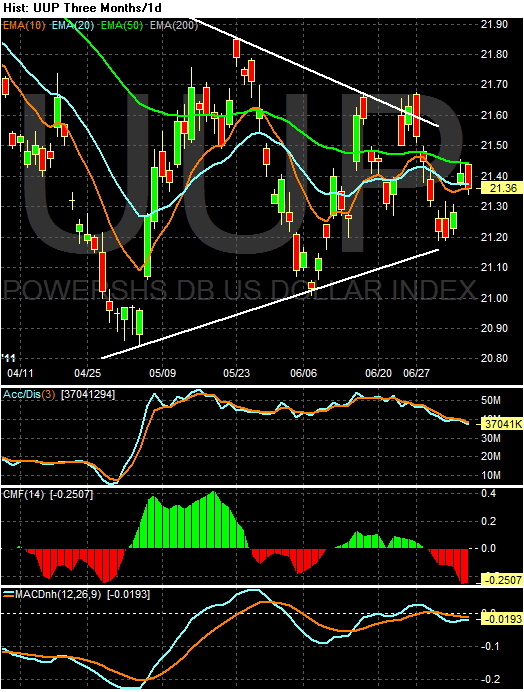
This week, the dollar continued its consolidation


The dollar is forming a classic triangle consolidation pattern right now, complete with decreasing volume. Note the EMAs are all tightly bundled and moving near horizontally.


Notice the A/D line indicates fresh money has not entered the market, which is confirmed by the low reading of the CMF. Also note the MACD is vacillating around a "0" reading right now.

This is a classic consolidation pattern in action.

The facts about Social Security and chain weighted CPI

- by New Deal democrat

There is a small furor in the political blogosphere today about Obama offering to index Social Security benefits to the "chain-weighted" CPI vs. the CPI for all urban workers, or CPI-W (the traditional measure). There is a lot of misinformation or poor information out there, including an article at the Great Orange Satan claiming that the resulting cut would only be 14 cents a month for the average recipient. Here are the facts.

Data for the chain weighted CPI has only been collected since December 1999. During the first 10 years, while the CPI-W rose 30%, the chain-weighted version rose 26.6%. On an annualized basis, that is 2.45% vs. 2.20%. In other words, so far chain-weighted CPI has averaged 0.25% less a year.

The diary on G.O.S. appears to take the 10-year average and then divide by 10, with an example that under the current system, a $1044 monthly benefit would rise to $1075.32 (a 3% increase). The diary claims that under the chain-weighted system, the payment would only go down 10 cents a month, to $1075.22. This is nonsense, it posits a change of .001%, not the .25% based on the evidence of the last 10 years.

In fact, under a chain weighted system, as opposed to the hypothetical 3% increase, the chain-weighted increase would be to $1071.77.

That's still only $3.55 a month.

The problem is, the changes are cumulative. Each year the chain-weighted index falls back further and further.
By the end of 10 years, the .25% loss of the chain-weighted increase would result in a net loss of 3.4%.
After 20 years, the loss is 5.4%.
After 30 years, the loss is 8.3%.
After 40 years, the loss is 11.1%.
After 50 years, the loss is 14%. And so on.

Hence David Dayen calculated the cumulative loss to a person retiring in 2012 would sustain a $500 loss in the year they turned 75, and a $1000 loss in the year they turned 85 under the chain-weighted system.

A tail-end boomer retiring in 2022 would face the $1000 cut by the time they turned 75.
A Gen-Xer retiring in 2032 would start out with the $1000 cut and it would get worse from there.
An early Millenial retiring in 2042 would start out with a $1500 cut a year compared with present benefits.

Those are the facts. I will leave you to your own opinion. BTW, feel free to educate the DKers, since I won't be cross-posting this.

Expect *another* poor nonfarm payrolls report tomorrow

- by New Deal democrat

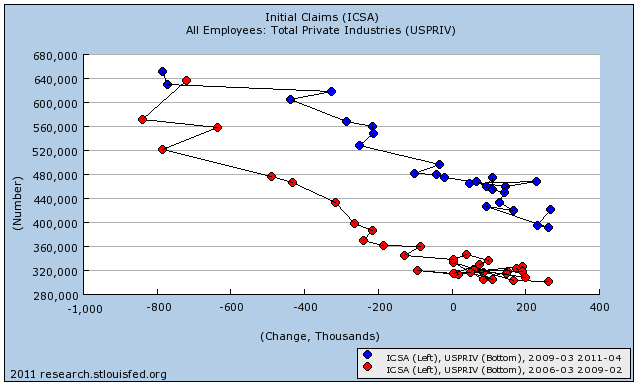
Last month, when the consensus was for a payrolls gain of about +150,000, I said to expect a report more like +50,000. I based this on the difference between how payrolls behave in the face of rising initial jobless claims vs. falling claims. For your reference, here is the scatter graph I ran last month comparing initial jobless claims vs. nonfarm payrolls, which includes the deterioration in jobs leading up to and into the recession in red vs. the improvement during the recovery in blue:


It simply makes a world of difference whether you are deteriorating into recession, or in recovery coming out of recession, leading to very different scatterplots as above (the same pattern is true for every other postwar recession).

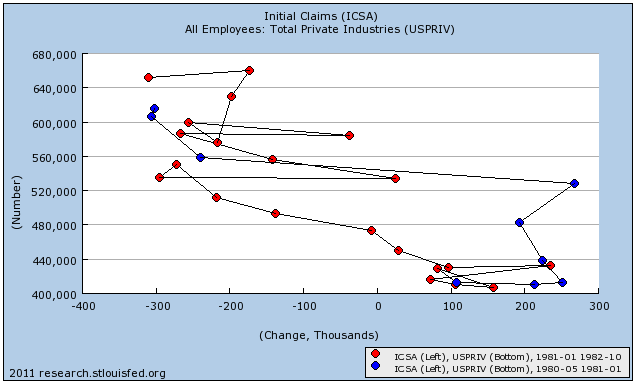
As I have previously noted, we only have one true example of a double-dip, and that is the failed 1980 recovery turning into the 1981-82 recession. Here is the scatter graph for that double dip, showing the abortive recovery (blue) and the double-dip (red):


Given the continuing initial claims in the 410,000 - 430,000 range, the poorer (red) trend on the scatterplot graphs is the one we should be referencing. More accurately, while we don't know what a new "red line" might be developing, it is almost certain to be to the left of the recent recovery "blue" line. Even with the "summer stall" last year, where GDP only fell to +1.7%, nonfarm payrolls fell into and remained in 5-digit territory.

Predicting the nonfarm payrolls number is admittedly a mug's game - there is variability of something like +/-125,000 around any estimate. This month the consensus is still for +110,000 private payrolls, and +80,000 total (meaning 30,000 lost government jobs). Unlike last month, both of these estimates look to be "in the ballpark." At the same time, a number similar to last month's looks more likely to me, and a larger loss of government jobs (which has happened in both June 2009 and June 2010). Let me put it this way: the range of reason includes a negative overall number for the first time in over a year.

Don't Expect a Second Half Rebound

The general thought process of most analysts argues for a stronger second half of the year. I am not so optimistic for the following reasons:

1.) Gas prices will not stay low. As I mentioned in today's oil market analysis, there is little hope for a continued period of low oil prices; the fundamentals of the market are simply far too bullish. Barron's article on the oil market last week summed up the basic situation:

Despite the recent 20% decline from April highs, new highs on crude, heating oil, diesel fuel, jet fuel and gasoline seem likely over the next 12 months. Following some further easing over the summer, the second leg of the long-term bull market in petroleum–the first occurred in 2007-08–probably will begin this fall.

As oil producers' spare capacity gradually declines to worrisome levels, the average monthly price could reach a record $150 per barrel by next spring, with spikes to $165 or $170. With this, $4.50-a-gallon gasoline will become the norm. That will put a huge dent in consumer wallets, while ramping up the desirability of fuel-efficient cars.

The continued short-term easing of oil prices should benefit the economy over the summer, only to exact a much larger payback later. The projected oil shock of spring 2012 will hurt the economic expansion, but not kill it, pruning about 1.5 percentage points from quarterly growth in real gross domestic product.

As such, I believe the choke hold of high oil prices will continue to exact growth concessions from the economy.

2.) The EU situation is continuing to lower overall confidence. Earlier this week, Portugal's debt was cut to junk status and there is already talk of problems with the Greek bail-out package. At this point, there is little reason to see this situation getting noticeably better -- that is, better to the point where it is no longer hurting overall confidence. Add to that the ECB is now hawkish on interest rates, and you have an added economic braking mechanism to contend with.

3.) The jobs market in the US continues to fluctuate around 9% unemployment, and initial new claims remain above 400,000. Washington is acting like its 1938 all over again, which will do nothing but hurt economic growth in the short-run as well as negatively impact confidence in the economy. Simply put, Washington is doing literally everything wrong right now, and the net result will be diminished growth.

4.) As I pointed out yesterday, Brazil now has an inverted yield curve, India's is flattening and China is raising rates and reserve requirements to lower overall inflation. In short, the central banks of the economies that drove world wide growth are raising rates to slow their respective economies. This will add to lower growth in the US, which has relied on exports to drive the last two years of expansion. We've already seen a wave of PMI slowdowns across Europe as a result.

5.) With the end of QEII, the largest buyer of treasury securities has left the market. The end result has been rising interest rates.

I seriously hope my analysis is wrong on this -- and if you see bright spots, please let me know. I just don't see any right now. At best, I see a muddling growth fluctuating around 2%.


Thursday Oil Market Analysis

Last week, I wrote the following about the oil market:
My long-term prediction for oil is for prices to again move higher and stay there because of the macro level supply/demand situation (see the link above for the charts). However, right now the chart has to move through a fair amount of technical resistance. Prices have to advance through the EMAs and several resistance levels. I would give prices through July or mid-August to accomplish that feat before moving into higher territory.
At the heart of my analysis is this basic situation:
The oil market is caught between two different issues. In the short-term, there is concern about the pace of expansion. Lower growth = lower oil demand = lower prices. However, as I pointed out above, there has been a strong, fundamental, long-term shift in the world's oil demand as countries like India and China have grown with their demand supplementing US/EU demand, providing a long-term floor under prices. But currently, these countries are also tying to slow growth due to increased inflationary pressures within their respective countries. In other words, there is currently a great deal of negative sentiment weighing down oil prices.


With 2 billion more people now demanding oil -- and supplies incredibly tight -- there is little hope for continued downward pressure on oil prices.

Simply put, there is tremendous amount of pressure on oil prices to move higher, with little to no reason for them to move lower. As such, arguing for higher oil prices is a no brainer.

Let's take a look at the chart:


Prices have sold-off for several reasons. First, the IEA coordinated a massive release of oil to offset lost production due to the Libya situation. In addition, for the last month there has been concern about the pace of economic recovery, leading traders to sell net long positions. However, we are now right in the middle of the summer driving season which will add upward pressure to prices. Additionally, nothing has changed in the supply and demand situation to warrant a change in the overall outlook.

On the chart, prices are now moving through several layers of technical resistance after their sell-off. However, they have already moved through the 10 and 20 day EMA as the MACD has printed a buy signal. The 10 day EMA is moving higher and the 20 day EMA is moving sideways. The next layers of resistance are the 50 day EMA and the 97.5/98 price level.

As I wrote last week, moving through this many layers of technical resistance takes time. I gave it about a month, which I still think seems like an adequate amount of time make this move. As such, I still see prices moving higher for the summer and for prices to be back over $100 within a month.

Wednesday, July 6, 2011

Brazil's Yield Curve is Inverted

From Bloomberg:


This is not what you want to see in an economy that is driving world growth.

China Raises Rates Again

From Bloomberg:

China raised benchmark interest rates for the third time this year after inflation accelerated to the fastest pace since July 2008.

The one-year deposit rate rises to 3.5 percent from 3.25 percent, effective tomorrow, the People’s Bank of China said on its website today. The one-year lending rate will increase to 6.56 percent from 6.31 percent.

Today’s move may fuel concern that monetary tightening will trigger a slowdown in the world’s second-biggest economy. A manufacturing index fell in June to the lowest level in 28 months on weaker growth in orders and output.

Inflation “is the Chinese authorities’ top policy priority for the near future,” Peng Wensheng, a Hong Kong-based economist with China International Capital Corp., said before the announcement.

I highlighted the increase in BRIC countries' interest rates yesterday. This is obviously more of the same. These economies are driving world growth. As they raise their rates, their economies will slow, hurting US growth.

The yield curve and pre-WW2 recessions

- by New Deal democrat

This continues my look at leading indicators as they may apply to pre-WW2 deflationary recessions. I have already looked at BAA bonds, housing starts, commodity prices, and the stock market. Today I will look at the yield curve.

Since 1960, the yield curve, in conjunction with "real M1," accurately foretold 8 of 8 recessions with no false positives. This is the "Kasriel Recession Warning Indicator" (named for Paul Kasriel of the Northern Trust Company). This indicator has also worked in reverse. If both the yield curve and real M1 were positive, the economy was expanding.

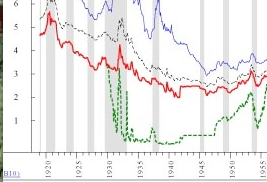
Two and a half years ago, I wrote a 5 part series, Economic Indicators during the Roaring Twenties and Great Depression, to see how well the Kasriel indicator worked before 1960. This series was sparked in large part by the most unnerving economic graph I've ever seen, from Ned Davis Research, the most relevant part of which is reproduced below:


In this graph, Fed Funds rates (pre-1935 rates are from the NY Fed) are in green, and long term government bond rates are in red (you can ignore the other two). As you can see, for virtually the entire period beginning in late 1929 and continuing right through the Great Depression and into the 1950s, the yield curve was resolutely positive. And yet that period coincided with the two worst downturns in the last 100 years, as well as three other recessions.

With help from a paper by a fellow named Ben Bernanke, I was able to reproduce graphs of long term interest rates (green), the fed funds rate (blue), and the CPI (red). Here they are for the 1920's:


And here they are for the early 1930's:


The result is, the yield curve inverted and accurately signaled the inflationary recession of 1920-21, the 1926 recession, and the onset of the 1929 "great contraction," but utterly failed to forecast its continuation, or the 1938 recession, or the two immediate post-WW2 recessions.

Of particular note, from early 1928 until late 1929, the yield curve was inverted. In fact, during 1929, with fed interest rates 6% over the CPI, the inverted yield curve (with long term bonds ~1.5%-2.5% under short term rates), was the most serious inversion until 1981 when Paul Volker killed inflation by raising interest rates some 9% over the inflation rate.

To sum up: in deflationary recessions, a positive yield curve is useless. An inverted yield curve in the face of deflation, however, does accurately signal the onset of a deflationary recession.

A Noted Increase in the Calls for Infrastructure Spending

From Hedge Fund Manager Barton Biggs:
Instead, Mr. Biggs, former chief global strategist for U.S. investment banking powerhouse Morgan Stanley, demanded the U.S. government temporarily return to ideas used in the Great Depression as a way to get the country back to higher growth.

"What the U.S. really needs is a massive infrastructure program … similar to the WPA back in the 1930s," he says.

The plan would be to employ some of the many unemployed people, jump start the economy, as well as help catch up with Asia, which is building state-of-the-art infrastructure from new mechanized port facilities to high-speed trains.

He suggested financing such building through the sale of U.S. Treasuries.

From Bill Gross of PIMCO:

Additionally and immediately, however, government must take a leading role in job creation. Conservative or even liberal agendas that cede responsibility for job creation to the private sector over the next few years are simply dazed or perhaps crazed. The private sector is the source of long-term job creation but in the short term, no rational observer can believe that global or even small businesses will invest here when the labor over there is so much cheaper. That is why trillions of dollars of corporate cash rest impotently on balance sheets awaiting global – non-U.S. – investment opportunities. Our labor force is too expensive and poorly educated for today’s marketplace.

In the near term, then, we should not rely solely on job or corporate-directed payroll tax credits because corporations may not take enough of that bait, and they’re sitting pretty as it is. Government must step up to the plate, as it should have in early 2009. An infrastructure bank to fund badly needed reconstruction projects is a commonly accepted idea, despite the limitations of the original “shovel-ready” stimulus program in 2009. Disparate experts such as GE’s Jeff Immelt, Fareed Zakaria, Jeffrey Sachs and Paul Krugman believe an infrastructure bank to be an excellent use of deficit funds: a true investment in our future. While the current administration admits that the $25 billion in Recovery Act spending on infrastructure only created 150,000 jobs, it also stabilized and improved this nation’s productivity for years to come. Clean/green energy investments also come to mind, most of which require government funding and a government thrust in order to create millions of jobs.

From Larry Summers:

Larry Summers, the outgoing director of the White House National Economic Council, said the US must ramp up spending on domestic infrastructure to drive the economic recovery.

Speaking at the Financial Times’s View from the Top conference in New York, Mr Summers called it a “short-term imperative and a long-term macroeconomic imperative” that the US government increase infrastructure investment. He said that a combination of low borrowing costs, cheap building costs and high levels of unemployment in the construction sector made this the ideal time to rebuild roads, bridges and airports.

What's interesting is the financial people don't seem to be concerned with fixing the deficit; they view the overall threat to growth as the primary problem facing the economy right now.

Treasury Tuesdays

Last week, I wrote the following about the Treasury market:
The fact that the long end of the curve didn't follow the belly higher is interesting. That and the continued deterioration in the TLT's technicals tells me the long end of the curve is selling off -- or at least holding even for awhile. I'm not convinced the IEFs are going to maintain a strong rally here, largely because the long-end of the curve is not following through. As such, I don't see the IEFs current move higher continuing. That would analysis would change if the TLTs break higher to new levels.
The Treasury market sold-ff last week. Yesterday, the WSJ today reported on the sell-off thusly:
The three-month run-up in Treasurys prices may be running out of steam—if the market isn't poised for an outright reversal. The longest selling streak in months has persuaded some analysts that yields have reached the bottom.

U.S. Treasury debt has sold off after a set of weak government debt auctions in the past five sessions—and has done so on notable trading volume. Until that point, prices had rallied since early April, fueled by a drumbeat of soft U.S. economic data and alarming headlines out of Europe.

On June 27, the benchmark yield touched a 2011 low of 2.842%. It has since catapulted above 3.20%. The 0.342 percentage-point jump in the past five sessions is the largest weekly advance since August 2009, prompting some analysts to suspect the bull run may be fizzling out. Bond yields move inversely to prices.

Goldman Sachs Group chief interest-rate strategist Francesco Garzarelli, on Thursday said he believed the Treasurys rally is over, as U.S. economic activity is expected to pick up in the second half of the year. He isn't the only one.

Barring any bad news from Europe, "we suspect the bottom is in," said Eric Green, chief U.S. rates strategist at TD Securities. He specifically pointed to the past months of weak data giving way to stronger economic growth and more attention to inflation.

Chris Ahrens, interest-rate strategist at UBS, says he sees yields pushing higher. "After a steady downward path since early April, it marks an important moment for the bond markets," he said. "The pressure is going to be on data to prove the more constructive [economic] scenario."

I'm not sold on the second half recovery story yet; although the recent action in the equity, copper and bond markets indicate traders are certainly buying into the argument. I do think the end of QEII is having a pronounced effect as the largest buyer of debt is effectively leaving the market. Let's take a look at the charts:

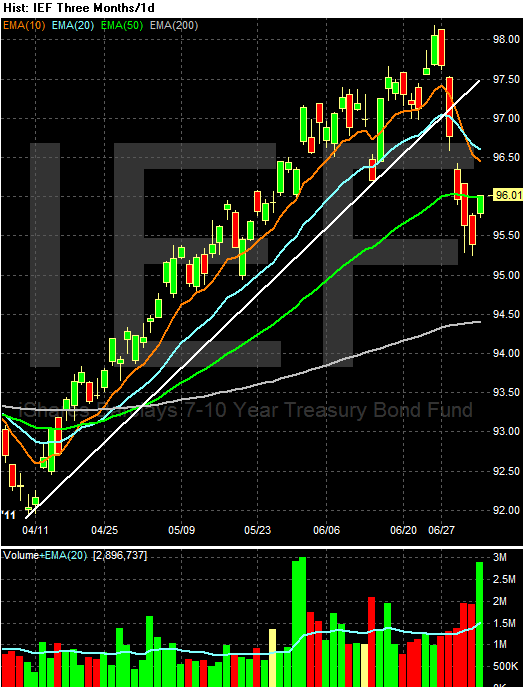
The 5-minute IEF chart shows the strength of the downtrend over the last 10 days. I've included Fibonacci retracement levels, as I would expect some type of rebound trade this week.


Prices have clearly moved below the 10, 20 and 50 day EMAs on an increase in volume. The 10, and 20 day EMA are both moving lower, and the 10 day EMA has crossed below the 20 day EMA. Prices have broken the upward sloping trend line. I would expect prices to rebound into the 10 or 20 day EMA before continuing their move lower with a price target of the 200 day EMA.


The TLT chart is slightly more bearish, as the 50 day EMA is also moving lower and prices are right below the 200 day EMA. However, notice the drop-off in volume as prices have moved lower these last two days, indicating the market may be using the 200 day EMA as a place to "pause" and catch its breath.

Given the low trading volume and the price action around the 200 day EMA, I'm thinking the TLTs will pause here or rebound into the EMAs. However, I think the IEFs are targeting the 200 day EMA. Given the Fed's departure, I believe the Treasury market is moving lower for the time being.

Tuesday, July 5, 2011

BRIC Economies Are Raising Short-Term Interest Rates

Consider the follow charts of short-term rates in China, Brazil and India:


Three of the four BRIC countries are hiking interest rates to combat inflation. Higher rates = lower growth.

Economic Week in Review

On Monday's I'm going to start looking at the previous week's major economic releases, analyzing the numbers along the same lines as used in the Fed's Beige Book. The reason is simple: this will help us all digest the news in a way that helps us understand the macro-level direction of the economy. Unlike NDD's higher frequency analysis, this will focus on the largely coincidental economic numbers that are released monthly and in some cases quarterly.

Consumer spending: Real personal consumption expenditures dropped .1%. The primary reason for the decrease is a drop in both non-durable and durable goods expenditures, which was caused by a drop in auto purchases. Real PCEs have now dropped the last two months, after a strong rise starting in early 2009. Consumer sentiment is still weak, as evidenced by both a drop in the Conference Board's number and the University of Michigan consumer sentiment number.
Link
Manufacturing: The ISM number surprised on the upside, but the new orders number was weak, as was the overall production number. In addition, the Chicago PMI also surprised on the upside. However, as I'll show later today, emerging economies are raising short-term interest rates, thereby slowing their respective economies. We've also seen signs of a slowdown at the global level in manufacturing, leading me to conclude this months numbers were abberations in an otherwise slowing manufacturing environment.

Real Estate: The good news here is the Case Shiller number increased, indicating the housing market may be bottoming. As I noted last week (see also here and here) -- and as NDD has also pointed out (see this post as well)-- it appears the housing market is closer to a bottom than conventional wisdom implies.

While the good news last week was Greece avoiding a default, the overall tenor of most reports was negative. Consumer sentiment is slipping, causing a drop in spending. Since this is 70% of US GDP, this is hardly a good development. Globally, manufacturing is in a slowdown, largely caused by emerging economies raising interest rates to control inflation.

Equity Week in Review and Preview of the Upcoming Week/Month

Last week, I wrote the following about the markets:
Right now, the 200 day EMAs are providing enough technical support to allow the markets to "catch their breath" from the recent sell-off. Traders have understandable concerns about the pace of recovery and the Greek debt situation. However, the disciplined pace of the sell-off and the stalling of the descent at the 200 day EMA indicate there is enough bullish sentiment to give the market pause -- at least for now.

However, a strong, multiple market break (involving 2 of the 3 major averages) below the 200 day EMA would be a watershed moment for this market. Should that happen, I would wait for a rebound into an EMA and then short.
I obviously did not see the strength of last weeks advance. Take a look at this five minute chart:


That is an incredibly strong rally that lasted for the entire week. All the EMAs are moving higher, prices are using the EMAs for technical support and there is a strong uptrend in place. The chart is printing a series of higher highs and higher lows -- a classic rally chart.


Prices have clearly bounced off the 200 day EMA and moved through all the EMAs. All the EMAs are moving higher, and the 10 day EMA has crossed over the 20 day EMA. Also note the strength of the bars, especially Friday's. Four of the five bars last week have very long bodies, indicating prices advanced throughout the day. There was also a nice bump up in volume for the last three trading days of the week. The fact the market did not sell-off on Friday is incredibly encouraging.


The A/D and CMF all indicate that money is flowing into the market, and the MACD indicates momentum is increasing.


The above chart shows possible support levels in case of a market pullback, which would be expected after a strong rally like that which occurred last week.

This week's rally was caused by three factors: first, we had end of the quarter fund manager window dressing, which forced managers with extra cash to put it to work. Second, the Greek vote agreeing to new austerity measures means the problems caused by the EU periphery have abated at least for now. Third, the market was oversold.

At this point, we should acknowledge that the stock market is a leading indicator. The question now becomes, was this week's advance a sign that equity traders think the worst is over, and therefore it's time to get into the action? The weakness in the Treasury market last week would bear this out, as would the rise in the oil market and copper's recent advance through key resistance areas. However, I'm personally not sold on a third or fourth quarter rebound yet. Consumer spending is weakening, global manufacturing is softening, emerging economies are increasing interest rates (US exports have been strong during the recovery) and Washington is full of idiots doing everything they can to screw up the economy. I would need to see an advance through previous highs on multiple indexes (with the Russell 2000 being one) before I'm sold on the veracity of this rally.

Monday, July 4, 2011

Happy Fourth of July

We'll be back tomorrow morning when the markets open

Friday, July 1, 2011

Weekly Indicators: manufacturing and commercial construction improve edition

- by New Deal democrat

Monthly data released this week showed relief from the manufacturing slowdown, as the Chicago PME rebounded to a strong 61.0 and the ISM manufacturing survey also rebounded to 55.3. The employment, new orders, and vendor delivery components were also up slightly.

New construction spending was mixed, with residential construction in May down 2%, but nonresidential construction up 1.2%. Residential construction is meandering near the bottom of a 3% range established since last July, while nonresidential construction has essentially been flat so far this year (i.e., it appears to be bottoming).

Real personal income was flat, and real personal spending decreased -0.3% in May, indicating further impact of high gas prices, and consumer confidence and University of Michigan consumer sentiment were both down. The Case-Shiller house index also declined, but but not as much as expected.

The high-frequency weekly indicators were also mixed this week.

Let's start with the good:

YoY weekly median asking house prices from 54 metropolitan areas at Housing Tracker showed that the asking prices declined only -3.5% YoY. This is the best reading since May 2007. The areas with double-digit YoY% declines decreased by three to 7. The areas with YoY% increases in price increased by four to 7. This adds more weight to the belief that in nominal if not real terms housing prices may bottom as early as this winter.

The ICSC reported that same store sales for the week of June 25 increased 3.0% YoY, and increased 2.9% week over week. This is the best YoY comparison in a month. Shoppertrak failed to report this week.

Other series remained in their recent range:

M1 was up 0.5% w/w, up 0.2% m/m, and up 12.5% YoY, so Real M1 was up 9.1%.
M2 was up 0.3% w/w, up 0.5% m/m, and up 5.2% YoY, so Real M2 was up 1.8%.
Real M1 remains very bullish, while Real M2 remains stuck in the caution zone under 2.5%

The BLS reported that Initial jobless claims last week were 428,000. The four week average increased slightly to 426,750. We appear to have stabilized under 430,000.

The Mortgage Bankers' Association reported that seasonally adjusted mortgage applications decreased 3.0% last week. It was 4.5% higher than this week last year. This is the fifth week in a row that YoY comparisons in purchase mortgages were positive. Except for the rush at the two deadlines for the $8000 mortgage credit, these are the first YoY increases since 2007. Refinancing decreased 7.6% w/w despite a decline in mortgage rates.

Topping the weak or bad numbers is the report from Railfax, which was up a mere 1.3% YoY for the week. Baseline traffic is actually down 662 carloads from a year ago. Cyclical traffic was also down, 7141 carloads YoY. Intermodal traffic (a proxy for imports and exports) was the only component up this week, at +19,128 carloads YoY. This series is very close to turning negative on a carload basis.

Oil was near $94 a barrel midday Friday, right at the level of 4% of GDP which according to Oil analyst Steve Kopits is the point at which a recession has been triggered in the past. Gas at the pump fell for the sixth week in a row, declining $.08 more to $3.57 a gallon. Gasoline usage at 9261 M gallons was -2.2% lower than last year's 9462. This is the first time in five weeks that gasoline usage has been significantly less than last year.

The American Staffing Association Index remained at 87 for the third week in a row This series is just barely above a stall, and is a significant danger sign. It is weaker than early 2007, but not trending down as during the recession.

Weekly BAA commercial bond rates remained the same at 5.73%. This compares with yields on 10 year treasury bonds decreasing .01% to 2.99%. The continuing decline in treasury rates shows fear of deflation, and the relative increase in corporate rates shows a slight increase in relative distress in the corporate market.

Adjusting +1.07% due to the 2011 tax compromise, the Daily Treasury Statement showed that for the first 21 days of June 2011, $135.2 B was collected vs. $136.5 B a year ago, for a decrease of $1.3 B YoY. For the last 20 days, $134.8 B was collected vs. $115.9 B a year ago, for an increase of $18.9 B, or 15%. Use this series with extra caution because the adjustment for the withholding tax compromise is only a best guess, and may be significantly incorrect.

While much of the data shows a stall, almost none of it shows any actual decline in economic activity. Housing and Oil prices continue to appear to be moving in the right direction. Contractionary fiscal policy coming out of Versailles remains the biggest risk.

Have a happy and safe Fourth of July weekend!

Stock prices and pre-WW2 recessions

- by New Deal democrat

This continues my look at leading indicators as they may apply to pre-WW2 deflationary recessions. I have already looked at BAA bonds, housing starts, and commodity prices. Stock market prices, in the form of the S&P 500, of course are part of the modern set of LEI. How did they perform in the Roaring Twenties and Great Depression? Let's have a look.

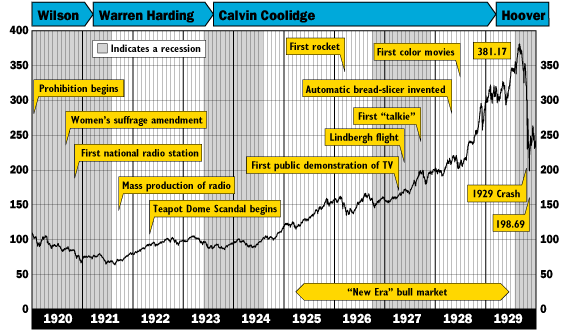
Here is a graph of the DJIA (the S&P 500 wasn't created until later) during the Roaring Twenties:


The 1920-21 recession was very much like the 1981-82 recession. High inflation during WW1 was broken via a deep but short-lived bust. Thereafter while the stock market did accurately top and bottom before the peak and trough of the 1923 recession, it rose right through the 1926-27 recession and infamously topped in September 1929 after the downturn that became the Great Depression had already begun.
For a more detailed look, here is a chart of the yearly highs and lows of the DJIA, with the date of those highs/lows in parenthesis, compared with recession dates:

YearYr. high (date)Yr. low (date)Recession dates
1920108.76 (Apr) 66.75 (Dec) 1/20-
192181.50 (Dec) 63.90 (Aug) - 7/21
1922103.43 (Aug) 78.59 (Nov) -
1923105.38 (Mar) 85.76 (Oct) 5/23-
1924120.51 (Dec) 88.33 (May) -7/24
1925159.39 (Nov)115.00 (Mar) -
1926166.64 (Aug) 135.20 (Mar) 10/26-
1927202.40 (Dec) 152.73 (Jan) -11/27
1928300.00 (Dec) 191.33 (Feb) -
1929381.17 (Sep) 198.69 (Nov) 8/29-
1930294.00 (Apr) 157.51 (Dec) cont.
1931194.36 (Feb) 73.79 (Dec) cont.
193288.78 (Mar)41.22 (Jul) cont.
1933108.67 (Jul) 50.16 (Feb) -3/33
1934110.74 (Feb) 88.57 (Jul) -
1935148.44 (Nov)96.71 (Mar)-
1936184.90 (Nov) 143.11 (Jan) -
1937194.40 (Mar) 113.64 (Nov) 5/37-
1938159.51 (Nov) 96.95 (Mar) -6/38
1939155.92 (Sep)121.44 (Apr) -
1940152.80 (Jan)111.84(Jun) -


The DJIA did make a trough in 1932 before the end of the contractionary part of the Great Depression, and did both peak and trough before the economic peak and trough of the 1937-38 recession.

Of the 9 total economic peaks and troughs in this period, the DJIA was a leading indicator 5 times, coincident 2 times, and missed one recession altogether. In short, useful but not perfect.

Manufacturing Slowdown is Global

Over the last two months or so, we've seen a variety of US manufacturing indexes show signs of a slowdown. However, the slowdown is not limited to the US

From Bloomberg

Manufacturing growth is slowing in from China to Europe, creating a dilemma for central bankers considering higher interest rates to combat inflation.

China’s factory index fell to the lowest level since February 2009, while in the 17-nation euro area, a gauge slipped to to an 18-month low. German manufacturing expanded at the weakest pace in 17 months, while Italy, Ireland, Spain and Greece contracted.

“There is a broad-based slowdown taking place in the manufacturing sector,” Silvio Peruzzo, an economist at Royal Bank of Scotland Plc in London, said by telephone. “But it’s still too early to jump on the view that we’re heading toward an environment where activity will be contracting.”

Europe’s debt crisis and slowing U.S. growth are damping demand for goods, putting pressure on policy makers to delay further rate increases even as prices gain. Inflation quickened to the fastest pace since 2008 in China, exceeded 20 percent in Vietnam last month and prompted protests in India. Euro-area inflation remained at 2.7 percent in June, exceeding the European Central Bank’s 2 percent ceiling for a seventh month.

Inflation pressures have prompted Asian central banks to be among the quickest to withdraw monetary stimulus as growth accelerated following the global recession in 2009. India, South Korea, Thailand and Taiwan raised their benchmark rates last month to contain rising prices, while China ordered lenders to set aside more cash as reserves.

See also this article from the WSJ

The article highlights the basic global themes we've seen over the last few months.

1.) Inflation is accelerating in emerging economies -- the same economies that are now the engine of global growth. As inflation has accelerated, emerging economy central banks have raised their respective rates. In fact -- we've seen emerging market's bond markets go inverted over the last few months.

2.) Not mentioned in the article -- but of equal importance -- is the effect of the Japanese earthquake, which has negatively impacted a variety of manufacturing issues.

3.) The US appears be hitting a slowdown caused by a lack of consumer confidence. With unemployment still high, job growth weak, gas prices high and political paralysis the standard method of conflict resolution in Washington, consumers appear to be lessening their spending on all but necessities at this point. As this makes up 70% of GDP growth, the overall impact is quite negative.