I've been writing about this topic for well over a year, and here we are again.
Reading the punditry is an excellent exercise in watching cognitive psychology at work. If you are a gold-bug like Mish, then the slowdown is about money printing. The Fed must be abolished and the gold standard re-adopted. If you are the Calafia Beach Pundit (Scott Grannis), then the slowdown is about the failure of Keynesian stimulus. To the contrary, if you are Paul Krugman, then the slowdown is about the inadequacy of the stimulus. And if you are Robert Reich, it is about failure to put spending power in the hands of ordinary Americans.
In short, the slowdown is like a Rohrshach blot onto which pre-existing worldviews are projected.
It ought to be clear that my political sympathies are with Krugman and Reich, but I'm not sure we need a particularly sophisticated explanation for the slowdown. Making use of Occam's razor, we can simply say that it is all about Oil prices. Here is a graph for the last 6 years of inflation-adjusted Oil prices where January 2010 prices = 1, where Oil analyst Steve Kopits' metric of Oil at 4% of GDP = $90 (blue). Real GDP growth is in red (*25 to make use of the same scale):
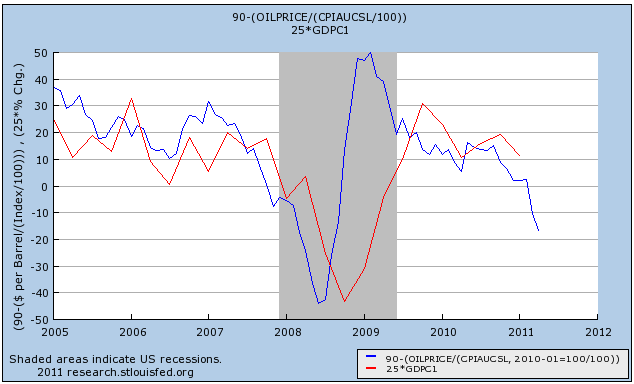
Over that time period, simply knowing the "real" price of Oil has been an excellent forecasting tool for GDP in the same or next quarter. (You may recall that Prof. James Hamilton found that his energy price shock model explained about half of the decline in the great recession).
As to other suggested contributing factors, Japan has just shifted demand back a quarter or two. If production slows now due to an availability of parts, it will make up the difference once the parts supply returns to normal.
As to Europe, if it were a real problem, we would see financial fear spiking again. To the contrary, as I pointed out last week, both the TED spread and LIBOR are comatose.
So the stop-and-go recovery comes back to a lack of a sustainable strong increase in consumer demand. Part of that is housing still being flat on its back, part of it is stagnating if not declining household wealth and near-deflation in wages. And how much consumers do have to spend in the productive economy depends very much on the wildly fluctuating price of Oil, which in turn is serving as a choke collar, cutting off the oxygen flow every time the recovery starts to run.


3 comments:
When we started down the slope into the recession, the prescription for what ailed us was Keynesian fiscal stimulus. The government could make up for the shortfall by borrowing money to spend in today's economy to be paid off when the economy recovered. We did do that to an extent, but not nearly enough to really get us out of the hole.
The one blessing we had was that China and India hit the recession as a minor speed bump and got back to growing. So while domestic demand was flat and government spending only provided modest stimulus, overseas we had demand growth that helped stave off the worst of the recession. The problem we face now is that China and India are facing inflationary pressures and are in the process of trying to clamp down on that. The odds of them doing that without inducing a recession there or at least a significant drop in growth is pretty low.
So now we find our economy once again in a precarious position. Demand overseas is falling, unemployment is still high and the housing market is continuing to fall. The choke collar of oil is a problem, yes, but will likely ease as inflationary pressures in east Asia abate.
The solution would be to extend and boost stimulus but, of course, all the fools in DC are talking up deficits and budget cuts. It's all sounding a lot like the recipe from 1937 playing out again.
Now to one point you make about TED and LIBOR. My concern is that these indicators are functionally meaningless right now. All of the major banks on the planet are being implicitly backed by various nations. You're safe loaning money to Bank of America because the Fed will save them, so why would those rates spike?
So we have these too big to fail institutions still making enormous speculative bets on the economy with little visibility into what exactly they are doing. In the event of even a small down turn, leverage effects could take minor bad investments by those banks and turn them into major crises very quickly without a hint of problems on the LIBOR or TED benchmarks.
Having said all of that, maybe we need a small down turn to prove that the system is stable. That if we weather a slow down in growth without a major crisis, it will boost confidence and finally get the economy growing at a good clip again. It will be interesting to see what happens...
Oh, NDd, it's time now for some meta about the misapplication of Occam's Razor.
Most people misunderstand the concept behind Occam's Razor because of Carl Sagan's (ironic) oversimplification of it as expressed in his otherwise wonderful book and movie "Contact".
It is completely true that Occam's Razor is designed to simplify and clarify complicated ideas, but how it's done and what it is designed to accomplish are often misconstrued.
The basic premise is this: Occam's Razor seeks to discover Truth by stripping away and discarding that which is False.
Imagine that Truth is known to be contained within an apple. Using a razor to carefully shave from the edge of the apple a slender slice that is known NOT to contain the Truth, we can be sure that Truth is still contained within the reduced apple. Carefully repeat the process, and the shape of the Truth becomes more and more clear, even though we can never be sure that we have ever removed all slices of Untruth away from it.
In short, Occam's Razor is a metaphor for how Science works:
Science seeks Truth by eliminating that which is False. Truth is never known with certainty -- it is merely suggested -- and is ALWAYS subject to falsification.
Professor Sagan was wrong when he let his character, Ellie Arroway, suggest that Occam's Razor was only about simplification. It is instead about clarifying Truth, however complex it might be.
To your point of economics, NDd, I would suggest that saying current economic conditions all come down to oil prices is NOT an example of Occam's Razor. I think it may go a slice or two too far.
Could it be that you have misapplied Occam's Razor so as to project the economic slowdown into your OWN pre-existing worldview?
The earliest definition of Occam's Razor:
Pluralitas non est ponenda sine necessitate.
- simply translated as -
The number of explanations shouldn't be more than necessary;
and the later formulation:
Entia non sunt multiplicanda praeter necessitatem.
- interpreted as -
If you can explain something by a simple theory, you should discard other - more complicated ones.
Post a Comment