- by New Deal democrat
You may recall that several weeks ago I looked for data series which turned before April, and were warnings of the deflationary downdraft. Among those were the behavior of bonds vs. stocks, and the Shanghai stock market.
Here is a one year graph of the 10 year treasury vs. stocks. Focus on the last month:
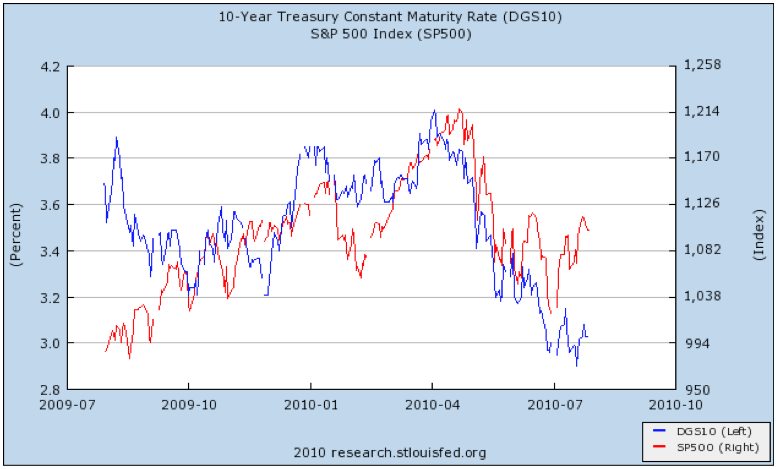
For the first time in 6 months, bonds and stocks are moving in opposite directions. Bond yields have generally continued to decline, while stocks have gone up over 10%. This means that the markets are no longer primarily concerned with deflation, but rather expansion. Note that this pattern mirrors that of a year ago, when the economy started to expand.
Now look at the Shanghai stock index:
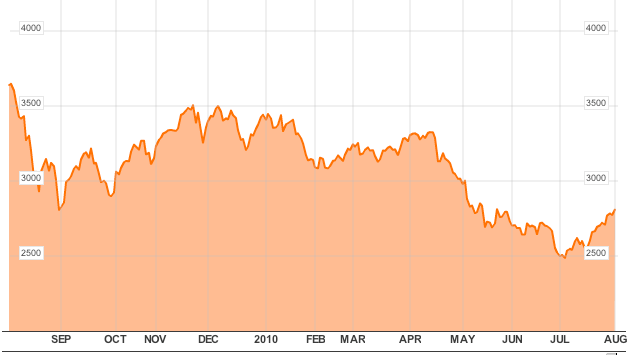
Remember that Shanghai for the last few years has tended to lead Wall Street. This index confirms that the upturn in US stocks is not a fluke.
The other indicators that turned before April included the purchase mortgage index, which may have bottomed several weeks ago. BAA commercial bond yields are now declining again. Oil closed over $80 again yesterday, which is bad news in terms of increased impact on the consumer, but good news in that a drop in demand is not the predominate issue. So far, this is all short term, but the turns in trend are welcome news if they are sustained.
This correlates with what has happened in the real world, in which the April downdraft marked the confluence of the Euro crisis (which has abated), the BP oil catastrophe (which has been capped), the expiration of aid to the states (which may be reinstated this week), the expiration of the $8000 housing credit (the negative reaction to which may have bottomed), and near $90 Oil (which did fall but is now back at $80 again).

3 comments:
I dunno anything about bond/stock prices. But I know that 4 big corporate employers have agreed to sponsor our office to the tune of $5,000 for a year. That's 3 more than we've had for a couple of years. They wouldn't spend the money if they weren't getting ready to hire college students. Anecdotal evidence that Thing Are Getting Better. utahgirl
You've just outlined the reasons that I became more long in the SPY in the past week or so. But this rally is occurring not on good economic data anyway but rather on currently low interest rates (except European soveriegn debt for many countries), the opening of US and European corporate debt markets, and the possibility of easing in China. These are similar conditions that sparked the equity market rally in early 2009. But the difference then compared to now is quite strong in many respects. First, in spring 2009 we were at the beginning of a massive money printing program, an inventory rebuild, a fiscal stimulus, and a little pent up demand. While now there is no money printing (or a little as the FEd balance sheet continues to mysteriously expand), the fiscal stimulus has already peaked, and the inventory rebuild is essentially over.
What's also much worse now is the trade deficit. The US is again seeing subtractions from GDP due to the trade imbalance. Back from 2004-2007 the trade deficit sapped nearly $800 billion per year from the US economy. We could afford that then during the housing bubble, but I don't think we can afford to lose $500 billion per year or more which we're not at.
With the fillibuster against the job's bill broken today in the senate, I'm more confident that the economy will barely manage to keep out of a double dip recession this fall. I also don't believe that failure to renew the Bush tax cuts will hurt the economy. Actually, contrary to popular belief, a strong economic recovery followed that last two tax increases in 1982 and 1993. My theory is that tax increases during times of large federal budget deficits in a poor economic environment ensured that productive public spending would continue. I suspect that allowing the Bush tax cuts expire (which was passed and signed by a Replican control fed. govt nine years ago)will give confidence to teachers, other public employees, and other workers whose jobs depend on public funding, that their jobs will be preserved for some time. This will allow them to increase their consumption, stimulating the economy.
However, I won't be surprised if we have one quarter of negative growth.
Post a Comment