As Bonddad pointed out a couple of days ago, Consumer Credit is up:

This brought to mind something I wrote 6 months ago:
One of the gloomy meme's du jour for the last few days has been how the record year-over-year post-WW2 drop in consumer credit presages worse times ahead. For example, the King of All Doomers had said:
Today, consumer credit contracted at a pace that is shockingly twice as bad as March, even though the March contraction was the biggest drop since 1990....
Now, I haven't heard any update on that from the Doomers in the last week, have you?
Here was my response then:
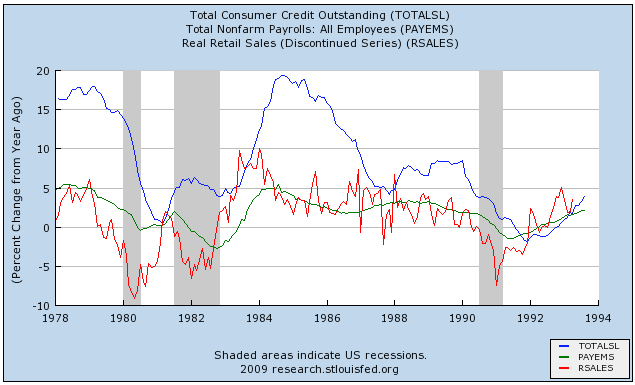
There's just one small problem with that analysis. Consumer credit is a totally reliable lagging indicator. Here's a couple of graphs showing the relationship among 3 data series: real retail sales (red), jobs (green), and consumer credit (blue). I have graphed in year-over-year terms to better show the trend, so this is the "first derivative" of the "real" numbers -- but the general relationship holds for the "actual" numbers as well. Notice the order in which each series turns.Here's the 1980s and 1991 recessions:
and here is the then-current data for the "Great Recession":
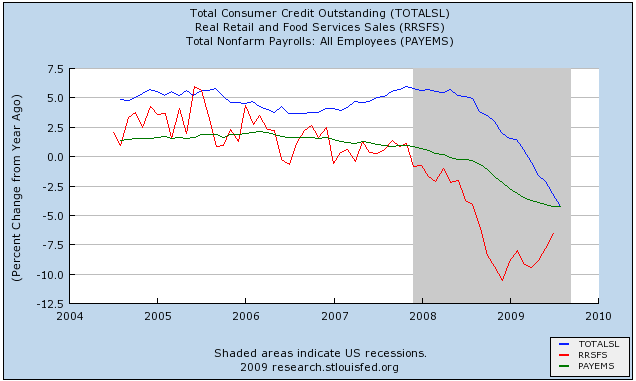
I continued:
The order is unmistakably clear (and it goes back as far as the data has been kept);Here is the same graph, updated through January's data, reported last Friday (green and red lines from the above graph are reversed):
1. First, real retail sales turn (red).
2. Then, jobs turn (green).
3. Finally, about a year after real retail sales turn, consumer credit turns (blue).
Real retail sales turned in December 2008.
Jobs are turning now.
Consumer credit will probably turn in about December.
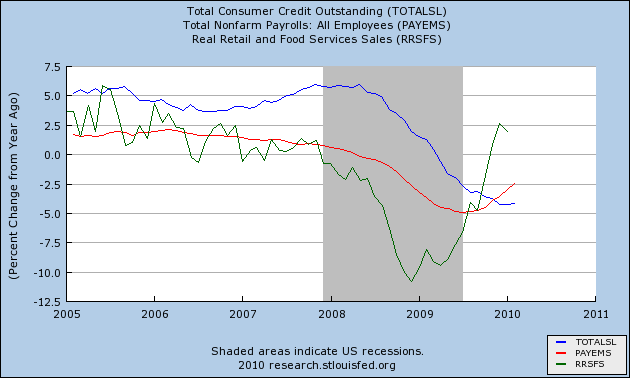
The updated graph shows that:
1. First, real retail sales turned.
2. Then, jobs turned.
3. Consumer credit bottomed in December and turned positive in January. Just as I said it would.
You're reading the right blog.


4 comments:
The comments about consumer credit turning up are a bit flawed.
http://www.federalreserve.gov/releases/g19/hist/cc_hist_mh.htm
The only category it went up was government. Private credit continues to contract substantially. The biggest reason govt credit has gone up so much is because they're in the auto business now and are giving everybody a loan who wants one to buy their cars. Credit from commercial banks continues to weaken dramatically per tonights new data:
http://www.federalreserve.gov/releases/h8/current/default.htm
The retail sales data is highly flawed. First, much of the increase over the past year has been because of gasoline and food prices. The rest is because consumer spending has been highly subsidized by the federal govt, whether from cash for clunkers, payroll tax cuts, stimulus checks, early tax return payouts this year, emergency unemployment benefits, and the huge general (and unsustainable) budget deficit.
Also note that past months retail sales continue to get revised down. This is because retail sales are guaged by a survey, and sales for non-respondents are estimated, even if they go out of business, because the surveyors are unaware that those companies have gone out of business until months later. The late April revisions in retail sales should capture a lot of this and revised sales down for all of last year.
The fact that the federal govt has helped subsidize consumer spending doesn't mean the data is flawed. The whole point of payroll tax cuts, stimulus checks, early tax return payouts this year, emergency unemployment benefits, and the huge (and unsustainable) budget deficit has been to help stimulate consumer spending, and thus, the economy.
Had it NOT helped stimulate consumer spending, then it could be said that those programs weren't working. Since it is helping to stimulate consumer spending, then it can be said that those programs are working.
Had the stimulus been even bigger, then the economy would be doing even better. The Chinese economy is doing well because their stimulus was gigantic.
Anon 1,
The first link you have only gives a breakdown by NSA. The SA shows a clear trend of improvement in the slope.
Second link is more interesting. If you actually look at the historical data on that one, there is nothing "cyclical" about it. Total commercial bank credit continued to expand right through the 1973-74, 1980, 1981-82, 1990-91, and 2001 recessions. The latest crisis is the first ever sustained decline in commercial credit, possibly since WWII.
What this tells us is that we are facing a Depressionary environment in the private sector for the first time since WWII.
Post a Comment