Tuesday, February 13, 2007

Trade Deficit Expands and Sets Another Record

From Bloomberg:

he U.S. trade deficit increased more than forecast in December as the price of imported petroleum rose and purchases of foreign cars and consumer goods reached records.

The gap between imports and exports widened 5.3 percent to $61.2 billion in December, from a 16-month low of $58.1 billion in November, the Commerce Department said today in Washington. For all of 2006, the trade imbalance expanded to a record $763.6 billion.

Higher petroleum prices in December increased the value of oil and gas imports into the U.S. Prices have since receded, and economists expect economic growth overseas, combined with the continued weakness in the dollar, will boost demand for U.S. products and keep the trade gap in check.

``The big picture is exports are growing, but in '06, imports grew faster, particularly consumer goods from China,'' said Chris Low, chief economist at FTN Financial in New York. ``We are looking for a small downward revision'' in fourth- quarter economic growth based on today's figures, he said.


Now we understand why the dollar chart for the last 4-years is in a big downtrend.
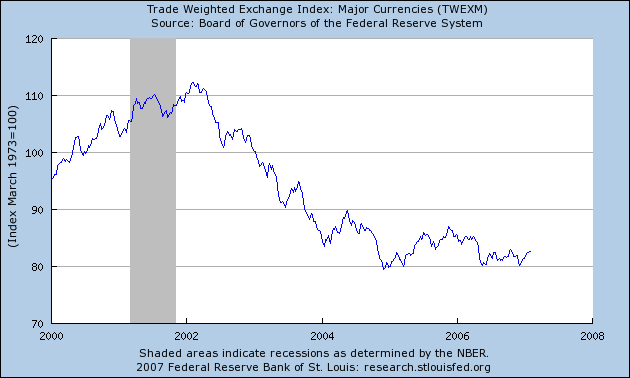
Photobucket - Video and Image Hosting

6 comments:

Charles said...

I'm not sure why this should be a surprise. The supply of dollars is bottomless, so the price falls.

The real question is why the price should have stabilized. I have seen things that suggest to me that there is off-the-books creation of dollars. The back-calculated M-3 values that you discussed earlier are one.

BruceMcF said...

The supply of most of the major traded currencies is bottomless, in the sense that the central banks more target interest rates than money supply (and on the occasion that they try to target money supply, they are a rather sorry failure) ... and those that peg in today's world must do so by maintaining an undervalued rate to protect against speculative attacks.

As to why the US dollar stabilized ... do bear in mind that the Chinese currency roughly pegs to the dollar (its a Singapore peg, so the basis of the peg is obscured), so that trade and investment flows between China and Japan and China and Europe also spill over into the value of the US$ against the Euro, Yen and Pound Stirling.

IOW, the constant acquisition of US$ as official FX reserves in order to keep the yuan stable and low against the dollar is also a factor in slowing down the fall of the US$ against other major capital flow currencies.

Charles said...

I understand about the purchase of dollars by China and Japan, Bruce. This has been going on for decades, as countries that want to export (either to maintain high employment or to earn hard currency) deliberately keep their currency weak, perhaps through a peg or perhaps through low interest rates.

But the supply of currency is not supposed to be bottomless. When a country issues more currency, it is supposed to issue more debt. In other words, it acquires currency in the present at the cost of losing currency in the future. When countries try to cheat, they get inflation, which reduces the value of their existing currency.

What we have seen in the US is extraordinarily high liquidity, leading to all this M&A activity. That would not be surprising: corporate profits have been very high. But when the price of oil and the yen/dollar start falling, that's a surprise. High liquidity should cause a rise in oil and a fall in the value of the dollar.

BruceMcF said...

Charles, the government is the issuer of its local currency. The policy decision by the central bank is what interest rate to maintain ... or in some cases, what exchange rate to maintain ... and the amount of currency issued is a side-effect of pursuit of that policy.

Charles said...

Bruce, central banks can set discount (short-term) rates and depositary requirements. The growth in the size of the private sector means that these have less and less impact on rates that the financial system uses for most transactions, which tend to be longer-term.

In addition, central banks can buy and sell securities to impact the money supply and influence rates at the margins. But to go outside of a relatively narrow range of parameters, there has to be formal notice taken on the balance sheet through the issuance of debt.

I have come across a report that the Bush Administration is literally printing money to fund the so-called "war on terror." I mean giving plates to the CIA and letting them print $100 bills. As long as that sort of activity is relatively modest in size, it would not impact the soundness of the financial system. But as we have learned, the Bush Administration does nothing modestly.

BruceMcF said...

This all is a diversion from the point I raised above.

And, yes, nations have been relying on discounted exchange rates to support pegged exchange rates since the collapse of Bretton Woods ... but what is historic is the size of the US trade and current account deficit.

A trade deficit of in excess of 6% of GDP ... with imports in excess of 15% of GDP and exports only 9% ... that's a lot of money that the Bank of China (and other peggers, many of them in ASEAN) have to soak up to avoid an increase in exchange rates.

China has judged that unemployment is a more serious threat to its political stability than the standard of living expansion it is giving up for the top 20% ... and so is exporting unemployment to the US. And that fits in perfectly for the current administration, which faced with the same choice prefers the standard of living expansion for the top 20%.