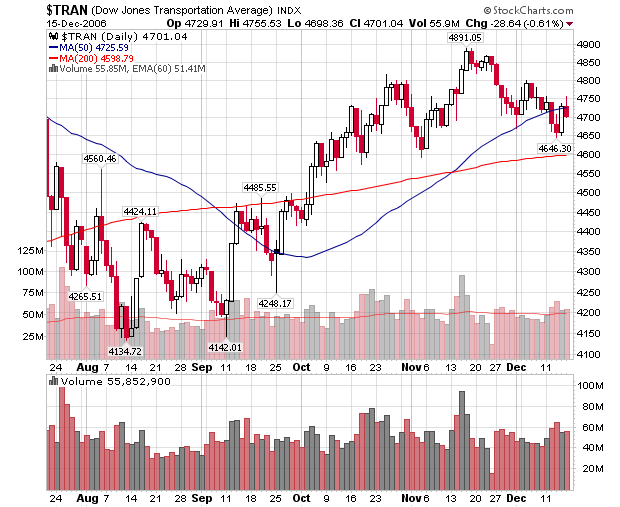
The main reason for this is trucking's poor price performance. Here is a 5-year chart from prophet.net.
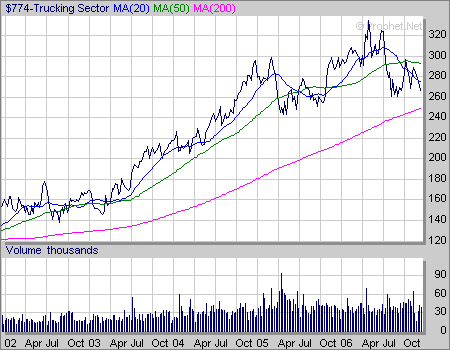
With the rise of online shopping and the Christmas season upon us, you'd think air transport companies would be rallying. But they've sold-off a touch. Additionally, they failed to make a new high when they had a chance over the last few weeks. Here's a 5-year chart.
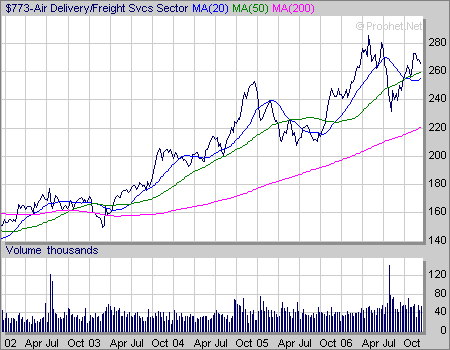
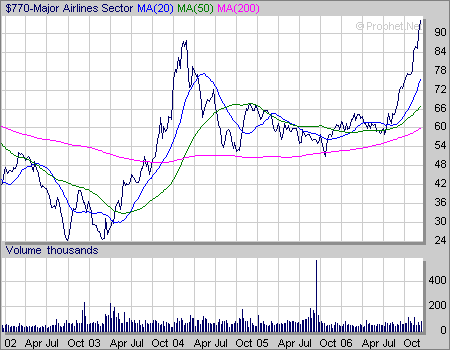
Regional and major airlines have been rallying, but largely on news of consolidation, not an improvement in business conditions. While some of the larger carriers are doing better, the industry still has to contend with incredibly high overhead making a continuation of profits difficult. So while these sectors are rallying, they are doing so for an industry specific reason -- consolidation -- rather than an improvement in overall business conditions. Below is a 5-year chart for the majors and regionals, respectively.
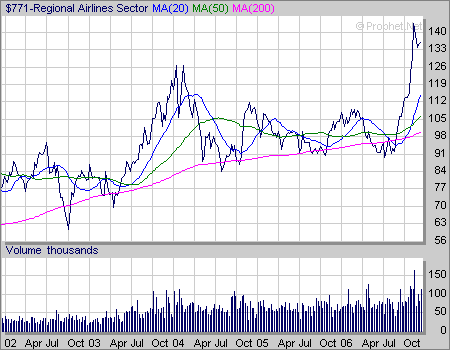
So -- is the Dow theory still relevant? Only time will tell. But -- it's worth considering.


10 comments:
Could argue it is not as relevant as it used to be as we don't have much manufacturing anymore, but on the other had the economy is consumption driven and those goods have to get to market somehow.
I think it's still relevant. As you mention, goods have to get from point A to B. They type of good is irrelevant.
Intervening variable is the price of energy.
melvynBut isn't the transportation problem really between sea ports and major cities? If so, the price of the ocean liner fuel (not diesel) may be key. Maybe people are just buying items with a higher price density (dollars/volume)?
When Dow Theory was invented, nearly all the components in the DOW were heavy users of transportation. Look at the components today: AIG, PFE, MSFT, AXP, C, T are not big users of transportation to get their product to market.
Dismissing divergences between the DJIA and DJTA is foolish. But when divergences do occur, they may be less relevant today than they were 100 years ago when Charles created the theory.
anonymous --
I agree to a point. But Redfish noted above that US GDP growth is heavily dependent on consumer spending. To do that, consumers have to buy goods, which have to get to market somehow. I would also add that with the increased use of the internet for shopping, shipping is important as well.
The preceding may indicate the more correct correlation is between consumer related issues -- consumer staples, retail etc... -- and the transports.
Wow. You've only been live here for what, a couple weeks, bonddad, and already you have a nice link from Barry R. (for your retail sales post, below)
Congrats.
Slightly more on topic, I'm beginning to think that Bush's self-induced reality is winning out over my reality-based reality. It's very difficult to understand just what the heck is going on with the markets, the economic reporting, all of it.
Saw you on big picture too, congrats the blog is doing great!
redfish and semper --
Thanks for the cudos. I am flattered the Big Picture would mention me. It is one of my favorite blogs.
Bonddad said... anonymous --
I agree to a point. But Redfish noted above that US GDP growth is heavily dependent on consumer spending. To do that, consumers have to buy goods, which have to get to market somehow. I would also add that with the increased use of the internet for shopping, shipping is important as well.
Of course, to the extent that some of that shipping occurs via USPS, it may be hard to buy into that stock. And while increasing reliance on online shopping also seems to imply increased business for UPS/FedEx/USPS, there is also the online shopping at places like iTunes where the Internet is the delivery medium.
But what really strikes me about an energy market where crude oil advanced to $80/barrel, nearly the level in real dollars of the second OPEC oil price shock, and has now retreated to $60/barrel ... transport may be caught betwixt and between. If we know that we are heading to $100/barrel oil next summer, you obviously buy into rail. If we know that we are going to stay stable at about $60/barrel for the next three-four years, there's still good reason to buy into trucking.
But if we know that we don't know, and expect to get a much better read when we see what happens this summer, than there is a case that can be made for adopting a watching brief ... which leaves transport sitting while people wait to get a better idea of what to expect.
Post a Comment