Saturday, March 30, 2019

Weekly Indicators for March 25 - 29 at Seeking Alpha


 - by New Deal democrat

My Weekly Indicators post is up at Seeking Alpha.

There were a number of important changes in the outlook this week.

As usual, clicking over and reading should not just be educational for you, but also rewards me a little bit for my efforts.

Friday, March 29, 2019

Real personal income and spending sag


 - by New Deal democrat

Along with jobs and wages, household and personal income and spending are my main focus on how average Americans are doing in the economy.

We’ll get the next jobs report a week from now, but today we got - almost updated to the present - January personal income and February personal spending.

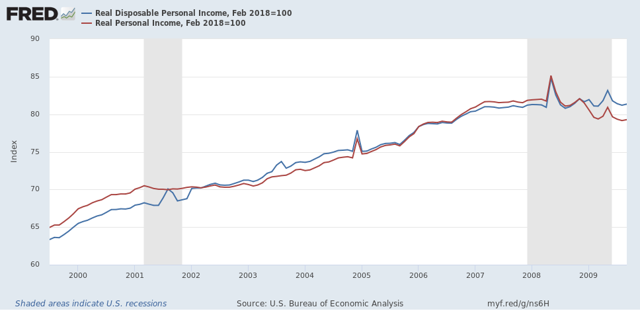
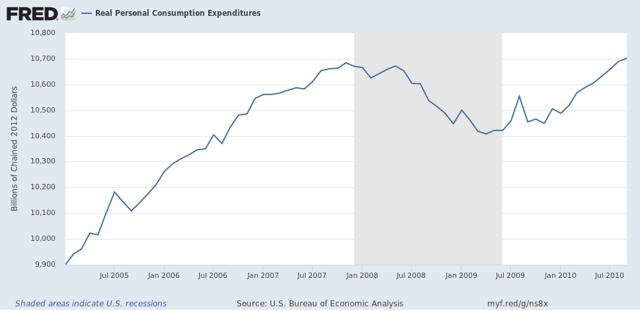
First of all, in my rubric of long leading, short leading, and coincident indicators, both of these are coincident. They tend to top out, or at least sharply decelerate, right when a recession begins. Here’s the performance of income including the last two recessions, and spending for the last one:


So they really tell us nothing about the future of the economy.

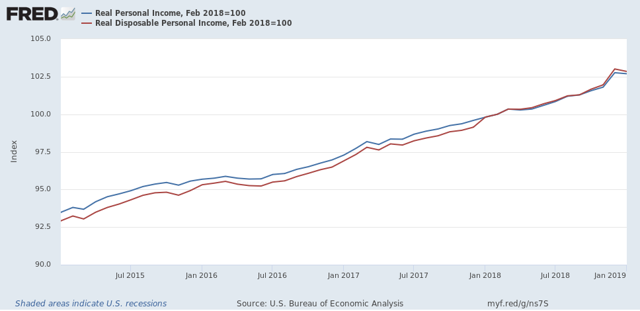
Now, to the data. Adjusted for inflation, incomes fell -0.2% in January


These have declined ever so slightly in the past two months, although they are up +2.7% and +3.0% since last February. Nominally incomes rose +0.2% in February, but we won’t have the inflation-adjusted figure until next month. If the deflator is in line with consumer inflation, which rose +0.2% in February, then real personal incomes will be flat.

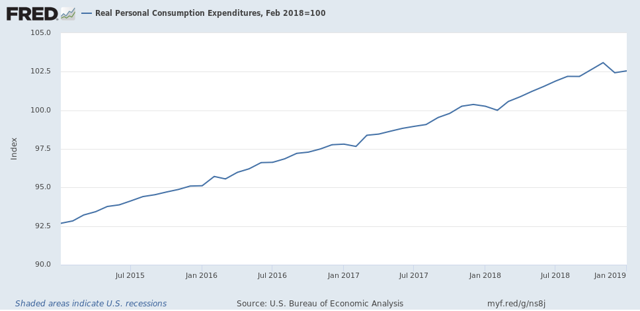
Personal spending declined -0.1% nominally in January, but rose +0.1% adjusted for inflation, after a decline in December:


These are weak reports, in line with the slowdown forecast I made last summer. Where they go from here will have a lot to do with whether the Fed lowers rates quickly or not, and whether or not there are more boneheaded economic moves from the Administration.

Thursday, March 28, 2019

The last long leading indicator, corporate profits, declined in Q4 2018


 - by New Deal democrat

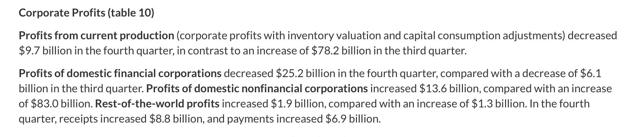
Three months after the quarter ended, corporate profits for Q4 of 2018 were reported this morning, and they were down slightly (-0.1%). Here’s the quote from the BEA:
Corporate profits deflated by unit labor costs are a long leading indicator. Since these costs were already reported at +1.6% q/q, that means that adjusted corporate profits were down about the same percentage.
Earlier, proprietors income for Q4 had been reported at positive, but that is a less accurate placeholder. In contrast, Q4 corporate earnings for the S&P 500, with 99.7% reporting, declined over -3% q/q.
This means that, in Q4 of last year, almost *all* of the long leading indicators declined, the first time that has happened since - perhaps not coincidentally - shortly before the last recession.

Wednesday, March 27, 2019

Here’s a model that didn’t pan out in 2018


 - by New Deal democrat 

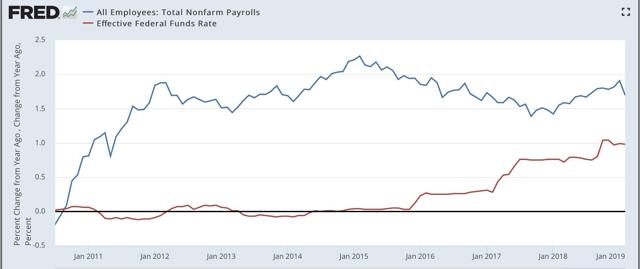
A little over a year ago, I proposed A simple model of interest rates and the jobs market. As I explained at the time, “during the past such era of [low interest rates in] 1930-1955 several recessions including the very bad 1938 recession occurred without a yield curve inversion, I have been looking at alternative measures.” 

What I found was that “a YoY increase in the Fed funds rate equal to the YoY% change in job growth has in the past almost infallibly been correlated with a recession within roughly 12 months.”

Here’s the graph I posted of “the relationship I describe in the above paragraph over the last 60+ years:”   


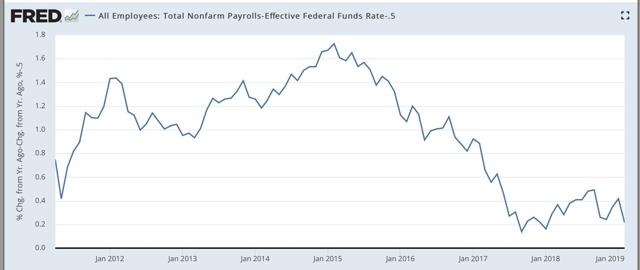
Another graph “subtract[ed] the YoY change in the Fed funds rate from YoY payroll growth, and subtracts a further -0.5%, showing that even when the relationship gets that close, with the exception of 2002-03 (a near recession), a recession has always followed:”


“In other words, there is only one false positive with two false negatives in the 1950s.”

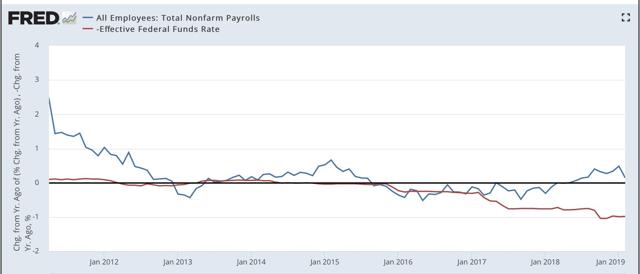
I further wrote that “because the YoY change in the Fed funds rate also does a very good job forecasting the *rate* of YoY change in payrolls 12 to 24 months out, as shown in the below graph (note that the Fed funds rate is inverted, so that a rise in that rate forecasts a deceleration in YoY jobs growth):”


I concluded that  “Currently [in March 2018] the spread is about +0.7%. Note that if the rate of YoY payrolls growth continues to decelerate at its pace from the last several years, and we get the three expected Fed funds hikes this year, we will probably cross the +0.5% threshold by year's end.”


In the last year, I haven’t referred to this model very much, and there’s a reason: it really hasn’t panned out.
To begin with, the YoY growth rate of jobs, instead of declining towards the rate of change in the Fed funds rate, instead increased (at least through January!):


More importantly, the model specifically forecast that the second derivative, i.e., the rate of change in job growth, followed the inverse of the change in the Fed funds rate (i.e., an increase of 1% in the Fed funds rate should lead to a decrease of 1% in the rate of job growth YoY). Instead, the opposite happened:


The only manner in which the analysis held up is that the rate of change in jobs growth never did decline to below +0.5% YoY, which almost always indicated a recession was near (note the graph below subtracts -0.5% from the result, so that the zero line is the decisive point):


So the forecast from one year ago of a decline in jobs growth to 0.5% of less was a complete bust.
Most likely, this was because of the boost to consumption spending beginning in late 2017 first as part of recovery efforts from the hurricanes and fires that year, and second as part of the tax cut stimulus (which even if inefficient and inequitable, was nevertheless a stimulus).
With these two factors no longer in play in YoY numbers, will the relationship reassert itself, in part or in full, completely knocking out the 2018 job gains? I don’t know. If something significant happens to answer this one way or the other, I will update.
But, because the forecast was so incorrect in 2018, I am reluctant to rely upon it as a “no recession” indicator now.

Tuesday, March 26, 2019

February housing data indicates slump not over UPDATED


 - by New Deal democrat

Housing data, in the form of February permits and starts, finally caught up after the government shutdown. Two sources of house price data were also released this morning.

The bottom line is that, depending on how you measure, housing construction is likely either at or just slightly above a short term bottom. Price growth, meanwhile, continues to decelerate.

I have a more detailed analysis in the queue at Seeking Alpha. Once it is published, I will link to it here.

UPDATE: Here’s the link to the Seeking Alpha article. As always, reading this not only should help you understand what is going on this important market, but rewards me a little bit for my efforts.

Monday, March 25, 2019

The coming slowdown in employment


 - by New Deal democrat

Last summer I wrote a piece entitled “What the compressed yield curve means for employment.” I re-read it over the weekend, and in light of what has been going on in the bond market, I thought it was worth an update.

Let me pretty much re-quote the entire piece:
————

Four times during the 1980s and 1990s the difference in the interest yield between 2 and 10 year treasury bonds got about as low as it is now [Note: i.e., August 2018] (blue in the graphs below). That occurred in 1984, 1986, 1994, and 1998. 

Even though on none of those 4 occasions a recession followed, on 3 of 4 of those occasions YoY employment gains (red, divided by 2 for scale) subsequently declined:


In both 1984 and 1994, YoY employment gains peaked within 2 months of the low point in the yield spread. In the 1980s, that decline continued right through and a little beyond the 1986 low in spreads. In both cases YoY gains in employment declined by roughly half. Only in 1998 was there no appreciable effect.

On all 4 of those occasions the Fed lowered interest rates until the economy started to rebound - quickly in the case of 3 of them.

In other words, even if the Fed stops raising rates now [as of August 2018], and the yield curve does not get tighter or fully invert, my expectation is that monthly employment gains will decline to about half of what they have recently been -- i.e., to about 100,000 a month -- during the next year or so.
——-
- End of quote

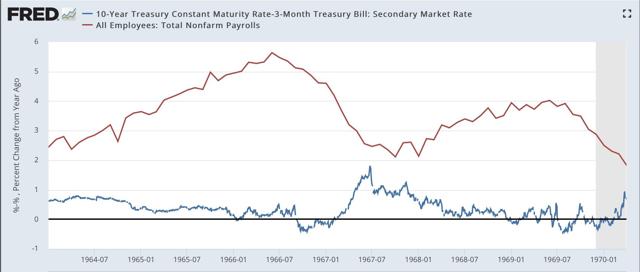
In the last week, I’ve noted that the current yield curve inversion also looks very much like the slowdown of 1966, so let’s look at what happened to employment then as well (note I am using the 10 year vs. 3 month rate, since the 2 year treasury doesn’t go back that far):

 YoY employment growth slowed down sharply, from over 5% to just above 2%.

Let me put this in all caps for emphasis: GOING BACK OVER 60 YEARS, ON 12 OF 13 TIMES THAT THE YIELD CURVE WAS AS COMPRESSED AS THIS, OR EVEN JUST NEARLY AS COMPRESSED, EMPLOYMENT GROWTH SLOWED DOWN BY AT LEAST 50% MEASURED YEAR OVER YEAR, INCLUDING BOTH RECESSIONS AND SLOWDOWNS.

Nothing is perfect, but that’s about as tight a correlation as you can get.

Returning to the present, since last August the Fed did not stop raising rates, raising them twice more in September and December. Most of the yield curve - although notably, neither the 2 year vs. 10 year, or 10 year vs. 30 yer ranges - has inverted.

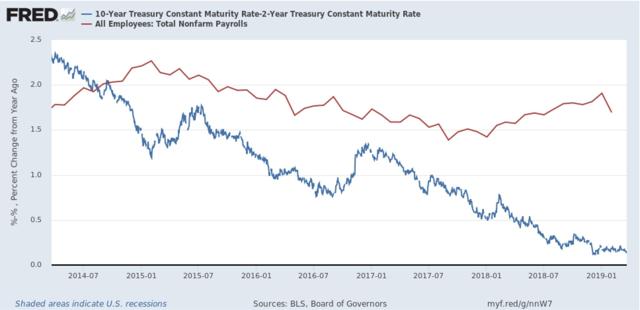
So let’s look at the same comparison of bond spreads and YoY employment for the last five years below:


Even if the Fed starts to lower rates soon, I strongly suspect that January was the YoY peak in employment, and we have started down the road to roughly 100,000/month employment gains - if not worse - later this year. 

Saturday, March 23, 2019

Weekly Indicators for March 18 - 22 at Seeking Alpha


 - by New Deal democrat

My Weekly Indicators post is up at Seeking Alpha.

As you can imagine, the big news was about the fact that almost every single yield curve there is - except the one I report on every week in that post - inverted yesterday.

Also, as I mentioned in an e-mail to a couple of folks this morning, the big thing that bothers me is that ***EVERYONE*** is watching it. And a forecasting tool that everyone pays attention to, ceases to be an accurate forecasting tool. It’s called “Second Order Chaos.” Humans are very clever and intelligent chimpanzees, and when you observe them, they observe you back, and react to the observation.

Anyway, as usual, clicking over and reading helps reward me with a little $$$ for my efforts.

Friday, March 22, 2019

... And, the 10 year treasury yield inverts


 - by New Deal democrat

Yesterday over at Seeking Alpha I wrote about how the Fed is boxed in. The essence of the article is that, while lower rates are good for the housing market, a fuller yield curve inversion adds to the evidence that a recession may take place first, unless the Fed completely reverses course and starts cutting interest rates very soon.

Please click on over and read the whole article. Not only should it be educational for you, but it rewards me a little for my efforts in writing about the economy.
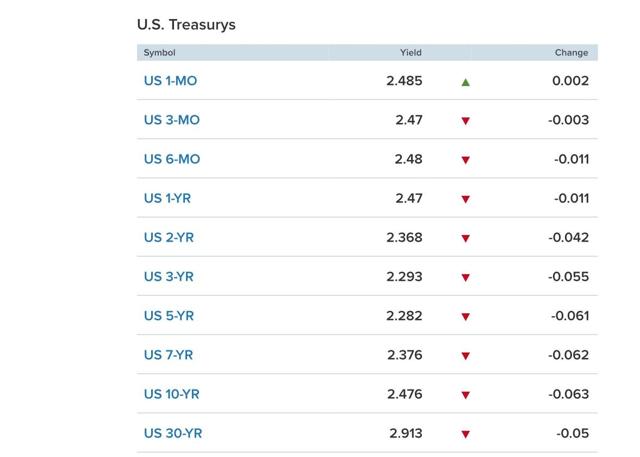
And so what do I see when I check out interest rates this morning? This:
For the first time, the yield curve inversion has spread to the 10 year Treasury, which is yielding less than either the 6 month or even the one month Treasury bill.
On December 3, the 2- and 3- to 5 year Treasury yield inverted, with the shorter maturities paying more than the longer maturity.
The next morning in a post entitled “The Camel’s Nose is in the Tent - Maybe,” which I’ll quote from at length below:
———-
Most of the commentary you have read probably boils down to an assertion that this is bad (it is) and that a recession is now likely in the next 12 to 24 months (maybe). ...
[Historically, w]hen the 2 to 5 year spread [has] inverted, typically the 2 to 10 year spread did so simultaneously or very shortly, as in days or a week, later. Usually later, so did the 10 to 30 year spread. In fact, when all three of those levels were in inversion simultaneously, a recession always followed within 12 to 24 months. But, even if we just consider the 2 to 5 year spread, its inversion usually was a prelude to a full spread inversion of the yield curve.
In other words, as the saying goes, "the camel's nose is in the tent." If you're not familiar with the saying, it means that the rest of the camel is likely to soon follow, with bad consequences for the people in the tent.
———-
I went on to note a few exceptions:
———
1. Several times - at the end of 1994 and the beginning of 1998 -- an inversion only happened for one day or even only intraday. [That did] not signal an oncoming recession ....
2. The 10 to 30 year spread had a number of false positives. We don't have to worry about that for now.
3. [T]he second half of 1998 a false positive as well, since no recession began until nearly 3 years after the inversion started, and over two years after it ended....
....
Most significantly, as in 1998, the Fed might react. If you are aware of the history of an inversion, and if I am aware of the history of an inversion, and if all of the other commentators who are writing about it are aware of the history of an inversion ... then don't you think the Fed and its economists might possibly discuss the possible implications of an inversion[?] ....The Fed is an actor. The Fed has agency. The Fed can affect the future course of the bond market. The Fed can react to this news if it chooses, and thereby change the future.
————
As I noted yesterday, the Fed did indirectly (via a steep stock market sell-off) respond to that inversion by changing its tone several weeks later, and earlier this week it pretty much eliminated the likelihood of any further rate hikes this year. But as I also noted, that might not be enough. The Fed may need to cut rates, and very soon, in order to stave off.a recession.
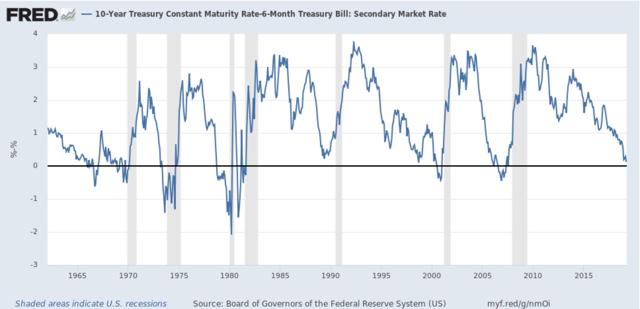
So let’s update through this morning. First, here’s what the 10 year minus 6 month treasury yield spread looks like for the past 60 years:
Aside from exactly one day in 1998, the only false positive was in 1966. Every other time this range inverted, a recession followed.
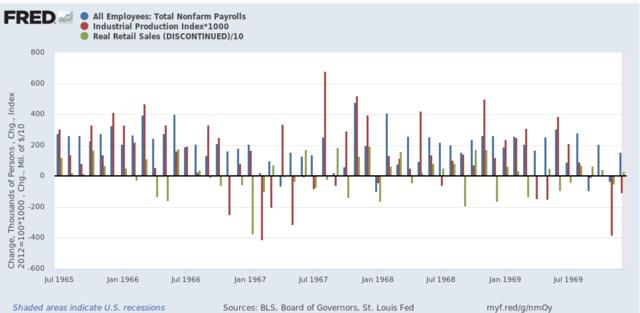
Following the inversion in 1966, the economy barely missed a recession, as payrolls, industrial production, and real retail sales all decline for several months or more in 1967:
Only real income continued to grow strongly, and real GDP only downshifted to near zero for one quarter in 1967.
And as I pointed out yesterday, the Fed lowered rates only 4 months after the inversion.
Meanwhile, virtually the last of the positive long leading indicators, corporate profits, finally get reported for Q4 next week. Earnings for the S&P 500 declined in Q4, and if corporate profits did too, then almost all of my long leading indicators will be flashing red.

Thursday, March 21, 2019

A couple of nuggets of good economic news


 - by New Deal democrat

Sometimes there is almost no economic news at all. This isn’t one of those times. 

Because there have been increasingly ominous signs among the long leading indicators, that have been spilling over into the short leading indicators, suddenly there are a lot of signs and portents to look at. A lot less about jobs and wages that I keep exclusively here.
So, once again I got waylaid preparing a long piece for Seeking Alpha, on how the Fed may need to *cut* rates quickly in order to avoid a recession, that may not get posted until tomorrow.
In the meantime, here are a couple of graphs to give you something to chew on.
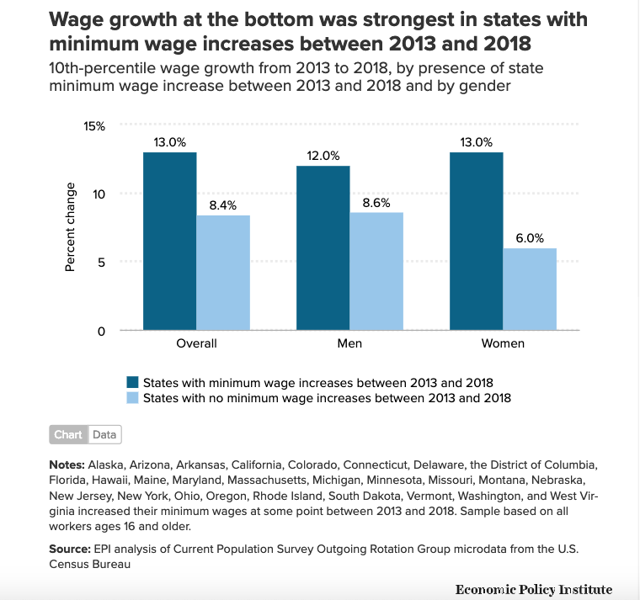
First, I’ve noted in the last few months how wages for ordinary workers have started to take off. A few people have pointed out that it may be less due to overall tightness in the labor market and more due to statutory minimum wage increases.
It looks like they’ve got a good point. Here’s a graph of wage growth for low wage workers in states that have raised the minimum wage vs. those that have not:
Pretty self-explanatory.
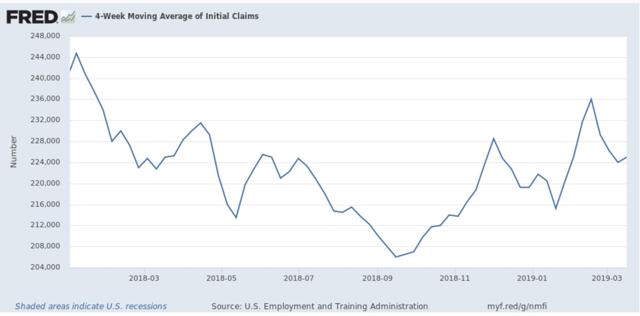
Second, recently the number of initial jobless claims has risen somewhat. The good news is, that number has backed off from the spike that occurred during the government shutdown:


The four week moving average of initial claims, at 225,000, is only about 9% above its low point 6 months ago. That does show some weakness, but not enough to warrant even a yellow caution flag at this point.

Wednesday, March 20, 2019

The widened Panama Canal is disrupting internal US transportation patterns


 - by New Deal democrat

The newly-widened Panama Canal opened to traffic in late 2016. Since then, there have been several ongoing disruptions in how goods are transported from suppliers in Asia to their ultimate markets in the US, including affects on seaports, trucking, and rail.

This post is up at Seeking Alpha.  As usual, clicking over and reading should be educational for you, and helps reward me for my work.

Tuesday, March 19, 2019

Over 50% of all wealth in the US is inherited not earned


 - by New Deal democrat

I got waylaid putting together a very detailed post about how the newly-widened Panama Canal is disrupting the internal US transportation network. When it goes up at Seeking Alpha, I’ll link to it.

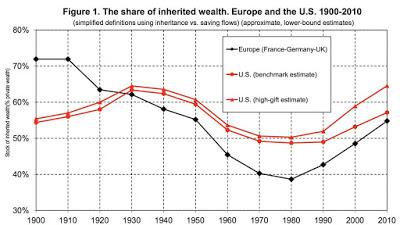
In the meantime, here is something that I found a week or two ago for you to chew on. Over half of all US wealth is not earned but inherited:


According to a report summarized recently in the Washington Post“The wealthiest 1 percent of American households own 40 percent of the country's wealth.”

It’s likely that about 25% of all wealth in the US is inherited of the top 1%. I strongly suspect the relationship is even more egregious at the level of the top 0.1% and top 0.01%.

It’s hard to argue that the US is at all a meritocracy when the starting points are so distorted.

Monday, March 18, 2019

The government shutdown may have caused a mini-recession


 - by New Deal democrat

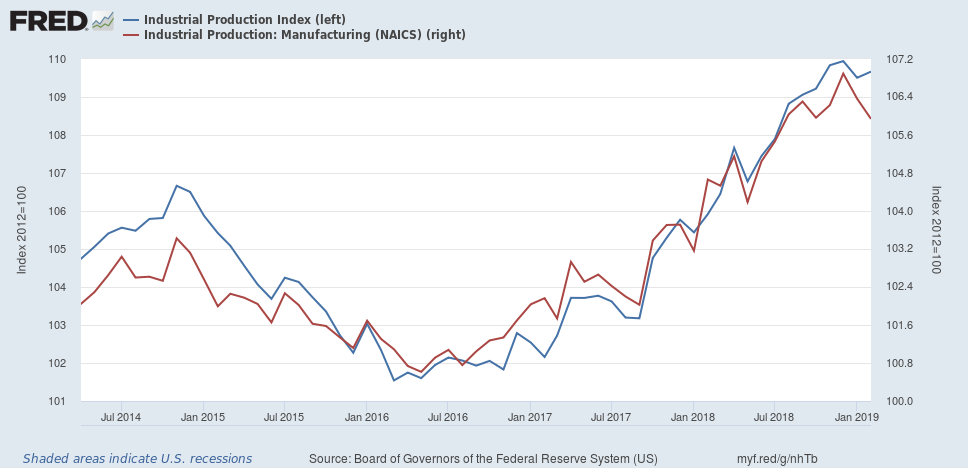
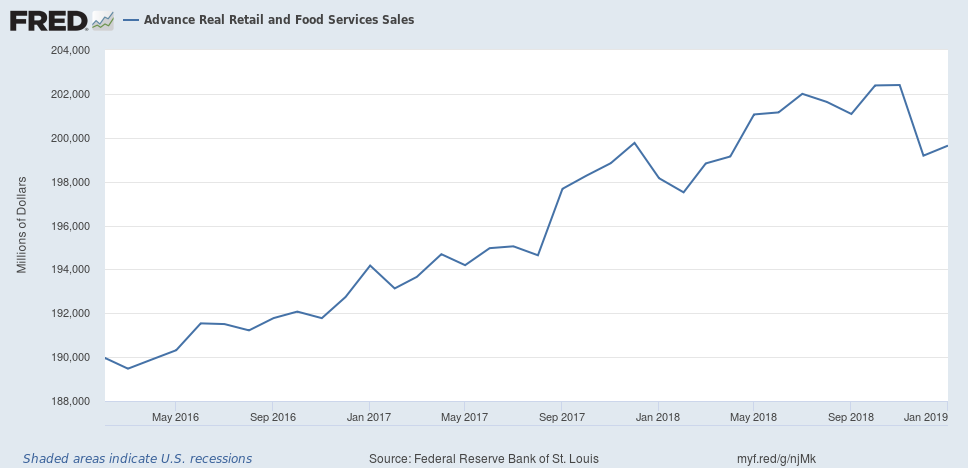
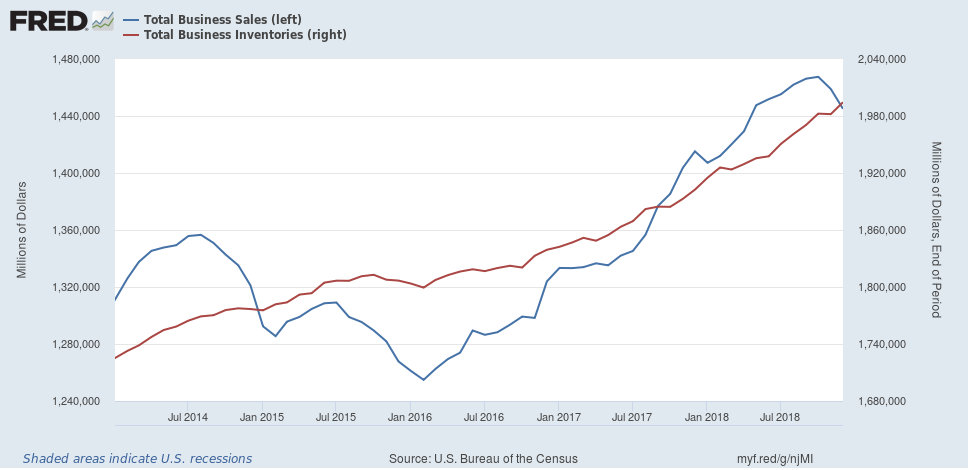
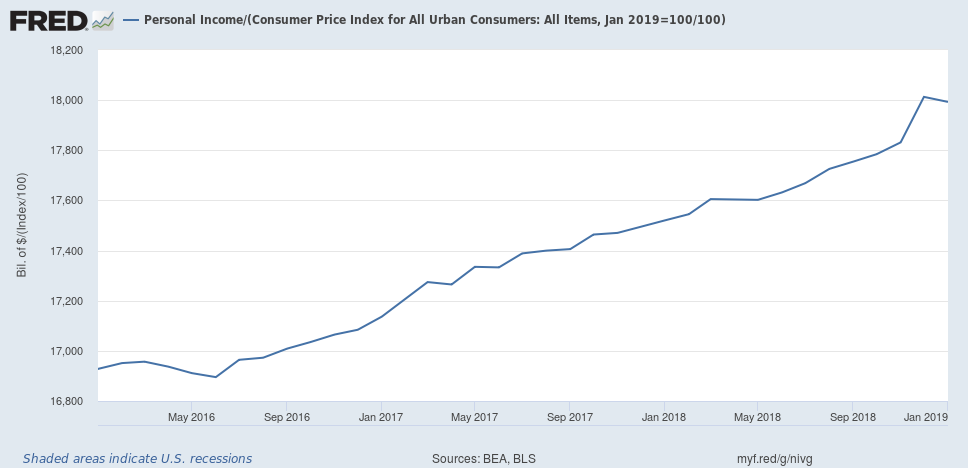
Aside from being a monumentally poor policy outcome, and aside from the hardship it caused nearly a million workers, the government shutdown may also have caused a general contraction in production, sales, and income, and a slowdown in employment, that if it were longer would qualify as a recession.
Because the affected three months straddle Q4 2018 and Q1 2019, both quarters will likely show positive real GDP growth, it won’t be a recession. Let’s call it a mini-recession.
Although shorthand for a recession is two quarters of GDP contraction, that wasn’t the case for 2001, and the NBER has indicated that a general downturn in production, employment, sales, and income are the crucial criteria. So let’s look at each.
Industrial production declined significantly in December, and the small rebound in January was not enough to overcome that downturn. This is especially true of the manufacturing component:
The same is also true of real retail sales:
But lest you think that retail sales were an outlier, here are general business sales (including manufacturers’ and wholesalers’ sales)(BLUE) which also peaked in November, and inventories (red):
I included both because sales lead inventories, as is shown for the 2015-16 “shallow industrial recession” in the graph.
The NBER pays attention to “real personal income less transfer payments.” Since we don’t have the deflator for January, nor the amount of transfer payments, I am making use of CPI as a placeholder for the deflator:
These increased strongly in December, but declined in January.
Finally, here is employment:
No decline here, but one of the three lowest monthly readings in February. And of course, this is well within the range of being revised to a negative over the next several months.
Put the four series together, and you get a picture of an economy that in terms of production, employment, income, and sales suddenly contracted in December and January.
Assuming these series bounce back no later than March - which I expect to happen - the downturn isn’t deep enough nor long enough to qualify as a recession. But the government shutdown may have done significantly more damage than was projected at the time. And this highlights how poor pubic policy, whether it comes from the Fed, the Congress, or the Administration, can very quickly topple a slowing economy into outright recession.

Sunday, March 17, 2019

Preventing Presidential autocracy: thoughts on reining in Executive power


 - by New Deal democrat

 Matt Yglesias posted a jarring tweet this past week when he wrote:


He elaborated by linking to a long-form article he wrote four years ago, explaining his position, where in relevant part, he wrote:
America's constitutional democracy is going to collapse. 
Some day ... there is going to be a collapse of the legal and political order and its replacement by something else. If we're lucky, it won't be violent. If we're very lucky, it will lead us to tackle the underlying problems and result in a better, more robust, political system. If we're less lucky, well, then, something worse will happen.
.... 
In a 1990 essay, the late Yale political scientist Juan Linz observed that "aside from the United States, only Chile has managed a century and a half of relatively undisturbed constitutional continuity under presidential government — but Chilean democracy broke down in the 1970s."
Yglesias — and Linz — saved me a lot of work. Because I had long ago heard that the US was the only Presidential democracy that hadn’t succumbed to autocratic rule. That was precisely Linz’s finding. At this point the only other democracies that I know of that come close are Costa Rica (since the last coup of 1948) and the Fourth and Fifth French Republics (since 1945).

Historically, the problem has been that, over time, in any Presidential system, the President accretes more and more power (vs. a corrupt, ineffective, and/or deadlocked Legislature) until the Legislature degenerates into a toothless rubber-stamp, or else is disbanded by a President turned autocrat.

The US has not been immune. The first six Presidents, through John Quincy Adams, saw themselves as “Chief Magistrates,” only vetoing laws they thought were unconstitutional, and at least approximating a meritocracy in their limited number of appointments.  That began to change with Andrew Jackson, who vetoed any legislation that did not exactly conform to his wishes, and initiated the “spoils system” of appointing only political backers to government posts.

With the vast expansion of the bureaucracy during the 20th Century, Presidents obtained much more power via all of the appointments they were able to make. And following the Second World War, the large and permanent global military footprint enabled lots of chances for the Commander in Chief to flex his muscle.

Now we are getting very close to the final crossroads. Obama committed troops to Syria after the Congress completely gave up their war-making authority, preferring to sit on the sidelines and snipe. Trump’s declaration of an emergency simply because he could not get what he wanted out of Congress, if upheld by the Supreme Court, all but ensures that government by Executive Decree, that can only be overruled by a 2/3’s majority of both Houses of Congress, will probably quite soon become the norm.

In fact, Trump’s refusal of the GOP’s compromise proposal is almost certainly because, now that he has found this powerful new toy, he intends to use it more.

Once Presidential Emergency Edicts become more routine, unless this or any future President’s party fails to seat at least 1/3 + 1 in both Houses of Congress, why even bother convening?   

The bottom line is, I agree with Yglesias. We are on the way to autocratic Presidential rule unless the power of the Presidency is definitively reined in.

So, how should the Executive be reined in? Obviously, this must be via Constitutional changes. Below are my considered opinions for how to do that.

The mixed Presidential-parliamentary system used, for example, in France, in which some Executive powers are vested in a “Premier” or “Prime Minister” who is a member of the Legislature seem to be the best remedy. In the US, there are seven Presidential powers that ought to be either limited, or devolved in whole or in part to the Congress or its Legislative head:

1. Appointment of rule-making authorities in the bureaucracy (vs. adjudicating authorities, whose appointments would remain with the President). For example, the SEC both makes rules for corporate governance, and enforces those rules. The President ought to be completely taken out of the former, Legislative, role. Those regulators should be appointed solely by Congress.

2. Aside from full declaration of war, or the need for an emergency response, devolution of the authority for taking of limited military action. Thus, for example, if the Congress were to refuse to declare war, then any commitment of troops to Syria would be the sole authority of the Legislative head. (This would make Congress far more responsive to popular skepticism of any such adventure). This is in accord with the manifest intention of the Consitution originally, in which *all* types of hostilities, including limited ones such as a “Writ of Reprisal” were vested in the Congress.

3. The 2/3’s majority requirement to overcome a veto gives the President too much Legislative power. The requirement, if not outright eliminated, ought to be reduced to something like 60%. And in any case, a sustained veto should only delay implementation of a law duly passed by Congress for two years, so that whether the law should go forward or not becomes a campaign issue in the next Congressional elections.

4. The Legislative head should be able to be removed in a no-confidence vote just as in Parliamentary systems, although a majority negative vote in both Houses of Congress might be required.

5. Unless specifically embodied in the language of Treaties, the President should not be able to single-handedly terminate them (just as the President cannot unilaterally terminate laws with which he disagrees).

6. The President should not be able to pardon any member of his own Administration for any acts committed before or during that person’s service during the Administration, nor for any acts undertaken in support of the President, or in conspiracy with the President.

7. No emergency declared by any President should be allowed to last longer than the time necessary for Congress to convene and debate the alleged emergency, e.g., 60 days.

I know I’m just typing some words on a keyboard for a few readers. But the bottom line is, government by Presidential Edict looks like it is looming in our near future. Parliamentary democracies are far less susceptible to such autocratic power grabs than Presidential systems have been. Two hundred years of such history ought to be enough to learn the lesson. The remedy must be a clear circumscribing of Presidential authority, with an effective counterweight in the Congress.

Saturday, March 16, 2019

Weekly Indicators for March 11 - 15 at Seeking Alpha


 - by New Deal democrat

My Weekly Indicators post is up at Seeking Alpha.

The rebound after the government shutdown has lifted the nowcast into slightly positive territory.  Still, it seems clear at this point that the shutdown caused the already-weakening economy to skirt with recession during December and January.

In my opinion Dean Baker is correct. Recessions aren’t as sneaky as Austin Goolsbee claims in his NYT article yesterday. What the *possible* “mini-recession” of December and January has in common with the very shallow 2001 recession is that both feature a weakening economy that is then hit with exogenous events, including poor government policy (the “China shock,” Trump’s trade wars, the government shutdown) and also in 2001, the September 11 terrorist attacks.

But as Baker points out, 2001 highlighted the bursting of a stock market bubble, apparent in the long leading indicator of corporate profits. Other long leading indicators had also flashed warning signals:

  • Housing had also declined over -10%, as measured by the long leading indicator of single family housing permits.
  • Long term interest rates had climbed over 2% from their 1998 lows. 
  • Real M1 had fallen by almost -7%
  • The yield curve had inverted.
  • Bank lending had gotten tighter.
  • Real retail sales per capita had peaked a year before.
Really not sneaky at all.

UPDATE: If you don’t want to go behind the NYT’s paywall, here is what Goolsbee said, via the trusty commenter Anne at Economist’s View. Goolsbee’s position is actually pretty close to what I’ve written above. Small shocks like poor government decisions can take a weak economy and tip it into recession, although Goolsbee focuses on consumer confidence.

Friday, March 15, 2019

Industrial production weak, while JOLTS employment remains strong


 - by New Deal democrat

I’ll have more to say next week, but for now here are the headlines on this morning’s data.

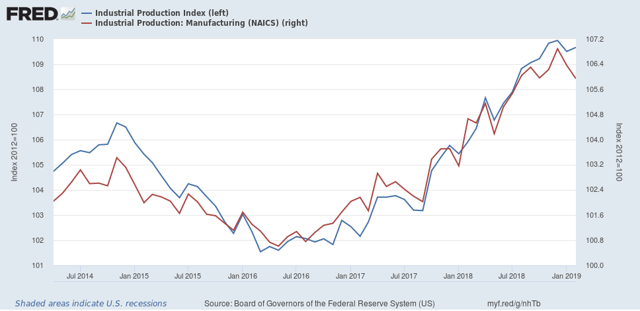
Taken together, production and employment are the King and Queen of coincident indicators - certainly in terms of how the NBER scores expansions and recessions. Both February industrial production and January JOLTS for employment were reported this morning, and delivered differing messages.
First, industrial production for February was weak. While total production gained slightly (+0.1%), manufacturing production declined for the second month in a row:


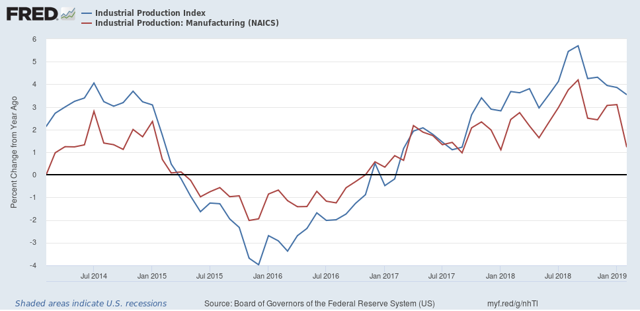
Here is what that same data looks like measured YoY:
There may have been a production boom last summer, but it’s over now.
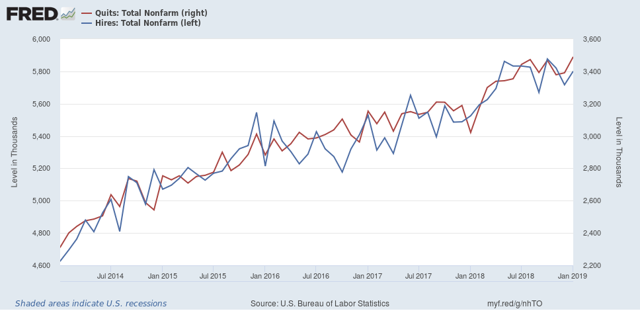
If industrial production is the King of Coincident Indicators, then employment is the Queen. The JOLTS report for January, which included substantial revisions for all of 2018, included an all-time high in the number of quits (red), and an improvement in hires (BLUE):


Not shown, but layoffs and discharges made a new 12 month low, and openings were just below theirs. If there is a fly in the ointment, it is that since midyear 2018, there has been very little improvement in all of the JOLTS metrics except for layoffs and discharges.
Basically, production and employment taken together show deceleration since summer of 2018, with production actually contracting slightly while employment continues to improve.

Initial jobless claims not at warning levels yet


 - by New Deal democrat

With the economy slowing so markedly, suddenly there is a lot I can post about!
So here is a quick note about initial jobless claims. They are a short leading indicator, and at least as smoothed over a 4 week or monthly average, they aren’t too noisy.
I have two ways of looking at them:
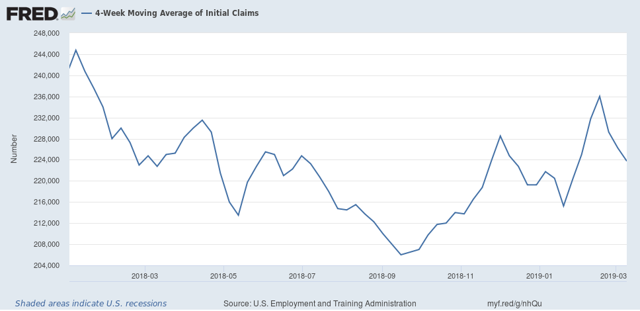
1. The four week moving average rises more than 10% above its low point almost once a year. But by the time it is 15% above its low, a recession is usually imminent or may even have begun. So my cutoff point is 12%, above which there is a significantly increased chance of an oncoming recession. In September, this average hit its expansion low of 206,000:

If the 4 week moving average rises above 230,600, this metric is triggered. It did hit this number last month likely due to the government shutdown, but I am discounting that.
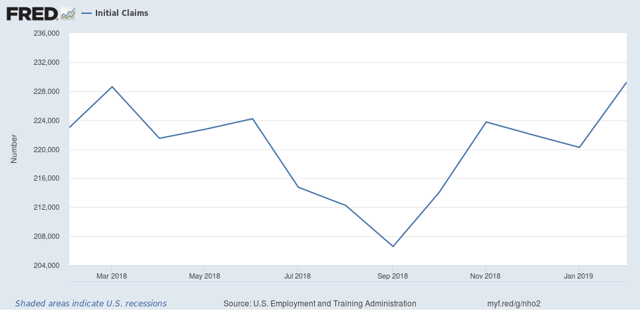
2. If the monthly average turns higher YoY for two consecutive months, that usually gives a short warning that a recession is about to begin. As the below graph shows, it was higher YoY in February:

If it averages higher than 228,600 for March, it would hit this point. For the first two weeks of March, it is 226,000:

Triggering one metric results in a yellow flag “caution”; hitting both results in a red flag “warning.”
Although we are close in both metrics, neither has been triggered yet.

Thursday, March 14, 2019

Leading scenes from the February jobs report


 - by New Deal democrat

Let me catch up with some details from last Friday’s employment report.

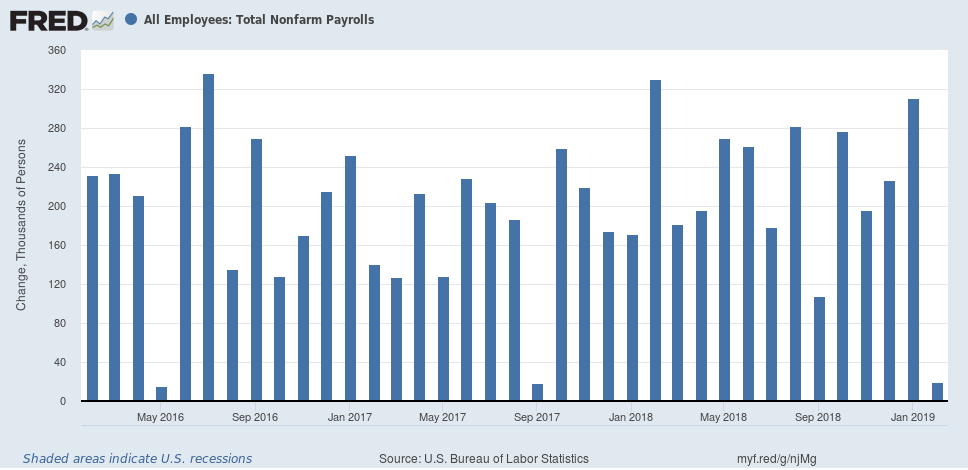
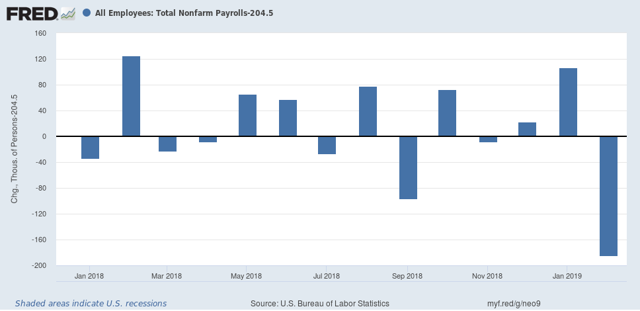
As a preliminary matter, the overwhelming take was that the poor +20,000 gain was “nothing to see here, just an outlier.” The problem with that take is that, for all of 2018, the average monthly gain in jobs was just over +200,000 a month. January came in more than 100,000 above that, at +311,000 jobs, and yet I don’t recall anyone taking the same position, that it was just an “outlier” to the positive side then! Here’s a graph, from which the 2018 average of 204,500 monthly jobs gain has been subtracted, so that the variance from that average shows as positive or negative:    

So, yes, it’s true that February was a bigger outlier, to the downside, than January was, to the upside, but both were outliers. If you average the two months together, you get +165,500 jobs per month, a significant downdraft from the 2018 average.

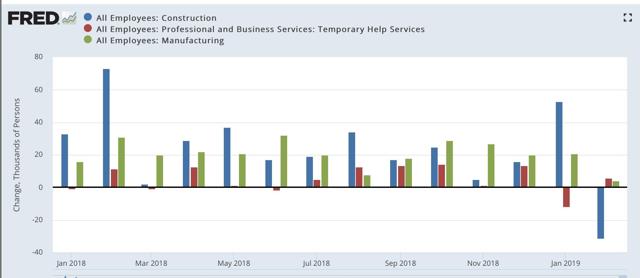
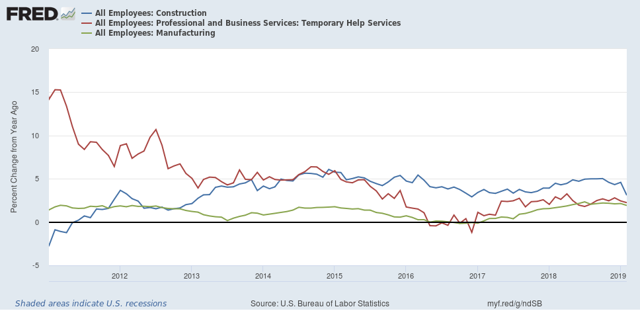
Moving on, last week I said to pay attention to three leading sectors of jobs: temporary jobs, construction, and manufacturing. In the past I’ve shown that at least 2 of the 3 sectors contract for a number of months before any recession begins. Here’s what all three sectors look like from January 2018 to the present:


We had a contraction in temp jobs in January, from revisions, and a contraction in construction in February, after an outsized January gain. Manufacturing hung on with a small gain.

Here’s the same information graphed as the YoY% change, first over the past 8 years:

The 2015-16 “shallow industrial recession” clearly stands out as a pocket of weakness.

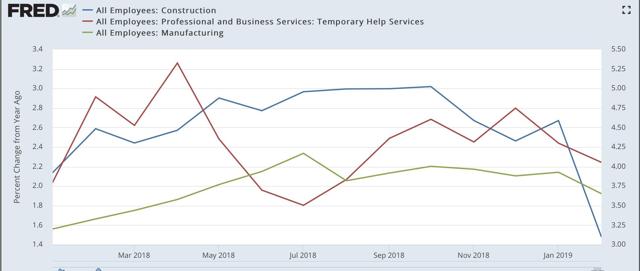
Now here’s a close-up since the beginning of 2018:


All three show decelerating YoY gains since roughly the beginning of last autumn.
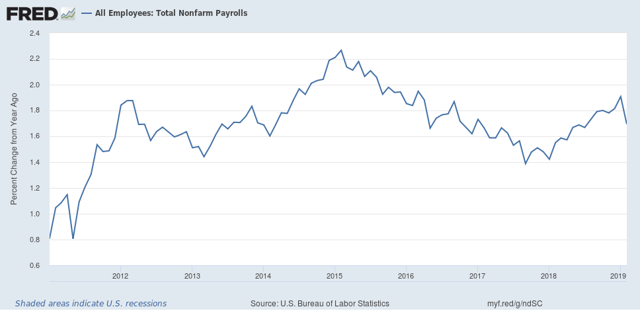
Last week I also said that I expected the YoY pace of job gains to start decelerating. Only one month, of course, but it did do that:

 
YoY job gains are at the lowest in over 6 months.

Finally, let’s take a look at two more leading metrics contained in the jobs report.

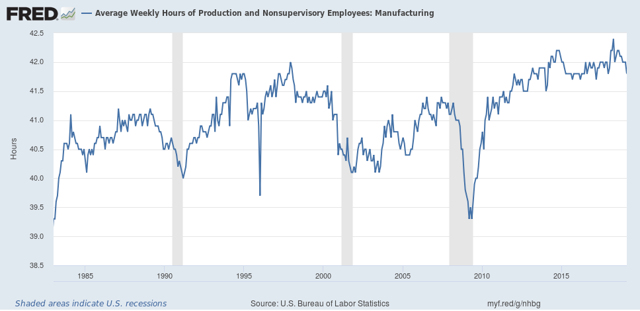
First, the manufacturing work week:

Historically, this starts deteriorating before manufacturing jobs. It is presently down -0.6 hours from its peak in summer of last year. In the past a decline of -0.5 hours has typically been associated with at least a slowdown, and by the time the decline hits 1.0 hours you are on the cusp of a recession.

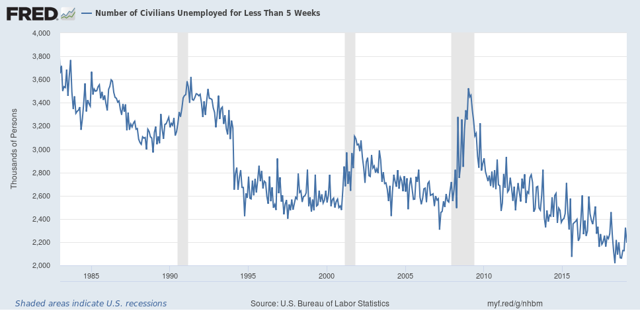
Next, short term unemployment of less than 5 weeks. This is one of the “short leading indicators” listed by Prof. Geoffrey Moore:

Typically if the three month average is less than 5% above its low, the expansion is intact. If that average is more than 10% above its low, a recession is near or may have just begun. Presently the three month average is 6% above its recent low. Take this with a grain of salt, because it includes the government shutdown month of January.

The bottom line is that, even averaging January with February, all of the leading employment indicators show some deterioration, but none of them are at a point where I would expect them to be if a recession were imminent.

Wednesday, March 13, 2019

More evidence for a Q4 “Recession Watch”


 - by New Deal democrat

About a month ago, based on those Q4 2018 reports that had not been delayed by the government shutdown, plus workarounds for those that were missing, I went of “Recession Watch” for Q4 of this year.

Now all of the missing pieces have been reported, and they add to the evidence justifying the call. 

This post is up at Seeking Alpha.

My base case remains slowdown vs. recession. But I see a slowdown becoming more entrenched as the year goes on, and government policy missteps (good thing we have a competent Administration, so we won’t see any of those! /s) could easily tip us into contraction. If we do go that route, it probably won’t be led by the producer side of the economy, but rather by stretched budgets on the consumer side.