Saturday, September 2, 2017
Weekly Indicators for August 28 - September 1 at XE.com
- by New Deal democrat
My Weekly Indicator column is up at XE.com.
Interest rates have improved, while there are several cracks in transport.


Friday, September 1, 2017
The August jobs report smacked of late cycle deceleration
- by New Deal democrat
As promised, here is my abbreviated and late take on this morning's employment report.
While the additions to temporary positions (a leading indicator for jobs overall), and construction, and manufacturing jobs were welcome, this report sure looked like late cycle deceleration.
The YoY% growth in jobs - a very un-noisy metric - declined again slightly:

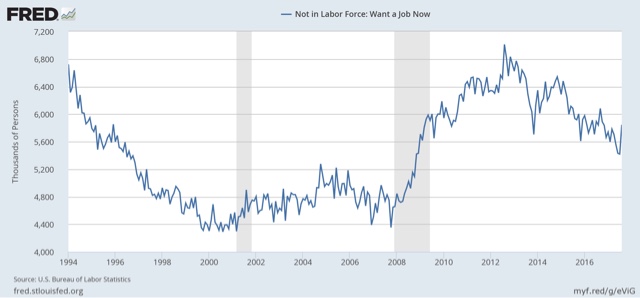
The number of people not in the labor force who want a job shot back up:
Those who are involuntarily part-time went sideways:

On the (relatively) bright side, when we adjust both of these metrics by the working age population, the comparisons with the last two expansions aren't quite so weak:


Finally, what on earth is it going to take to get wage growth for nonsupervisory workers?

And, although I won't bother showing the graph, we didn't make any progress on either the unemployment or underemployment rate.
So while the good news is, I still don't see any actual downturn anywhere near in time, this employment report was another sign of late cycle deceleration.
Housekeeping note on the employment report.
- by New Deal democrat
I will be running an errand when the employment report comes out at 8:30.
I will put something up at about 10:30 to 11 eastern time. It will be a little truncated, but I will hit the high (or low) points, and try to highlight a few things that are overlooked in other commentators' posts.
Thursday, August 31, 2017
Trickle-down, with the emphasis on "trickle"
Since the turn of the Millennium, a torrent of corporate tax cuts has resulted in a trickle of investment growth.
- by New Deal democrat
This morning Dean Baker objects to:
the argument ... that reducing corporate taxes will lead to more investment and thereby greater wage growth in the future. The data from the last seventy years show there is no relationship between aggregate profits and investment.

As can be seen, there is no evidence that higher corporate profits are associated with an increase in investment. In fact, the peak investment share of GDP was reached in the early 1980s when the after-tax profit share was near its post war low. Investment hit a second peak in 2000, even as the profit share was falling through the second half of the decade. The profit share rose sharply in the 2000s, even as the investment share stagnated. In short, you need a pretty good imagination to look at this data and think that increasing after-tax profits will somehow cause firms to invest more
I was a little puzzled why Dean didn't differently scale the two series so it would be easier to see any leading/lagging relationship. Further, since corporate profits are a long leading indicator, and nonresidential fixed investment is more of a coincident indicator, I was pretty sure that there would be a correlation.
To take a better look, I compared the YoY% changes in each, so that they would scale more equally. Here's what that looks like divided into 1948-86, and 1986-present:


Sure enough, there is a leading/lagging relationship between the two. That doesn't mean that an increase in corporate profits *causes* more investment, it just means there is a correlation with a lag.
But also notice that, in the post-WW2 era, the two series move in similar scales: a 40% increase in profits tends to lead to something close to a 40% increase in investment. From the 1980s to the present, a 40% increase in profits leads to a much smaller increase in investment on the order of 10%.
In other words, even if we take the strong case, and assume there is a causative relationship, when we scale the two series more equally, we see that there is a big difference between the post-WW2 era, and the era that began with Ronald Reagan's presidency:


Simply put, particularly since the turn of the Millennium, a torrential increase in corporate profits only leads to a teaspoonful of investment.
The same is true of wage growth. Since wage growth is pro-cyclical, it tends to peak at the end of expansions, well after corporate profits peak. So there is a leading/lagging relationship on a *cyclical* basis. But *secularly,* corporate profits have increased while wage growth has gradually deflated:

At this stage of the economic expansion, under counter-cyclical policy, if anything we should be trying to run a fiscal surplus. As we have seen above, a corporate tax cut now will do next to nothing for ordinary Americans, and will recklessly blow out the budget at the exact wrong time.
Bottom line: we don't need even more profits for corporations. We need to increase the share of wage growth relative to corporate profit growth.
Wednesday, August 30, 2017
A Quick update on Bonddad
- by New Deal democrat
I had a long conversation with Hale Stewart this morning.
He says he has been incredibly lucky. He, his spousal unit, and his pooches are all fine. They have had no flooding at all.
On the other hand, he says that metro Houston in general is a complete mess. It sounds like, once the water has finally receded, Houston 2017 might resemble New Orleans 2005.
Tuesday, August 29, 2017
Comparing the 2014 and 2017 housing slowdowns
- by New Deal democrat
We had an interest rate spike late last year similar to the spike in mid-2013. In 2014 the resulting housing slowdown resolved positively. Will it do so again this year?
This post is up at XE.com.
Monday, August 28, 2017
Notes on Harvey: if Karma could bring her litter to visit the Texas GOP
- by New Deal democrat
First of all, as many of you already know, the M.I.A. proprietor of this here blog, Hale Stewart, resides in the Houston area. I traded messages with him on Saturday, and as of then, he was doing OK.
Secondly, when Superstorm Sandy hit New Jersey and New York, Texas Republicans were prominent among those who opposed aid. Ultimately aid was provided -- but not until 75 days after the storm.
There were two Sandy-related aid bills.
The first bill granted FEMA a $9.7 billion increase to borrow for the National Flood Insurance Program. It passed the Senate on a voice vote, but the following Texas GOP Members of Congress voted against the aid:
Mike Conaway (Midland)
Bill Flores (Bryan)
Louie Gohmert (Tyler)
Kenny Marchant (Coppell)
Mac Thornberry (Clarendon)
Randy Weber (Pearland)
Roger Williams (Austin)
The second bill provided $17 billion emergency funding to the victims and to affected NY and NJ communities. Both Texas Senators Ted Cruz and John Cornyn voted agains the bill. In addition to all of the above Representatives, the following Texas GOPers also voted against this aid:
Ted Poe (Humble)
Sam Johnson (Plano)
John Ratcliffe (Heath)
Jeb Hensarling (Dallas)
Joe Barton (Arlington)
Kevin Brady (The Woodlands)
Michael McCaul (West Lake Hills)
Kay Granger (Fort Worth)
Lamar Smith (San Antonio)
Pete Olson (Sugarland)
Michael Burgess (Lewisville)
Blake Farenthold (Corpus Christi)
John Carter (Round Rock)
John Carter (Round Rock)
Pete Sessions (Dallas)
Now that it is Texas suffering a catastrophe, of course some of these same politicians will be at the front of the line braying for help. While with the GOP in control of the entire federal government, Karma will not be paying a visit with her litter, in a just world aid would be provided immediately -- on the same day they all visit NY and NJ, apologize, and abjectly beg forgiveness.
Of course, the "better angels" will prevail this time. But rest assured, the next time a disaster befalls anywhere in the Northeast, these same Texas politicians will once again vote against aid. In the meantime, above is the Roll Call of Shame for posterity.
Saturday, August 26, 2017
Weekly Indicators for August 21 - 25 at XE.com
- by New Deal democrat
My Weekly Indicators post is up at XE.com.
There was no eclipse of the positive tone this week.
Friday, August 25, 2017
An economy on autopilot between Scylla and Charybdis
- by New Deal democrat
Interest rates are a vital determinant of longer term growth. While the economy has remained on autopilot for the last several years, with almost no political stimulus or disruption -- though that may well change next month -- the Fed has to steer a course between the Scylla of an interest rate spike and the Charybdis of an inverted yield curve. The Presidential election spike in long term interest rates has been enough to cause growth in the housing market, whether measured by permits, starts, new or existing home sales, to stall out. Meanwhile the several hikes in the Fed funds rate has cause a slight flattening of the yield curve.
So while it is somewhat welcome that longer term interest rates have fallen back below 2.20%f and mortgage rates below 4%:

that just means that there is less of a spread between longer term and shorter term yields.
Almost any inversion in yields out further than 3 months is a warning sign. The below graph shows that 3 month rates (green) have been lower then the Fed funds rate (red) almost consistently since the early 1980s:

Meanwhile 1 year treasury yields (blue) typically only fell below the Fed funds rate later in the expansion.
Here's a close up on what that looks like since just before the Fed started this tightening cycle:

So far the 1 year treasury yield remains higher than the Fed funds rate, but the spread is tighter.
For now autopilot is keeping us off the rocks, but there is a significant risk of "controlled flight into terrain" before September 30. Even if we escape that, another Fed rate hike could finally create a yield curve inversion near the shorter end.
Thursday, August 24, 2017
New and existing home sales show stall is continuing
- by New Deal democrat
The stall in the housing market brought about mainly by the post-Presidential election spike in interest rates continued in July, based on both new and existing home sales.
This post is up at XE.com.
Tuesday, August 22, 2017
Free Trade, the Primrose Path, and the Blinkered Blindness of macroeconomists
- by New Deal democrat
Here's what I learned today: the origin of the phrase "being led down the primrose path."
It turns out that in medieval times, one meaning of the word "primrose" was the "prime," or first or loveliest, rose. Thus taking the primrose path was a particularly lovely journey. At least by the time of Shakespeare's "Hamlet," where Ophelia speaks of the "primrose path" to Laertes, the connotation developed of the use of a lovely and seductive experience to lure a mark to their misfortune or doom.
The doctrine of free trade is macroeconomists' primrose path. Today's example comes from Tim Haab's blog "Environmental Economics," in the below post entitled "Quote of the Day: Both sides win from free trade . . . sheesh," which I am reproducing in full:
The doctrine of free trade is macroeconomists' primrose path. Today's example comes from Tim Haab's blog "Environmental Economics," in the below post entitled "Quote of the Day: Both sides win from free trade . . . sheesh," which I am reproducing in full:
That moment you realize the Chinese administration understands economics better than the U.S. administration...
"In reality, China and the United States' long term cooperation has brought about real benefits for both countries' peoples, any unbiased person will clearly see this fact," [Chinese Foreign Ministry spokeswoman Hua Chunying] told a daily news briefing in Beijing.
"We have also said before, a trade war has no future. A trade war does not serve the interests of any party, as fighting a trade war will not produce a winner. We hope that relevant parties can stop viewing issues of the 21st century with a 19th- or 20th-century mentality."
Hua's quote is in reaction to Steve Bannon's claim that the U.S. is losing the trade war with China:
"It's in all their literature. They're not shy about saying what they're doing. One of us is going to be a hegemon in 25 or 30 years and it's gonna be them if we go down this path," he was quoted as saying."If we continue to lose it, we're five years away, I think, 10 years at the most, of hitting an inflection point from which we'll never be able to recover."
Now, I am no fan of Steve Bannon, but alas in this case it is economist Tim Haab who has the worse argument. Here's why.
Let's assume that Haab is completely right in what he says: that free trade in the aggregate absolutely benefits both countries which engage in it. End of story?
No, and here is where macroeconomists' blinkered blindness to human behavior is on full display.
Wealth is, generally speaking, not accumulated for its own sake, but rather to be spent of stuff that you really want. So Country A and Country B can use the increased wealth from free trade to fund the stuff they really want.
So let's suppose that while both Countries benefit from free trade, Country A's wealth increases by an additional 5% a year, while Country B's wealth increases by an additional 1% a year. By the magic of compounding, over 10 years Country A's wealth increases by 63%, and over 20 years by 265%. Meanwhile Country B's wealth has only increased by 10% in 10 years and 22% in 20 years.
Suppose further that what Country A really wants to do with this wealth is invade and take over Country C, which alas is an ally of Country B, meaning that Country B will have to go to war to defend it.
Is Country B's 22% increase in wealth worth the loss of life and destruction it will incur defending Country C? This calculation nowhere appears in any of the arguments by free traders.
Meanwhile, if I am the leader of Country A, I am more than happy to lead Country B down the primrose path of free trade, knowing what I have in store at the end.
What's worse, we have already been through this exercise once before, with calamitous results, In 1909, Norman Angell's "The Great Illusion," argued that countries that trade with one another would never go to war, because it was so illogical. At the time, free trade had burgeoned among the countries of Europe.
But it turns out that wasn't the priority of Kaiser Wilhelm or other European monarchs. Only 5 years later, all of that wealth was poured into a catastrophic war.
Even though the historical facts devastatingly rebut the macroeconomic theory, macroeconomists ignore the facts. Since the uses to which ocountries might put the increased wealth obtained by trade lays outside their theory, they are blinkered and blind to it, and assuming that it does not exist. That World War I rebuts their argument is waved away as ancient history, even though human nature has not changed one wit. In their blinkered blindness, macroeconomists fail to see that free trade can be used as the primrose path.
Monday, August 21, 2017
Revisiting the Apartment Boom
- by New Deal democrat
The entry of the large Millennial generation into the housing market should have generated more permits and starts in condos and apartment complexes than we have seen.
What's going on? Factoring in the number of units under construction appears to give us at least a partial answer.
This post is up at XE.com.
Saturday, August 19, 2017
Weekly Indicators for August 14 - 18 at XE.com
- by New Deal democrat
My Weekly Indicators post is up at XE.com.
If you are looking for DOOOOOM, you are looking in the wrong place.
Thursday, August 17, 2017
Industrial production: once again, the hard data fails to confirm the sof ... ofertheluvofgaud
- by New Deal democrat
This morning's report on industrial production confirms that the economy remains on autopilot, and that's a good thing.
Overall production increased again, and the trend of rising production since spring of last year is clear:

When we break it down by manufacturing (blue, left scale), mining, and utilities (red and green, right scale), we get pretty much the same picture:

While it's true that the manufacturing subindex is below its April peak, I am not terribly concerned. There were very volatile readings in March, April, and May, and if we smooth the readings out via a three month moving average, July is only slightly below June, and both June and July are above every other 3 month average reading.
So the Doomers will have to move on from their "soft data/hard data" argument to something else.
Housing is still going sideways
- by New Deal democrat
.
Although June got revised higher, July housing permits and starts continue to fail to impress
This post is up at XE.com.
Wednesday, August 16, 2017
On the erection of Confederate memorials: in which I have to get this off my chest
- by New Deal democrat
Below is a photograph of the World War Two Memorial on the National Mall in Washington, D.C.

Keep it in the back of your mind. I'll return to it.
I am a data nerd, and leaping to conclusions about data is a pet peeve of mine. I really hate it when anyone, and particularly my own side, falls for groupthink, jumping to instant conclusions which then become the only acceptable opinion. In the last 48 hours, without consideration of other possibilities, or looking for contrary vs. corroborating data, it seems that just about everyone on the center and left has become an instant expert on the fact that Confederate statues were erected because of Jim Crow.
In support of that, a number of graphics, such as this one, have been used:

So, has it occurred to nobody that there might be a more straightforward reason why there would be a huge spike in Memorials (cough, cough, hint, hint) ***50*** and ***100*** years after the Civil War?
Yes there were a number of racial incidents that occurred in the 1910s. But before the last 48 hours, the general consensus was that there was a resurgence in violence associated with white supremacy in the 1920s, not the 1910s.
But 1910-1915 marked 50 years sine the Civil War, and those 20 year old soldiers who fought it had dwindled to a band of 70 year old men, who did not want themselves or their cause to be forgotten after their generation had passed.
For (huge) example, on July 2-4, 1913, on the 50th anniversary of the Battle of Gettysburg, there was a reunion of both northern and southern armies who camped out at the site. That reunion was commemorated by the Eternal Light Peace Memorial erected on the 75th anniversary during another encampment of the last few survivors:

In our own time, we have had a demonstration of the exact same psychology: the World War Two Memorial shown at the beginning of this piece was championed as the 50th anniversary of the war approached, as a monument to the "Greatest Generation," particularly by veterans such as Bob Dole who did not want their sacrifice to be forgotten after they shuffled off to the Last Great Muster in the sky. Bill Clinton signed the authorizing Act for the memorial in 1993.
I am sure speeches were made lionize Jim Crow when the statues were dedicated, and none of this affects the debate on what should become of them. But can our side please not succumb to leaping to conclusions?
Here's a good test: when were monuments to Union soldiers and leaders erected? I haven't found any information onlline on that subject. Was there a similar spike in the vicinity of the 50th anniversary of the Civil War? If there wasn't, then there was something "special" about what the South did. But if there was, then the more straightforward explanation is probably the correct one.
Thank you for letting me get that off my chest.
UPDATE: Oh, good, I'm not the only one. Here's a data analyst and neurocognitive researcher replying to Kevin Drum:

Tuesday, August 15, 2017
Real retail sales disappoints . . . the Doomers
- by New Deal democrat
This morning's report on July retail sales once again belies the claim that "hard data" and "soft data" are divergent..
Not only did July come in at a strong +0.6% (+0.5% ex-autos), but June was revised up as well. Given basically non-existent inflation, this means that real retail sales made two more new records for this expansion:

In fact, real retail sales look like they are right in line with a multi-year trend.
Real retail sales per capita tend to turn down well in advance of the onset of a recession, so here is real retail sales per capita:

Again, the upward trend is continuing .
Finally, although the relationship is noisy, YoY growth in retail retail sales tends to correlate with YoY growth in employment during the ensuing months:

.So this suggests that recent stronger monthly jobs reports will continue.
Doomers will once agin have to find a new place to hang their hats.
Monday, August 14, 2017
One tiny little ray of hope
- by New Deal democrat
After the Charlottesville, VA white supremacy violence, and his failure to explicitly condemn it, Donald Trump's Gallup approval rating has fallen to a new low of 34%, and his disapproval to a new high of 61%:

This puts him below the lowest ratings during their entire term of Lyndon Johnson, Ronald Reagan, and Bill Clinton. Only Truman, Ford, Carter, and George W. Bush ever scored lower.
So far, alas Rasmussen has not followed suit.
Measuring full employment by actual hires vs. job openings
- by New Deal democrat
How close are we to full employment? One method that is sometimes touted is the Beveridge curve. The Beveridge curve (invented by a British economist named, you guessed it, Beveridge, compares the level of job openings with the level of unemployment. Generally speaking, if there are as many job openings as there are unemployed, then the economy is running at full employment (since everyone who wants a job ought to be able to get one).
As we saw last week, job openings as measured by the JOLTS report are at an all-time high. This gives us a Beveridge curve that suggests that the US is close to full employment:

The unemployment rate, at 4.3%, is only 0.3% above the job openings rate, at 4.0%. Of course, another way to look at the data is that it has taken many more job openings to get us down to 4.3%, compared with the last expansion at least.
But as I have frequently noted, this assumes that job openings are offered in good faith. If employers are just trolling for resumes, or laying the groundwork for H1-B slave labor visas, then job openings aren't offered in good faith. I think we have to measure employers not by their words (advertising openings), but by their deeds (actual hires).
So I put together a graph to compare labor market tightness by the ratio of openings to the unemployment rate (blue line) vs. the ratio of actual hires to the unemployment rate (red line):
So I put together a graph to compare labor market tightness by the ratio of openings to the unemployment rate (blue line) vs. the ratio of actual hires to the unemployment rate (red line):

Note that at the end of the late 1990s boom, we really were at full employment. The ratio of both openings and hires to the unemployment rate was close to 1:1. Pretty much everyone who wanted a job could be matched with one. The 2000s economy never got to that point. While the current economy looks like it is at full employment measured by openings, measured by actual hires there is still slack, as there are only 8.5 hires for every 10 people who are unemployed.
For completeness' sake, I did the same thing with the U6 underemployment rate. Here's what that shows:

Here the relative comparison is considerably worse. While the ratio of job openings to the underemployed is close to its 1990s boom level, the ratio of actual hires to the underemployed isn't even close -- and hasn't reached the peak of the 2000s economy either.
Needless to say, I think the most reliable measure is based on deeds rather than words, and measured by deeds, we aren't at full employment, let alone a boom.
Sunday, August 13, 2017
"The Changing of the Guard:" the prescient 1980 book that foretold neoliberalism
- by New Deal democrat
About a month ago I read the synopsis of an interview in which Thomas Frank described the near evisceration of the Democratic Party. Here's his simple version:
"[T]he Democrats have, what happened is that some years ago they decided they didn't want to be the party of the people anymore. They didn't want to be the sort of traditional Democratic Party that I grew up with, the party of Roosevelt, Truman, Kennedy, Johnson. That's not what they wanted to be.
"They wanted to be something different. This involved ... It was an enormous transition in the Democratic Party all through the seventies, all through the eighties, all through the nineties until they are what we see them as today. They are a party that represents a group of very affluent white collar professionals. That's who leads the party. That's who they speak for. That's whose issues they care about. That's really who they are....
"[T]he Democrats, as they moved away from their old working class base and they treated them very poorly and they did the same with other essential elements of their constituent groups, minorities for example ... [W]hen they did things like got NAFTA passed which was really hard on working class people, when they did those things they used to have a saying. They'd say, 'Well you know we don't have to worry about that. Those people have nowhere else to go.' Nowhere else to go. This was a Democratic saying in the 1990s.
"Trump gave those people somewhere else to go."
This critique rang a bell, not because I have read similar requiems before, but because I read it as a foretelling nearly 40 years ago, in the late David Broder's "Changing of the Guard." Broder described the worldviews of a bunch of technocratic Democrats -- and some Republicans -- then in their 30s and 40s, people like Gary Hart, Jerry Brown, and a guy named Bill Clinton, who ... well, let me turn the mike over to the right-wing Commentary Magazine, which said in its review at the time:
"For anyone still perplexed by the Democratic party’s recent [in the early 1980s] misfortunes, a careful look at these interviews ... suggests that the much-heralded collapse of liberal ideology is a more serious problem than even the election debacle would indicate. The conventional analysis is that liberalism’s dilemma stems from a failure to advance beyond the policies and attitudes embodied in the career of Hubert Humphrey: a reliance on economic growth as the principal means of curbing poverty, a generous and ever-expanding system of social-welfare benefits, and a foreign policy stressing containment of the Soviet Union and aid to the developing world. But it is important to keep in mind that many new-generation liberals have consciously rejected the Humphrey tradition. “We are not a bunch of little Hubert Humphreys,” Gary Hart declared upon winning election to the Senate in 1974 ....
"They speak with pride of having promoted more open and efficient government, of being more accessible to the public, of maintaining their “independence” from the established party organizations, and of their opposition to the spoils system."
That was exactly my recollection of the then-young Democrats described in the book. They eschewed New Deal style economic programs, and the unions and big city machines that delivered the electoral victories that made those programs possible, in favor of social equity, and an economically "efficient" streamlined government, that would produce a meritocracy which would be accepted as fair by all.
As it happens, I still have my copy of "Changing of the Guard," so I went back and re-read parts of it, especially the interviews with people like then-Governor Bill Clinton who went on to more prominence. (Obama was a teenager in high school in Hawaii at the time, so no interview with him!) Keep in mind that all of the quotations you read below are from almost 40 years ago.
Broder begins with a telling overture to economic complacency and political restlessness (pp. 43-44):
"The oncoming generation of political leaders is the product of a period of rising independence in our politics ....
"A [ ] basic reason has been the mass movement from the cities to the suburbs .... The old fashioned political machine was a product of the big city .... That kind of machine is disappearing ....
"A[nother] basic change is that as the country emerged from the Depression and World War II into a period of sustained postwar prosperity, the sharp economic and class lines that marked the New Deal period began to erode ....
"Organized labor found itself falling out of comfortable collaboration with other elements of the New Deal coalition [over social justice issues]."
Younger readers may not know this, but one of the chief sources of that falling out was that nepotism was rampant in trade unions. An older member getting a spot for his son or perhaps a nephew or two was not uncommon. Affirmative action or racial quotas meant that some of those family members were rejected in favor of African American applicants. Older union members bristled, to say the least.
To be sure, the young Republicans interviewed were repulsed by what they deemed "over-regulation" by the federal government (pp. 99-100):
"[T]he young Republicans' aversion for federal policy making was more than just a rhetorical bow to [conservatism].... Both of the men who served as Jerry Ford's White House chief of staff, Donald Rumsfeld and Richard Cheney, said they had become more conservative in their outlook as a result of what they had seen in Washington.
"... Cheney said ... 'I saw how difficult it is to have government programs well designed to achieve any significant results .... There are all too often unanticipated consequences ....
"Rumsfeld echoed the same skepticism...."
"[GOP Delaware Governor Pete] DuPont [had] an argument with then Secretary of Energy James R. Schlesinger, who had demanded to know what had happened to the 'moderate, thoughtful Congressman' he had known ....
"I said, 'I'll tell you what's happened to me,' Du Pont said, 'I've had to go back to Delaware and live under this federal bureaucracy, and I think it has made me very much more hardheaded, considerably more conservative and very antagonistic to what the federal government is constantly forcing me to do. My schools are being run by a federal judge. My prisons are being run by a federal judge. Construction for a new hospital ... has been delayed a year and a half because of federal judges' fiddling around with various lawsuits.... I mean the red tape and the morass and the harassment from Washington is endless ...."
But if GOP aversion to intervention by the federal government was perhaps only to be expected, they weren't alone in what Broder described as "public dissatisfaction with the performance and the cost of government" (p. 46):
"But the people pressing for change were not only Republicans. Many of the younger Democrats were as impatient with the formulas of the New Deal-Great Society era as any GOP critics.... [lambasting the older generation of Democratic politicians] for not confronting ... the need for improved government efficiency and relief from the 'overregulation' of society."
Epitomizing that impatience was Gary Hart:
"Hart was cold-blooded in rejecting the New Deal policies of the past... in what turned out to be an accurate preview of the economic and social-policy revisionism of many of the young Democrats elected to Congress in [1974]. They have been far less sympathetic to organized labor, and far more concerned about middle-income taxpayers."
Surprisingly, neither Al Gore nor John Kerry get any significant mention at all in the book, but a discussion of the then-described "New South" dwells at length on a young Governor named Bill Clinton, including a mention that (p. 381):
"He is married to an ardent feminist who has kept her maiden name, Hillary Rodham, and her own law practice in Little Rock."Of Bill Clinton, Broder writes:
"[T]oday's Southern politicians have moved beyond the race issues that have been dominant in the past .... They are young.... They are well-educated. Most of them have graduate degrees in law or other studies. They bear out Terry Sanford's contention that the commitment to education which began in his generation of Southern leaders will be accelerated in this new generation ....
"Clinton [was] elected as governor[ ] in 1978 on [a] platform[ ] stressing ... measures to improve the laggard education systems in their states.
"Southern politicians see conservative fiscal policies and sound management as a precondition for gaining public support for the social-welfare programs they espouse."
Clinton said:
"'In Arkansas [...] there's probably a hard-core thirty percent that is always going to vote for the more conservative of the two candidates. But the election can still be won by a more progressive candidate if you can persuade people you've got a center core* they can understand and relate to and trust' .... [E]conomic conservatism is more important than social conservatism, he said.
[*In hindsight, it might be said that if you can fake that 'center core,' you can get elected President!]
Of the then-young Democratic and GOP leaders in the South, Broder says (p. 382):
"The new politicians of the South are [not] birds of a feather.... Rather, they are competitors for control of a region whose political future is, more than almost any other part of the nation, up for grabs in the Eighties and Nineties."
"On the surface, the populist Democrats like Clinton seem at the opposite pole from the conservative Republicans like ... [Trent] Lott ..., who stress their criticism of the expanding role of the federal government.... But in reality, the voters ... seem equally receptive to either appeal.... What is important is simply that the candidate place himself on the voters' side against some of the big, unresponsive bureaucracies...."
At least some of the older generation of Democrats were aware of the change. Here's former Governor Pat Brown, Jerry's father (p. 17):
"[T]he real change is that after the New Deal, the Fair Deal, the War on Poverty and the Great Society, the whole Democratic Party has retreated into conservatism."Alas, Pat Brown also thought that the conservatisim of Proposition 13 in California would be a passing fad. And former democratic Governor of North Carolina Terry Sanford and young democrat-turned-republican Mississippi Senator Trent Lott both swore that the issue of race in the South was over.
In contrast, one young State Representative in Massachusetts, Barney Frank, described his still very relevant signature issue (p. 457):
"the corrosive effect of interstate competition for industry. ... [T]he economy has become more national, but the political system hasn't, so business can play the states off one against the other."But portentiously, Frank described himself as one of the few remaining leftist liberals.
In his conclusion, Broder accurately forecast the large-scale dismantling of populist government intervention in the economy (p. 473):
"The products of the 'baby boom'* [*actually, since most of the politicians interviewed were born before 1946, they were not Boomers] ... are all rebels against ... [bureaucratic] mass culture and huge institution.... The bipartisan drive for deregulation of the economy and decentralization of the government decision making is a secular force that seems almost certain to gain momentum as this generation gains power.
Even now, two generations later, as we have seen that when you take economic equity for granted it goes away, Chuck Schumer in 2016 and Mark Penn this year have continued to laud a strategy grasping for suburban Republicans and eschewing the traditional Democratic urban working class. As it turned out, bill Clinton had the priorities of voters fundamentally wrong: social conservatism was categorically more important to a critical mass of (especially white Southern) voters than economic conservatism.
But the ideology that Bill Black spoke of in June was already flowering 40 years ago -- the turning away from traditional Democratic power centers, and from broad government programs anchored in economic populism, in favor of social issues and a commitment to lower taxation and more efficient fiscal prudence -- espoused by a group that grew up in the post-war middle class suburbs and sought to appeal to those suburbanites first and foremost, taking for granted that the broad prosperity that those programs forstered would continue.
How much the country has suffered from how wrong they were.
But the ideology that Bill Black spoke of in June was already flowering 40 years ago -- the turning away from traditional Democratic power centers, and from broad government programs anchored in economic populism, in favor of social issues and a commitment to lower taxation and more efficient fiscal prudence -- espoused by a group that grew up in the post-war middle class suburbs and sought to appeal to those suburbanites first and foremost, taking for granted that the broad prosperity that those programs forstered would continue.
How much the country has suffered from how wrong they were.
Subscribe to:
Posts (Atom)