Showing posts with label nonresidential construction. Show all posts

Wednesday, February 2, 2011

Has Nonresidential Construction bottomed?

- by New Deal democrat

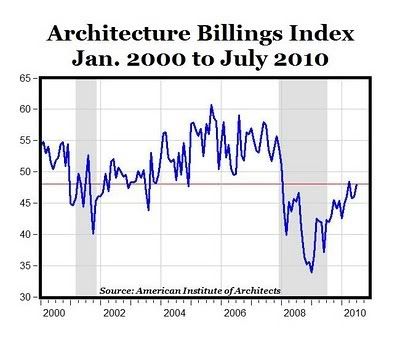
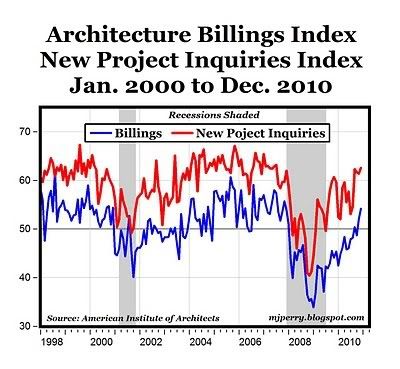
Lost in usual chatter about the monthly decline in private nonresidential construction spending reported for December yesterday, was the fact that it may have already bottomed last July. Indeed, back in September I asked Is Nonresidential construction stabilizing? and concluded that "it looks like it is time to watch for a bottom," reasoning from an improving AIA architectural billings diffusion index that
This makes me think that the AIA index may be similar to the ISM manufacturing index. Both are diffusion indexes, with 50 being the dividing point between most businesses reporting an increase vs. a decrease. But the ISM says that its index signals expansion before the index reaches 50. Several months' readings at 46 (the actual number may even be lower, I didn't go back and check), are sufficient to signal expansion. The 2002-03 readings of the AIA index suggest the same may be the case.
The AIA architecture billings index has only improved since then. It now shows absolute improvement rather than subsiding declines, a trend that has picked up steam in the last couple of months:
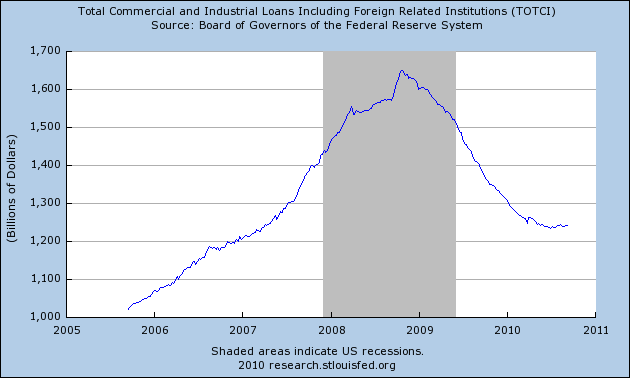
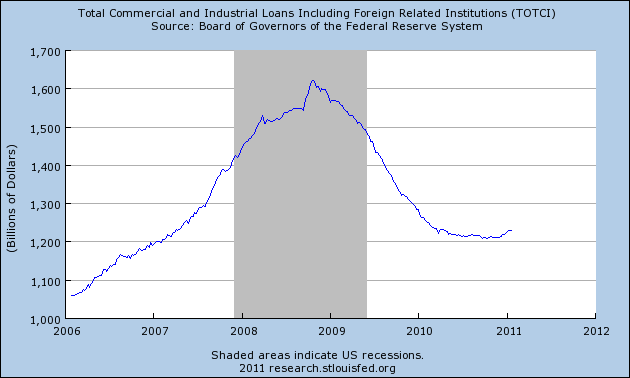
In September I also cited in support of the analysis, that Commercial and Industrial loans from banks looked like they were bottoming. This too has been confirmed by more recent data:


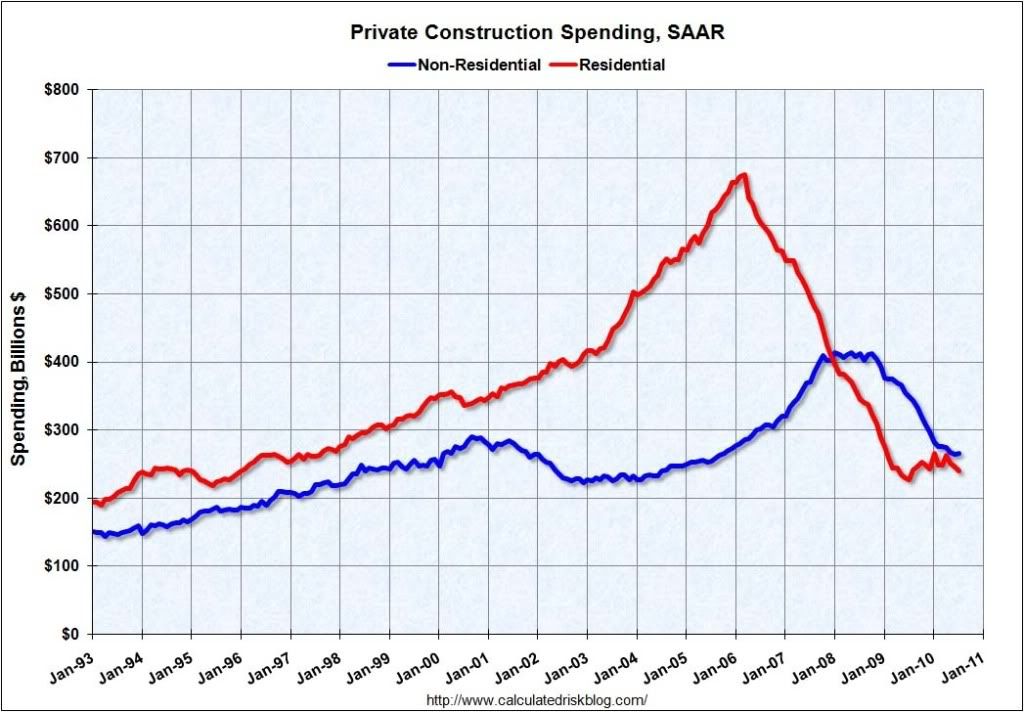
Now here is the graph (h/t Tomorrow's Economy Today) for both residential (blue) and nonresidential (red) spending:
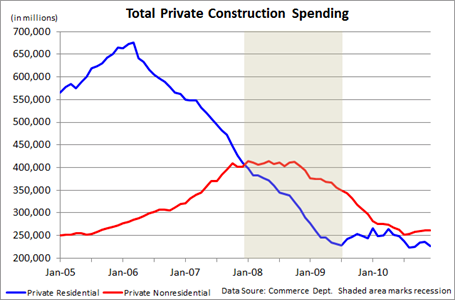


Notice that for the last six months, nonresidential spending has essentially been flat - and the lowest reading was actually in July. In any event, what is clear is that its 2 year decline from mid-2008 has been broken.

One of the reasons for more optimism about how the economy will perform in 2011 is that it will no longer be fighting against a decline in both residential and nonresidential spending. In fact both may begin to show at least some increase. Which also means at least a few construction jobs - finally - being added to payrolls as well.

Thursday, September 23, 2010

Is Nonresidential Construction stabilizing???

- by New Deal democrat

I'm sure it's too early to say that nonresidential construction has bottomed, but a few items make me believe it is time to start watching. Yesterday Bill McBride a/k/a Calculated Risk treated us to his monthly recap of architecture billings, with his usual note indicating that nonresidential construction would continue to decline for the foreseeable future. I'm not so sure.

Here is the same graph of AIA billings, but from Prof. Perry's Carpe Diem blog, with a line indicating how last month's reading compares with past readings:

Note that the most recent reading of the AIA is consistent with readings in early 2002 and early 2003.

Now let's turn to CR's most recent graph of residential (red) and nonresidential (blue) construction, through July:


Note that in early 2002 nonresidential construction was still declining, but in the second half of 2002 it stabilized and remained flat throughout 2003.

This makes me think that the AIA index may be similar to the ISM manufacturing index. Both are diffusion indexes, with 50 being the dividing point between most businesses reporting an increase vs. a decrease. But the ISM says that its index signals expansion before the index reaches 50. Several months' readings at 46 (the actual number may even be lower, I didn't go back and check), are sufficient to signal expansion. The 2002-03 readings of the AIA index suggest the same may be the case.

In support of that analysis, here is a graph of Commercial and Industrial loans from banks, updated through last week:


This series appears to have made a bottom in July. If it isn't the bottom, it at least is probably very close in time and value. At least some of those loans must be for new construction.

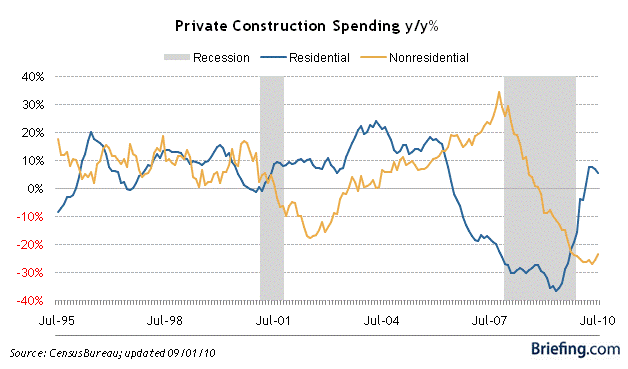
Finally, here is another graph of construction spending, from Briefing.com, showing YoY% changes. This shows the "second derivative" has turned up in the last few months, and its trajectory may be sharp - i.e., it may reach 0 in 6 - 9 months:


While it is probably too early to say that nonresidential construction has stabilized, it looks like it is time to watch for a bottom.