Last week I noted that weekly gasoline usage was down almost 10% YoY. Because the series can be noisy, it was suggested that the 4 week moving average might be a better guide to the trend. Well, this week's data was released yesterday, and here is the graph showing gasoline demand for the last two years:
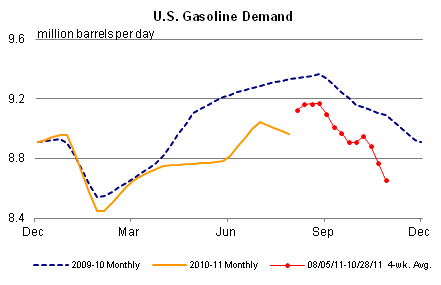
The 4 week moving average is now off nearly 5%. In fact, the graph doesn't really do the downturn justice. By compariing the EIA gasoline demand weekly raw data, we can see that demand actually held up quite well (as in, within 1 or 2% YoY compared with 2010) through June. As gasoline prices were near $4 a gallon in April, and up about $1.50 a gallon, or +40% YoY, it made sense that consumers were cutting back.
But the decline in usage intensified in July, and now at -5% YoY is the worst since the mid-September through mid-October 2008 period when we were being told that we faced Economic Armageddon. And like that decline, this one is occurring despite an ongoing decline in gasoline prices (down about $0.50 since April).
Something's happening here, but what it is ain't exactly clear. The most obvious candidates are:
1. demand destruction. But if so, why is consumer spending, as measured by the Gallup daily survey, holding up so well?
2. energy efficiency. But have we really bought so many hybrid vehicles to make that big a difference?
3. the weather. OK, we did have a strange Nor'easter that pummeled the northern and western suburbs of the Megalopolis, but that was one day only.
4. random stuff just happens. Always a possibility, but this seems unlikely given at least three weeks in a row of awful YoY comparisons.
I don't have any single great explanation. But something is clearly going on as far as I can tell, and hopefully some other bloggers will take a serious look for which explanation is the most important.


13 comments:
Gasoline Demand: short-term relatively inelastic, long-term quite elastic as the SUV is sold for hybrids or other efficient car, decisions where to live in relation to work, etc. can be executed over a multi-year timeframe.
Ten years ago, the price of oil was not a highly public statistic that everyone followed like the Dow. Now it on most folk's radar screen and it's apparent to all that it hovers sub-100 waiting for the first sign of recovery to shoot to 150. Fewer folks wish to be vulnerable to that.
It appears to be trending about the same as in 2009-2010, just at a lower level, with a slightly steeper slope for the last couple weeks.
Maybe habits are simply changing. The free market at work!
Improved mileage could really be behind it, with just standard gasoline engines. In my own experience, I traded in a Chevy Trailblazer in 2007 for a Chevy Impala for 31% better mileage (21 mpg vs 16 mpg average for my city/hwy driving. I traded that in 2010 for a Chevy Equinox, with 14% better mileage.
Of course there are countertrends and reinforcing trends that come in to play (recession based reduction in driving, moves to and from exurbs, etc)which make a simple cause hard to discern. Nonetheless, I think consumer preferences for even modest increases in fuel economy are a significant factor.
I largely agree with Uncle Toby. We saw similar changes to behavior and car-buying preferences in the '70s. That made a lasting change to the demand curve (the famous "hump" on the up-slope of the peak oil curve).
Agreed. While I personally haven't changed vehicles I know many people who have given up their trucks/SUVs for the sole reason of fuel economy.
A 5% efficiency bump in transportation is not outside the realm of possibility, but I believe the overall efficiency improvement to be more like 2-1/2% with 2-1/2% demand destruction due to price.
I wonder if we may be seeing the end of the "Jevon's Paradox". We have a 5% YoY reduction in U.S. demand but as of right now we have a price of $94.17 / BBL. That is, will current and future efficiency improvements in the use of liquid petroleum not have the corresponding eventual increase in consumption usually associated with those efficiency improvements. If that's the case (it's a little too soon to tell), then that's a strong indicator of "peak oil".
Bikes!
Plus, most of the newer cars I see in LA are on the small side.
We see a lot fewer SUVs on the road lately. They were every other car five years ago. (Yes, that's probably an exaggeration, but they were more common.)
@inventor
Jevons paradox is real but it applies only when the supply is constrained by productivity. For oil, we are probably well past this point and into true resource access constraint.
Is it possible that one contributing factor is pent-up consumer demand for other commodities? In other words, have consumers been holding off on other priorities but now that's starting to change, and they're reducing spending on oil/gasoline to compensate for this? I imagine this is a hypothesis that could be examined by looking in more detail at subcategories of consumer spending.
It would be nice if improvements in energy efficiency are a factor as well. I hope Uncle Toby is right.
Cash for clunkers got three quarters of a million less efficient cars off the road, and it is the least efficient ones that swapping out gains the most in efficiency.
The 5 mpg difference in % gained in fuel efficiency between a 40 mpg and a 45 mpg car is much less than the difference between a 4 mpg and a 9 mpg car.
Most were real guzzlers:
“Average fuel efficiency between trade-ins and newly purchased vehicles rose about 50 percent, from roughly 15.5 miles per gallon to 24."
http://www.businessofgovernment.org/blog/implementation-recovery-act/cash-clunkers-digging-deeper
Cash for clunkers ended in 2009. Why would it make a difference b/w 2010 and 2011 demand?
No, I don't think we magically became more efficient over the summer. I'll make a guess that a significant portion of the poor have stopped being gasoline consumers. Maybe those that lost their unemployment benefits and still haven't found work. I think that adds up to about 5% of demand.
Consumer spending has reportedly been driven by the upper and middle classes.
Good points, Andy. I think you're probably right here, unfortunately. I think Susan and others raise some good points about the merits of more efficient vehicles, but efficiency doesn't explain why this significant change is happening now in particular. Perhaps a perusal of the expiry dates of unemployment benefits would help.
Also, to what extent is the relationship between oil/gasoline spending and other consumer spending inverse? Spending will go up across the board under some conditions, whereas other times one type of spending may be pursued at the expense of others.
Has there been any change in usage of public transport during the same timeframe as the decrease in oil/gasoline expenditures?
Post a Comment