Friday, June 11, 2010

Weekly Indicators: Double-dip??? Edition (1)

- by New Deal democrat


Although this was a slow news week, as I noted several days ago, 2 of 5 data points that can help determine if we are headed for a 'double dip" recession or just a slowdown were released today.

And boy oh boy did the first indicator, well, indicate! Retail sales didn't just disappoint due to gas station sales, they were poor across the board, going down-1.2% in total, and -1.1% ex autos. Retail sales ex-gasoline were down -1.0%. (April's retail sales were revised up from +0.4% to +0.6%, but that is trivial in comparison). Since May 2009 real retail sales were up +0.6%, this will lead to a YoY decline in real retail from about +5.5% to +4.5%. Peter Broekvar at The Big Picture has a very interesting point, that all of the non-gasoline decline was in building materials. More on that in the weekly rail traffic indicator below.

On the plus side both weekly M1 and M2 increased substantially. For the month of May, this means that "real" M1 is up over +0.8%, and M2 is up 1.1%. Since M2 is a Leading Economic Indicator, this will add +0.2 or +0.3 to that index in May. "Real" M2 will be up at least +0.8%. This means that "real" M1 is well above zero, and "real" M2 has turned positive on a YoY basis (but I would want to see +2.5% YoY on a "real" basis for M2 to be sure we are out of the woods).

Turning to the weekly indicators:

The ICSC reported that year over year sales were up 3.0% from last year for the week ending June 5, and also up +0.8% from the previous week. Shoppertrak reported that YoY retail sales increased 3.9% for the month of May compared with 2009, but did not make a weekly report.

The price of Gas remained steady at $2.73, a decline of $0.17 or about 6% from its high of $2.90 four weeks ago. The 4 week average of usage last week is actually slightly down from last year, again suggesting that the price of Oil did begin to "bite" and suggesting a slowdown. The price of a barrel of Oil is now only about 6% higher than last year at ~$74/barrel. [UPDATE: Apologies for the blank spaces. The spamalator at my place of employment decided the Bonddad blog was a personal storage and backup site and blocked me out for most of today! Hopefully this is just a one-time problem].

The BLS reported 456,000 new jobless claims last week. The inability of this indicator to decline below 440,000 has become a real concern. While we have no way of knowing from what sector this continued elevated level of layoffs is coming from, the monthly jobs reports make me suspect that it consists of construction jobs post expiration of the housing credit, and state and municipal workers.

The American Staffing Association's weekly index of temporary employment declined 0.95%, the first decline in 3 months. The Association blamed this on the shortened week due to the Memorial Day holiday.

Railfax - for the first time this year, this indicator is trending down YoY, although still ahead of last year's absolute numbers. Almost all of the loss can be laid at the doorstep (and framing and roof) of lumber shipments.
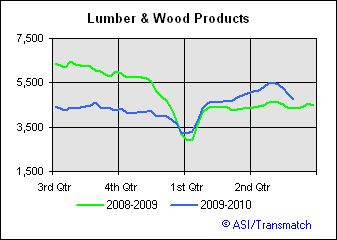
This bodes ill for the May and June housing statistics. May permits and starts will be reported next -Thursday- Wednesday.

Seven days into -May- June, the Daily Treasury Statement shows $54.7B in withholding taxes collected compared with $48.1B last year, a gain of 14% YoY! For the last 20 reporting days, withholding taxes for 2010 are $129.4B vs. $120.9B a year ago, a gain of 7%.

Given the strongly positive money indicators, and the strongly negative retail sales, railroad, and purchase mortgage indicators, all three focused on housing, next Thursday's housing permits and starts data is looming like the monster in "Cloverfield" over the economy.

9 comments:

Anonymous said...

Regarding the Daily Treasury Statement, you mean seven days into JUNE, right? Not May? If it was seven days into May, I dont know if it would as good news. :)

Constant Learner said...

Hello NDd,

thanks for focusing so much on the double dip right after my request. It might not be related but it's appreciated.

As you must have seen :
- the ECRI's weekly leading indicator is now negative (http://www.businesscycle.com/resources/) ;
- the investment grade market's 200 moving average is now under it's 50 moving average.

These are 2 of the best leading indicators for the stock market and the economy and even though that's just one month of data, the double dip theme has just gained a lot of credibility. That is not enough to turn me into a bear but I will watch your next notes with even more attention.

Here's a very interesting tool that you might like :
http://stats.oecd.org/mei/bcc/default.html

Anonymous said...

Kind of figured it would be a mixed bag after you posted the 5 points to watch for. I'd say 2-3 of the 5 will disappoint and leave us still wondering what direction things will go.

brodero said...

Since we have fairly strong Real M1
growth and we have a very steep yield
curve ( using 10 year treasury minus 3 month libor) at 2.70. I side with a possible slowing although the lengthening of the
average workweek makes me think we
could see some really good payroll
numbers.Also the 52 week moving average of nonseasonally adjusted jobless claims
continues to move down consistently
every week ( this week was a very good week). We are now at 496,854 down from the high made on October 31 2009 at 576,928.

New Deal democrat said...

Anon at2:34 p.m. Thanks, fixed now.

DL: ECRI's leading indicator has tanked apparently prmiarily due to the purchase mortgage index, which is reported to be a component of their own index.

Anon at 2:59 p.m.: Yes it could be. But if the weakness is mainly in housing-related data, that is a longer leading indicator, as housing tends to show both weakness and strength first. See Prof. Leamer's historical work on business cycles.

esong_98 said...

I hope the retail weakness is just the housing credit running out and we are witnessing what economists call "intertemporal substitution.". With the housing credit running out, home sales will be very weak for a couple of months, which means weak sales for consumer goods associated with housing (carpet, furniture, kitchenware, washing machines etc...) After a couple of months, housing sales will return to normal, and retail sales rebound.

My big worry is that last month's downturn is a result of a lost confidence in Obama's leadership abilities due to his poor perceived management of the oil disaster crisis. When people lack confidence in their leadership, malaise sets in and consumers stop spending. I think this is what happened to Jimmy Carter.

Anonymous said...

@esong

That is oversimplifying things a bit. The private economy doesn't rely on whoever is in the White House. For instance in 1983 the economy finally turned at what would be considered the low point of the Reagan presidency.

Anonymous said...

How important is the preliminary June consumer confidence reading from University of Michigan? It was the highest reading in 2 1/2 years, Jan 2008, almost before the beginning of the recession. It could be a fluke, and I know it might not translate into better consumer spending, but still, after a month of poor jobs numbers, European debt crisis, and oil spill, hard not to be encouraged by it.

esong_98 said...

Anonymous:

In August of 1982, the economy was in the doldrums. The morning after the evening Congress passed the biggest tax hike in history, was the morning that the bull market of the 1980s began. Four months later, unemployment peaked and the economic recovery of the 1980s began.

Does it matter who is in the White House? I suppose that's a big controversy. Many Real Business Cycle economists would say that it doesn't matter who is president. That pretty much all policy is neutral. In their view, random shocks to technology is what causes economic fluctuations. I tend to disagree. I think that to a certain extent, morale and psychology can affect the economy.