There's a lot of buzz this morning about a NY Times article documenting the increasing number of homeowners who are "doing the math" and deciding it makes no sense to continue paying the mortgage. They are simply letting the bank have their property, and walking away, a/k/a "jingle mail."
[B]y the third quarter of 2009, an estimated 4.5 million homeowners had .. their home’s value dropping below 75 percent of the mortgage balance.
....
[A] growing body of research indicates that significant numbers of borrowers are declining to live under what some waggishly call “house arrest.”
Using credit bureau data, consultants at Oliver Wyman calculated ... that about 17 percent of owners defaulting in 2008, or 588,000 people, chose that option [of walking away] as a strategic calculation.
I'd like to challenge the conventional wisdom (I know, you're shocked) and suggest that this is probably a good development, placed in larger context.
One of the most widely used graphs in the blogosphere a few years ago was this one, dating from January 2007 ("month 1" in the description) showing an initial wave, now passed, of subprime ARM resets, and a subsequent wave of option-ARM and jumbo resets and recasts (picking up steam now and really taking off later this spring):
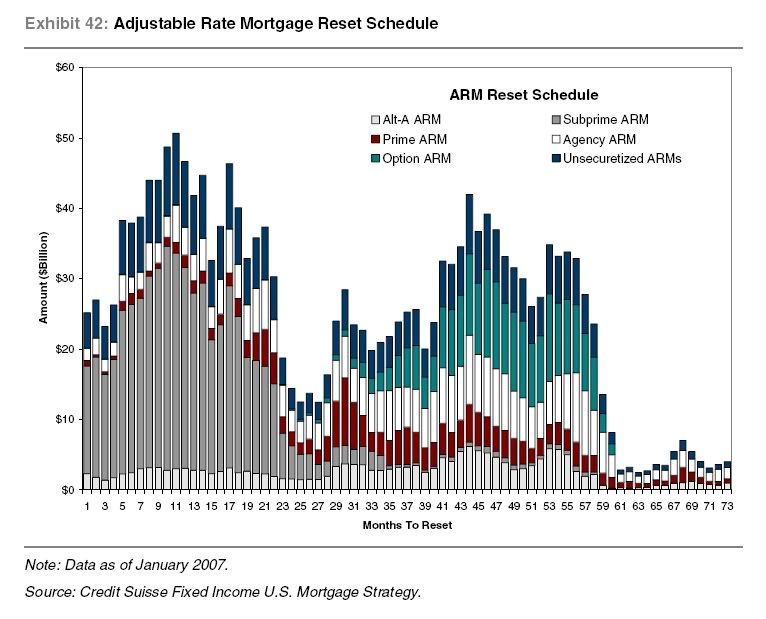
The typical argument, set forth among other places in a leading article at the place where I used to blog, is that this means that foreclosures are about to explode, more homeowners will be living out of cardboard boxes and we are all Doomed!!!
My rejoinder has been that these homeowners presumably did not spend the last 3 years like deer in the headlights, but did occasionally notice the housing implosion happening all around them, and many if not most may have already taken action, such as selling the place early for as much as they could get. The Times article suggests I've been right:
Mr. Koellmann ... bought a small, plain one-bedroom apartment for $215,000.... He put down 20 percent and received a fixed-rate loan from Countrywide Financial.Don't know about you, but to me Mr. Koellman's actions look perfectly rational. And as the article mentions, there are a burgeoning number of people just like him.
Not quite four years later, apartments in the building are selling in foreclosure for $90,000.
“There is no financial sense in staying,” Mr. Koellmann said. With the $1,500 he is paying each month for his mortgage, taxes and insurance, he could rent a nicer place on the beach, one with a gym, security and valet parking.
Undoubtedly this will drive the price of houses down even further, but as this graph of Case-Schiller house prices shows, they need to drop further to get back to a more normal valuation:

So in other words, the series is: homeowner walks away ---> gets cheaper, better apartment or house ---> housing prices go down further, becoming more affordable ---> foolish (bank) creditors take the haircut, debtors can increase new spending and stimulate the economy.
I'm trying to figure out what the downside is in all this ....


7 comments:
Bank creditors taking a haircut? (When allowed to actually happen) that didn't work out so well for the economy and the markets. I'd say that's the [necessary] downside and the "DOOM" meme that you guys rail against seemingly 100 times a day
See also the wire story on consumers that are paying their credit cards but are delinquent on their mortgages. TransUnion was the source of the information.
Obviously, the recommendation to people is to pay on secured assets first and let the unsecured go because so long as you have the income to support the payments you wouldn't lose them in a bankruptcy for example.
However, if you are underwater on your mortgage in a non-recourse state there may be advantages in maximizing available cash in dropping the mortgage payment. The jump in people paying credit cards as opposed to their mortgage hit 10 percent in California which is a non-recourse state.
Florida also had a big jump in this mode of debt service allocation though I don't think it is a non-recourse state.
I can't believe this won't create systemic pressures considering that so much of the problems are with states such as California and Florida.
The bigger question really is - how will the government, let alone the banks, tackle this issue?
The downside could be reduction in necessary risk tolerance. Such tolerance is made up of risk experiences "in the small" - if I experience problems in 3 small events, it may reduce my tolerance for risk in a larger event even if there is no real connection between them. If 3 homeowners go under, I may not want to loan to a small business (or, in fact, I may not be able to if my risk capital was eaten by those homeowners).
There is an argument that the last thing we need right now in this economy is reduced tolerance for risk. I'm talking about the type of risk tolerance that enables start-up enterprises that can dislodge an economy from the depths of recession. Such tolerance depends on an opinion that "there is no place to go but up". But, if we continue to be dragged down by a thousand cuts elsewhere, a capital supplier may not be able to define that bottom and work off of it, upwards.
This risk tolerance is different from the pathological risk we have in financial institutions now. Since our economy evolved from production-centric to finance-centric in the 1980's-90's, the concept of risk is distorted. This distortion monopolizes institutional attention to finance instruments and away from considering risk related to, e.g., business startup. These risk premiums cannot be considered next to each other because they deal with fundamentally different "goods".
How will the pending wave of defaults impact the credit default swap situation and mortgage backed securities overall? Weren't there trillions of dollars in CDS, and wasn't the spectre of having to make good on them as mortage defaults rose and housing prices plummeted a major factor in the recession? What happened to these trillions in obligations? Seems like there's still a ticking bomb out there, and I haven't read anything about them in the last 9-12 months.
What is the source for your Median
exising home price and median family income chart...I am a little bit confused 61521 is median family income (latest Census survey which is 2008 data)...National Association of Realtors median existing home price
for December was 178300....
As an aside you got me thinking and
did some homework,,,using National
Association of Realtors median exisiting price to median family income...here are some data points I came up with...today 2.90...2006
3.94....2000 2.73...1997 2.42...
1986 2.73
If you can find Alt A bonds they
have most if not all of this priced in.....
Post a Comment