The U.S. Census Bureau and the U.S. Bureau of Economic Analysis, through the Department of Commerce, announced today that total November exports of $124.8 billion and imports of $183.0 billion resulted in a goods and services deficit of $58.2 billion, $0.6 billion less than the $58.8 billion in October, revised. November exports were $1.1 billion more than October exports of $123.7 billion. November imports were $0.5 billion more than October imports of $182.5 billion.
In November, the goods deficit decreased $0.3 billion from October to $64.7 billion, and the services surplus increased $0.2 billion to $6.5 billion. Exports of goods increased $0.6 billion to $89.1 billion, and imports of goods increased $0.3 billion to $153.8 billion. Exports of services increased $0.5 billion to $35.7 billion, and imports of services increased $0.3 billion to $29.2 billion.
In November, the goods and services deficit was down $5.8 billion from November 2005. Exports were up $14.8 billion, or 13.4 percent, and imports were up $9.0 billion, or 5.2 percent.
A few notes:
1.) With one reporting month left, the 2006 trade deficit is already $15.836 billion shy of the record 2005 level. In other words, 2006 will be another record year.
2.) By far the US' biggest import is oil which comprised 10.33% of total imports in November 2006. On September 22 of last year, the San Francisco Federal Reserve released a study on oil prices and the trade deficit. Here is there conclusion:
Oil prices have almost quadrupled since the beginning of 2002. For an oil-importing country like the U.S., this has substantially increased the cost of petroleum imports. International trade data suggest that this increase has exacerbated the deterioration of the U.S. trade deficit, especially since the second half of 2004. One factor can explain this evolution: The real volume of U.S. petroleum imports has remained essentially constant. One explanation for why the demand for petroleum imports has not declined in response to higher prices comes from a model in which firms are fairly limited in their ability to adjust their use of energy sources, such as oil, in the short term.
The study had the following graph which illustrates the point:
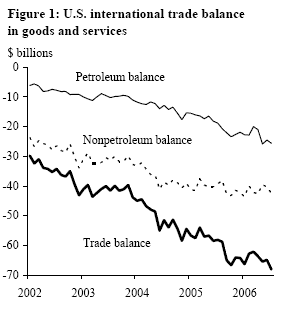
As oil prices are continuing to drop the trade deficit will probably continue to narrow over the coming months. This bodes well for a decrease in the trade deficit next year.

