- by New Deal democrat
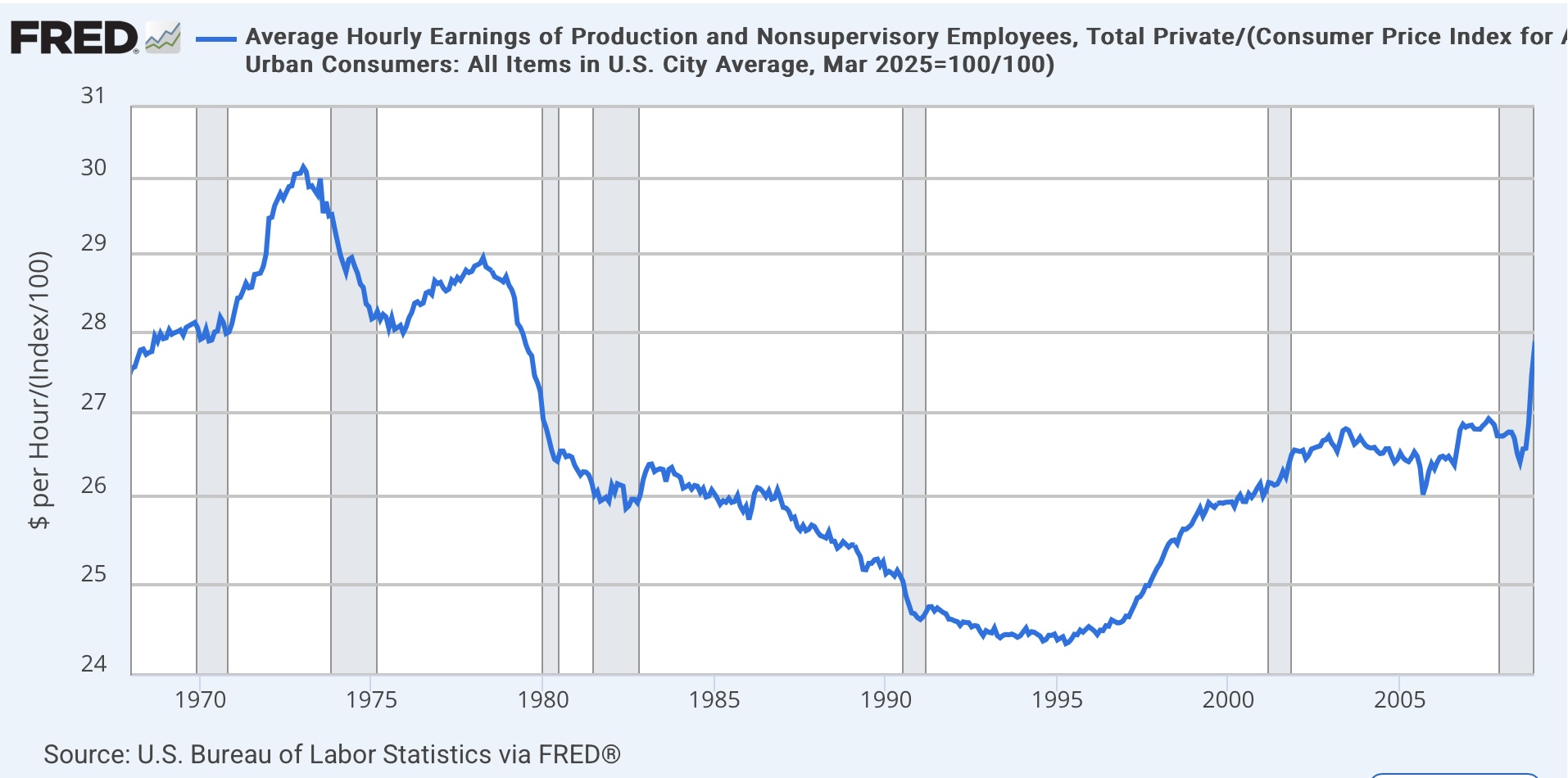
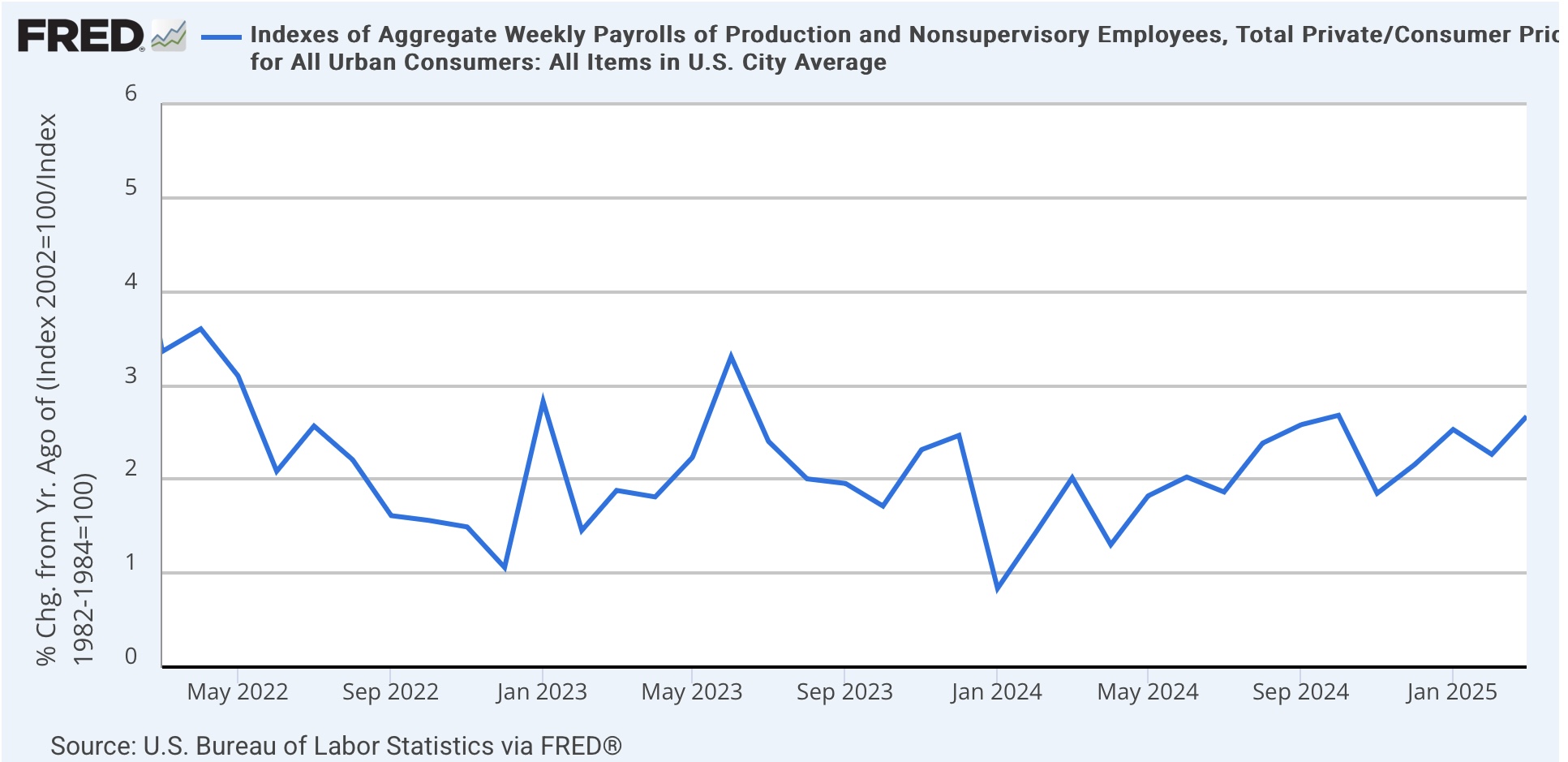
With yesterday’s CPI report, we can update two important measures of ordinary American workers’ well-being, that also serve as short leading indicators: real average hourly earnings and real aggregate nonsupervisory payrolls.
- by New Deal democrat
With yesterday’s CPI report, we can update two important measures of ordinary American workers’ well-being, that also serve as short leading indicators: real average hourly earnings and real aggregate nonsupervisory payrolls.
- by New Deal democrat
In March, with the exception of the usual problem child of shelter, almost every other component of consumer prices was tame - except for meat and eggs. And even shelter continued to decelerate. If Jerome Powell hadn’t tied his wagon to the core CPI number that includes shelter, he could simply declare victory over inflation.
- by New Deal democrat
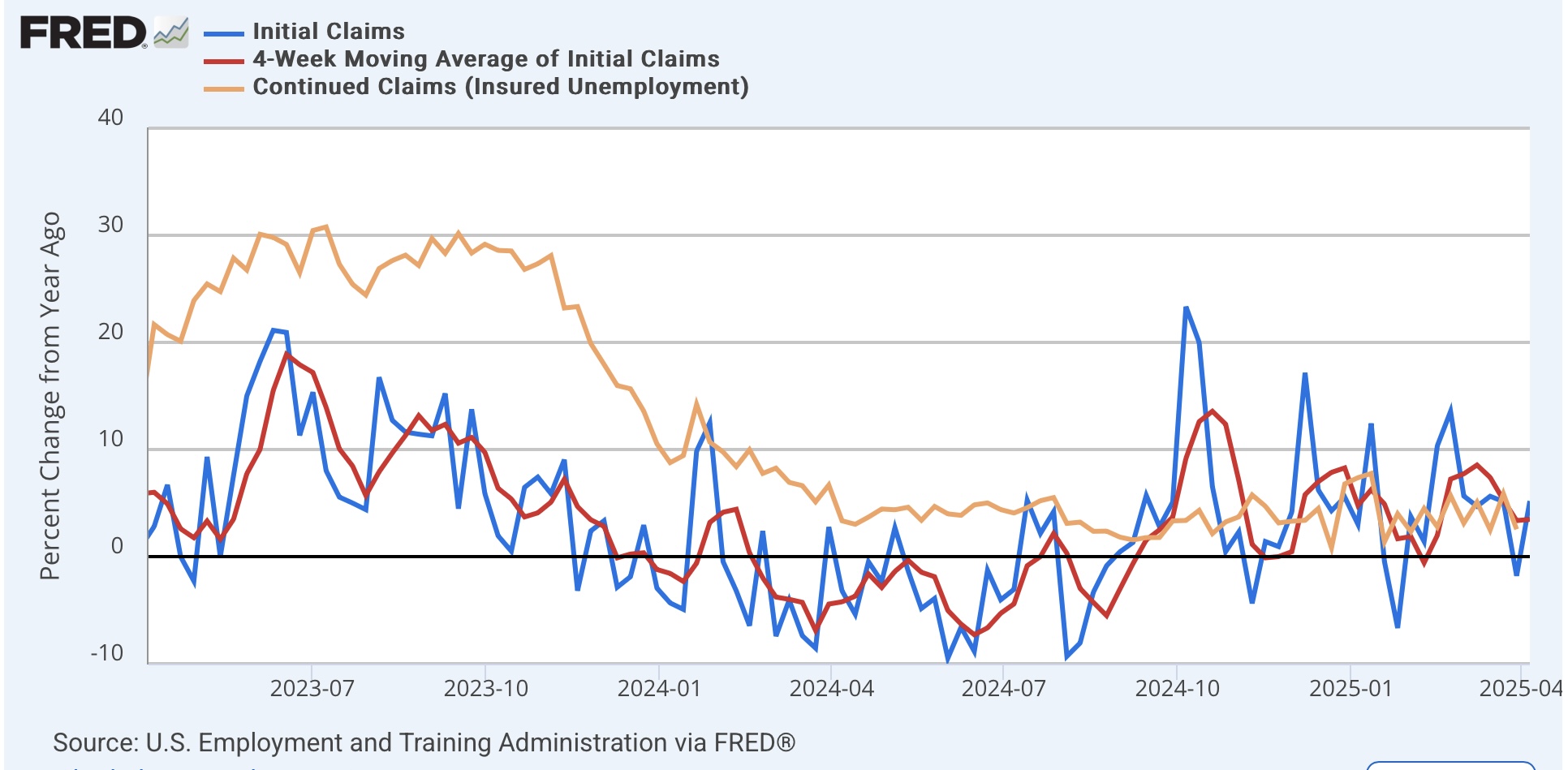
Before I deal with this morning’s March CPI report, let’s first update jobless claims.
-by New Deal democrat
Congress is not permitted to abdicate or to transfer to others the essential legislative functions with which it is thus vested.This principle is the basis of the nondelegation doctrine that serves as an important, though seldom used, limit on who may exercise legislative power and the extent to which legislative power may be delegated.
The doctrine was first made explicit by Chief Justice Roberts in West Virginia v. EPA in 2022, where he wrote: “[I]n certain extraordinary cases, both separation of powers principles and a practical understanding of legislative intent make us "reluctant to read into ambiguous statutory text" the delegation claimed to be lurking there…. To convince us otherwise, something more than a merely plausible textual basis for the agency action is necessary. The agency instead must point to "clear congressional authorization" for the power it claims; an further that “a decision of magnitude and consequence rests with Congress itself, or an agency acting pursuant to a clear delegation from that representative body
And as pointed out above, in Biden v. Nebraska, in 2023, the Court held that Congress did not authorize the Department of Education to institute a sweeping student loan forgiveness program under the HEROES Act of 2003, despite the explicit language in the statute allowing the Deparment to “waive or modify” the terms of the loans. Which looks pretty darn explicit.
So let’s turn to the issue of tariffs. Traditionally courts have shown great deference to Presidents using delegated authority to regulate specific tariffs, and also where there are national security implications. But T—-p’s actions last week arose under the International Emergency Economic Powers Act of 1977, which gave the President authority "to deal with an unusual and extraordinary threat, which has its source in whole or substantial part outside the United States, to the national security, foreign policy, or economy of the United States, if the President declares a national emergency with respect to such threat.
It’s pretty clear that the main driver of the tariff announcements last week were to deal with the decades’-long and chronic issue of the US’s trade deficits. There is absolutely nothing that has happened in the past year that would transform this chronic issue - that Congress has never significantly legislated about - into an “emergency.”
Further, the tariff pronouncements are such that they have almost instantaneously upended the decades’ long integration of global markets.
Was there ever a “clear congressional authorization" for the President to completely reorder the global trade relationships of the United States? Does it sound like “a decision of a magnitude and consequence [that] rests with Congress itself, or an agency acting pursuant to a clear delegation from that representative body?
Let me put it this way: is there the slightest doubt that if President Obama or Biden had done this that the Roberts Court would not cite the Major Questions Doctrine to stop it?
The bottom line is that it is not just Democrats in opposition who are horrified by T—-p’s tariffs. It is the core GOP constituencies of Wall Stree and corporate America who are screaming the loudest.
The Roberts Court has made a thoroughgoing record of being partisan. But in this case the disagreement is not between the Left and Right, but between two core constituencies of the Roberts Court itself. And the economic damage to the United States might prove catastrophic, and quite quickly too.
Under those circumstances the Roberts Court might well be receptive to enjoining the T—-p tariffs under the “Major Questions Doctrine.”
- by New Deal democrat
Are the T—-p tariffs quickly putting the US into a recession?
- by New Deal democrat
Normally on the Monday after the employment report, I do a deeper dig into its details. But today that seems a little quaint, sort of like rhapsodizing about the Roaring 20’s the week after the great Crash of 1929.
- by New Deal democrat
My “Weekly Indicators” post is up at Seeking Alpha.
You may be surprised to learn that despite the 10%+ stock market crash on Thursday and Friday, my rating for the short leading indicator of the S&P 500 is still “neutral.” That’s because the market is extremely volatile. There was an all-time high only six weeks ago. And there is no guarantee whatsoever that T—-p won’t declare “VICTORY!” in a week or two, completely reverse this week’s tariffs, and the entire downturn in the market will reverse as well. My discipline says that if there have been both a 3 month high and a 3 month low within the past 3 months, that’s neutral - and it pays to stick with a discipline and not make exceptions.
In any event, you can get caught up to date on the state of all the indicators by clicking over and reading, and I will get rewarded with a little pocket change for the effort.
—-
And now, this week’s special update.
My “quick and dirty” recession indicator consists of two high frequency indicators: (1) a YoY downturn in the S&P 500; and (2) a 10%+ upturn in the four week average of initial jobless claims (inverted in the graph below).
Well, as of Friday, the S&P 500 is now down YoY, fulfilling the first criterion. Jobless claims are only 3.4% higher YoY, so even though that signal is weak, it isn’t negative yet:
If the tariffs do stay in place longer than a few weeks, it would not surprise me to see layoffs increase sharply, fulfilling the second criterion. But we’re not there yet.
BTW, the peak in YoY stock market performance - over 40% - was just before the November 5 elections. A more damning chart would be hard to find.
- by New Deal democrat
My question over the past year has been whether “decleration” would turn into “deterioration.” For a “soft landing,” deceleration would need to end, and the numbers stabilize, vs. continuing to deteriorate towards an actual downturn. With the stupefying economic moves by the new Administration, looking for hard data indicating the onset of a recession must also be a top concern.
Below is my in depth synopsis.
- by New Deal democrat
This week initial jobless claims declined -6,000 to 219,000. The four week moving average declined -1,250 to 223,000. With the typical one week delay, continuing claims rose 56,000 to 1.903 million, the highest number since 2021:
- by New Deal democrat
Before I get to today’s data, let me make this brief note on the tariffs that were announced late yesterday and the instant reaction overnight. As to the effect on the US and global economy, I really don’t have anything useful to add to the general consensus of economists and other financial types; namely, this will function as a tax increase on consumers, who must pay more for the imported goods and services. I doubt very much there will be an expansion of domestic employment in “re-shored” industries to make up for that loss.
- by New Deal democrat
Along with all the other reports, yesterday the JOLTS survey was updated for February. This survey decomposes the employment market into openings, hires, quits, and layoffs, and so gives a more granular view. The question over the past year has been whether they best describe a “soft landing,” or “hard” one ending in recession.
- by New Deal democrat
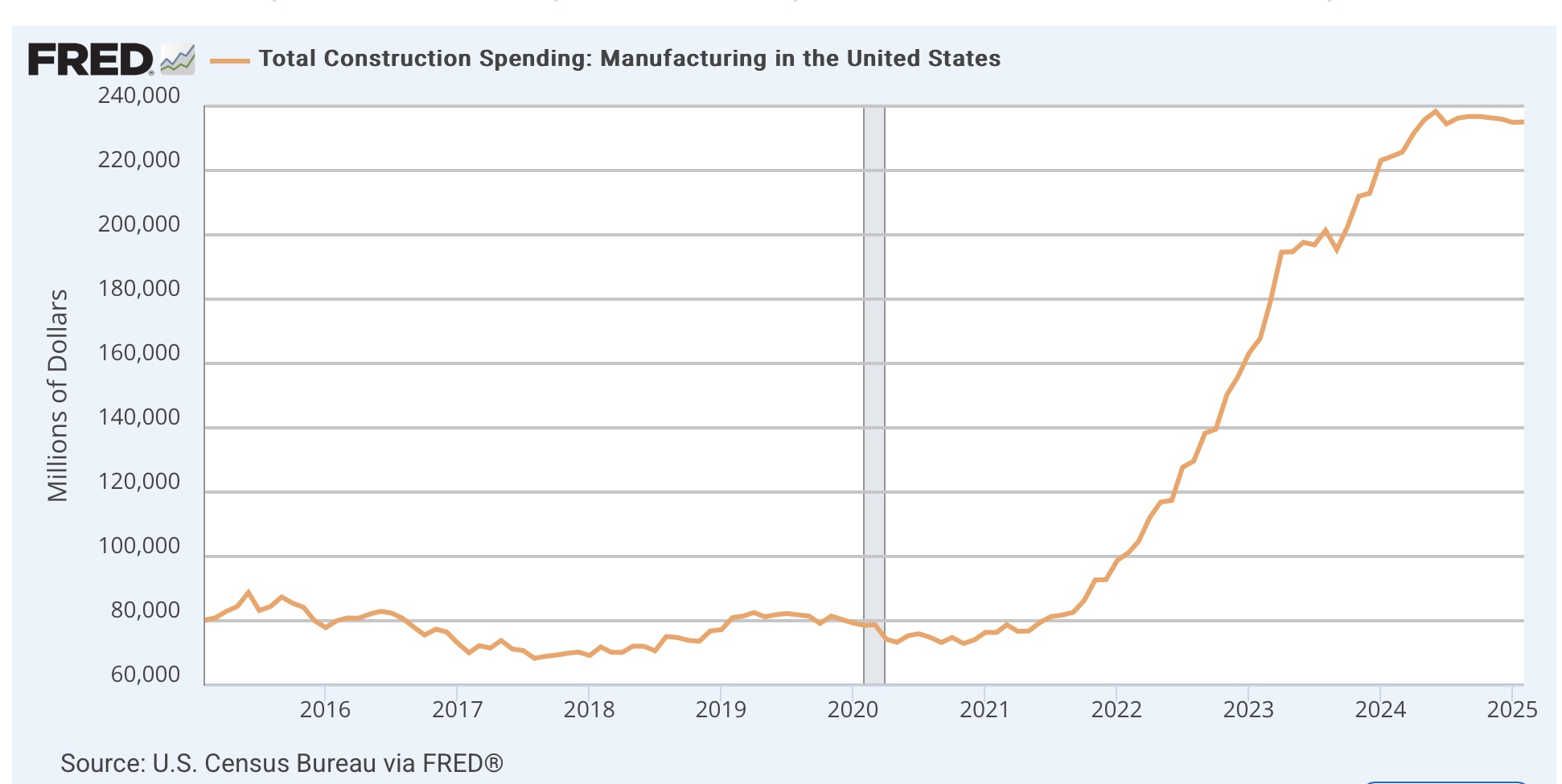
Since the turn of the Millennium, a downturn in manufacturing has not been enough to tip the economy into recession. There must also be a decline in construction as well.
- by New Deal democrat
After this morning’s contractionary ISM manufacturing report, it occurred to me to look at heavy truck sales to see if they confirmed the downturn. They did, but like the manufacturing index,