Friday, December 18, 2020

Housing permits and starts for November: yet more evidence of an economy primed for takeoff in 2021


 - by New Deal democrat

If there was bad news yesterday in the further increase of initial jobless claims, there was also good news in the 10+ year highs in new housing permits.


Here’s the graph of permits (blue), single family permits (red, right scale), and housing starts (green):


Not only total permits, but also the much less noisy single family permits, made 13 year highs. While the much noisier starts didn’t, the only months in the past 13 years that were better were last December through this February.

Because housing construction involves spending on all sorts of trades in the following year, and spending on landscaping, appliances, and other furnishings thereafter, new home building is an excellent long leading indicator.

Bottom line: yet more evidence that once the pandemic is brought under control, the economy is primed for a very vigorous takeoff.

Thursday, December 17, 2020

Jobless claims negative trend reversal likely; expect a poor December jobs number


 - by New Deal democrat

This week new jobless claims rose further from their recent pandemic lows, while continuing claims, seasonally adjusted, made a new pandemic low. Nevertheless I strongly suspect the downward trend has broken.

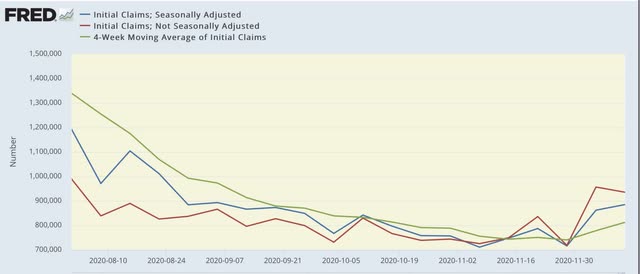
On a unadjusted basis, new jobless claims declined by 21,335 to 935,138. Seasonally adjusted claims, on the other hand, rose by 23,000 to 885,000. The 4 week moving average also rose by 34,250 to 812,500, the highest reading in a over a month. Here is the close up since the end of July (for comparison, remember that these numbers were in the range of 5 to 7 million at their worst in early April):

Because of the huge distortions caused by the pandemic in seasonally adjusted numbers, and because we are at a time of year when seasonality causes the most distortions in any event, let’s also take a look at the YoY changes in all of the above metrics:
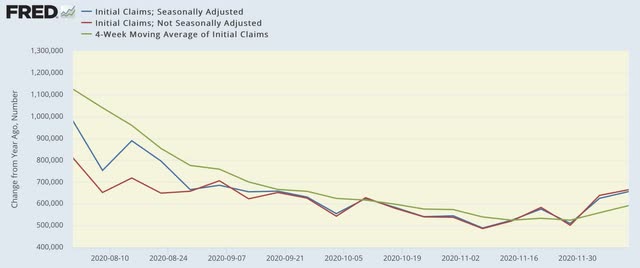


There is now a 5 week trend of increasing YoY comparisons of the weekly data, and the 4 week average also looks like it has started a trend higher YoY. Thus it is very likely that the renewed explosion of the pandemic has indeed caused new jobless claims to break into an upward trend due to the rampaging pandemic. Nevertheless, as I wrote last week, I won’t feel certain unless and until seasonally adjusted new claims rise over 900,000 and the 4 week average over 850,000, which would take both out of the range they have been in over the past 4 months. We’re not quite there yet.

The “good” news was that continuing claims, which historically lag initial claims typically by a few weeks to several months, fell by 312,257 to 5,492,701 on an unadjusted bases, and also declined by 273,000 to 5,508,000 after seasonal adjustment, a new pandemic low:
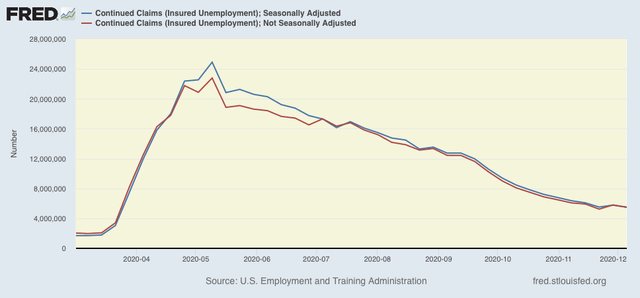

Because these lag initial claims, I strongly suspect we will see an upward reversal in the next few weeks.

Additionally, although I won’t bother with a graph, both initial and continued claims remain at or above their worst levels from the Great Recession.

Finally, the increase in new jobless claims has averaged 72,000 in the past 4 weeks. Here’s what that looks like vs. monthly job gains or losses this year (note that the 2 week change in jobless claims is inverted so that an increase shows as a downward bar:
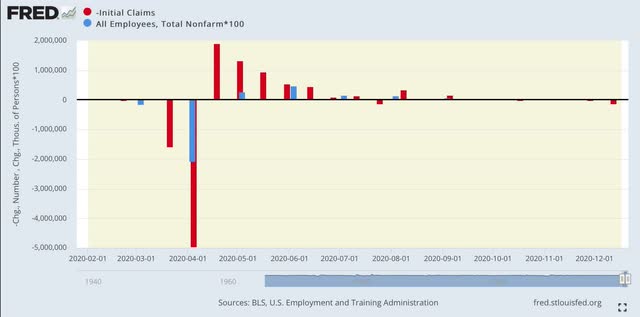

I mention this because such a dramatic increase in jobless claims over a month has never occurred outside of a recession, and has always coincided with a *loss* of jobs in the monthly report:
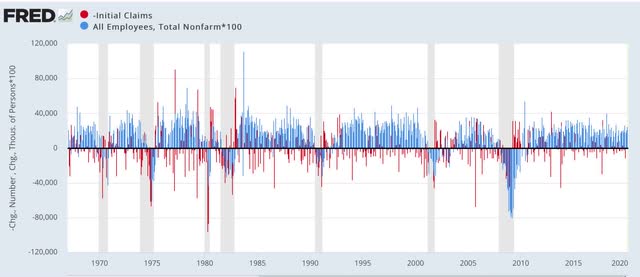

Because we are in uncharted territory all I really feel comfortable saying is that I suspect that the December jobs report is going to be the weakest since May.  A negative number is very possible, and if there is a positive number, it looks likely to be well under 200,000.  

Additionally, I also suspect the unemployment claims situation is going to continue to worsen as long as the pandemic does. I have no idea how much worse it will get.

Wednesday, December 16, 2020

November retail sales poor m/m, but trend still good


 - by New Deal democrat

Retail sales for November clocked in at -1.1% without adjusting for inflation. After inflation, the number was -1.3% m/m.

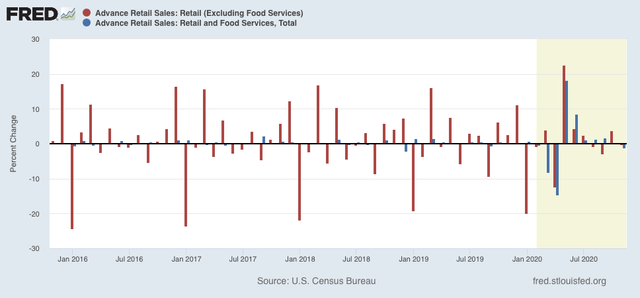
While the seasonally adjusted headline was certainly bad, this year tracking the unadjusted numbers is also important due to the havoc COVID is playing with consumption and employment. So the below graph shows the m/m changes over the past 5 years of both the adjusted (blue) and unadjusted (red) numbers:


As you can see, comparing this way shows that the November downturn is, relatively speaking, just a blip. Over the past 10 years November sales, unadjusted, had typically improved over 3% m/m as the Christmas season ramped up. This year sales declined -0.2%. So at very least we need to see if December changes the holiday dynamic this year.

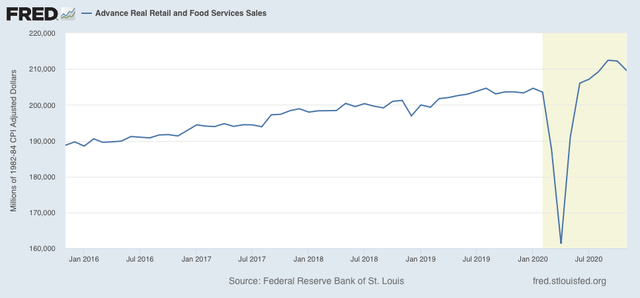
On an absolute basis, real retail sales are still up 2.9% since February:


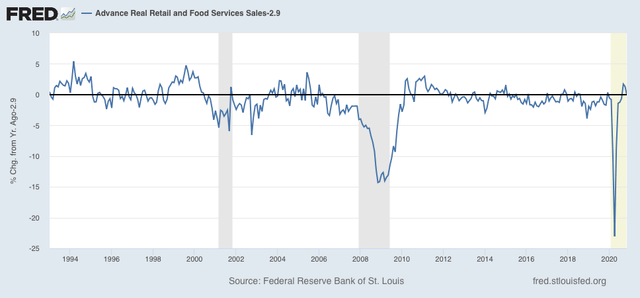
They are also up 2.9% YoY. The below graph subtracts 2.9% from the YoY value to show how the present compares with the historical data:


In short, whether measured since just before the pandemic hit, or YoY, sales still look pretty good.

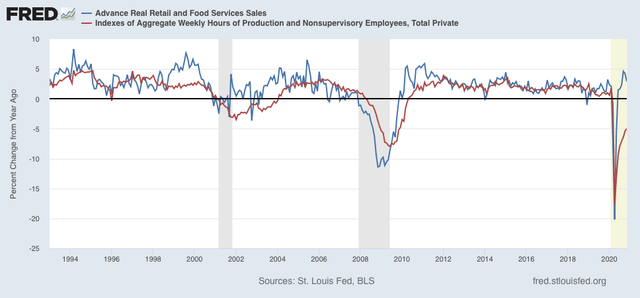
Finally, as I have pointed out many times, consumption leads employment. It’s even a better match for aggregate hours worked in the economy, as shown in the long term graph below:


So I continue to expect employment to continue to rise - with a lag, and quite possibly a pause during this winter as the pandemic continues to rage - to match the level of sales, probably as more and more people are vaccinated and warmer weather returns.

Indeed, tucked away in the Census Bureau’s report is this important note:

“[Sales in] Nonstore retailers were up 29.2 percent (±1.6 percent) from November 2019, while food services and drinking places were down 17.2 percent (±3.7 percent) from last year.”

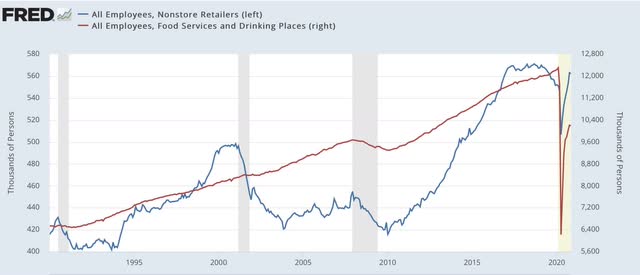
When we compare employment in the two above sectors, this is what we see (note the huge difference in the left vs. right scales):


As of November, nonstore retailers have regained almost all their employees since the pandemic started,  but food and beverage retailers are still down over 2 million jobs! It is this sector that will probably catch back up once the pandemic is brought under control.

Tuesday, December 15, 2020

Industrial production continues to progress, at a slower rate, in November


 - by New Deal democrat

I call industrial production the “King of Coincident Indicators” because it is the metric that is usually the decisive one for the NBER in determining when recessions and expansions begin and end.


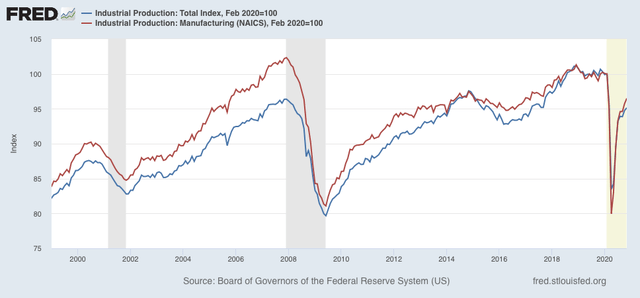
November’s report continues the trend of a strong rebound in production, as overall production increased 0.4% from October, and manufacturing 0.8%. Total production has recovered about 70% from its April low compared with February just before the pandemic struck, and manufacturing has recovered over 80% from that point:


Even so, both are currently off their peaks by about the same percentage as the worst of the 2001 recession, and the 2016 “shallow industrial recession.”

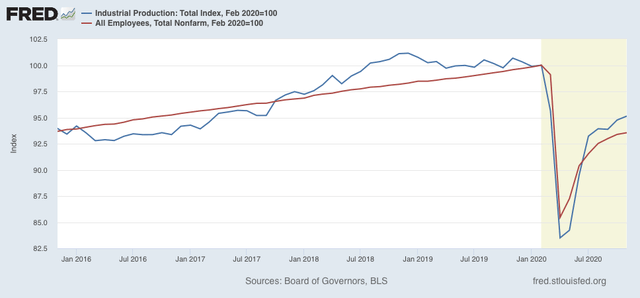
The next graph compares overall production (blue) with nonfarm payrolls (red), both normed to 100 as of February:


Jobs were hit harder in March and April, but have recovered more, as they are only about 3.5% lower than their February peak. On the other hand, it’s quite clear in the graph above that the recovery in both production and employment has slowed considerable in the past 3 months, even if both continued to make progress through November.

Note finally that, exactly because these are *coincident* indicators, they tell us where we are now, but do not forecast the next few months. In other words, as always it would be a mistake to assume or project that the present trend is going to continue.

Monday, December 14, 2020

The US economy is primed for takeoff in 2021


 - by New Deal democrat

The fist vaccine against COVID-19 began to be distributed today. At last there is light at the end of the tunnel.

The pandemic has been dictating the state of the economy ever since it hit. But for the last several months and longer, the “high frequency” data I follow each week has painted a picture of an economy that “wanted” to accelerate.

But because the weekly data can be very volatile, a look at the more reliable, long-established leading indicators that are provided monthly or quarterly is worthwhile.

I have prepared a post doing exactly that, first with the long leading indicators that help us know the direction of the economy about 1 year out. This post is up at Seeking Alpha.

As usual, clicking over and reading should be informative for you, and a little bit $ rewarding for me.

Sunday, December 13, 2020

The GOP has crossed the Rubicon


 - by New Deal democrat

In the Roman Republic, military leaders automatically lost their legal authority to command at the Rubicon River in northern Italy. When Julius Caesar crossed the Rubicon with his legions, it was an act of war against the Republic. With the filing of their  Amicus brief in the Supreme Court this past week, the GOP as represented by their Congressional delegation similarly finally broke with the idea of American democracy itself. 


For the first several weeks after Trump’s railing against the election results, the GOP simply took the position that he was entitled to pursue legal remedies if he believed he was wrong. The mask was ripped off, and that pretense abandoned, when in their brief, the GOP took the core position  not just that there were allegations of errors which were entitled to be explored, but rather ***asserted as a fact*** that millions of votes in 4 swing States were invalid and should not be counted. Not because dead people voted, or people not properly registered had voted, but rather simply on the flimsiest of assertions that actions by Courts and Executive officials carrying out their respective States’ election laws rendered all of the votes cast in good faith reliance upon the law by millions of voters in those States null and void.

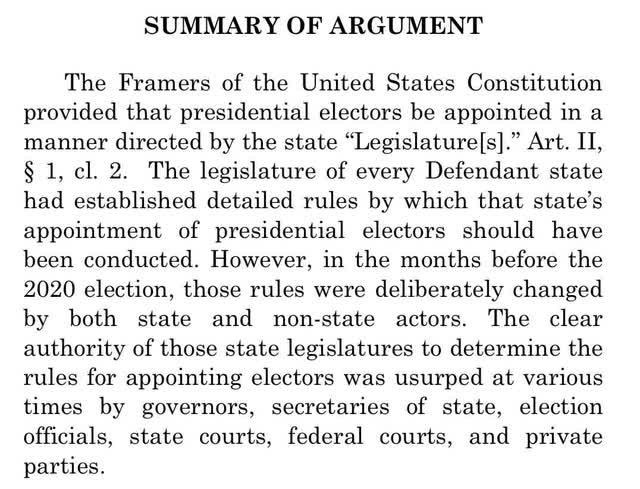
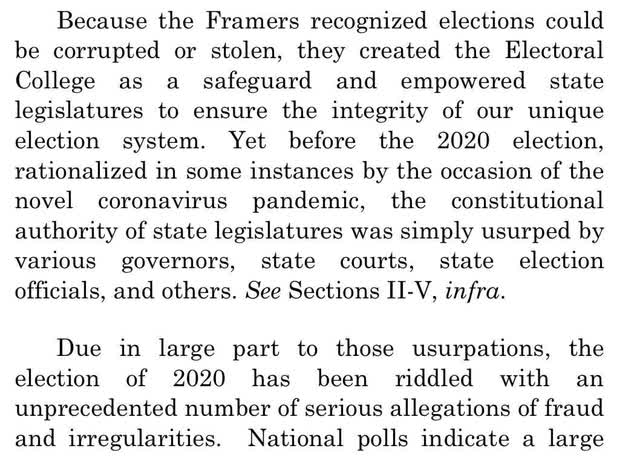
Here’s the “Summary of Argument” from the GOP Brief:


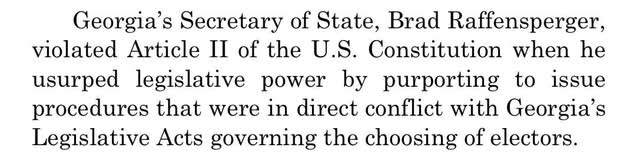
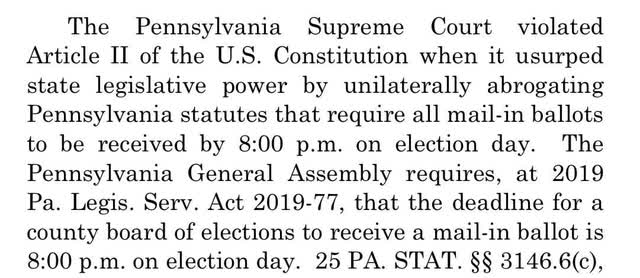
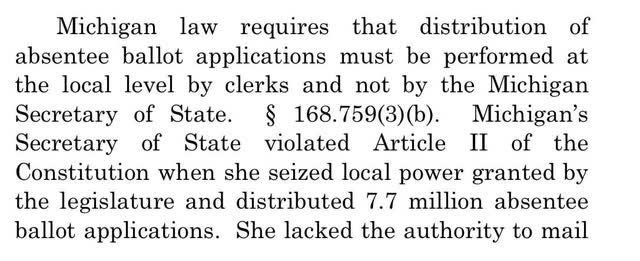
And here is a sample of their assertions against the 4 swing States.

Georgia


Pennsylvania:


Michigan


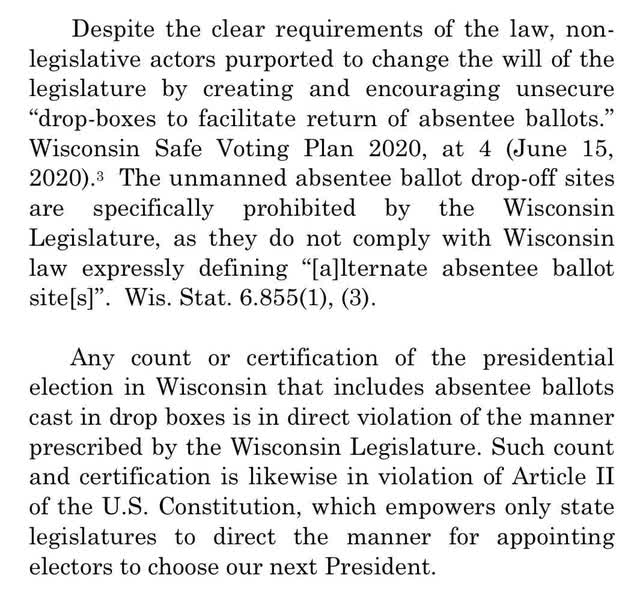
Wisconsin


Not a single one of these assertions indicates that any of the votes so cast were not by US citizens who were properly registered to vote, and were acting in good faith relying upon their State’s guidance.

While the Electoral College will cast their votes on Monday, it is crystal clear that on January 6, when the new Congress convenes to confirm the election, GOP Senators and Representatives will en masse object to the counting of these 4 States’ Electoral votes, and perhaps the Electoral votes by other swing States as well. Meaning that if there were a GOP majority in the House, they would refuse to confirm Biden’s election and instead declare Trump the winner.

In short, we have reached the point where the GOP as an institution has declared that if it has the power to do so, it will overturn a Presidential election vote for the Democratic candidate. They have crossed the Rubicon, and no longer support democracy in America.