Thursday, October 7, 2010

Automation Over Hiring

From the LA Times:

"Labor is so expensive," said Young, whose great-grandfather started farming row crops in Kern County in 1910. "There's their wages, truck, insurance, workers' comp and the safety regulations. We went to a high-value crop that needed less labor input."

Young estimates that at seasonal peaks, he now employs 70% fewer workers.

That sentiment isn't unique to farming. Forced to cut costs during the recession, employers across the country are looking at ways to avoid hiring. They've accelerated use of computers and technology, replacing administrative assistants with software, cashiers with self-service kiosks and laborers with machines.

These structural changes mean some jobs that disappeared during the recession may never come back. Productivity gains are good for company profits and help the economy grow over the long run. But in the short term, the shift is exacerbating America's jobless recovery.

"Recessions tend to act as ratchets; they'll often speed the pace of fundamental changes that were going on in the economy anyway," said Erica Groshen, vice president and director of regional affairs at the Federal Reserve Bank of New York.

Ditching workers is an appealing prospect to many California farmers. Few states have minimum wages higher than California's $8 an hour. The heightened focus on workers' immigration status has increased farmers' administrative burden.

With the help of machines, though, growers can continue to boost output while reducing headcount. Farm labor in California has fallen 11% over the last decade, yet cultivation of heavily automated crops soared over the same period: almond production has more than doubled, to 1.6 billion pounds.

"If cheap technology is available, you substitute technology for people," said Allen Sinai, chief global economist at Decision Economics in Boston.

Automation has been a steady progression since the Industrial Revolution. Still, laying off workers is never easy. Recessions give companies a motive to move more swiftly than they otherwise might have to cut staff, outsource work to cheaper locations and implement labor-saving technology, Sinai said. When sales pick up, companies can help profits rise quickly by keeping a lid on hiring.

That's part of the reason that earnings at some large companies have soared over the last year while job creation has lagged behind. In August, U.S. private sector employers added 67,000 jobs, far fewer than the 100,000 needed to keep pace with population growth.

Capital intensity — how much a firm relies on software, tools and machinery — contributed 1.6% to productivity gains from 2007 to 2008 after growing just 1% from 2000 to 2007, according to the Bureau of Labor Statistics.


This is something I've touched on before (see here and here).

Geithner Joins the Currency Discussion

From Bloomberg:

Treasury Secretary Timothy F. Geithner called for cooperation to rebalance currency markets and warned of a “damaging dynamic” of competitive weakening that could limit global growth.

“More and more countries face stronger pressure to lean against the market forces pushing up the value of their currencies,” Geithner said in a speech yesterday in Washington. Currencies are “inherently a multilateral issue” that is “much easier to solve if countries come together.”

Global exchange-rate policies are a source of contention ahead of this week’s meeting in Washington of the International Monetary Fund, World Bank and Group of 20 officials. Brazil’s Finance Minister Guido Mantega last week warned of a “currency war” as governments in Asia and Latin America seek to spur exports and economic growth.

This is the latest development in a multi-pronged story. I believe it started with the Brazilian statement regarding a currency war, although the US House's action on raising tariffs on Chinese imports may have also started the wave. Now we have the US Treasury Secretary entering the fray.

I think it's great that this issue is now out in the open.


Where Will Growth Come From? Part IV; Services

The primary source of information on the service sector comes from the Institute for Supply Management's ISM index. Here is the latest report:

"The NMI (Non-Manufacturing Index) registered 53.2 percent in September, 1.7 percentage points higher than the 51.5 percent registered in August, indicating continued growth in the non-manufacturing sector at a faster rate. The Non-Manufacturing Business Activity Index decreased 1.6 percentage points to 52.8 percent, reflecting growth for the 10th consecutive month, but at a slower rate than in August. The New Orders Index increased 2.5 percentage points to 54.9 percent, and the Employment Index increased 2 percentage points to 50.2 percent, indicating growth in employment for the third time in the last five months. The Prices Index decreased 0.2 percentage point to 60.1 percent, indicating that prices increased in September at a slightly slower rate. According to the NMI, 11 non-manufacturing industries reported growth in September. Respondents' comments continue to be mixed about business conditions, with a slight majority reflecting optimism."
The anecdotal information contained in the report is showing a slower situation:


  • "General state of the business has not changed in the last three months. The market is still soft for new sales due to financing requirements." (Construction)
  • "Business seems to be flat from last month." (Finance & Insurance)
  • "Signs that the economy may be improving, but our sector is still flat or declining." (Professional, Scientific & Technical Services)
  • "Business activity is generally stable — slightly better than last year." (Accommodation & Food Services)
  • "Third quarter is looking profitable with improving confidence and expectations in the economy. Capital expenditures are being approved." (Wholesale Trade)

I've always assumed they include various anecdotal statements because they are representative of the industry or a group of statements. The above statements use the word "stable/flat" is pretty prominent. In other words, things are OK, but not great. No one is saying, "people are literally kicking the door down to buy something."

Let's take a look at some of the data:


Like the ISM manufacturing index, the non-manufacturing index bottomed at the end of 2008 and rose until 2010. Over the last few months we've seen it slip, but it is still showing readings above 50 indicating expansion.


The new orders index is still above 50, but it is also in a clear downtrend.

We can also glean some information from the Federal Reserve's Beige Book:

Activity was largely stable or up slightly for professional and other nonfinancial services. Providers of information technology (IT) services such as computer software saw substantial revenue and sales gains in the Boston and Kansas City Districts, with increased demand for IT labor reported in Chicago as well. Demand for professional services such as accounting held largely steady, with Minneapolis and Dallas noting increases for selected types of consulting and legal services. Conditions were mixed for providers of real estate services, as heightened appraisal activity for refinancing purposes was offset by depressed home sales and consequent limited needs for agents and brokers. Demand for temporary staffing services remained on an upward trend, with increases noted by Boston, Philadelphia, Richmond, and Minneapolis, although Chicago pointed to a slight softening during the reporting period. Reports from the health-care sector were mixed: Boston, Cleveland, and Chicago reported ongoing increases in demand for health-care workers, while Philadelphia indicated a flattening in demand for health-care services and San Francisco noted a decline in the frequency of elective procedures and routine tests. Demand for shipping and transportation services generally expanded, although according to Cleveland the pace of growth slowed and contacts there expect little change from existing volumes in the near term.


Let's take a look at some of the Fed regions:

Boston: Software and information technology contacts in the First District report that business conditions continued to improve. Year-over-year revenue increases ranged from mid-single digits to 15 percent in the most recent quarter. Half of contacted firms increased their headcounts and another was "on the cusp of hiring."

Philly: Service-sector firms generally reported minimal gains or flat rates of activity since the previous Beige Book. A large business services firm reported that client companies were not contracting for as much business as they had indicated earlier in the year. Several health-care organizations noted recent flattening in activity that is interrupting a long growth trend. In contrast, some temporary employment agencies noted that demand had picked up recently. Looking ahead, most of the services firms contacted for this report expect growth to be slow for the rest of the year. Some have reduced their forecasts; as one contact said, "It looks like we were a little too optimistic earlier this year."

Richmond: Services-providing firms also gave mixed reports. Contacts at healthcare organizations noted that demand was typical for the summer, while airport officials and electrical contractors saw a small increase in demand for their services. A telecommunications contact reported accelerating revenues, while several administrative-support firms cited flat or slowing revenue growth. Local officials in Norfolk, Virginia noted that a recently announced shut-down of major military facilities would affect a large number of civilian contractors. Community leaders indicated that they will be vying for other military projects. Price growth slowed slightly at services firms in recent weeks, according to survey respondents.

St. Louis: The District's services sector also has continued to improve since our previous report. Firms in the transportation, business support, telecommunications, and government services industries expanded existing operations and hired new employees. Additionally, firms in the restaurant industry opened several new facilities. In contrast, contacts in the business support services and janitorial services industries reported plans to decrease operations and lay off workers.

Minneapolis: Activity in the professional business services sector increased since the last report. Contacts from the legal sector reported that billings during July were up from a year ago, especially for firms that deal with bankruptcies. A call center is expanding in South Dakota. Appraisers and other professional services firms that support home refinancing reported strong activity over the past month.

Kansas City: Growth in transportation services moderated slightly from previous surveys but remained solid, and a major supplier of diesel fuel reported continued solid sales. Most high-tech services firms reported strong growth in sales, although a few contacts noted softened demand. Business firms' expectations for future sales eased somewhat from the previous period but remained positive.

Dallas: Most staffing firms report that demand continues to grow at a solid pace, and is particularly strong for light industrial, sales, administrative, professional and technical workers. Placement activity continues to be mostly for contract work as employers are still hesitant to hire permanent staff. Near-term outlooks are optimistic, but respondents are cautious about the longer term. Accounting firms note that while demand for tax-related services has slowed seasonally and that for real estate and construction-related work remains nonexistent, there has been a pickup in transactional and consulting activity. Demand for legal services was largely unchanged during the reporting period, with the exception of an uptick in corporate demand for mergers and acquisitions-related activity.

Demand for transportation services remains positive. Railroad respondents noted a broad-based increase in cargo volumes, with shipments of grain products recording the largest increase. Shipping firms said small parcel cargo volumes rose, while large freight shipments declined during the reporting period. Intermodal transportation firms reported a modest increase in shipments. Airline traffic was flat to slightly down since the last report, but is stronger than a year ago. The outlook is for continued stability in air travel demand.

San Francisco: Demand for services improved modestly on balance but remained lackluster overall. Demand for professional, media, and entertainment services was mixed across sectors but appeared to be largely stable at low levels on net. Providers of energy services reported stronger demand for industrial use, with the exception of wood products. Contacts from around the District noted increased business travel and tourism activity, as reflected in higher visitor volumes, hotel occupancy rates, and airline passenger miles, although visitor spending remained weak. Providers of health-care services reported that demand slipped somewhat, which they attributed in part to rising postponements or cancellations of elective procedures and routine tests by individuals who lack health insurance.

Overall, the general tone is one of growth, but muted. Growth is between "lackluster" and growing, but the emphasis seems to be on caution. People are seeking services, but at a reduced pace.

Yesterday's Market


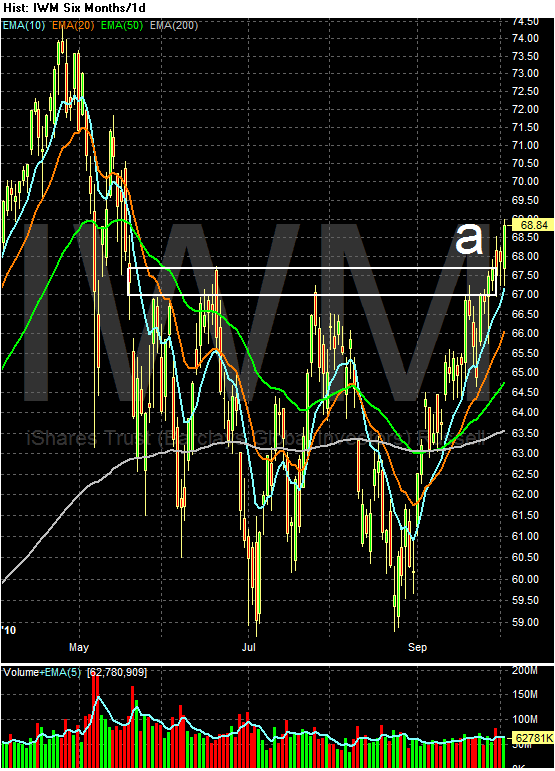
Stocks are now above the 61.8% Fibonacci retracement level. There is very little overhead resistance aside from round numbers at this point (I'll touch on the recent action below).


At the same time, the 7-10 year part of the curve is also rallying. While it has broken the primary uptrend (a) it has now formed a second uptrend (b).


The TLTs -- the long-end of the Treasury curve -- are also rising. They are also above key support levels (b).

S0 -- at the macro-level, both stocks and bonds are rising. The move into stocks indicates there is an increased risk appetite on the part of investors. In addition, the lower yields on Treasuries is driving investors to seek higher dividends and more capital appreciate in stocks.

The rise in bonds indicates two things. First, investors don't see the Fed lowering rates anytime soon. In addition, inflation is also not a concern; if it was, people would be moving out of Treasuries.


The dollar's chart also tells us that traders don't thing the Fed will be raising rates anytime soon. After forming the head and shoulders formation, prices broke through the neckline and have moved lower at a strong pace.


As a result of the lowering dollar, we've seen an increase in commodities, which are clearly in a rally (a) and are just below key resistance (b). Part of the rise in commodities is the result of the lower dollar:


But part of it is also the rise of demand from growing industrial economies.

Overall, the markets are fairly bullish for the economy: the rise in equities indicates an increase in risk appetite; the rise in Treasuries indicates that traders think rates will stay low for the foreseeable futures; the lower dollar bolsters the interest rate argument and helps exports and commodities are rising because of increased demand.

Wednesday, October 6, 2010

Industrial Metals Rising

From to FT:

The price of tin has jumped to a new high, making the metal, widely used in electronic goods, the first base metal to surpass the peak it hit during the boom years before the global financial crisis.

The record comes as resurgent demand, particularly from Asia, is being met by sluggish supply in all the industrial metals, driving prices higher.

.....

Copper, the red metal used in electrical wiring and piping, rose above $8,200 a tonne for the first time in two years, and there is widespread expectation in the industry that it will post an all-time high above $9,000 within months.

Even aluminium, the laggard of the group whose supply is plentiful, has risen 25 per cent since June and is trading near a two-year high.

This bodes well for manufacturing in the future, as it indicates demand is increasing.


IMF Chief Warns of Currency War

From the FT:

Governments are risking a currency war if they try to use exchange rates to solve domestic problems, the head of the International Monetary Fund has warned.

The comments by Dominique Strauss-Kahn came before the yen fell as a result of the Bank of Japan shifting towards quantitative monetary easing, cutting its key interest rate and proposing a new fund to buy government bonds and other assets.

“There is clearly the idea beginning to circulate that currencies can be used as a policy weapon,” Mr Strauss-Kahn told the Financial Times on Monday.

“Translated into action, such an idea would represent a very serious risk to the global recovery . . . Any such approach would have a negative and very damaging longer-run impact.”

Where Will Growth Come From? Part III; Manufacturing

Let's start with a look at where we've come from:


Overall industrial production has clearly rebounded, as has


Capacity utilization. However, note how far capacity dropped; this was the steepest loss of capacity in the last 50 years, indicating how severe the industrial contraction was.


The ISM number started to rebound in early 2009, and continued higher until earlier this year. The number has moved lower for the last few months; however it is still above 50 indicating an expansion. In addition, the number reached an incredibly high level, indicating there was nowhere to go but down. However, there are other signs of a manufacturing slowdown in the data.


Overall durable goods orders have been down three of the last five months. Also note that aside from two big gains, this series has been printing right around zero. However, it is important to remember that aircraft orders are part of this series, which tend to have a very disruptive effect on the numbers reported. However, regardless, the numbers are getting weaker and have been for the last few months. In addition, the regional Federal Reserve surveys are showing a slowdown.


The Empire State Index printed strong numbers earlier this year, but has since fallen back to just about 0. This is still an expansionary reading, but obviously not very strong.


The Philadelphia Manufacturing Index moved below 0 last month, but is currently right around that level.

The Richmond index is also moving lower, although still positive.


The Texas manufacturing index has been teetering just above 0 for the last year.

The Kansas City Fed's number printed a decent number last month.


The Chicago Fed's Midwest index is still increasing, although it is doing so from very low levels.

These numbers show that the Eastern Seaboard's manufacturing is slowing, but the mid-west's is fair and Texas' is borderline.

The overall slowdown in durable goods orders indicates the manufacturing sector is slowing. However, the overall ISM readings and numbers from the Midwest should be enough to keep manufacturing from contracting at a strong rate. I think these numbers indicate a level right around 0 is the worst case scenario going forward.

Yesterday's Market


On the daily chart, yesterday's price action was incredibly important because prices broke through key resistance on several fronts. For the last week or so, equities and bonds have been competing for investor's attention, with bonds taking just enough away from equities to keep equities from moving higher. Yesterday may have ended that situation.


Also note there is a ton of empty space above the SPYs, indicating prices have room to run.


Yesterday, prices gapped higher at the open, and continued higher all day. Along the way, there were several consolidation patterns (b). This is a very strong chart.


The primary market holding stocks have is the bond market. Notice that while prices are still below the main uptrend, they are still clustering in a high position, giving no indication of selling off. So long as fixed income can pull money away from equities, a possible upward break exists on the equity markets.


The dollar is in a clear downtrend. In the last ten days, there have been three downside gaps (a, c and d) and one big move lower during the day. This has very bullish implications for the commodities markets.

Tuesday, October 5, 2010

Factory Orders Decrease .5%

From Bloomberg:

Factory orders fell back in August but were skewed by a month-to-month dip for aircraft which, based on a run of order announcements from Boeing, looks to swing higher in September. Factory orders fell 0.5 percent in August yet were up 0.9 percent excluding transportation, which is the category that includes aircraft. Details show a 1.5 percent decline in durable goods (revised from minus 1.3 percent) with the first reading on non-durables up 0.3 percent on strength in chemicals.


From the WSJ:

U.S. manufactured goods orders decreased by 0.5% to $408.94 billion, the Commerce Department said Monday.

Commercial airplanes drove the decline; excluding transportation, all other factory orders rose.

The report had positive data. A barometer of business capital spending increased; non-defense capital goods orders excluding airplanes rose by 5.1%.

The big problem with this report is Boeing, which can really play with the numbers.

Let's look at some of the subparts:

Excluding transportation, we're seen the following numbers for new orders for the last three months: -.6%, -.9% and up .9%. That is two monthly declines, although this months number was strongly higher.

Excluding defense, we've seen the following numbers for new orders for the last three months: -.5%, .5%, -.5%.

For machinery, we've seen the following numbers for new orders for the last three months: 4.1%, -9.8%, 5.2%. These only account for 6.57% of all orders, but are an indicator for future business investment.

New orders for computers and electronic components. have printed the following for the last three months: -.9%, -.3% 3.7%. These only account for 6.94% of new orders.

Overall, this number points to a slowing in the manufacturing sector, but hardly a collapse.

Here's a link to the Census report.

More Currency Market Developments

We've seen the US House take action against the yuan and a statement from Brazil that we're actually in the middle of a current war. Now we have a call for a new international understanding:

The world’s leading countries should agree a new currency pact to help rebalance the global economy, a leading association of financial institutions has urged.

The Institute of International Finance, which represents more than 420 of the world’s leading banks and finance houses, warned on Monday that a lack of such co-ordinated rebalancing could lead to more protectionism. Charles Dallara, IIF managing director, said: “A core group of the world’s leading economies need to come together and hammer out an understanding.”

.....

Mr Dallara, who as a US official worked on the 1985 Plaza Accord which co-ordinated international action to strengthen the yen against the dollar, called for a more sophisticated updated version of such an agreement. This should include stronger commitments to medium-term fiscal stringency in the US and structural reform in Europe. “Exchange rate understandings are of little use on their own,” he said.


And then we have this from Europe:

European policy makers on Tuesday ramped up pressure on China to allow its currency to strengthen, claiming the yuan's weakness threatens Europe's economic recovery.

Their direct language followed their meeting with Chinese Premier Minister Wen Jiabao as part of the Asia-Europe summit here and marked growing support from Europe for U.S. efforts to offset China's export advantage from the weak yuan, also known as the renminbi.

Jean-Claude Trichet, president of the European Central Bank, departed from ECB practice of not identifying countries for criticism. "We noted that the evolution in terms of the effective exchange rate, also vis-a-vis the euro, was not exactly what we would have hoped ourselves," Mr. Trichet said at a news conference. "This exchange-rate flexibility is very, very much in the interests of China."

Where Will Growth Come From? Part II; Investment

Let's continue out look at where growth will come from by looking at the second part of the GDP equation: investment, which accounts for 14.8% of US GDP. Investment has three sub-categories: residential investment (housing), non-residential structures (commercial real estate) and equipment and software.

Let's start with a look at overall construction spending:


The above chart shows the year over year rate of change in overall construction spending. While the rate of decline as lessened, it is still printing negative numbers indicating that construction spending is still having problems.


The month to month percentage change has been getting less bad, but is still in a very negative situation.


Construction spending is composed of two data subsets: residential -- which accounts for 30.68% of all construction spending and non-residential which accounts for 69.31% of construction spending. Residential investment accounts for 22.33% of construction spending in the GDP equation and 3.3% of US GDP. Commercial real estate is 28.53% of investment spending in the GDP equation and 4.22% of total GDP. However, construction spending is incredibly important because of its ancillary benefits. Construction employs construction workers and increases purchases of durable goods. That's what makes these numbers so important.

Notice that residential has started to print positive year over year numbers; it's commercial real estate that is in the doldrums, although it does appear the rate of decline has hit bottom.

Taking a closer look at the housing market, we see the following two data sets:


Total building permits are bouncing along a bottom, as are


housing starts. Both of the above charts indicate that residential housing construction has bottomed. The main issue is when will it start to add to the recovery? The good news there is the absolute level of new homes for sale is at incredibly low levels:


The bad news is the economy is weak and households are de-leveraging. So while a quick resurgence in new home demand could really provide a spark for the economy, the reality is that probably won't happen anytime soon.

Regarding commercial real estate -- the largest part of construction spending -- change may be on the horizon.


First, fewer and fewer institutions are tightening lending standards for commercial real estate.


In addition, demand for CRE loans appears to be picking up. However (and it's a big however)


The non-current rate on C and I loans is very high, indicating the market is experiencing serious problems. In addition,


The total amount of C and I loans outstanding has decreased. However, also note that in the last two recoveries, this number decreased for an extended period of time into the recovery, indicating the current situation is not abnormal.

So, the short version for real estate investment is it won't be a major player going forward. This leaves equipment and software investment. Equipment and software investment accounts for 50.74% of total investment spending and 7.5% of GDP.


Above is a graph that shows the quarter to quarter percentage change at the seasonally adjusted annual rate. Notice the rate of increase has been increasing, largely because of the sharp downturn this part of GDP growth experienced during the recession -- note the extreme negative readings preceded the recent increases. However, this number is constrained by a low capacity utilization rate:


Some of this capacity may have to be replaced because it is no longer technologically valid. However, there is also a fair amount of unused capacity that can come back on line.

So to sum up.

1.) Commercial real estate -- the largest component of construction spending may by bottoming, but it has a long way to go before it can play a meaningful part in the recovery. Current C and I loan delinquencies are high total C and I loans outstanding are decreasing.

2.) Residential real estate is bouncing along the bottom. While the low level of the current new home inventory is potentially encouraging, the high unemployment rate creates a major constraint on this number.,

3.) Equipment and software investment spending is picking up, but may be constrained by low capacity utilization.

So, investment may add a touch to growth, but not a lot.

Yesterday's Market


Yesterday's price action was straightforward: prices declined in a disciplined manner in the morning (a) and then moved slightly higher in the afternoon (b). However, the afternoon's action was more of a bottom; there was a slight upward bias, but nothing very strong.


Prices are still above key resistance levels, but have not been able to move much higher. The EMAs are still very bullish -- all are moving higher and the shorter are above the longer -- but there is little momentum to move beyond this point. The reason is money is still moving into the Treasury market:

Yesterday, prices gapped higher at the open (a) and then moved higher (b). This is the mirror image of the equity markets price action yesterday.


On the daily chart, prices are below the big, long-term trend line, but that's about it. The EMAs are still in a very bullish orientation -- the shorter are above the longer and all are moving higher.

Last week, the USDA reported a larger corn crop estimate, which took the wind out of the corn market rally (which was also rallying in sympathy with Wheat because of the Russian drought). Notice that prices rallied in an increasingly sharper upward angle (A, B, and C) until they hit their latest peak. But we've seen prices move fairly sharply lower (D), now resting at/near the 50 day EMA (E). Also notice the MACD has also given a sell signal.


Wheat prices have moved lower in a disciplined downward sloping pennant pattern (A). Also notice that momentum is decreasing (B).


Although the oil market is still in a trading range (A) it has had a nice price bump over the last few trading sessions (B), along with a buy signal from the MACD (B). However, prices need to move above upper resistance of at least 84 before this becomes a bull market. And remember there is a tremendous amount of supply which is holding back the market.

Monday, October 4, 2010

Don't Forget About India

Remember the BRIC economies -- the four foreign economies that will help to drive the next century's overall world growth -- includes India. The Economist has a story in their latest magazine on the country that is very interesting:

India’s GDP is expected to grow by 8.5% this year, and could grow even faster. Chetan Ahya and Tanvee Gupta of Morgan Stanley, an investment bank, predict that India’s growth will start to outpace China’s within three to five years. China will rumble along at 8% rather than double digits; India will rack up successive years of 9-10%. For the next 20-25 years, India will grow faster than any other large country, they expect. Other long-range forecasters paint a similar picture.

India’s GDP is expected to grow by 8.5% this year, and could grow even faster. Chetan Ahya and Tanvee Gupta of Morgan Stanley, an investment bank, predict that India’s growth will start to outpace China’s within three to five years. China will rumble along at 8% rather than double digits; India will rack up successive years of 9-10%. For the next 20-25 years, India will grow faster than any other large country, they expect. Other long-range forecasters paint a similar picture.

Several factors weigh in India’s favour. The first is demography. Indians are young (see chart 1). “An ageing world needs workers; a young country has workers,” says Mr Nilekani. Previous Asian booms have been powered by a surge in the working-age population. Now it is India’s turn. The proportion of Indians aged under 15 or over 64 has declined from 69% in 1995 to 56% this year, says the UN. India’s working-age population will increase by 136m by 2020; China’s will grow by a mere 23m, says Morgan Stanley (see chart 2).

.....

India’s second advantage is that the economic reforms of the early 1990s have unleashed an explosion of pent-up commercial energy. Tariff ramparts have been torn down (see chart 3). The “licence raj”—a system under which it seemed that a businessman could not pick his teeth without a permit—has been swept aside. Private firms have been forced to compete with the world’s best. Many have discovered that they can. Exports have shot up.


Where Will Growth Come From?, Part I: PCEs

This week, I'm going to take an in-depth look at the four components of GDP: personal consumption expenditures (PCEs), investment, exports and government spending to see how each may or may not contribute to economic growth over the next few quarters. Let's start with PCEs.

Above is a chart of PCEs percentage change from the previous month. Notice that PCEs have increased for the last four months and in 9 of the last 12 months. Let's break that number down into its smaller components (for more information on what we spend our money on, go to this link).


Service expenditures account for 65% of PCEs. On a month to month basis, this part of PCEs has been increasing at a small but consistent rate.


Non-durable goods -- which account for 22% of PCEs -- were weak for a period of four months, but grew strongly in the period before and after that weak patch.


Durable goods purchases have also been weak.


Above is a rate of the percentage change in PCEs at an annually compounded rate. PCEs are increasing at about 2%/quarter at an annual rate. While this is a lower compounded annual rate than previous expansions, it is still growth.

So, the consumer has been spending, but not at a robust pace. There are several reasons for the slower pace of PCE growth. The most obvious and perhaps most important is the high unemployment rate, which obviously lowers consumer confidence. Here is a chart of the University of Michigan's consumer sentiment:


First, notice the total index (the blue line) has been printing continually lower numbers for the last two expansions. This indicates consumers have been growing more and more concerned over the last decade; it's not a new phenomena. Secondly, notice this expansion is also printing lower numbers overall compared to the last two numbers. So, despite four quarters of growth, overall sentiment is mired in a lower range than previous expansions.

Also hurting sentiment is the housing market, which is still correcting and will probably be doing so far at least another year. The primary issue is a massive inventory overhang in relation to overall demand. Until this inventory is cleared, expect housing to be an issue.

Finally, there is the issue of household debt. According to the latest Flow of Funds report, total household debt outstanding is $13.4 trillion. Total consumer credit outstanding has been decreasing for the last 9 quarters, indicating consumers are moving away from debt.

In addition, the savings rate is increasing, indicating consumers are shunning away from consumption and moving towards saving money for a "rainy."


However, pay is also increasing modestly, providing consumers with new funds. First, here is a chart from the Kansas City Fed:


Notice that average hourly earnings are edging higher even though weekly hours have been moving sideways. Here is a chart of average weekly earnings in 1982/1984 dollars from the BLS:

The number was stagnant for most of last year, but rose strongly during the first half of 2010 year before plateauing over the last few months. In addition, here is a chart of the month to month percentage increase in disposable personal income:


So, there is some new money entering the economy, meaning consumers have the money to make new purchases. However, it appears they are dividing their "expenditures" between savings, paying down debt and PCEs.

So long as the employment situation remains the same -- that is, high unemployment and weak job growth -- there is little reason to think consumers will change their current behavior of slower spending growth, increased savings and paying down debt.