Showing posts with label unions. Show all posts

Thursday, March 8, 2007

Memo to Employers: Lose the Second Yacht

Photo Credit: Jared Rodriguez 
Why is Pace University making it so hard for Chris Williams to get a union contract? 
The U.S. House passed legislation last week that would level the playing field for employees trying to form a union—but judging by the reaction in the business community, you’d think the bill is the end of corporate freedom as we know it.

On March 1, the House voted 241–185 for the Employee Free Choice Act, which would establish stronger penalties for violation of employee rights when workers seek to form a union and during first-contract negotiations. It also would allow employees to form unions through a majority verification process, in which workers sign cards to indicate their support for a union.

In attacking the bill, Big Business has misleadingly insisted it would take away the secret ballot election process by which workers now form unions. But that argument is a red herring. First of all, Employee Free Choice Act doesn’t take away the secret ballot process. Workers will have a choice between the ballot process and majority verification.

Second, as currently run by the nation’s labor board, this management-controlled election process is anything but democratic. The long, drawn-out process gives management plenty of time to harass and intimidate workers—and let’s face it, how many people want to join a union if their employer threatens to fire them (which 25 percent of private-sector employers do, even though it is illegal)?

Former Labor Secretary Robert Reich puts it this way:
A secret ballot sounds democratic, but workplaces aren’t democracies because employers have the power to hire and fire. That's where the potential for intimidation lies. And the only way around it is to go with a simple up-or-down vote.
There are many examples of how the so-called “election process” doesn’t work. Chris Williams, an adjunct physics professor at Pace University in New Jersey, shared his story with us at the AFL-CIO. In December 2003, Williams and a majority of his co-workers signed authorization cards saying they wanted to be represented by New York State United Teachers/AFT (NYSUT/AFT). Pace University's administration then went to enormous lengths to block them from winning recognition and a contract. (A majority of workers can sign authorization cards now—but employers are not required to recognize the union. The Employee Free Choice Act would fix that.) Why would Williams, a well-educated professional, want to join a union? Says Williams:
I would starve to death if I had to rely on my wages from Pace. I'd be homeless. The average pay for an adjunct for a three-credit course is just $2,500 for a 15-week course.
While a tenured professor might earn $100,000 per year, an adjunct faculty member in the next classroom with the same qualifications would earn subsistence pay of only $15,000 for the equivalent of a full-time workload. (What was that again from the Bush administration about lack of education behind the nation’s low-wage economy? We’ll address that canard in a future post.)

The adjunct faculty then tried the election process route of the National Labor Relations Board (NLRB). First, the university tried to delay the election. Then, after the election was held in spring 2004 and the adjunct faculty voted overwhelmingly for the union, the university came up with a bizarre legal argument that hundreds of adjunct faculty members should be excluded from the bargaining unit. It actually refused to include them in negotiations with the union. The director of NLRB's Region 2 found the disputed adjunct faculty members were part of the bargaining unit, and the five-member NLRB in Washington, D.C., rejected a request by the university to have the region's decision overturned. But even now, Pace is appealing the decision to the federal appeals court. That postpones the adjunct faculty's rights even longer. So a staggering two-and-a-half years of negotiations have passed and the adjunct faculty still has no contract.

That's why Williams, who sees firsthand the flaws in the current system, supports the Employee Free Choice Act, which provides for mediation and then arbitration if managements and unions can't work out a contract in 90 days.

So, given that most businesses are not interested in running their workplaces like a democracy (“How many people want a four-week vacation? Raise your hands”), we thinketh they doth protest too much that the bill would take away this nonexistent freedom.

Business interests also say workers would be “coerced” into joining a union through the majority verification process. That presumes most workers don’t want to join a union. That presumption is wrong. In fact, some 60 million U.S. workers say they would join a union if they could, based on research conducted by Peter D. Hart Research Associates in December 2006.

Commenting on the American Chronicle, Stephen Crockett, co-host of Democratic Talk Radio, points out how employer cries of intimidation are directed in the wrong direction.
The intimidation is almost entirely on the side of the companies. Companies are in a position of power over workers. Co-workers are simply not in a similar power situation. Only the company is really in the kind of power position to intimidate workers.
Most critically, the bill is about economic justice: Full-time workers in unions had median weekly earnings of $833 in 2006, compared with $642 for their nonunion counterparts, and are far more likely to have good health and retirement security. In March 2006, 80 percent of union workers in the private sector had jobs with employer-provided health insurance, compared with only 49 percent of nonunion workers. Union workers also are more likely to have retirement and short-term disability benefits.

And its here—in the dollars and cents—we find the real reason for employer opposition to the Employee Free Choice Act. The past two decades have seen an unprecedented growth in compensation only for top executives and a dramatic increase in the ratio between the compensation of executives and their employees. The average CEO made 411 times the salary of the average worker in 2005. That’s up from 42 times in 1980—a tenfold increase. Meanwhile, average worker's pay increased to about $43,000 in 2004 from about $36,000 in 1980, an 0.8 percent a year increase—about 19 percent total increase—in inflation-adjusted terms.

The average CEO of a Standard & Poor's 500 company made $13.51 million in total compensation in 2005, according to an analysis by The Corporate Library. And that's just the annual take. Seems like what CEOs really fear about the Employee Free Choice Act is that by granting their workers family-supporting wages and health care and retirement security, they might have to forgo that second yacht.

Again, Robert Reich:
America's rising economic tide has been lifting executive yachts, but leaving most working people in leaky boats. Workers need more bargaining power. They should be allowed to form a union when a majority of them wants one. As simple as that.

Monday, February 12, 2007

America's Workers: Boxed In

Committee hearings on Capitol Hill focusing on the abuse of taxpayer funds, Iraq re-construction process and wrangling in the Senate over non-binding resolutions on Bush’s Iraq war have understandably taken center stage in recent media coverage. But there’s another set of congressional hearings under way equally as important for America’s workers.

Rep. George Miller, head of the House Committee on Education and Labor, on Jan. 23 launched hearings on Strengthening America's Middle Class: Finding Economic Solutions to Help America's Families.

The committee is considering three main items:
  • Creating a competitive economy that includes good new jobs that pay well.
  • Restoring workers' rights—including their freedom to bargain for better wages and benefits.
  • Making health care more affordable and accessible.
Or, as AFL-CIO Secretary-Treasurer Richard Trumka summarized when the hearings reconvened Feb. 7:
Why, in the richest country in the world, is it so difficult for so many families to make a living by working?


It’s safe to say that in the Republican-controlled Congress of recent years, this committee—which under Republicans was renamed the Committee on Education and Economic Opportunities, in a deliberate slap at unions—never considered the growing economic distress of the middle class.

When hearings opened Jan. 23, William Spriggs, an economics professor at Howard University in Washington, D.C., told committee members the economic recovery, which began six years ago, has not benefited working families. Instead it has meant more money for the rich while working people and the poor have seen their standard of living stall or drop.

One cause of the widening gap, says Spriggs, is the failure to raise the minimum wage for 10 years. But that’s only one source of the problem. Says Spriggs:
The other source is the redistribution of corporate income, from wages to capital income. The latest data from the Bureau of Economic Analysis shows that the share of corporate-sector income going to wages is down to its lowest share in over 25 years….The latest CBO [Congressional Budget Office] figures show that almost 60 percent of capital income goes to the top 1 percent in the U.S. income distribution.
Behind the unequal distribution of the nation’s wealth is a much more fundamental change in our country’s economic policies, according to Trumka. He told the committee:
The shift in economic policies in the late 1970s from a “Keynesian consensus” to what George Soros has called “free market fundamentalism” explains much, in my view, about changing corporate behavior, the imbalance of power between workers and their employers, stagnating wages and the growing divide between productivity and wages.
Describing “free market fundamentalism” policies as a box that systematically weakens the bargaining power of America’s workers and drives the growing inequality of income and wealth in our country, Trumka continued:
On one side of the box is “globalization,” unbalanced trade agreements that force American workers into direct competition with the most impoverished and oppressed workers in the world, destroy millions of good manufacturing jobs and shift bargaining power toward employers who demand concessions under the threat of off-shoring jobs.

On the opposite side of the box are “small government” policies that privatize and de-regulate public services and provide tax cuts for corporations and the wealthy, all to “get government off our backs.”

The bottom of the box is “price stability.” Unbalanced macro-economic policies that focus exclusively on inflation and ignore the federal government’s responsibility to “maximize employment,” even out the business cycle and assure rapid economic growth.

The top of the box is “labor market flexibility,” policies that erode the minimum wage and other labor standards, fail to enforce workers’ right to organize and bargain collectively and strip workers of social protection, particularly in the areas of health care and retirement security.
Climbing out of this box won’t be easy.

Bottom line, Trumka told committee members: We need to follow three important economic values that resonate powerfully with all Americans:
  • Anyone who wants to work in America should have a job.
  • Anyone who works every day should not live in poverty, should have access to quality health care for themselves and their family and should be able to stop working at some point in their lives and enjoy a dignified and secure retirement.
  • American workers should enjoy the fundamental freedom to associate with their fellow workers and, if they wish, organize unions at their workplace and bargain collectively for dignity at work and a fair share in the value they help create.
We took a step in recent days toward achieving the last goal with the introduction of the Employee Free Choice Act in the House, which I discussed here in detail last week.

And in coming weeks, we are looking forward to a robust discussion on creating policies that encourage family-supporting jobs stay in this country and developing new strategies for ensuring working families have access to quality, affordable health care. Economists in a new progressive network, the Agenda for Shared Prosperity, will publish issue papers on these and other critical topics for America’s working families.

In its debut media conference, the Agenda for Shared Prosperity, a project spearheaded by the Economic Policy Institute (EPI), highlighted a paper by EPI economist Jeff Faux on globalization and economist Jacob Hacker’s plan for health care reform. The next series of papers will be released Feb. 22 in an event that may include New York Times columnist Paul Krugman, and we’ll be back here with the details.

Tuesday, February 6, 2007

America’s Workers Need the Employee Free Choice Act

If your employer tries to cut your health care and pension by 98 percent, what do you do?
As a rule, not much.

Unless you’re in a union.

When 2,800 workers at the Harley-Davidson plant in York, Pa., were faced with that appalling ultimatum last week, the members of Machinists Local 175 knew they didn’t have to keep their mouths closed and swallow whatever the employer dictated. As union members, they spoke with their feet and now are walking the picket line. The company closed the plant after the last shift Friday.

Analysts disagree on the cost of the strike for Harley. One predicts the walkout could cost $11 million a day; another estimates $3 million per day. The York plant assembles the most profitable Harley-Davidson models. Other plants in the Milwaukee area and Kansas City make parts for assembly in York.

But let’s face it. Most workers aren’t in unions. In fact, the percentage of U.S. workers in unions declined last year, from 12.5 percent in 2005 to 12 percent in 2006. Yet some 60 million workers say they would join a union if they could.

So why don’t they? The primary reason is that our nation’s labor laws are outdated and so full of holes some employers get away with illegal actions like firing workers who express an interest in joining unions. U.S. labor laws, which date back to the 1930s, are skewed in favor of corporate giants who spend big bucks to harass and intimidate workers. And their techniques work—after all, how many people want to lose their jobs? (Although, as I noted, it’s illegal to fire workers for forming unions, management does it anyway, counting on the fact that it often takes years for a worker’s appeal to wind its way through the regional and national labor boards and even the courts.)


Workers represented by unions earn, on average, 30 percent more than nonunion workers: $833 in median earnings a week compared with $642. Some 80 percent of union members have employer-provided health insurance, compared with 49 percent of nonunion workers.

And as for those pensions, 68 percent of union members have guaranteed (defined-benefit) pensions—and only 14 percent of nonunion workers.

I noted here last week how the nation’s middle class—and increasingly, professional and technical workers—worry about their economic future as jobs become less stable or more difficult to attain and the quality of work life slides downhill. A growing number of professionals find their middle-class life threatened by economic forces that, without a union voice at work, they can’t control.

Yet when they try to form unions, the deck is stacked against them. Why is Harley- Davidson willing to lose millions of dollars in profits instead of trying to negotiate a contract that doesn’t decimate pension and health benefits?

AFL-CIO Organizing Director Stewart Acuff puts it this way:
[There is a] direct correlation between 25 years of stagnant, flat-lined wages and the assault on unions. Forty-seven million of us are without health care and 40 million with inadequate health care, [and] 20 percent more of us [live] in poverty now than when this decade started.
A few years ago, we in the union movement began pushing for a bill called the Employee Free Choice Act that would level the playing field for workers and help rebuild America’s middle class and restore the freedom of workers to choose a union. It would restore workers’ freedom to choose a union by:
  • Establishing stronger penalties for violation of employee rights when workers seek to form a union and during first-contract negotiations.
  • Providing mediation and arbitration for first-contract disputes.
  • Allowing employees to form unions by signing cards authorizing union representation.
Even in the unpleasant 109th Congress, we got 215 co-sponsors in the House and 44 in the Senate. But with a new, worker-friendly Congress, we now have 231 House co-sponsors—and the bill, H.R. 800, was introduced Monday night.

The last time legislation to change U.S. labor laws was introduced was in the late 1970s, and it didn’t get very far.

We have a list of the House co-sponsors here. Check it to see if your lawmakers have signed on. E-mail them and ask them to support the bill, H.R. 800.

The Employee Free Choice Act isn’t just about unions. It’s about raising the standard of living for all of us in this nation. By leveling the playing field for workers seeking to form unions, the Employee Free Choice Act will improve the wages, working conditions and job security for workers who want to sign on. By ensuring that workers who want to join unions don’t experience employer harassment, the Employee Free Choice Act can replicate the experience of workers like Asela Espiritu, a registered nurse at Kaiser Permanente who didn’t have to endure harassment and intimidation to win a voice on the job through her union.

Espiritu works at the Kaiser Permanente Medical Center-Orange County in Anaheim, Calif., which was the only hospital—out of Kaiser’s 13 hospitals in Southern California—in which the workers didn’t have a union.

She and her co-workers formed a union in 2000 with United Nurses Associations of California/Union of Health Care Professionals-AFSCME at Kaiser under their company’s national neutrality and majority sign-up agreement. Requiring employers to follow a code of conduct in union campaigns and allowing more workers to use the majority sign-up process are both part of the Employee Free Choice Act.

The employees formed a union quickly—three months after they had started their organizing effort. Under the current National Labor Relations Board process, it can literally take years for workers who want to join a union to do so. Says Espiritu:
The 2000 negotiations gave us a lot of power and the voice to speak up on behalf of our patients. It’s not perfect, but we are on the road to solving the issues that affect the rank and file day in and day out. We have stability, and we have become a very desirable workplace.

Everyone wants to work here now. Nurses say, ‘I want to be a nurse at Kaiser.’ Our vacancy rate is at an all-time low. We are the highest-paid nurses in the county. It’s not just about the benefits either; it’s about the nurse-to-patient ratio we were able to get through Kaiser and the union working together.
We stand a good chance to get the Employee Free Choice Act passed in the House. The harder part will come in the Senate. But we’re making progress getting co-sponsors there as well, and when we get a firm list, you’ll see it here.

Wednesday, January 31, 2007

Globalization Barreling Down the Highway Toward America's Middle Class

When Muhammad Yunus accepted the Nobel Peace Prize last month, the Bangladeshi banker who invented the practice of making small, unsecured loans to the poor, said the globalized economy was becoming a dangerous “free-for-all highway.” According to The New York Times:
Its lanes will be taken over by the giant trucks from powerful economies… Bangladeshi rickshaws will be thrown off the highway.
Further, as The Times paraphrased Yunus as saying:
While international companies motivated by profit may be crucial in addressing global poverty…nations must also cultivate grassroots enterprises and the human impulse to do good.
Yunus has accomplished untold good for his nation’s impoverished citizens, even as he and others for years have sounded the alarm about the negative impact of globalization on the world’s most impoverished. But more and more, it’s not only the poor who are being run off the road. America’s middle class increasingly finds itself faced with the effects of globalization—and seemingly no way to stop the collision. And white-collar professionals are among those now in the headlights.

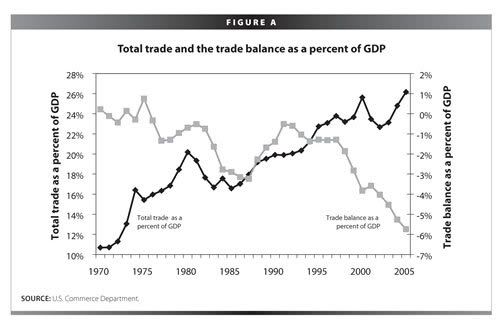
The United States always has traded with other nations—but until the 1970s, the international share of the U.S. economy was modest, and exports and imports were generally in balance or showed a small surplus. As Economic Policy Institute (EPI) economist Jeff Faux notes:
...in the last 25 years, foreign trade has risen 700 percent, more than doubling as a share of gross domestic product to 28 percent. In 2006, the excess of imports over exports will reach some $900 billion—7 percent of GDP [gross domestic product].

Faux’s briefing paper, “Globalization That Works for Working Americans,” was released Jan. 11 at the launch of a new network of progressive economists, the Agenda for Shared Prosperity. In it, he continues:
This dramatic shift reflects more than simply an increased movement of goods and services between the United States and other nations. It reflects an unprecedented economic integration with the rest of the world that is blurring the very definition of the "American" economy.

American business is steadily moving finance, technology, production, and marketing beyond our borders. Some 50 percent of all U.S.-owned manufacturing production is now located in foreign countries, and 25 percent of the profits of U.S. multinational corporations are generated overseas—and the shares are rapidly growing.
As EPI economist Larry Mishel puts it, more trade, regardless of its terms, is not better for all of us. For many working Americans, the huge growth in foreign trade has resulted in the loss of family-supporting jobs, downward pressure on wages and increased inequality: From 2000 to 2005 alone, 3 million manufacturing jobs disappeared, at least one-third because of our trade deficit. But the greatest damage has been to wages— Mishel estimates as much as a loss of $2,000–$6,000 annually for the typical household. The doubling of trade as a share of our economy over the past 25 years has been accompanied by a massive trade deficit, directly displacing several million jobs.

Mishel, who testified Tuesday before the House Committee on Ways and Means, told lawmakers:
That trade will make the distribution of income worse is embedded in fundamental economic logic. When American workers are thrown into competition with production originating from low-wage nations, both those workers employed directly in import-competing sectors and all workers economy-wide who have similar skills and credentials will have their wages squeezed. In fact, at the same time as trade flows with low-wage nations have increased, the distribution of income and wealth in the U.S. has grown more and more unequal.
Such a view is not confined to progressive think tanks. David Autor, an economist at the Massachusetts Institute of Technology The New York Times yesterday:
The consensus until recently was that trade was not a major cause of the earnings inequality in this country. That consensus is now being revisited.
After years of thinking the nation’s economic gains were passing primarily by manufacturing workers, middle-class professional and technical workers are recognizing the oncoming car wreck is headed in their direction as well.

Discussing a recent Center for American Progress study, White Collar Perspectives on Workplace Issues, Jim Grossfeld and Celinda Lake wrote on The America Prospect online that “many young, white collar workers are now as bewildered by the ‘new economy’ as manufacturing workers have been for a generation.”
As a 20-something techie in the once bustling Silicon Valley told us: "I think a lot of people, you know, 30 years ago, could get a job that was relatively stable, but, here I am, five years out of school, and I've had four jobs. It's not because I'm not good because I've gotten praise from every single job I've been at. It's just that the fact that the companies don't seem stable."

But it's not just that these workers' future career prospects look murkier. The quality of their work lives is tanking, too. It is difficult to overstate the importance of this decline. Technical and professional employees share a profound conviction that their work ought to be intellectually satisfying—even an expression of their values. However, when employers press for cost savings and workloads soar, psychic wages take a plunge. Echoing the sentiments of many of the workers we spoke to, when asked to describe her office, one San Jose woman answered: "Busy, overworked, under staffed, not enough people in the group to do all the work we need to do so everyone's doing a lot of work and just running around like a chicken with a head cut off."
In fact, new data compiled by EPI show employment growth in the past five-year post-recessionary period has been subpar due to a weak economy. This conclusion is supported by the fact that employment rates, which some thought were at the demographically set peaks, have risen sharply in response to job growth and falling unemployment in 2006.

The union movement doesn’t oppose trade and globalization. In fact, it’s precisely because we recognize we live in a global economy that we see a lot of policy changes that should be made at the federal level to enhance the quality and stability of jobs in this nation. And when trade deals are negotiated, they need to do more than line corporate pockets—they need to ensure workers don’t get run off the road.

Faux offers many solutions in his issue paper on globalization, one of many the Agenda for Shared Prosperity will issue in coming months in advance of the 2008 elections on topics such as pension, health care and more. One solution he offers: Eliminate perverse tax incentives.
By law, corporations that invest in the United States pay taxes when they are earned. But corporations that invest overseas can delay the payment of taxes until they repatriate their profits—which can take a long time. In 2005, in order to get some short-term relief to the fiscal deficit, the Congress voted to offer corporations that brought their money back that year a 5.25 percent tax rate, a much lower rate than they would pay on profits made in the United States.

This loophole might have been justified after World War II as a way of helping Europe and others get back on their feet. But it has long outlived its rationale and should be eliminated.

Indeed, U.S. integration into the global economy requires us to rethink our whole approach to taxation. Other nations, for example, use "border-adjustable" value-added taxes (VATs) to favor exports over imports. A progressive VAT is some-thing that ought to be considered as an instrument to level the playing field.
In contrast to the Hamilton Project, which supports unfettered globalization, Faux offers many other options to making globalization work for working people. It’s all here.

As AFL-CIO President John Sweeney wrote recently in a USA Today op-ed:
Without dramatic changes in trade policy, we will continue to hemorrhage good jobs, while corporations take advantage of workers whose basic human rights are violated daily.

Tuesday, January 9, 2007

Jobs and Wages Are Up. But There's More to the Story

So, the latest jobs report released Friday by the U.S. Bureau of Labor Statistics (BLS) showed more job growth than analysts anticipated, and you practically could hear the champagne corks go off at the White House. The same report that found jobs increased by 167,000 in December also reported that average hourly earnings rose 4.2 percent in December.

Must mean America’s workers are sitting pretty, right?

Unfortunately for the economy and U.S. workers, such short-term trends are misleading.

Looking at long-term wage growth, Jared Bernstein, senior economist for the nonprofit Economic Policy Institute (EPI), puts it this way:
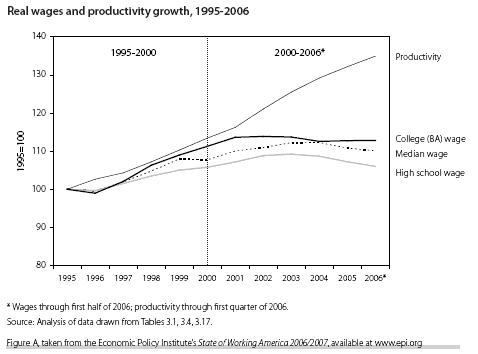
Real wages for most workers, after rising for the first few years of the 2000s, have fallen lately, and despite 14 percent higher productivity, a typical worker’s real weekly earnings are down 3 percent over this expansion. Median family income is down about $1,500 since 2000, and more than 5 million people have been added to the poverty rolls.
Wages and salaries today account for the smallest percentage of our gross domestic product on record, while corporate profits are at their highest level since the 1960s.

In touting his economic policies in the months before the elections, Bush frequently referred to the 6.3 percent rise in the average net worth of an American family between 2001 and 2004, a statistic from the Federal Reserve Board’s Survey of Consumer Finances. But the law of averages here isn’t in favor of working families. For families at the bottom 40 percent of income, the median net worth actually fell.

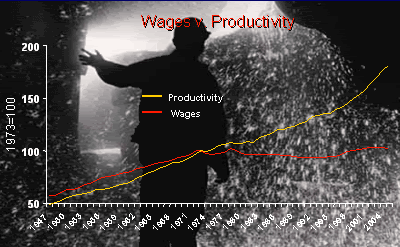
Another long-term trend is the separation of worker productivity from wage growth. Up to the early 1970s, the two grew together, with productivity 10 percent to 15 percent higher than wage growth. But since that time, workers have sped up their rates of productivity—but their employers have not similarly increased what they pay their employees. Wages now lag by more than 50 percent behind productivity.


Bob Herbert in his New York Times column yesterday highlighted the perversity of a system in which employees work harder but see no correlative increase in their paychecks—not the best incentive for long-term productivity and certainly no benefit to workers. Herbert sums it up this way:
The productivity gains in the go-go decades that followed World War II were broadly shared, and the result was a dramatic, sustained increase in the quality of life for most Americans. Nowadays workers have to be more productive just to maintain their economic status quo. Productivity gains are no longer broadly shared. They’re barely shared at all.
Now, back to job growth. While the superficial BLS stats show the quantity of jobs created, behind that data a darker picture lurks—the quality of salary and benefit levels. What counts is not just the number of jobs created but how well those jobs provide a middle-class standard of living. (There’s a lot we can do about all this—and future posts will highlight elements of a populist economic agenda spearheaded by EPI that we in the progressive movement can rally behind in coming months.)

Jobs are increasing in sectors such as service and health care that, for the most part, offer low wages and unaffordable or no health care and pension plans. Meanwhile, jobs in industries such as manufacturing are in free fall: Between 2000 and 2003, annual manufacturing employment in the United States declined by nearly 3 million jobs and has been largely flat since then. The level of manufacturing employment in 2003 was 14.3 million, the lowest since 1950. It’s easy to pooh-pooh manufacturing jobs as part of the “old economy,” but the fact is that manufacturing jobs provide solid salaries and health and retirement security rarely offered in the industries where we see rapid job growth.

And as Jacob Hacker has shown in The Great Risk Shift, the unemployment rates we hear about omit what Hacker calls “shadow unemployment,” which includes the length of time workers now are unemployed. Writes Hacker:
Statistics on the long-term unemployed tell an equally worrisome story. Despite the sunny job statistics that most of us are familiar with, the share of the labor force experiencing unemployment for a half year or more—the standard definition of long-term unemployment—has in fact grown dramatically over the last generation. Indeed, compared with the late 1960s, the share of workers who experience long-term unemployment during the peak of the business cycle has more than tripled.
Short-term upticks won’t solve these long-term problems, and they won’t go very far to help working families dig out of debt and pay their mortgages on time. As Bonddad reported in December:
The Mortgage Bankers Association, in its quarterly snapshot of the mortgage market released Wednesday, reported that the percentage of mortgage payments that were 30 or more days past due for all loans tracked jumped to 4.67 percent in the July-to-September quarter.

That marked a sharp rise from the second quarter’s delinquency rate of 4.39 percent and was the worst showing since the final quarter of last year, when delinquent payments climbed to a 2-1/2-year high in the aftermath of the devastating Gulf Coast hurricanes.
A recent Center for American Progress report showed the nation’s middle class is in worse shape than ever. Some of the report’s findings:
  • From 2001 to 2004, the proportion of middle-class families that has saved three months’ worth of income dropped to 18.3 percent from 28.8 percent.
  • To maintain day-to-day consumption, families have taken on a record amount of debt, equal to 126.4 percent of disposable income in the first quarter of 2006, according to the study.
In Election Day exit polling for the AFL-CIO, Peter D. Hart Research Associates found only 31 percent of voters felt they and their families could get ahead financially in the current economy—the rest report that they are just keeping up or falling behind. As pollster Geoff Garin summarized:
Among the total electorate, 39 percent of voters said the economy was an extremely important issue for them in this election. These voters broke solidly for the Democrats—voting for a Democratic candidate in House races by a margin of 59 percent to 39 percent.
Or, as economist Paul Krugman says:
The reason most Americans think the economy is fair to poor is simple: For most Americans, it really is fair to poor.
It’s been the pattern of the Bush administration to cherry-pick a few good stats to plump up its failed economic policies. But short-term data seldom work to describe long-term trends—and certainly don’t describe working families’ day-to-day reality of trying to pay the bills.

Tuesday, January 2, 2007

Contract Settlement at Goodyear Sets the Pattern for 2007 Bargaining

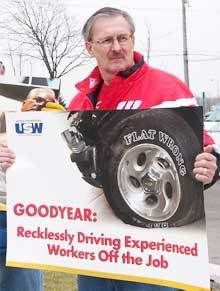
Days before health care benefits ran out for nearly 15,000 workers at 12 Goodyear Tire & Rubber Co. plants across the nation, members of the United Steelworkers (USW) union approved a three-year contract that USW Executive Vice President Ron Hoover calls “a fair and equitable contract that protects quality health care for active and retired members.” Workers are back on the job today.

The settlement at Goodyear marks the beginning of contract expirations at major U.S. industries, including the Big Three automakers, General Electric, the Las Vegas hotel industry, grocery stores in northern and southern California and Disney World in Orlando, Fla. Major public-sector contracts also will be up for New York City teachers and state workers in Connecticut, Hawaii, Iowa, New Jersey, New York, Pennsylvania, Washington and Wisconsin.

No surprise: Health care and retirement security will be prominent issues in most or all of these negotiations.

The USW action at Goodyear is an indication that union workers are ready to go on strike and do whatever it takes to maintain decent health benefits and job security, while Steelworkers at Goodyear have set a standard of commitment that other employers must live up to at the bargaining table this year.

Union members approved the settlement Dec. 29 by a more than 2–1 margin, following an 86-day strike. The walkout began Oct. 5, after the company refused to budge on its plans to close a 1,100-worker plant in Tyler, Texas, and sought to abandon its obligation to provide health care benefits for 30,000 retirees.

As a result of the strike and the nationwide support of the union and progressive movements, workers won an agreement that requires Goodyear to rescind its demand for immediate closure of its Tyler, Texas, plant and instead provide for a one-year period of transition, during which workers will have the opportunity to take advantage of sizeable retirement buyouts.

Significantly, the contract also requires Goodyear to create a $1 billion health care fund for retirees that will secure medical and prescription drug benefits for current and future retirees and dramatically increases Goodyear’s investments in union facilities. In addition, the contract:
  • Enhances the ability of USW-represented plants to meet the challenges of global competition by having Goodyear triple its capital investments to at least $550 million in those plants.
  • Maintains affordable, high-quality medical and prescription drug coverage for active members and retirees.
Goodyear says the pact will help reduce its costs by $610 million over three years and $300 million a year thereafter—and isn’t the first time workers helped out the giant tire maker. Goodyear sought to close the Tyler plant—its third plant closure in four years—despite making nearly $500 million in profit last year. In moving to close the plant, Goodyear tried to walk away from promises the company made to work in partnership with the USW and not cut jobs after union members came to Goodyear’s aid several years ago by taking wage and benefit freezes when the company experienced financial hardship.

On Dec. 16, thousands of union members and allies rallied in support of the striking workers at Goodyear tire sales outlets across the country, publicly highlighting how Goodyear planned to send jobs to China and abandon its obligation to provide health care benefits for 30,000 retirees. Many gave generously to the USW Strike Fund to help workers and their families through the holidays.

Next up for the USW are negotiations with Bridgestone-Firestone. The Steelworkers represent some 6,000 workers at eight Bridgestone-Firestone plants, including one in Oklahoma City that the tire maker closed earlier this month, putting 1,400 people out of work. No dates have been set for the next round.

Although the union is ”not entirely happy with the outcome at Tyler,” says Thomas Conway, USW vice president and chairman of the union’s Goodyear negotiations:
We were able to ensure that as long as Goodyear stays in the market for the tires built at Tyler, those tires will have to be produced at USW-represented plants in the U.S. The company simply won’t be able to outsource that work or service this market segment with imports from China or anywhere other than a USW facility.
After the ratification vote, USW President Leo W. Gerard said “credit really belongs to our members and their families, whose solidarity prevented the company from short-changing them, despite all its attempts. Gerard also said:
Special thanks go out again to all of our AFL-CIO union affiliates, activist groups, community organizations, businesses and public officials who not only understood our struggle, but stood shoulder to shoulder with us.
Negotiations between the USW and Goodyear began in June 2006, and after the July 22 expiration, USW and Goodyear reached a day-to-day extension agreement in which either party could terminate the agreement after a 72-hour notice. Lack of progress in bargaining talks forced the USW to deliver notice on Oct. 2 and 15,000 USW members in 16 plants throughout North America struck on Oct. 5.

The U.S. contract covers workers at Goodyear plants in Akron, St. Mary’s and Marysville, Ohio; Gadsden, Ala.; Buffalo, N.Y.; Lincoln, Neb.; Topeka, Kan.; Fayetteville, N.C.; Danville, Va.; Sun Prairie, Wis.; Union City, Tenn.; and Tyler.