Showing posts with label globalization. Show all posts

Monday, March 19, 2007

Our Low-Wage Nation

Of the 44 million jobs in the United States, nearly one in three of the total pays low wages—and often does not include affordable health insurance, paid sick days or retirement coverage. That eye-opening information, provided in a new report by The Mobility Agenda, finds these $11.11-an-hour-or-less jobs also tend to have inflexible or unpredictable scheduling requirements and provide little opportunity for career advancement.

So maybe that’s why when Bush touts the nation’s low unemployment rate, few people outside Wall Street cheer. They are too busy working several jobs to make ends meet.

The Mobility Agenda, a special initiative of Inclusion, a virtual think tank affiliated with the Center for Economic and Policy Research, finds that since 2001, there has been a sharp decline in wages for workers at the bottom third of the wage scale. Worse, reviewing the evidence on economic mobility, the authors of Understanding Low-Wage Work in the United States conclude:

In the U.S. labor market, it is not possible for everyone to be middle class, no matter how hard they work. Moreover, it has been getting harder to do over time.

Oh, and about that middle class. A devastating report by Robert Pear in The New York Times March 5 documents the economic fragility of the U.S. middle class when it comes to paying for health care.

Seems that more than one-third of those without health insurance—17 million of the nearly 47 million—have family incomes of $40,000 or more, according to the Employee Benefit Research Institute, a nonpartisan organization. More than two-thirds of the uninsured are in households with at least one full-time worker. As Pear writes:

It is well known that the ranks of the uninsured have been swelling; federal figures show an increase of 6.8 million since 2000.

(The AFL-CIO supports universal health care, and last week, the AFL-CIO Executive Council approved a statement saying such a system should be built upon the nation’s most successful universal health coverage plan for seniors—Medicare.)

A confluence of forces is behind the sinking of the middle class. But one big factor is the disproportionate gain by corporations in the growing global economy. So wide is the gap, in fact, that even the denizens of economic world leadership, at their annual gathering in Davos, Switzerland, this year started humming a new refrain: Globalization isn't working for everyone. According to The Wall Street Journal (subscription required):

Stagnating wages and rising job insecurity in developed countries are creating popular disenchantment with the free movement of goods, capital and people across borders.

In theory, less-developed countries win from globalization because they get jobs making low-cost products for rich countries. Rich countries win because, in addition to being able to buy inexpensive imports, they also can sell more sophisticated products like machine tools or financial services to emerging economies.

"The first win is there, but the second win is going to the owners of capital rather than labor," says Stephen Roach, chief economist at Morgan Stanley.

Ouch. There’s that capital-and-labor dichotomy again. From Morgan Stanley, no less. Guess it didn’t go away with the 20th century after all.

Several key factors are fueling the inequities in globalization. One is the rapid growth of foreign direct investment by U.S. corporations to other countries—while internal investment is decreasing. According to economist Thomas Palley:

Since investment in the U.S. is critical for future economic prosperity, these patterns are troubling and provide evidence of how globalization and flawed policy are encouraging corporations to abandon America.

With regard to outward [foreign direct investment], part of the increase is attributable to affirmative improvements in emerging market economy prospects, but part is due to bad policy. The over-valued dollar has encouraged U.S. business to shift productive investments from the U.S. to both developing and other developed economies, while the lack of global labor and environmental standards encourages shifts to developing economies where standards are lower or even absent.

Another factor is the preferential tax treatment of foreign profits of U.S. corporations, which encourages outward FDI that displaces domestic investment. This speaks to repealing that provision.

Palley notes the U.S. Commerce Department recently launched an initiative to promote such investment, promising to actively court foreign companies. But the approach, while beneficial, also is “incomplete and inadequate.”

Cheerleading cannot substitute for fundamental policy change...the exclusive focus on [internal direct investment] is like one-hand clapping and completely misses the problem of investment off-shoring by U.S. corporations.

Another factor exacerbating the gap between what the wealthy are paid and everyone else is excessive CEO pay. We’ll discuss that in a couple weeks, when the AFL-CIO releases its Executive PayWatch report in early April.

Photo Sharing and Video Hosting at Photobucket

Source: http://www.inclusionist.org/files/lowwagework.pdf

Monday, February 12, 2007

America's Workers: Boxed In

Committee hearings on Capitol Hill focusing on the abuse of taxpayer funds, Iraq re-construction process and wrangling in the Senate over non-binding resolutions on Bush’s Iraq war have understandably taken center stage in recent media coverage. But there’s another set of congressional hearings under way equally as important for America’s workers.

Rep. George Miller, head of the House Committee on Education and Labor, on Jan. 23 launched hearings on Strengthening America's Middle Class: Finding Economic Solutions to Help America's Families.

The committee is considering three main items:
  • Creating a competitive economy that includes good new jobs that pay well.
  • Restoring workers' rights—including their freedom to bargain for better wages and benefits.
  • Making health care more affordable and accessible.
Or, as AFL-CIO Secretary-Treasurer Richard Trumka summarized when the hearings reconvened Feb. 7:
Why, in the richest country in the world, is it so difficult for so many families to make a living by working?


It’s safe to say that in the Republican-controlled Congress of recent years, this committee—which under Republicans was renamed the Committee on Education and Economic Opportunities, in a deliberate slap at unions—never considered the growing economic distress of the middle class.

When hearings opened Jan. 23, William Spriggs, an economics professor at Howard University in Washington, D.C., told committee members the economic recovery, which began six years ago, has not benefited working families. Instead it has meant more money for the rich while working people and the poor have seen their standard of living stall or drop.

One cause of the widening gap, says Spriggs, is the failure to raise the minimum wage for 10 years. But that’s only one source of the problem. Says Spriggs:
The other source is the redistribution of corporate income, from wages to capital income. The latest data from the Bureau of Economic Analysis shows that the share of corporate-sector income going to wages is down to its lowest share in over 25 years….The latest CBO [Congressional Budget Office] figures show that almost 60 percent of capital income goes to the top 1 percent in the U.S. income distribution.
Behind the unequal distribution of the nation’s wealth is a much more fundamental change in our country’s economic policies, according to Trumka. He told the committee:
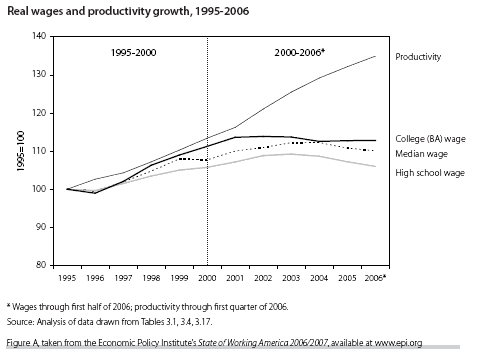
The shift in economic policies in the late 1970s from a “Keynesian consensus” to what George Soros has called “free market fundamentalism” explains much, in my view, about changing corporate behavior, the imbalance of power between workers and their employers, stagnating wages and the growing divide between productivity and wages.
Describing “free market fundamentalism” policies as a box that systematically weakens the bargaining power of America’s workers and drives the growing inequality of income and wealth in our country, Trumka continued:
On one side of the box is “globalization,” unbalanced trade agreements that force American workers into direct competition with the most impoverished and oppressed workers in the world, destroy millions of good manufacturing jobs and shift bargaining power toward employers who demand concessions under the threat of off-shoring jobs.

On the opposite side of the box are “small government” policies that privatize and de-regulate public services and provide tax cuts for corporations and the wealthy, all to “get government off our backs.”

The bottom of the box is “price stability.” Unbalanced macro-economic policies that focus exclusively on inflation and ignore the federal government’s responsibility to “maximize employment,” even out the business cycle and assure rapid economic growth.

The top of the box is “labor market flexibility,” policies that erode the minimum wage and other labor standards, fail to enforce workers’ right to organize and bargain collectively and strip workers of social protection, particularly in the areas of health care and retirement security.
Climbing out of this box won’t be easy.

Bottom line, Trumka told committee members: We need to follow three important economic values that resonate powerfully with all Americans:
  • Anyone who wants to work in America should have a job.
  • Anyone who works every day should not live in poverty, should have access to quality health care for themselves and their family and should be able to stop working at some point in their lives and enjoy a dignified and secure retirement.
  • American workers should enjoy the fundamental freedom to associate with their fellow workers and, if they wish, organize unions at their workplace and bargain collectively for dignity at work and a fair share in the value they help create.
We took a step in recent days toward achieving the last goal with the introduction of the Employee Free Choice Act in the House, which I discussed here in detail last week.

And in coming weeks, we are looking forward to a robust discussion on creating policies that encourage family-supporting jobs stay in this country and developing new strategies for ensuring working families have access to quality, affordable health care. Economists in a new progressive network, the Agenda for Shared Prosperity, will publish issue papers on these and other critical topics for America’s working families.

In its debut media conference, the Agenda for Shared Prosperity, a project spearheaded by the Economic Policy Institute (EPI), highlighted a paper by EPI economist Jeff Faux on globalization and economist Jacob Hacker’s plan for health care reform. The next series of papers will be released Feb. 22 in an event that may include New York Times columnist Paul Krugman, and we’ll be back here with the details.