

U.S. new-vehicle sales are expected to rise in November from a year earlier, adjusted for two fewer sales days this year .... [C]ar sales are seen rising 3.8% in the U.S. from a year ago. Without the adjustment for there being 23 selling days this year and 25 last year, the auto Web site's estimate is 4.5% below last year's sales and down 15% from October...."The ICSC reported that same store sales fell -0.1% last week, the second minimal decline in a row. On a YoY basis, sales are up 2.4%, and
The overall annualized sales rate in November is projected to be 10.3 million, down slightly from October's 10.43 million rate.
ICSC Research expects same-store sales for November could beShopperTrak an increase of 0.7% in mall retail sales compared with a year ago, and also up 7.5% from the previous week.
as strong as up 5 to 8 percent.


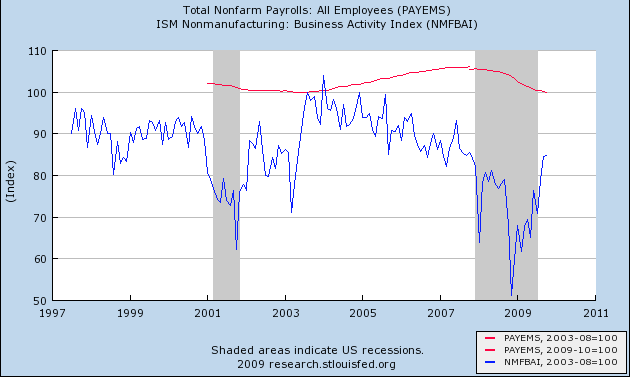
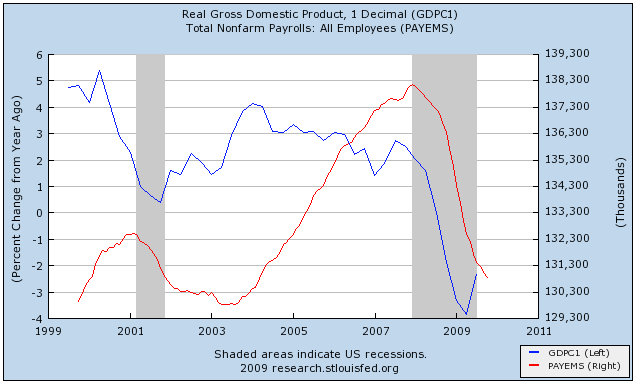
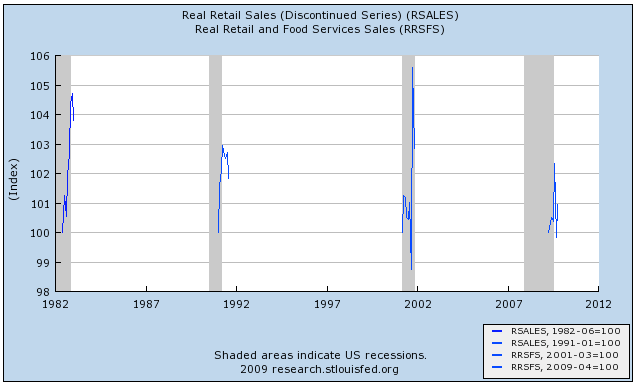

During Tim Geithner's somewhat contentious appearance before Congress today, some Republicans took every opportunity to get their shots in. Congressman Michael Burgess (Asshat-TX), was no exception. He got his sound bite in -- "I don't think you should be fired, I think you never should have been hired," or something to that effect. Whatever, he's entitled to his opinions, but not his own facts.
It's what the Congressman said immediately before that that intrigues me, as he and Geithner duelled on the merits of different economic policies, Burgess being all about "cut taxes and get out of the way." He said, and I quote:
“When I came here in 2003 we were in a jobless recovery. Tax relief was passed in May of 2003 and as a consequence, by July of that year we were adding jobs at a significant [ed. note: he stresses "significant"] rate. It [referring to tax relief] seems to have worked fairly well.”
Watch it here at 3:57 into the video.
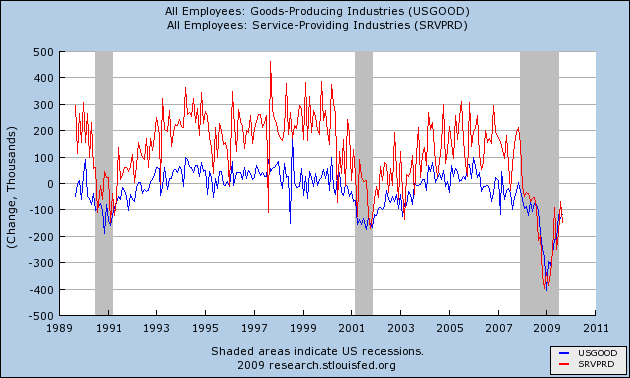
Well, if by "significant" he means a 25,000 add in July 2003 followed by a
-42,000 loss in August, then he's on to something. Otherwise, he's just a lying sack of shit (whose office was oddly unable to answer my simple question as to what the hell he was talking about):

Business as usual: Just make stuff up.
P.S. Congressman, if you're out there, just drop your response in the comments section.

Privately-owned housing starts in October were at a seasonally adjusted annual rate of 529,000. This is 10.6 percent (±8.7%) below the revised September estimate of 592,000 and is 30.7 percent (±8.3%) below the October 2008 rate of 763,000.


1) Markets tend to return to the mean over time.
2) Excesses in one direction will lead to an opposite excess in the other direction.
3) There are no new eras -- excesses are never permanent.
4) Exponential rapidly rising or falling markets usually go further than you think, but they do not correct by going sideways.
5) The public buys the most at the top and the least at the bottom.
6) Fear and greed are stronger than long-term resolve.
7) Markets are strongest when they are broad and weakest when they narrow to a handful of blue chip names.
8) Bear markets have three stages -- sharp down, reflexive rebound, and a drawn-out fundamental downtrend.
9) When all the experts and forecasts agree -- something else is going to happen.
10) Bull markets are more fun than bear markets.
Print them out and keep them handy. You'll be glad you did.


With Congressional Democrats in near-panic amid forecasts that unemployment will remain high through next November’s midterm elections, a party leader said on Thursday that the House will pass a new “jobs bill” before Dec. 18.
Senate Democrats likewise are weighing options. And the signals from Congress follow by a day the White House’s announcement that President Obama will follow his “Forum on Jobs and Economic Growth” on Dec. 3 with a “Main Street Tour” starting the next day in Allentown, Pa., and continuing to other hard-hit places in coming months.
With more than half of last winter’s $787 billion package of tax cuts and stimulus spending still in the pipeline, Representative Steny H. Hoyer, the Democratic majority leader from Maryland, said the new measure should not be called another stimulus bill.
“I don’t want it to be as broad as that,” he said. “I want it to be very targeted on jobs.”
He indicated that the legislation might include money for public jobs, which many liberals have advocated; tax credits to employers for new hires, an Obama campaign proposal that was shelved early this year amid concern that businesses might game their payrolls; and additional spending for infrastructure and road projects.
First, this is an overall good idea. With unemployment at 10.2% every little bit helps.
But it's also important to remember exactly what has happened in the economy and where we are in the cycle to understand exactly what is going on. And no -- the following is not an endorsement of bad times; it is simply an explanation of the facts without a judgment attached.
At the end of last year and the beginning of this year the US was losing jobs at a rate of 600,000/month. That lasted for 5 months. Or to put it another way, the US lost 3 million jobs in 5 months. That is almost half of all the jobs created during the last expansion. That tells us the severity of the economic situation was indeed severe. Employers simply cut everybody they could and then some. In addition, we have also learned that the BLS has added an additional 800,000 jobs losses to the official job loss total. These will be added in February. This further indicates we were in an extremely severe economic contraction.
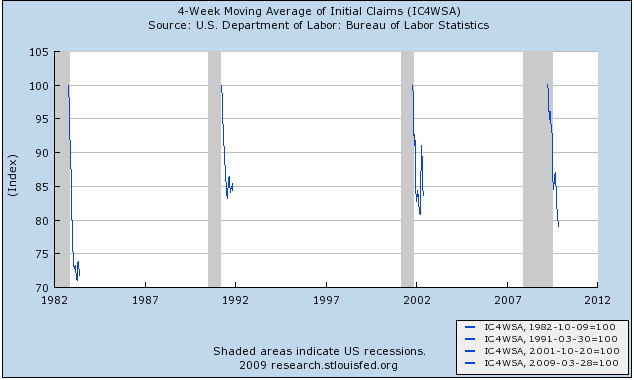
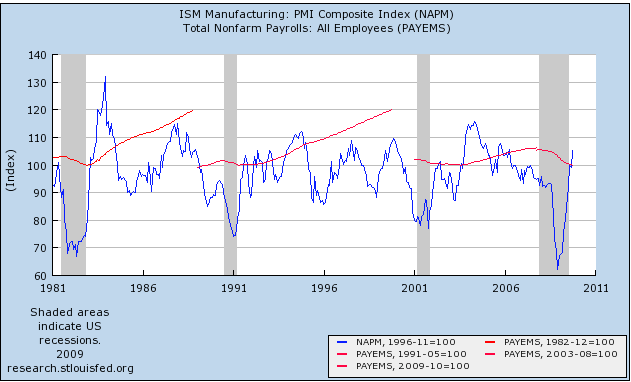
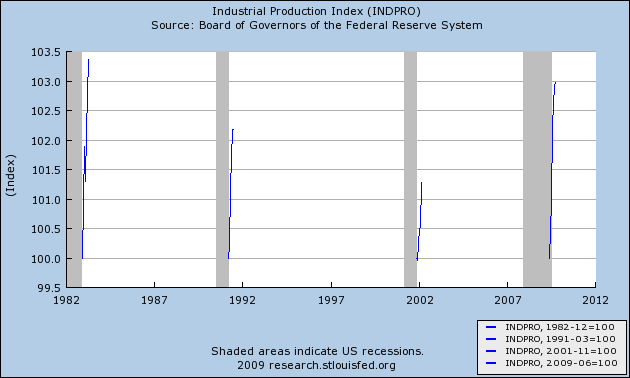
Currently the economy is back from the brink. We printed a solid GDP number last quarter and the rate of job losses continues to decrease. In addition, the pace of initial unemployment claims continues to move lower. All of these facts tell us we're moving in the right direction. BUT -- and this is very important -- remember where we were last year at this time. There were a lot of people talking about depressions and deflationary spirals. These are the most severe economic events we can experience. The repercussions of these events last a long time.
Does this statement imply that I am unsympathetic to the unemployed? No. I have never advocated (and will never advocate) that we decrease or cut off unemployment benefits or show any less sympathy for those who have lost their jobs. That is not the point of the above recitation of historical facts. The point is things are moving in the right direction. Recoveries -- especially from near financial collapses -- don't happen overnight. As the article states we've only just started to use the stimulus money. We've just printed our first quarter of positive GDP growth. By this time next year things should be better.


The Empire State Manufacturing Survey indicates that conditions for New York manufacturers improved in November, but at a somewhat slower pace than in October. The general business conditions index fell 11 points, to 23.5. The indexes for new orders and shipments posted similar declines. Pricing pressures eased, with the prices paid index positive but lower than last month and the prices received index rising to a level just below zero. Employment indexes fell from October’s elevated levels, remaining slightly positive. Future indexes conveyed an expectation that activity and employment would improve in the months ahead and that both input and selling prices would increase significantly.


 Also note the employment component of the report is also getting better.
The U.S. Census Bureau announced today that advance estimates of U.S. retail and food services sales for October, adjusted for seasonal variation and holiday and trading-day differences, but not for price changes, were $347.5 billion, an increase of 1.4 percent (±0.5%) from the previous month, but 1.7 percent (±0.5%) below October 2008. Total sales for the August through October 2009 period were up 1.5 percent (±0.3%) from the same period a year ago. The August to September 2009 percent change was revised from -1.5 percent (±0.5%) to -2.3 percent (±0.3%).
Excluding the 7.4% increase in auto sales, retail sales rose 0.2% in October, the data showed. Sales excluding autos have risen for three months in a row and in five of the past six months.

The Empire State Manufacturing Survey indicates that conditions for New York manufacturers improved in November, but at a somewhat slower pace than in October. The general business conditions index fell 11 points, to 23.5. The indexes for new orders and shipments posted similar declines. Pricing pressures eased, with the prices paid index positive but lower than last month and the prices received index rising to a level just below zero. Employment indexes fell from October’s elevated levels, remaining slightly positive. Future indexes conveyed an expectation that activity and employment would improve in the months ahead and that both input and selling prices would increase significantly.
Also note the employment component of the report is also getting better.The U.S. Census Bureau announced today that advance estimates of U.S. retail and food services sales for October, adjusted for seasonal variation and holiday and trading-day differences, but not for price changes, were $347.5 billion, an increase of 1.4 percent (±0.5%) from the previous month, but 1.7 percent (±0.5%) below October 2008. Total sales for the August through October 2009 period were up 1.5 percent (±0.3%) from the same period a year ago. The August to September 2009 percent change was revised from -1.5 percent (±0.5%) to -2.3 percent (±0.3%).
Excluding the 7.4% increase in auto sales, retail sales rose 0.2% in October, the data showed. Sales excluding autos have risen for three months in a row and in five of the past six months.