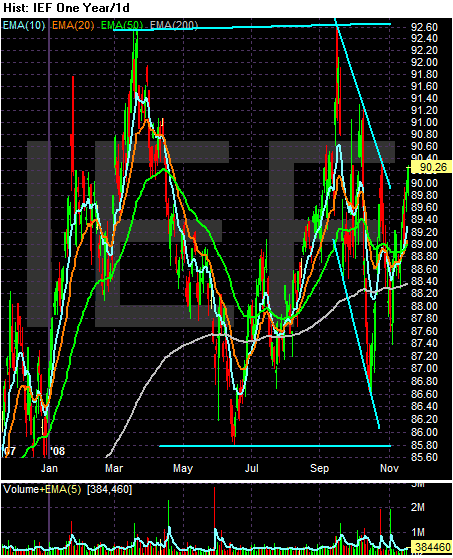
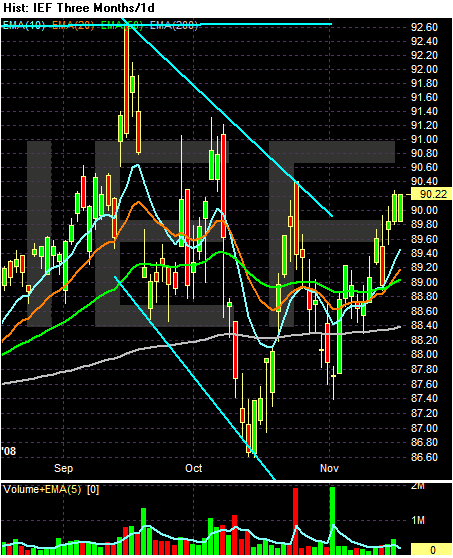
Treasuries raced higher Thursday, driving government debt yields down to historic lows, as recession fears pummeled stock markets and powered a frantic rush to the safety of bonds and cash.
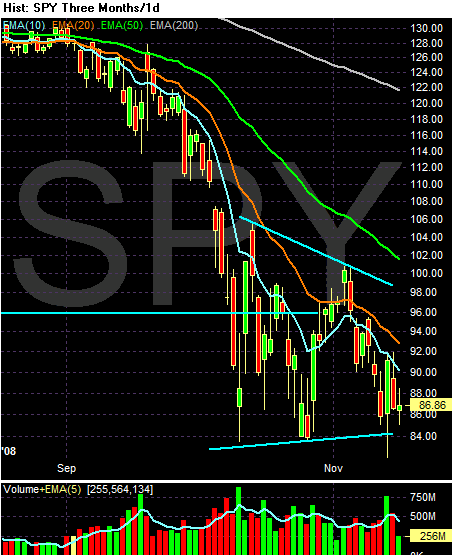
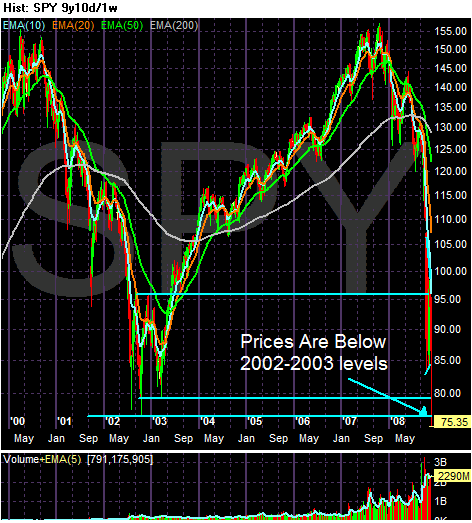
The gains in bonds, which benefit from economic hardship, were almost inversely proportional to the plunge in stocks. The benchmark S&P 500 index slid to its lowest since 1997, erasing more than a decade of stock market gains.
The fall of longer-dated note and bond yields to five-decade lows marked a new extreme of risk aversion among investors, many of whom have not experienced such tumultuous financial market turmoil in their lifetimes. Many analysts are now starting to worry that there is at least an outside chance of a depression, not just a recession.

Manufacturing in the Philadelphia region shrank in November at the fastest pace in 18 years, a sign that the credit crunch and weak demand are causing companies to cut back.
The Federal Reserve Bank of Philadelphia's general economic index was minus 39.3 this month, weaker than forecast and the lowest reading since October 1990, from minus 37.5 in October, the bank said today. Negative readings signal contraction. The index averaged 5.1 last year.
The deepening credit crisis and economic slump are forcing companies to trim payrolls, investment and production. Slowing global demand is weighing on manufacturing, which accounts for about 12 percent of the U.S. economy.
``Manufacturers are getting hit by several different forces,'' Dean Maki, co-chief global economist at Barclays Capital Markets in New York, said in an interview with Bloomberg Television. ``Real exports are being hit pretty hard because the slowdown is heading abroad as well.''
 Click for a larger image


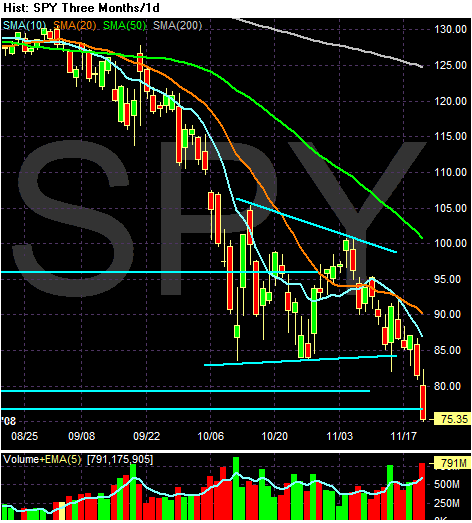
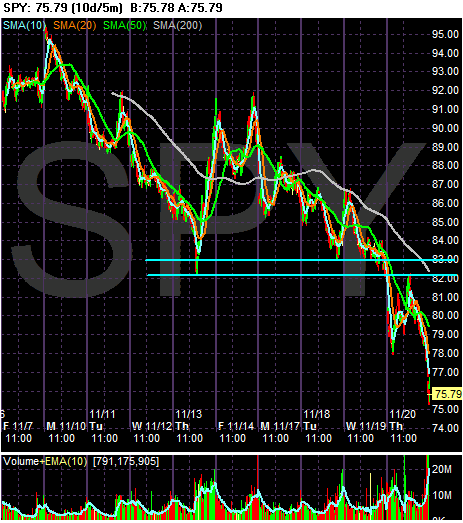
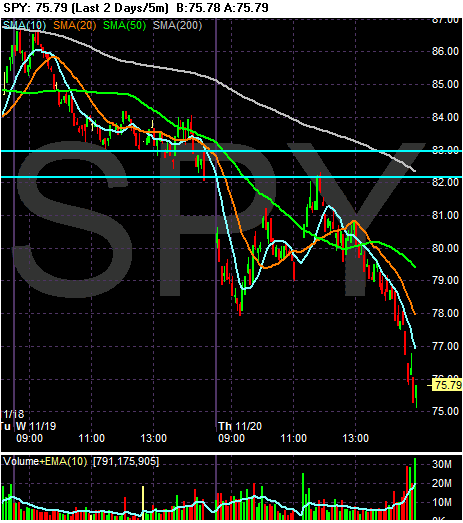
New claims for unemployment benefits jumped last week to a 16-year high, the Labor Department said Thursday, providing more evidence of a rapidly weakening job market expected to get even worse next year.
The government said new applications for jobless benefits rose to a seasonally adjusted 542,000 from a downwardly revised figure of 515,000 in the previous week. That's much higher than Wall Street economists' expectations of 505,000, according to a survey by Thomson Reuters.
That is also the highest level of claims since July 1992, the department said, when the U.S. economy was coming out of a recession.
The four-week average of claims, which smooths out fluctuations, was even worse: it rose to 506,500, the highest in more than 25 years.
In addition, the number of people continuing to claim unemployment insurance rose sharply for the third straight week to more than 4 million, the highest since December 1982, when the economy was in a painful recession.
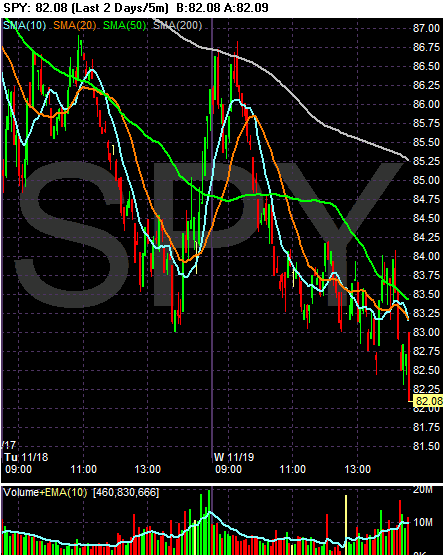
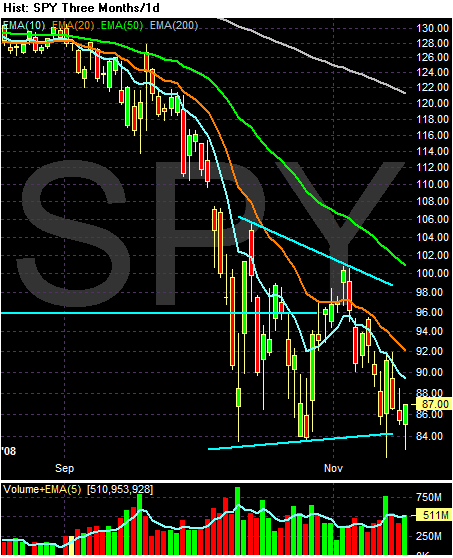
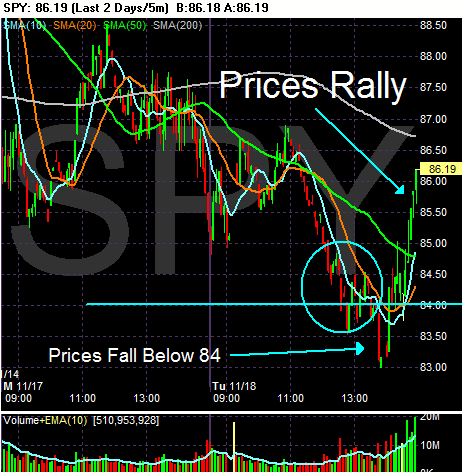
A simple, or arithmetic, moving average that is calculated by adding the closing price of the security for a number of time periods and then dividing this total by the number of time periods. Short-term averages respond quickly to changes in the price of the underlying, while long-term averages are slow to react.


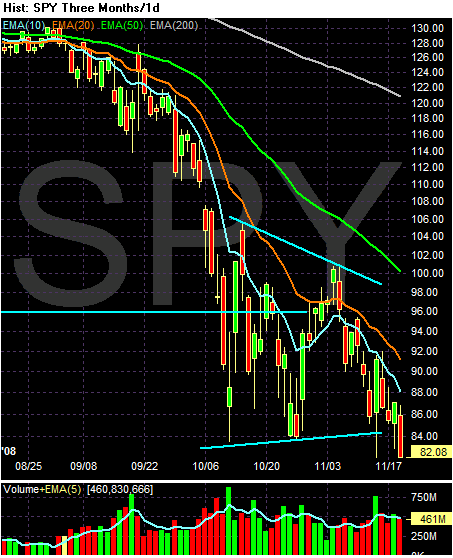

The consumer price index plunged 1 percent last month, the most since records began in 1947, the Labor Department said in Washington. Commerce Department figures showed housing starts tumbled to an annual rate of 791,000, indicating the industry’s contraction may extend into a fourth year.
Today’s CPI report signals deflation, or a prolonged price slide, may become another hazard facing Federal Reserve Chairman Ben S. Bernanke and President-elect Barack Obama. Deflation could worsen the economic downturn by making debts harder to pay off and countering the impact of Fed interest-rate cuts.
“The economy’s really just in horrific shape,” said Joseph LaVorgna, chief U.S. economist at Deutsche Bank Securities in New York. Fed officials will “take rates as low as they have to” to avoid “a deflation-type scenario, which now all of a sudden is very possible.”
LaVorgna predicts the Fed will cut its main rate to 0.5 percent from its current 1 percent when it meets on Dec. 16.
Fed Vice Chairman Donald Kohn said today that while the risk of deflation is “still small,” policy makers must be “aggressive” in fighting the danger. The economy “is declining right now” and will record a couple of quarters of contraction, he said in answering questions after a speech in Washington.
Because the price of goods is falling, consumers have an incentive to delay purchases and consumption until prices fall further, which in turn reduces overall economic activity - contributing to the deflationary spiral.
Since this idles capacity, investment also falls, leading to further reductions in aggregate demand. This is the deflationary spiral. The solution to falling aggregate demand is stimulus, either from the central bank, by expanding the money supply, or by the fiscal authority to increase demand, and borrow at interest rates which are below those available to private entities.
FOR A FLEETING TIME TUESDAY AFTERNOON, the stars in the stock market were aligned in a configuration not seen in a half-century: shares yielded more than bonds.
Specifically, the dividend yield on the Standard & Poor's 500 stock index touched 3.57% at 1:13 PM Eastern time, exceeding the 3.54% yield on the benchmark Treasury 10-year note, according to Bloomberg News. That's something that hadn't happened since 1958.
Reeling from a relentless sales slide, Toyota Motor Corp (7203.T) said on Wednesday it would stop all of its North American factories for two days next month, while rival Nissan Motor Co (7201.T) renewed its pessimism over the industry's near-term prospects.
.....
Ghosn told CNBC that U.S. industry-wide sales falling to 11-11.5 million vehicles next year was a "realistic" assessment. Sales totaled 16.15 million in 2007.
Detroit's auto makers continue to lag behind Asian and European competitors in car resale value, an important consumer gauge.
Kelley Blue Book, a well-known vehicle appraiser, plans to announce Wednesday its annual ranking of the top 10 brands for projected resale value -- and not a single one will be American. Kelley, which ran its calculations before the big car makers began pushing for government financial help, defines resale value as the amount of a vehicle's sticker price that is retained after five years of ownership. The typical Chrysler car, for example, is expected to retain just 24.2% of its original cost. By comparison, the top-rated Honda brand's vehicles are expected on average to retain 44.5% of their value.
The typical Chrysler car is expected to retain just 24.2% of its original cost. By comparison, the top-rated Honda brand's vehicles are expected on average to retain 44.5% of their value.
The U.S. industry's poor showing bodes poorly for its ability to win back consumers to American brands after years of slipping market share. Resale value, also known as residual value, is a factor consumers consider closely when buying or leasing a new car. Because monthly lease payments cover the difference between a vehicle's sticker price and its expected value at the end of the lease, cars that hold their value better have lower lease payments.
After the Honda brand, made by Honda Motor Co., Kelley Blue Book's top picks include the Toyota brand, made by Toyota Motor Corp.; Volkswagen AG's Volkswagen brand; the Subaru brand by Fuji Heavy Industries Ltd.; and Toyota Motor's luxury Lexus brand. Rounding out the top 10 are BMW AG's BMW brand; Nissan Motor Co.'s Infiniti brand; Honda's Acura brand; Volkswagen's Audi brand; and the Nissan brand.
Gleaming new Mercedes cars roll one by one out of a huge container ship here and onto a pier. Ordinarily the cars would be loaded on trucks within hours, destined for dealerships around the country. But these are not ordinary times.
For now, the port itself is the destination. Unwelcome by dealers and buyers, thousands of cars worth tens of millions of dollars are being warehoused on increasingly crowded port property.
And for the first time, Mercedes-Benz, Toyota, and Nissan have each asked to lease space from the port for these orphan vehicles. They are turning dozens of acres of the nation’s second-largest container port into a parking lot, creating a vivid picture of a paralyzed auto business and an economy in peril.
“This is one way to look at the economy,” Art Wong, a spokesman for the port, said of the cars. “And it scares you to death.”
The backlog at the port is just part of a broader rise in the nation’s inventories, which were up 5.5 percent in September from a year earlier, according to the Commerce Department. The car industry has been hurt particularly, with sales down nearly 15 percent this year.
WASHINGTON -- The chief executives of Detroit's Big Three auto makers appealed in dire language for U.S. taxpayers to help their industry, but couldn't dispel doubts in Congress that have clouded prospects for a government-led rescue.
In appearances Tuesday before the Senate Banking Committee, the leaders of General Motors Corp., Ford Motor Co. and Chrysler LLC, together with the head of the United Auto Workers union, argued the shaky U.S. economy couldn't withstand a collapse of any of the companies.
The chief executives of GM and Chrysler said they could run out of funds without the government's support. GM CEO Rick Wagoner said the package is needed to "save the U.S. economy from a catastrophic collapse."


Home prices fell in four out of every five U.S. cities in the third quarter, a record spurred by distressed foreclosure sales across the country, the Chicago-based National Association of Realtors also said today. The median price of a U.S. home fell 9 percent from a year earlier and sales of properties with mortgages in default accounted for at least a third of all transactions.
“We are in a crisis situation,” NAHB chairman Sandy Dunn, a builder from Point Pleasant, West Virginia, said in a statement. “Tremendous economic uncertainties have driven consumers from the housing market, and it’s going to take some major incentives to bring them back.”
The Producer Price Index for Finished Goods fell 2.8 percent in October, seasonally adjusted, the Bureau of Labor Statistics of the U.S. Department of Labor reported today. This decrease followed a 0.4-percent decline in September and a 0.9-percent fall in August. At the earlier stages of processing, prices received by manufacturers of intermediate goods moved down 3.9 percent in October after declining 1.2 percent in September, and the crude goods index dropped 18.6 percent subsequent to a 7.9-percent decrease in the previous month.
.....
For the 12 months ended in October, finished goods prices advanced 5.2 percent. Over the same period, prices for finished consumer foods climbed 6.5 percent, the index for finished energy goods increased 5.5 percent, and the index for finished goods other than foods and energy rose 4.4 percent. From October 2007 to October
2008, prices received by intermediate goods producers advanced 10.2 percent, while the crude goods index decreased 1.4 percent.

Prices paid to U.S. producers plunged in October by the most on record as the faltering global economy caused demand for commodities to dry up.
The larger-than-forecast 2.8 percent drop followed a 0.4 percent decline in September, the Labor Department said today in Washington. So-called core producer prices that exclude fuel and food rose 0.4 percent, indicating that the declines in raw- material costs have yet to feed through to other products.
Today's figures, along with a U.K. government report showing Britain's inflation rate fell the most in at least 11 years, show a rising threat of deflation. That's likely to spur central banks to keep cutting interest rates, with some benchmarks approaching zero percent, economists say.
``The broad-based softening of prices shows inflation is contained, and disinflation is taking hold,'' John Herrmann, president of Herrmann Forecasting LLC in Summit, New Jersey, said before the report. ``It gives the Fed the ammunition to cut rates further.''
 Click for a larger image