Saturday, July 20, 2024

Weekly Indicators for July 15 - 19 at Seeking Alpha


 - by New Deal democrat


My “Weekly Indicators” post is up at Seeking Alpha.

While several of the monthly updates I’ve discussed here in the past week have tiptoed in the direction of yellow caution flags, that’s not apparent at all in the high frequency data that is updated every week, much of which comes from private sources.

In fact, this week for the first time in a long time, not a single coincident indicators was negative. A majority were positive, and the rest neutral.

As usual, clicking over and reading will bring you up to the virtual moment as to the state of the economy, and reward me a little bit for gathering and organizing the data for you.

Thursday, July 18, 2024

Jobless claims join other data series inching in the direction of yellow caution territory


 - by New Deal democrat


Ever since jobless claims started higher in May, I’ve cautioned that I suspected that unresolved seasonality may be at play. We are now at the point where claims were at their low points for all last summer. In other words, last week through next weeks are the acid test for that hypothesis. Last week the news was good. This week it was more mixed.

Initial jobless claims rose 20,000 to 243,000, while the four week moving average rose 1,000 to 234,750. Continuing claims, with the usual one week delay, rose 20,000 to 1.867 million, the highest level since December 2021. I’ve needed to expand the graph below from its usual 2 year time period in order to show that:


On the YoY basis that is more important for forecasting purposes, initial claims were higher for the first time since early May, up 5.2%. But the less noisy four week average remained lower by -1.1%. Continuing claims were 4.5% higher, still within the lower end of their recent range:


There is an additional seasonal complicating factor this week, in that July 4 fell during different counting weeks last year vs. this year. For the combined 2 week period, initial claims were only 1,500, or 0.6%, higher than last year, at 233,000 vs. 231,500.

This is a very mixed signal, and seems likely to resolve higher YoY next week. The continuing uptrend in continuing claims in particular absolutely speaks to relative weakness in the labor market relative to one and two years ago.

Which brings me to the update of the “Sahm rule” forecast. As I have written numerous times, for over 50 years initial claims have led the unemployment rate. This year that has not been the case, as the unemployment rate has trended higher despite a downturn in initial claims during the first four months of this year. The likely reason is a surge of working age immigrants in the last two years, some of whom are having a more difficult time finding employment. Since they are in the labor force but have not previously held jobs, they are not filing for unemployment benefits.

With that lead-in, here is the updated graph through mid-July:


Both initial and continuing claims suggest that there will be upward pressure on the unemployment rate in the next few months. Since it is already at 4.1%, this suggests a significant chance that it will trigger the “Sahm rule,” although note that the comparison point, of the lowest 3 month average during the past 12 months, will also be moving higher. Because the likely trigger is immigration, however, as I have previously written the economy is likely to be nevertheless expanding - in other words, if triggered it is likely to be a false positive.

A one week 5.2% YoY. Increase in new jobless claims is not nearly enough to trigger even a yellow caution flag. For that we would need, at absolute minimum, a 10%+ comparison lasting multiple weeks. Still, together with the combined economically weighted ISM composite index, real retail sales, and housing under construction, we now have a number of significant sectors signaling weakness.

Wednesday, July 17, 2024

Industrial and manufacturing production close to 10 year+ highs in June


 - by New Deal democrat


If the news in housing construction this morning was cautionary, the news on manufacturing and industrial production was very good.


Manufacturing production (red in the graph below) rose 0.4% in June, and is only 0.2% below its post-pandemic high in October 2022. It is also only 1.2% below its highest level since the Great Recession, which was set in September 2018.

The news was even better for total industrial production (blue), which rose 0.6% in June to a new post-pandemic high, and is only 0.1% below its all-time high, also set in September 2018:


In the past, industrial production has been the King of Coincident Indicators, since its peaks and troughs tended to coincide almost exactly with the onset and endings of recessions. That weighting has faded somewhat since the accession of China to the world trading system in 1999 an the wholesale flight of US manufacturing to Asia, generating several false recession signals, most notably in 2015-16. But it is still an  important measure in the economy. 

In other words, while several important leading indicators are getting close to yellow flag cautionary signals, or in one case (real retail spending) already there, this very important coincident indicator signals all clear for the present.

Housing permits and starts stabilize, but construction comes close to generating yellow recession caution signal


 - by New Deal democrat


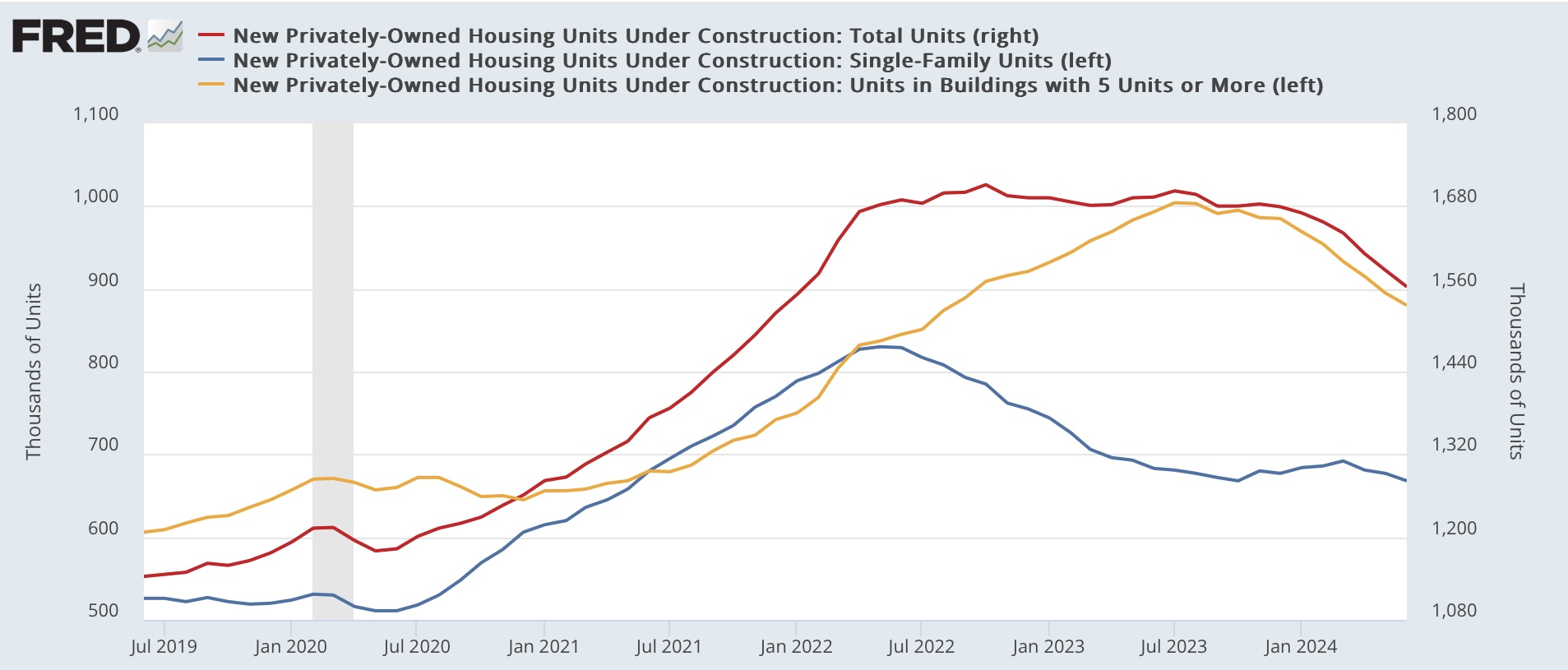
There was good news and bad news in this morning’s report on housing permits, starts, and construction. The good news is that both permits and starts stabilized after last month’s initially reported multi-year lows. The bad news is that single family permits declined further, and even worse the metric best showing the actual economic impact of new housing, building units under construction, declined to a new 2+ year low, only slightly above the level where it gives a recession caution signal. 

Let’s start with the good news.  the longest leading signal in the data - permits (black in the graph below) - rose 47,000 or 3.4% on an annualized basis to 1.446 million. Starts (light blue), which are slightly less leading and much more noisy, rose 39,000 or 3.0% to 1.353 million annualized. Further, last month’s abysmal readings for permits and starts were both revised higher.

Now the bad news. Single family permits, which are the least noisy of all the leading data (red, right scale) declined a further -22,000 or 2.3% to 934,000 units annualized:


In other words, the rebound in permits was all about the much noisier multi-family unit sector (gold in the graph below), which increased sharply but not in any way breaking its general downtrend:


Now let’s turn to the bigger bad news. Ill spare you the long term graph this month, but usually it has taken more than a 10% decline in units under construction to be consistent with a recession. In 1970 and 2001, the declines were less than that. But in the late 1980s and 2000s, it took almost a 25% decline before a recession occurred. 

With this morning's further decline, total units under construction (red, right scale) are now -8.6% below peak (vs. permits, black, left scale):


In the past few months I have commented that I did not expect this decline to exceed the -10% level, mainly because mortgage rates had stabilized, and mortgage rates lead permits and starts, which I also expected to stabilize. While obviously the situation is more dicey, I still believe we are getting close to, if not at, a stabilization point for units under construction, because mortgage rates are only slightly higher than they were one year ago, and depending on how you measure, are either generally flat or Elise in a slight uptrend (red, vs. permits, blue, right scale):


At the moment both single family units and multi-family units under construction are both in downtrends, but I expect single family units in particular to stabilize shortly, since that portion of the market was the first to turn down:


Earlier this month, I wrote that the economically weighted average of the ISM indexes was very close to generating a recession caution yellow flag. Yesterday I wrote that consumer spending as measured by retail sales already warranted such a flag. With this morning’s residential construction report, that sector too has gotten close to generating a yellow caution flag. The next big data I will be watching is whether personal spending on goods follows retail sales into cautionary territory, and whether employment in manufacturing and construction (the latter of which typically shortly lags, but follows, building units under construction), neither of which has turned down, change direction in the next few jobs report.

Tuesday, July 16, 2024

The yellow caution flag on retail consumption is up


 - by New Deal democrat


Retail sales declined -0.1% in June, but since consumer inflation also declined -0.1%, real retail sales were unchanged for the month. There was an upward revision to May which helped out the comparisons slightly, but for the entire first half of this year real retail sales have been treading water at a level below last year. The below graph is normed to 100 as of right before the pandemic, and shows the similar measure of real personal consumption of goods (light blue) as well:


There’s been a general slight downtrend in real retail sales ever since the burst of pandemic stimulus spending in early 2021, that fortunately has not been confirmed by the broader measure of real personal spending on goods. On the other hand, real personal consumption of goods has also been lower all this year so far from its peak last December.

We are also down -0.7% YoY:


Although I won’t bother with the historical graph this time around, I’ve note previously In the entire history of real retail sales going back 75 years, much more often than not such downturns foreshadowed a recession within half a year.

Last month I wrote that “the negative YoY retail sales for four of the first five months of this year [ ] is now a real concern, although it has not been confirmed by the similar metric of real personal spending on goods.”

I also said that “Since we are now over three years past the last pandemic stimulus, I suspect real retail sales are also giving a more accurate signal for employment (red in the graph below) in the months ahead, as they did for decades before the pandemic [Here’s the updated graph for this month]:


“Consumption has historically led employment, and this suggests weaker monthly employment reports in the months ahead.” 

It’s worth noting that in the graph above, real personal spending on goos is also lower YoY than payroll employment. It’s also worth recalling that there is good reason to believe that the payroll employment gains of 225,000-300,000 one year ago are likely to be revised significantly lower in view of the poor QCEW comprehensive census for the last two quarters of 2023.

My concluding remark last month was that, especially in view of the relatively poor numbers since the start of this year, real retail sales had to be regarded as raising a caution flag for the economy. That is if anything even more true this month, with an additional month of data, especially where an important component of the economically weighted ISM indexes released at the beginning of this month showed contraction in June.

The yellow flag is up. We’ll get important information about both the manufacturing and construction sectors tomorrow.

Monday, July 15, 2024

The inverted Treasury yield curve: we are in uncharted territory


 - by New Deal democrat


We passed a significant anniversary last week: the spread for the 10 year minus 2 year Treasury has been inverted for over 2 years (blue in the graph below). The 2 year minus 3 month Treasury spread has also been inverted for 20 months (red):


Why is this significant? Because neither spread has been inverted for as long as they have at present without a recession having already started. In fact in a few case the recession has been close to ending, or even already ended!

The closest case was when the 10 year minus 2 year spread inverted at the start of 2006. A recession did not start until 23 months later. 

What happens now? There is no good historical analogy. We are in uncharted terrritory.

As I have pointed out a number of times in years past, the yield curve is not infallible. There was a significant yield curve inversion in 1966-67 without a recession occurring. On the other hand, there were no yield curve inversions at all between 1933 and 1960, and yet there were 6 recessions during that time, including the very deep 1938 recession:


Since the Fed began to more actively manipulate the Fed funds rate in the 1950s, typically a 2% or greater increase in the rate within a year has triggered a recession (graph below subtracts 2% so that a 2% YoY increase shows at the zero line):


There were two false positives (1984 and 1994) and one false negative (2000, when a 1.75% increase in the Fed funds rate over 12 months preceded a recession).

Needless to say, the very aggressive Fed funds rate hikes of 2022 did not trigger a recession in the 2 years since. 

In the case of 1938, it is thought that a very deep fiscal retrenchment was the main trigger for that recession. In the case of 1966, LBJ’s aggressive “guns and butter” fiscal spending kept the economy stimulated enough to avoid a recession (blue line below, showing Federal spending YoY):


And in 2022-23, the unspooling of pandemic-related supply chain bottlenecks more than outweighed interest rate tightening (as shown by the red line below, in which commodity prices declined on average almost 10% during that time):


It just goes to show that no metric is infallible. 

As for what happens now that both the stimulus spending and supply chain unspooling are done, there are two realistic possibilities:

 1. Because interest rates remain very elevated compared to before 2022, their constricting effect has just been delayed.
 2. Because interest rates are even with or below where they were when the supply chain unspooling ended, they are no longer restrictive relative to that period, so the economy should continue on trend.

As I said above, we are in uncharted territory. There is no on point historical analogue. That’s why I am watching the leading sectors of manufacturing and construction so closely this year. We’ll get updates on both of them for June later this week.

Saturday, July 13, 2024

Weekly Indicators for July 8 - 12 at Seeking Alpha


 - by New Deal democrat


My “Weekly Indicators” post is up at Seeking Alpha.

The good news this past week on inflation was confirmed by the weekly data, and YoY nominal consumer spending hit a new high as well.

The good news cause bond yield to decline significantly, and stocks to make yet another all time high.

As usual, all of the details on the most up to the moment data are organized for you in the post, and clicking over and reading will reward me a little bit for doing so.

Friday, July 12, 2024

Real average nonsupervisory wages near, real aggregate nonsupervisory payrolls at, all-time highs


 - by New Deal democrat


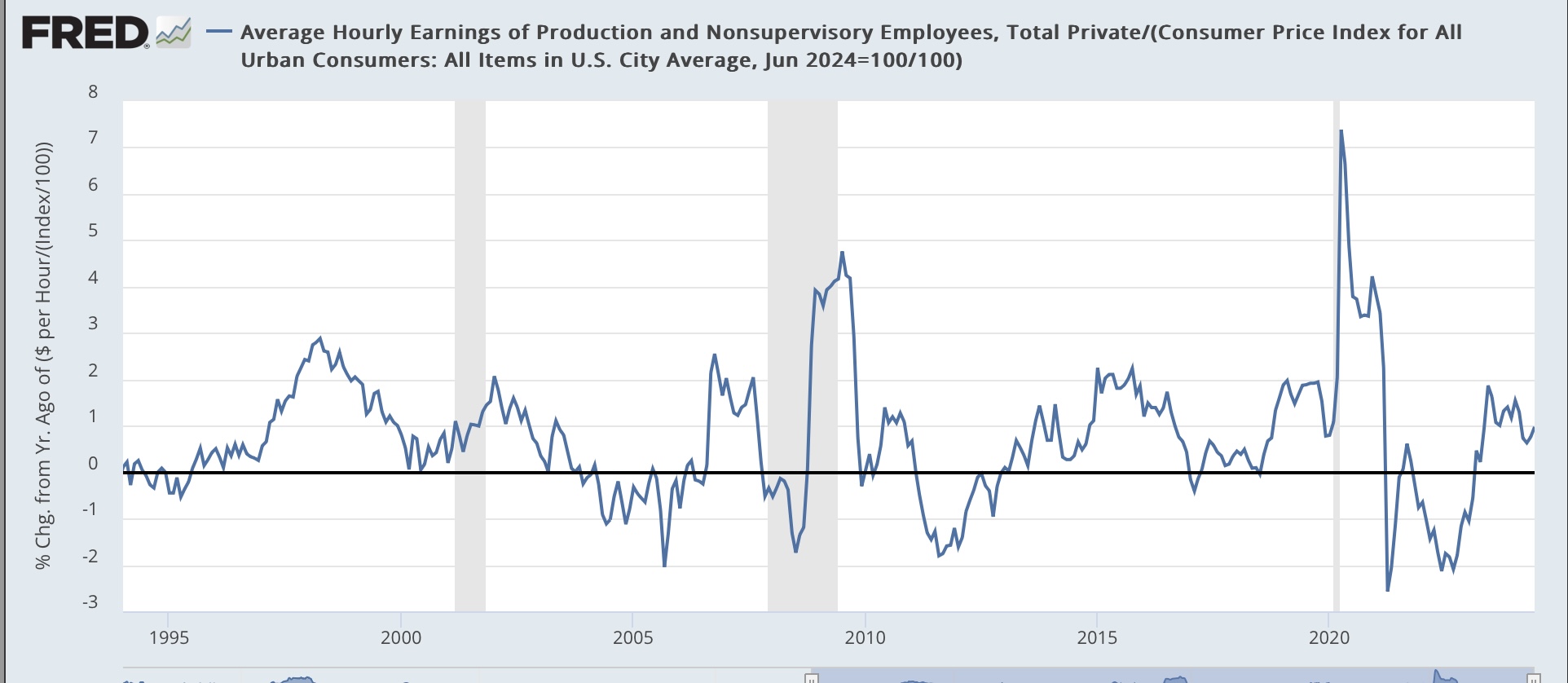
Now that we have the CPI reading for June, we can calculate how average wag earners are doing in “real” terms.


First, real average hourly nonsupervisory wages increased 0.4% for the second straight month. On a YoY basis, they have risen slightly under 1.0%:


This is on par for average real wage growth for the past 30 years.

More importantly, in absolute terms after declining earlier this year, real average hourly wages are at their highest level since September 2021, and only 0.1% below that month and December 2020 for the highest all-time real wages excluding the three lockdown months that were subject to extreme labor force distortions (since so many more low wage workers were laid off compared with office workers):


Although I won’t bother with the long term graph, the previous all-time high in January 1973 was never exceeded before the pandemic. June’s reading was 0.7% higher than that.

Second, and perhaps even more importantly, real aggregate nonsupervisory payrolls rose 0.2% in June to another all time record high (blue in the graph below, right scale). On a YoY basis, they are up 2.3% (red, left scale):


I particularly like this metric because, not only does it measure the “real” well-being of average American workers, but it has been an infallible short leading indicator for the economy for almost the past 60 years, as shown in the pre-pandemic historical graph of the same information as above (note blue line is in log scale to better show shorter term trends):


To recap what I have written previously, not only have absolute real payrolls always peaked at least several months before a recession, but the rolling over process has tended to be gradual rather than sudden. And on a YoY basis, real aggregate wages almost always turn negative within two months before or after the onset of a recession.

As shown in the first graph above, real aggregate nonsupervisory payrolls show no signs of rolling over. That is an excellent indication that the expansion has some time to go.

While I am at it, here is the latest monthly estimate through May of real median household income from Motio Research:


Per their calculations, real median household income is 0.2% its all-time non-lockdown high set this March.

Thursday, July 11, 2024

A somnolent consumer price report, with headline YoY inflation marginally under 3%, tests whether 2% inflation is a target or a ceiling for the Fed


 - by New Deal democrat


Consumer prices in June failed to show any inflation at all for the second month in a row, as they declined -0.1% following an unchanged reading in May. On a YoY basis inflation decelerated -0.3% to 3.0% (technically 2.98% if you go out one further decimal point), the lowest YoY increase since March 2021. 

For the record, “core” inflatioin less food and energy increased 0.1%, the lowest monthly increase since January 2021. On a YoY basis it was higher by 3.3%, the lowest since April 2021.  Here is the YoY% change in both headline (blue) vs. “core” (red) inflation:


As usual, the price of gasoline and the imputed price of shelter were the primary components, as energy declined -2.0% for the month, while shelter increased 0.2%, the lowest monthly increase in that component since February 2021. Here are the monthly (blue, right scale) and YoY (red, left scale) % changes in the shelter index:


On a YoY basis, imputed shelter inflation was 5.1%, the lowest since March 2022.


Shelter has continued to behave just as I expected. Here is an update to the 12-18 month leading relationship between house prices (as measured by the FHFA) and Owners’ Equivalent Rent in the CPI:


 House prices are currently increasing a little higher than their average pre-pandemic rate (because, ironically, the Fed’s rate hikes have exacerbated a shortage in housing supply, thereby driving up its price), which has translated to OER and the other measures of shelter inflation to continue to decelerate YoY, but at a much slower pace than their initial rapid decline. I expect this trend to continue in the coming months.

When we strip out shelter, all other items declined -0.1% for the month, again after being unchanged in May, and are only up 1.8% YoY - the 14th month in a row they have been up less than 2.5% YoY:


In other words, properly measured, inflation continues not to be a problem at all. 


Before I finish, let’s take an updated look at our recent and former problem children, starting with new and used vehicle prices. The former were unchanged in June - the 10th time in 11 months they were unchanged or actually declined, while the latter declined another -1.5%. On a YoY basis both are in outright deflation, as new car prices are down -0.9% and used vehicle prices are down -9.5%:


Since just before the pandemic, new vehicle prices are up 20.4% and used vehicle prices are up 27.2%. Meanwhile average hourly wages for nonsupervisory personnel are up 25.7%:


While car prices may still seem shocking, the fact is that wages have almost completely caught up.

Here’s what happened with the remaining problem areas of inflation:

  (1) food away from home, which peaked at 8.8% YoY over one year ago, increased 0.4% again in June, and increased 0.1% (actually 0.03% one decimal point further) on a YoY basis to 4.1% i, vs. its pre-pandemic average of 2.5%-3.0%:


 (2) electricity, which had followed gas prices higher, appears to be starting to follow them lower, declining -0.7% in June, and has decelerated to a 4.4% YoY gain:


 (3) transportation services - mainly car repairs (up 0.2% for the month, but down from its peak of. 14.2% YoY in January 2023 to 6.0%) and insurance (up 0.8% for the month and up 19.5% YoY - still down from April’s 22.6% YoY gain) - declined-0.5% for the second month in a row. It had rocketed from its pre-pandemic range of 2.5%-5.0% to as high as 15.2% in October 2022, but has since decelerated to a gain of 9.2% YoY:


Based on the past inflationary period of 1966-82, it is clear that transportation services lags increases in vehicle prices by 1-2 years and even more, sometimes increasing right through recessions.

To sum up: aside from shelter and transportation services, *no* sub-sector of prices was up more than 4.4% YoY. Many measures, including headline and core measures, made new 3 year lows YoY. And inflation ex-shelter continued well under control.

On final important comment: the Fed tolerated a number of years where inflation was up to 1% below its target of 2% with complete equanimity. Now that YoY inflation is marginally under 3%, a Fed with symmetric preferences would be equally comfortable, and open to lowering rates. The suspicion before the pandemic was always that the Fed treated 2% inflation more as a ceiling than a target. Given recent signs of weakening in some sectors, and the fact that Fed policy takes a long time to reach full effect, my personal opinion is that this report gives the Fed has the cover it needs, if it chose to, to lower rates at its meeting later this month. If it doesn’t, that suggests that its preferences are in fact asymmetric - and in the more dangerous deflationary direction.

On jobless claims, the unresolved seasonality hypothesis is holding up


 - by New Deal democrat


Ever since jobless claims started higher in May, I’ve cautioned that I suspected that unresolved seasonality may be at play. This week and the next two weeks are the acid test for that hypothesis, because they were the lowest weeks for claims all last summer.


And . . . The unresolved seasonality hypothesis held up for the first of those weeks.

Last week initial claims declined -17,000 to 222,000 - a lower number than any week last summer. The four week average declined -5,250 to 233,500. With the usual one week delay, continuing claims declined -4,000 to 1.852 million:


But of course, if seasonality is at play, the YoY numbers should be benign. And they are.

YoY initial claims are down -3.6%. The four week average is down -4.6%. Continuing claims, which have been higher YoY for many months, are close to the bottom of that YoY range, higher by 4.6%:


Since the YoY metrics are most important for forecasting purposes, this continues to be a positive sign for the economy.

Finally, although I’ve cast doubt on whether the “Sahm Rule” is giving an accurate signal this time around because of the huge impact of recent immigration, here is an update through the first week of July for that comparison:


Initial and continuing claims are more consistent with an unemployment rate of perhaps 3.8%, not 4.1%. I strongly suspect the recent increase in the unemployment rate is indeed recent immigrants who have been unable to find permanent jobs yet.

Wednesday, July 10, 2024

The leading sectors of the labor market are still generally trending positive


 - by New Deal democrat


Our economic news drought ends tomorrow with the CPI report, and I’ve beaten the issue of unemployment to death, so today let’s turn to the leading sectors from the Establishment Survey portion of the jobs report, where as I’ve been reporting for months, the situation is considerably better.


Since I’ve been paying special attention to the manufacturing and construction sectors, let’s start by taking an overall look at them:


Going back 40 years, prior to a recession at least one of the two has been in a downturn, with the other at most flat. But while manufacturing employment has been flat in the past year, construction employment has continued to boom.

Average weekly hours in the manufacturing sector is one of the 10 “official” leading indicators, and here the story is downright positive:


Hours have always declined prior to or just entering a recession. By contrast, since January of this year, average hours have *increased* from 40.2 to 41.0 per week.

Let’s next take a look at several leading sub-sectors. Truck transportation has indeed declined sharply, following a major bankruptcy in the sector last summer. Residential construction jobs, by contrast, have bucked the trend of higher mortgages and lower starts, and have continued to increase in the past year:


Temporary help services have been in a severe downtrend for over two years:


I don’t have any special insight into this, but it appears that some kind of secular change is taking place.

One other sector - not a leading one, but as it is large and important, worth mentioning - that is also under stress is professional and business jobs:


These are only up 0.3% in the past year. In the past entire 85 year history of this series, that weakness has never happened outside of a recession.

But let’s bring this back to where I began above. Manufacturing and construction together make up the vast bulk of the goods producing sector, and that in the aggregate has always turned down in advance of a recession; but it is still increasing:


In summary, when we look at the leading sectors of the labor economy, while a few pockets - trucking and temporary help - are in real downturns, the bulk of the indicators are pointing higher. Until I see broader weakness in the goods-production measures of the jobs report, I see no support there for a recession beginning in the next few months.

Tuesday, July 9, 2024

A historical look at labor force participation surges, real GDP, and unemployment


 - by New Deal democrat


In my discussion yesterday of why the Sahm Rule might be giving a false signal at present, I noted that “in addition to the 1980-81 double-dip period, significantly the only other time [a big increase in new entrants into the labor force leading up to a recession] even came close was 1968-69, when the Baby Boom was entering the labor force in droves.”


Let’s explore that more today, and why it is relevant to our current situation.

Between 1946 and 1963, 76 million Boomers were born to a population of 190 million at the end of the period. By contrast, for example, 73 million Millennials were born between 1981 and 1996 to a population that ended the period at 270 million. In other words, Millennials only accounted for 27% of the total population at that time, while at the end of 1963 Boomers accounted for a full 40% of the entire US population!

Here’s what happened when that huge generation entered the labor force, including for the first time most young women.

Most notably, as the prime age population surged, so on a secular basis did the unemployment rate. As the surge ended, the unemployment rate declined on a long term basis as well:


With so many new entrants to the labor force, lots of pressure was place on wages as well. When the surge subsided, real wages began to increase again:


Along with the surge in population, the labor force participation level surged as well, and the two gradually abated together also:


Over the long term, the civilian labor force has increased by an average of roughly 1% annually. So below let’s compare the YoY% increase in the civilian labor force minus 1%, with the unemployment rate:


Even there, with considerable noise, we can see that the outsized increase in the labor force that began as the Boomers entered it in the 1960s and ended in the late 1990s corresponded to a secular increase and then decrease in the unemployment rate with a delay of several years.

I want to emphasize that I am hardly advocating for a monocausal view of the economy or unemployment rate. Trade, tax, and business policies mattered, as most certainly did the OPEC oil shocks of the 1970s and their collapse in 1986. But the correlation is clearly there.

Now let’s take this same graph and apply it to the post-pandemic era. Note that this is using the Census Bureau’s population numbers, rather than the CBO’s much larger numbers:


Even using the Census Bureau’s numbers, the increase in the labor force has equaled that of the 1960s and 1980s. If we were to use the CBO’s numbers instead, it would look much more like the 1970s.

In short, the only other time in the past 75 years when we had a major surge in growth in the labor force, we also had a general uptrend in the unemployment rate on a secular basis. 

Finally, this secular uptrend in the unemployment rate included periods of very robust real GDP growth, frequently over 5% YoY:


So history does support the hypothesis that we can have an expanding economy even with a gradual uptrend in the unemployment rate caused by labor force increases.

Monday, July 8, 2024

Further on why the big increase in immigration has been distorting the signal from the ‘Sahm Rule’


 - by New Deal democrat


In my summation of Friday’s employment report, I wrote that “[t]here will probably be lots of chatter in the next few days as to whether the “Sahm Rule” has been triggered. It has not, because the 3 month average in the unemployment rate is 4.0%, and the lowest 3 month average in the last year is 3.6%. Additionally, Claudia Sahm herself has indicated that the same immigration issue I have highlighted may also make her metric signal a false positive this time.”


And right on cue, the usual suspects have pounced.  So let’s take a more in-depth look.

To be clear, the data is pretty close to triggering the “Sahm Rule.” Here’s the real time indicator from FRED from which I have subtracted the 0.5% threshold so that it shows at zero, first for the post-pandemic period:


And now for the pre-pandemic period:


In the past, there have only been three occasions - 1967, 1976, and 2002 - when the current level has occurred in the absence of a recession. Indeed, more often than not, once the 0.3% threshold has been crossed, a recession has been close to occurring.

But as I wrote last month, and as Sahm herself as well as Harvard econ professor Jason Furman have suggested, this time might indeed be different because of immigration.

Let’s start with a long term graph I have run many times before: the YoY% change in initial unemployment claims (red) vs. the YoY% change in the unemployment rate, prior to the pandemic:


It is crystal clear that initial claims, for over half a century, have led the unemployment rate.

Now let’s look at the last three years:


Despite the fact that initial claims have turned *lower* YoY ever since the beginning of the year, the unemployment rate YoY has continued to climb. 

This is unprecedented. There has not been a single time at any point in the past 50+ years when initial claims have been declining YoY and the unemployment rate has not followed suit. Not once!

But the unemployment rate might rise because jobs are harder to find (essentially a demand side issue), or it might rise because there is a surge in people trying to find a similar amount of jobs (a supply side issue). To see which has been more important, let’s slice and dice the recent number of unemployed (blue in the graphs below) by the number of permanent job losers (gold), and also new entrants (like recent immigrants) plus re-entrants (red):


Since the low in December 2022, the total number of unemployed has risen by 1.113 million. Of that, only 261,000 have been permanent job losers. By contrast, new and re-entrants to the labor force have increased by 514,000, about double the number of job losers!

By contrast, here is the historical record pre-pandemic:


We only have a full record going back 30 years, but in that period of time before both pre-pandemic recessions, permanent job losers increased sharply, while new and re-entrants to the labor force stayed steady or even declined.

This strongly suggests a supply side explanation.

Another way to look at similar data is to break out new entrants, like recent immigrants (gold in the graphs below) from total unemployed (blue again) and new plus re-entrants (red again):


We can see that both new and re-entrants have increased in the last several years.

Now here is the pre-pandemic comparison:


Only during the 1980-81 “double-dip” recession period did new and re-entrants increase prior to a recession.

And just how much have new and re-entrants increased? By about 20% YoY for new, and over 10% for re-entrants in the past year, a considerably higher rate than total unemployment:


Such an increase was almost totally unprecedented in the 50 years before the pandemic:


In fact, in addition to the 1980-81 double-dip period, significantly the only other time it even came close was 1968-69, when the Baby Boom was entering the labor force in droves.

Indeed, going back 60 years, the 20%+ increase in unemployment in new entrants, and 10%+ increase among re-entrants has only been seen coming *out of* recessions, not going in to one:


With that in mind, let’s again take a look at the increase in the native born (blue) and foreign born (red) labor force since the onset of the pandemic:


The native born labor force declined much more sharply, and only in the past two months has exceeded its pre-pandemic level, while the foreign born labor force has exceeded its pre-pandemic level by roughly 1,000,000.

And now remember that the population figures I have been using above have probably undercounted post-pandemic immigration to the US by over 3 million, and the number of recent immigrants in the labor force by 2 million!

Put this together, and the picture painted is not one of a labor market where the demand for workers has gone soft, but primarily where the supply of new workers, especially recent immigrants, as well as re-entrants to a strengthening market, has swamped the number of positions available.

And because so much of the increase in labor supply is driven by people who were not previously part of the US economy (because they were foreigners), it is perfectly compatible to have both a growing economy (i.e., one not in recession) and an increasing unemployment rate.