Showing posts with label currency. Show all posts

Friday, July 18, 2008

Forex Fridays -- the Yen

Let's continue Friday's usual forex theme with a look at the yen.


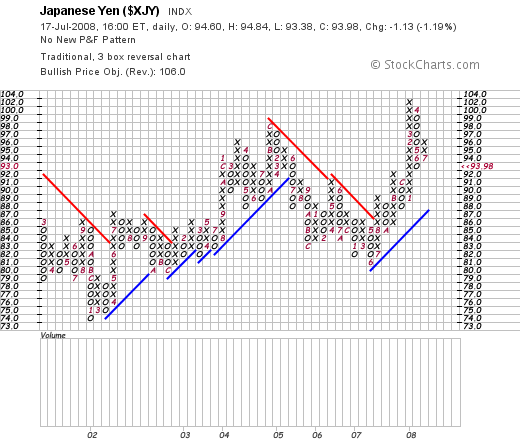
First, let's look at the P&F chart. This will give us an idea of the "absolute moves" of the yen. Notice that from 2004 until the beginning of 2007 there was a general downward sloping trend to the chart as prices made a series of lower peaks and lower lows. This is indicative of a bearish slump in the overall value. Then note that at the beginning 2007 the trend reversed, although the last two columns of the chart indicate some selling activity.
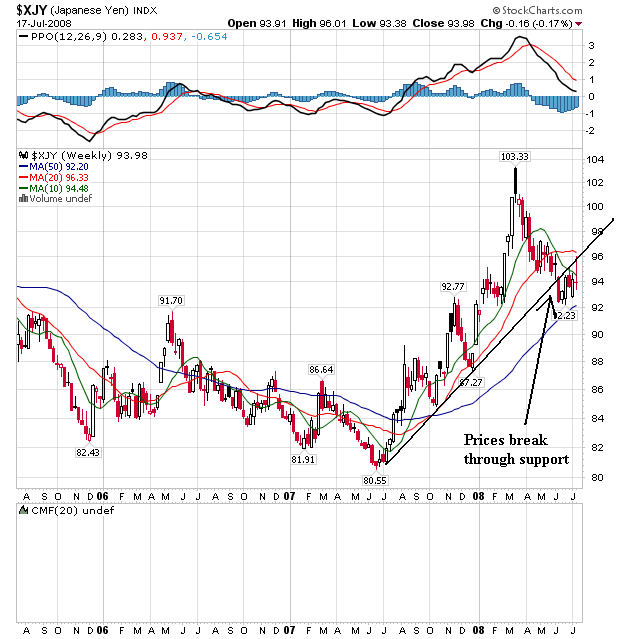


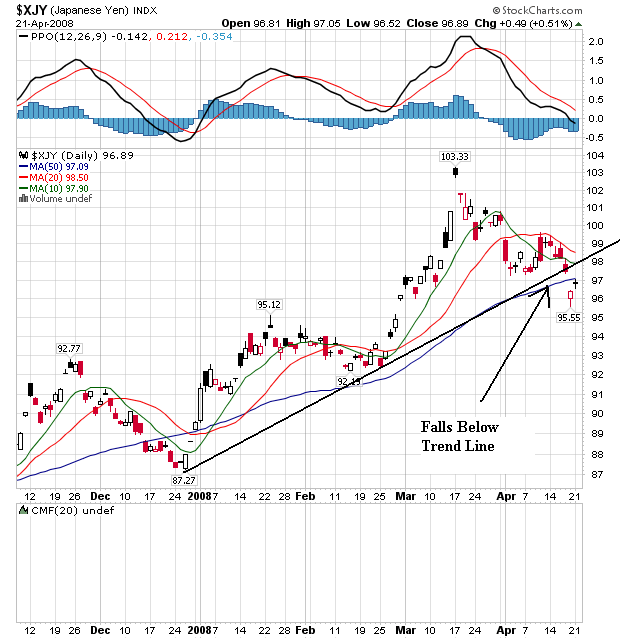
On the weekly chart, notice that since mid 2007 prices have risen sharply, continually breaking through resistance and then consolidating gains in a downward sloping flag pattern. However, prices broke below this upward sloping trendline in June of this year and are now using this trendline (along with the 10 week moving average) as resistance.
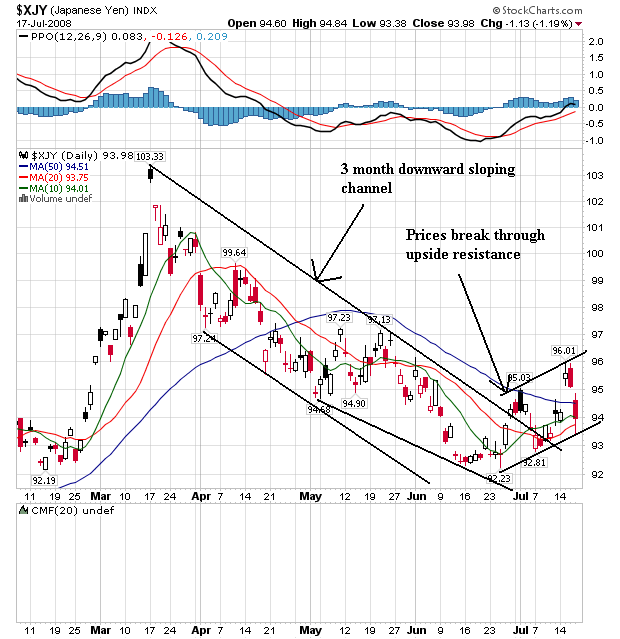


On the daily chart of the yen notice the following:

-- Prices were in a downward sloping trading range from late March until early July.

-- The 10 and the 20 day SMA are both moving higher

-- The 10 day SMA has crossed over the 20 day SMA

-- The 10 and 20 day SMA are below the 50 day SMA

-- The 50 day SMA has leveled out

This chart is in transition. The March - July correction is over, but the price/SMA picture is still cloudy. The short term SMAs are heading higher, but they are still below the longer SMAs. In addition, prices have broken above the 50 day SMA but have retreated from those levels.

Friday, June 6, 2008

Forex Fridays

Bernanke made public statements supporting the dollar on Tuesday and Wedndesday:

Federal Reserve Chairman Ben Bernanke's warning this week about the dollar's steep fall marks the latest step in a Bush administration effort that began in November to use stronger rhetoric to try to prop up the sagging U.S. currency.

The stepped-up rhetoric comes as the world's economic powers prepare to gather in Japan next week for the Group of Seven meeting. The dollar, along with the U.S. economy, is expected to be a key topic of discussion. International concerns about the dollar have been growing as Europeans, in particular, fret about the falling dollar's impact on their exports to the U.S.


The article also made this observation:

The increased focus on the dollar represents somewhat of a gamble by Messrs. Paulson and Bernanke. Their bet is that as the housing crisis subsides and the Fed finishes cutting interest rates, the dollar will climb -- making their rhetoric seem like it is having an impact.


ECB President Trichet said something similar on Thursday:

European Central Bank President Jean-Claude Trichet said Thursday that inflationary pressures in the euro zone will last longer than previously expected, with risks to price stability increasing further in the wake of robust food and oil prices.

The ECB may even raise its 4.0% interest rate, left unchanged on Thursday, at its July meeting, Trichet said. "I don't say it's certain, I say it's possible," he said.

Inflation trends have put the ECB in a state of "heightened alertness," Trichet said after the Governing Council meeting in Frankfurt.

.....

His more hawkish slant was further underscored by the bank's new staff projections for economic growth and inflation over the next two years. Inflation in 2009 is seen at around 2.4%, Trichet said.

Any projection for inflation in 2009 above 2.3% is "an unexpectedly hawkish signal," said Holger Schmieding, an economist for Bank of America.

"A number of us (on the Governing Council) "thought there was the case for raising rates," but Thursday's decision was taken by consensus, Trichet told reporters.


So -- we have dueling central bankers (as it were). The only difference is Trichet has a history of acting on his statements, whereas the US is the talker not the doer in the central bank world. That's a big difference and it boils down to a massive credibility gap for the Fed.

Let's start this week with the euro and review it's weekly chart:


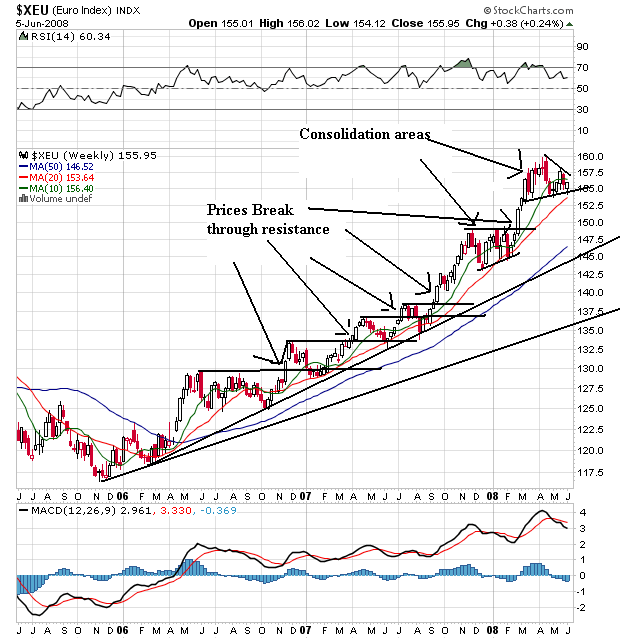
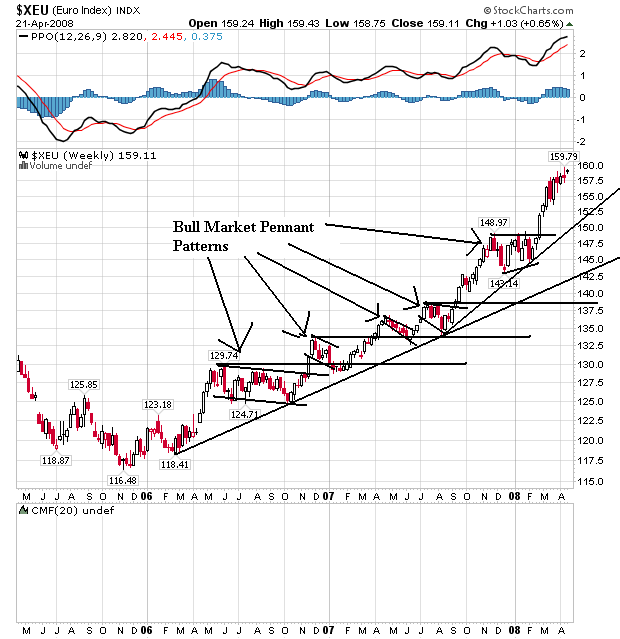
This is a great bull chart. Notice the prices have continually advanced through resistance and then consolidated gains. Also notice the shorter SMAs are above the longer SMAS and all all the 20 and 50 day SMA are moving higher. The 10 is curving lower right now and prices are caught between the 10 and 20 day SMA.


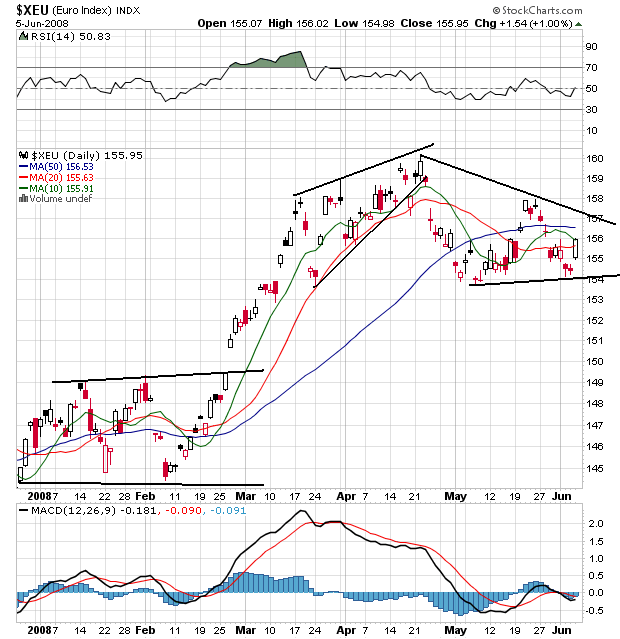
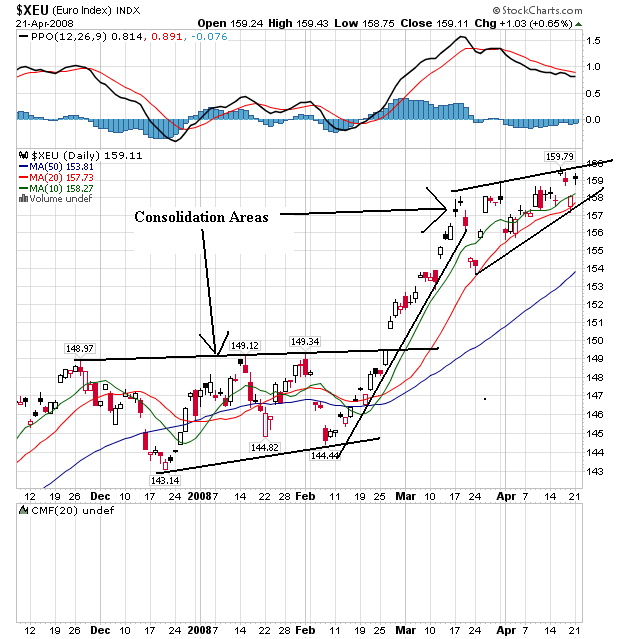
On the daily chart, notice that prices consolidated at the end of 2007 and beginning of 2008. They broke through resistance in late February, peaked in late April and have come down a bit since. Right now prices are bunched up with all the SMAs in s a consolidation pattern. But notice the big pop today after the ECB comments.


The yen has been in a rally since mid-2007. Notice that as the index rose prices took time to consolidate gains. Also note that consolidation was sharp. Right now prices have dropped below the 20 week SMA which will contribute to that SMA moving lower. Also note the 10 week SMA is about to cross below the 20 week SMA which is a bearish development.


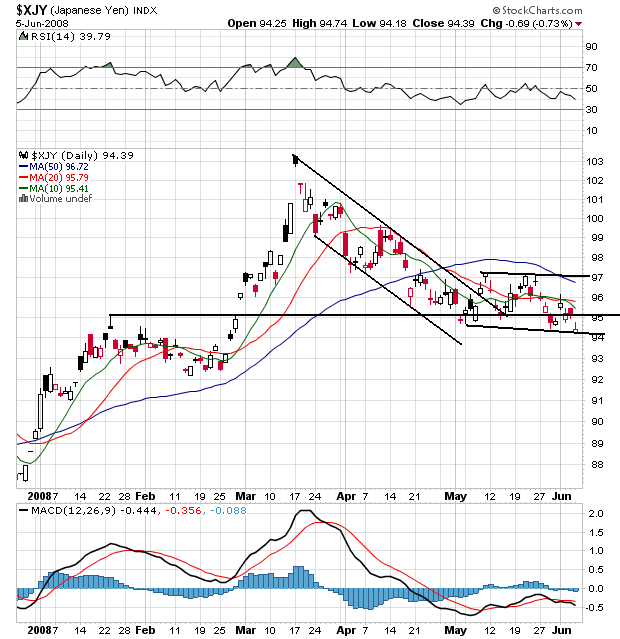
On the daily chart, notice that prices advanced from the beginning of the year through mid-March. Since then they have come down a bit and consolidated horizontally. Note that prices and all the SMAs are bunched together right now, indicating a lack of direction.


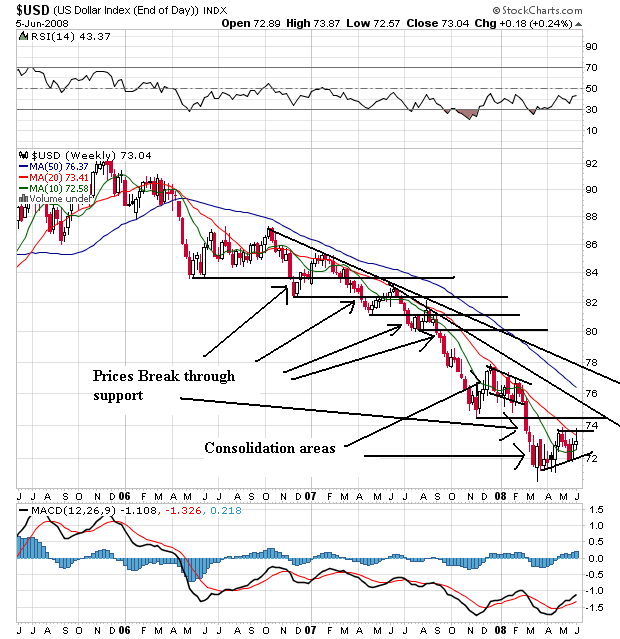
One of the nest examples of a bearish chart I have ever seen. Prices have been moving lower for two years, with prices continually breaking through support to make new lows. Note the 20 and 50 day SMA are both moving lower. The 10 week SMA is about to move a bit hight, but it has done this before at the beginning of the year with no success.


On the daily chart, notice the dollar has rallied a bit since the end of April. Also note that prices are above the SMAs which will pull them higher. Bernanke's statements jawboning the dollar may help in the short run, but we'll need action for this chart to turn around.

Friday, May 23, 2008

Friday's Forex Round-Up

Let's start with a long-term chart of the dollar:


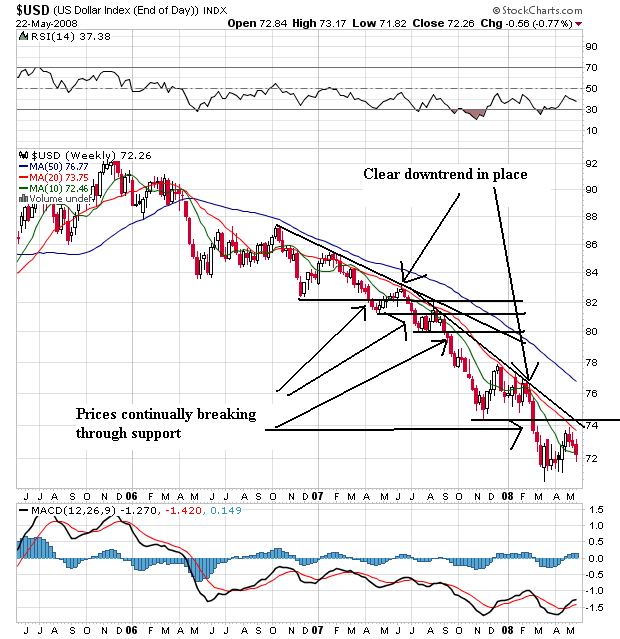
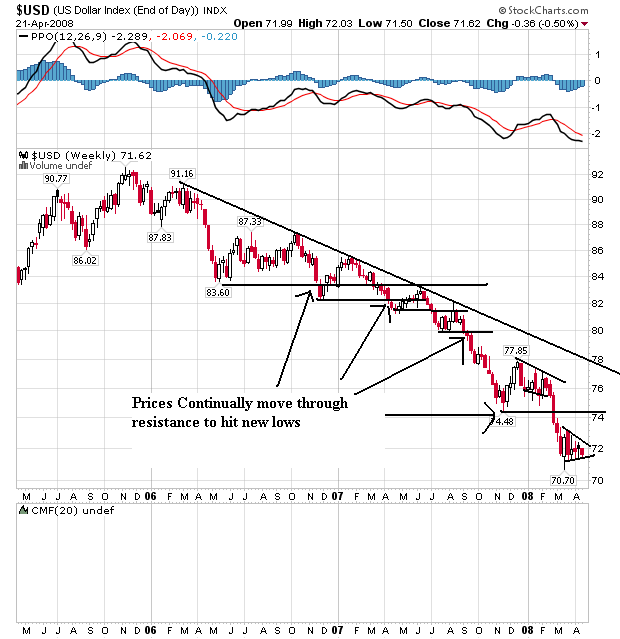
Remember we're dealing with an incredibly weak chart. Prices have been dropping for the better part of to years, with prices continually breaking through downside support and making new lows. This had been going on for two years -- long before the economy started to slow. That means traders saw fundamental problems with the economy long before big drops in GDP started to show up.


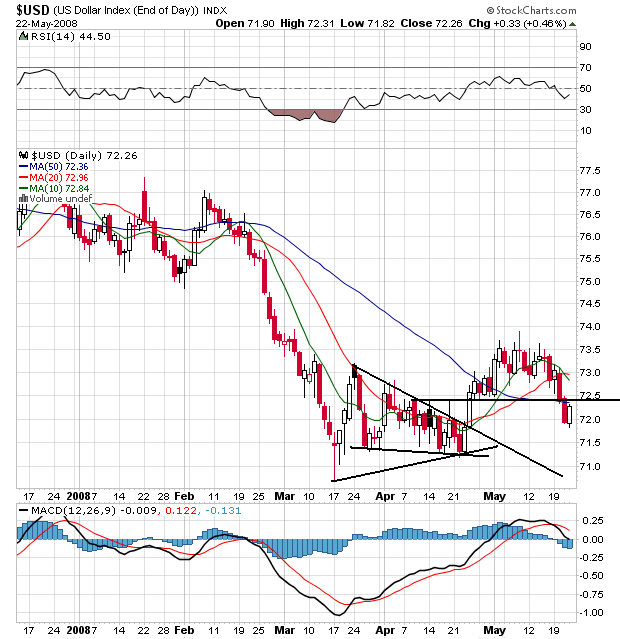
On the daily chart, notice that Prices formed a consolidation triangle from mid-March to the end of April. Then prices rallied out from that pattern. However, prices have had a hard time maintaining any upside momentum. Prices have now dropped below all the SMAs. Also note the 10 day SMA has crossed below the 20 day SMA and the 50 day SMA is at best even. A few weeks ago, the general consensus was for the dollar to rally. Now it doesn't look that hot.


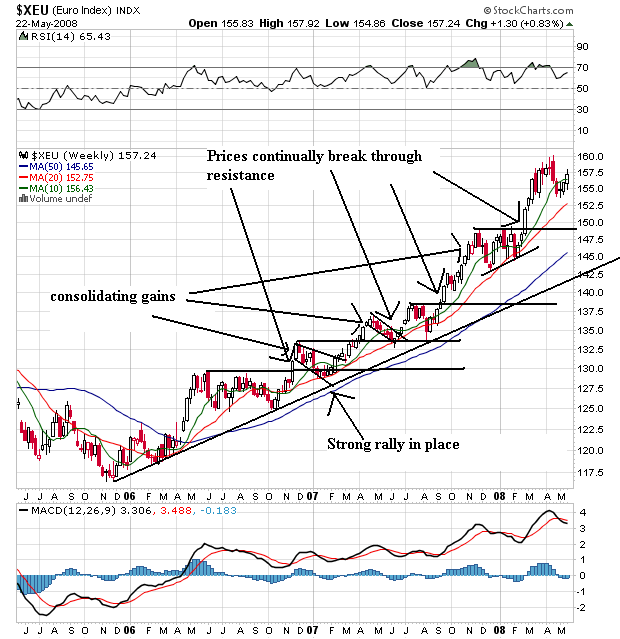
The Euro has been the direct beneficiary of the dollar's drop. Notice the euro is in the middle of a multi-year rally with a strong uptrend in place. Also notice that as prices rallied, they also consolidated their gains in several places, allowing traders to digest price action and plot their next move.


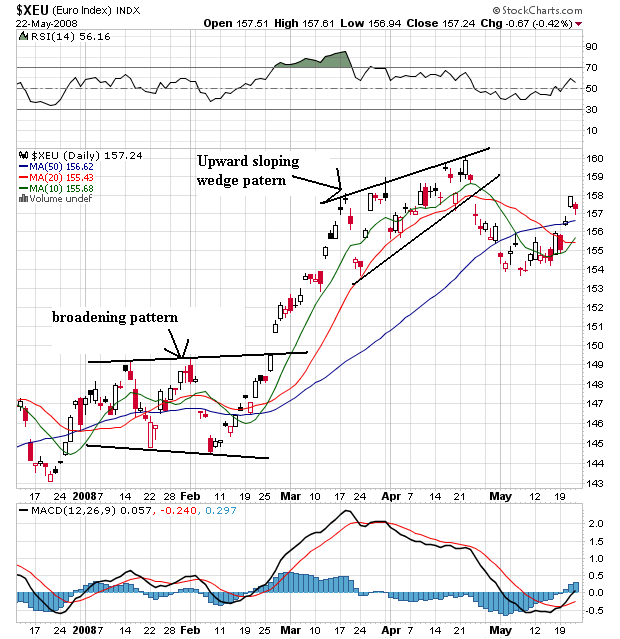
On the daily euro chart, notice the broadening pattern at the beginning of the year and the upward sloping wedge pattern from the end of March to the end of April. Prices dropped from there and fell below the SMAs. But notice how the euro has bounced back and moved through all the SMAs. Also note the 10 day SMA has moved through the 20. This chart is turning around, although it's not time to say with confidence it's completely bullish.


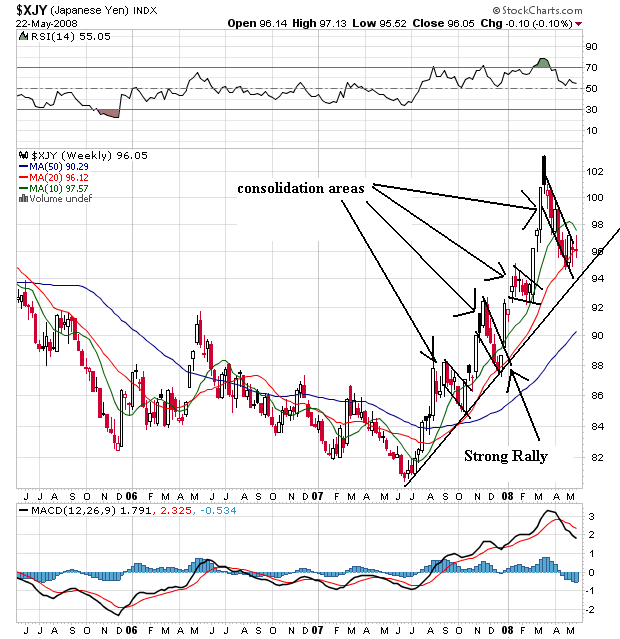
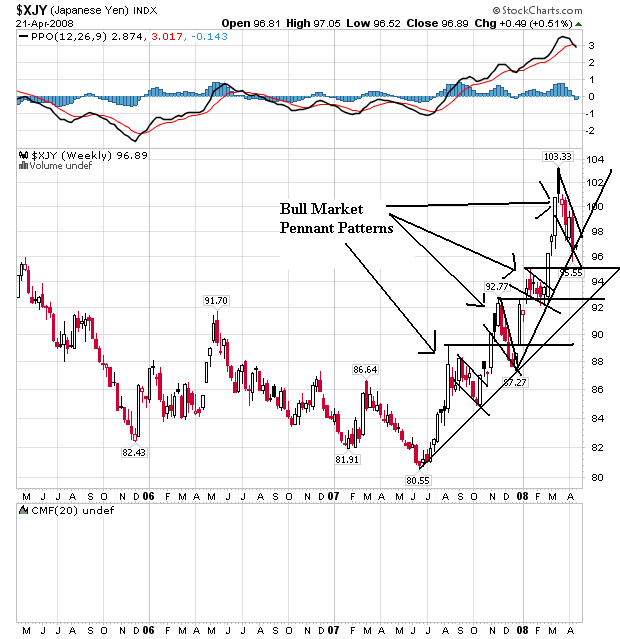
On the weekly yen chart, notice the strong rally that started in the middle of last summer -- right before the US market started to tank hard. Also notice that as prices have rallied, they have also fallen back in several triangle patterns to consolidated gains. Finally, notice how the week chart uses the 20 week SMA as support.


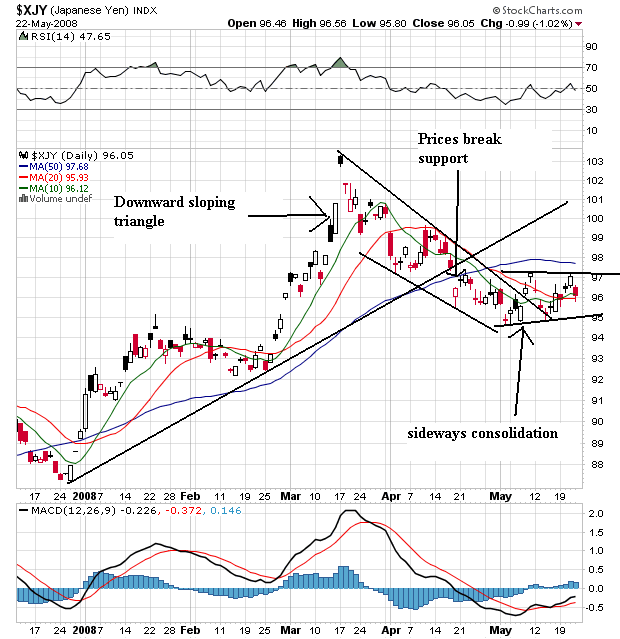
The yen broke through upside support in mid-April, but formed a solid downward sloping channel starting in mid-March. Since the beginning of May prices have been moving sideways as traders await the next big move.

So -- what can we discern from all this?

1.) The dollar's "comeback rally" isn't shaping up that well.

2.) The euro may be turning around, but we can't make a solid call yet.

3.) The yen is waiting to see what happens.

Tuesday, April 22, 2008

A Closer Look At the Currency Markets

Let's take a look at the daily and weekly charts of the three big currencies -- the dollar, the euro and the yen.


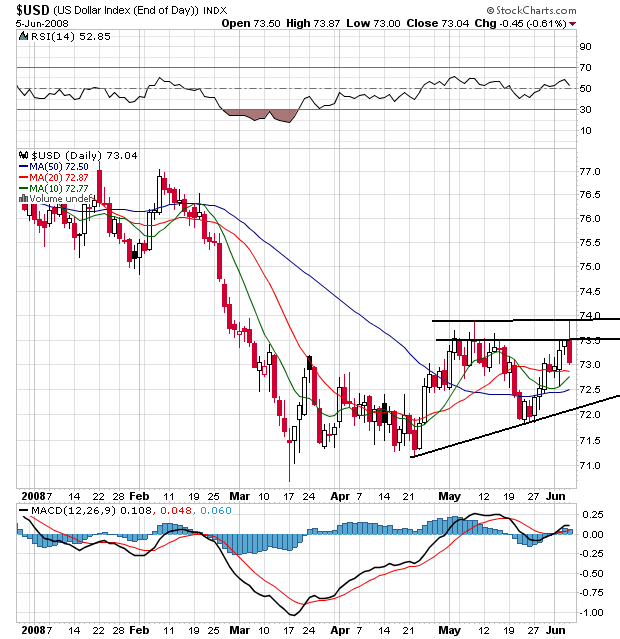
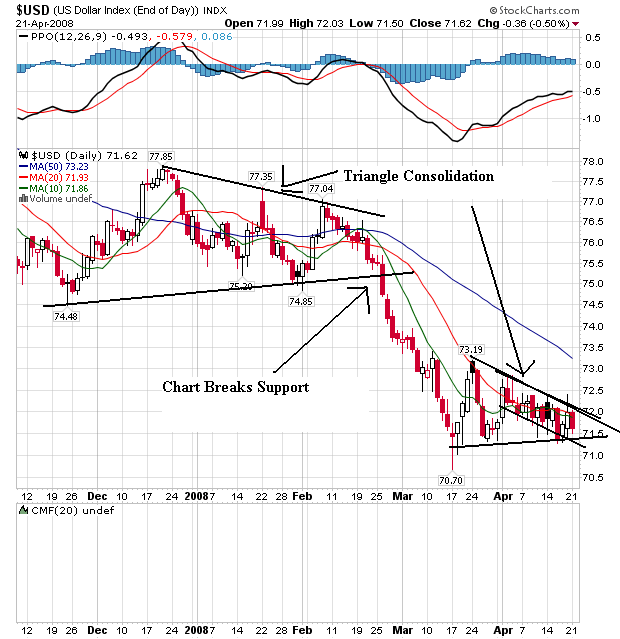
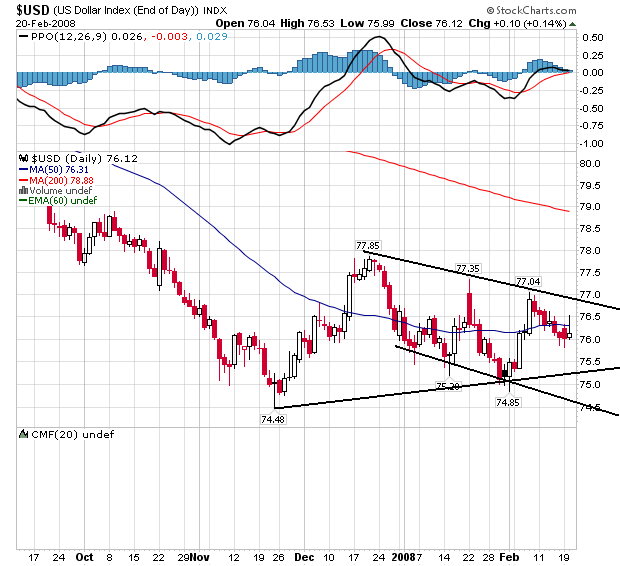
Notice the dollar was in the middle of consolidation pattern from late November 2007 to late February 2008. The dollar fell through support at this time and has since been in the middle of another consolidation pattern between 71 and 73. Prices and the 10 and 20 day SMA are bunched up at this level, indicating traders don't have a firm idea about where they want to send the dollar.


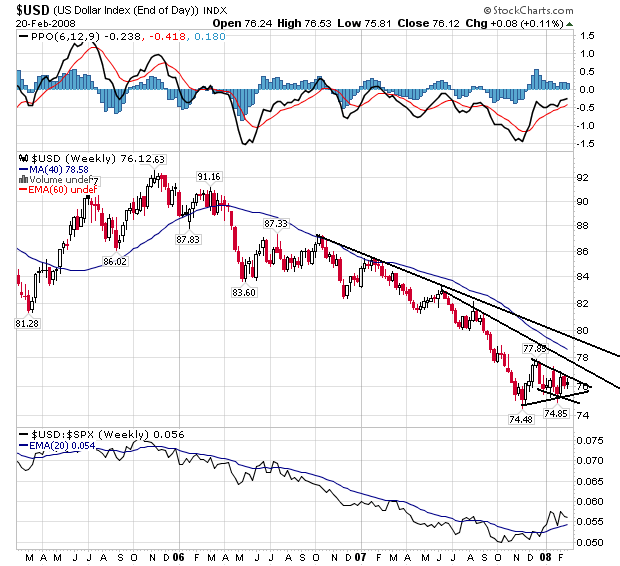
On the weekly chart, notice a clear bear market. Prices are clearly moving lower and have been for the last two years. Prices have continually moved through support to make new lows. Currently the market is forming a triangle consolidation pattern.


On the euro's daily chart, notice how it is nearly a mirror image of the dollar's chart. The euro consolidated from late November to late February, broke through upside resistance and has formed a consolidation triangle pattern over the last month or so. Prices and SMAs are both moving higher, although they are also a bit bunched indicating a lack of direction.


Here we also have a near exact opposite of the dollar. Prices have continually moved higher. There are pennant consolidation patterns along the way and prices have continually moved through upside resistance.


On the daily yen chart, notice that prices have broken through support. However, they still are around the 50 day SMA level where they were at the end of December. However, this is the last area of support for the yen, so if it wants to keep in it's rally it has to, well, start rallying from this level sometime soon.


On the weekly chart, notice that prices have been rallying hard for nearly a year. They have continually moved through price resistance levels and formed bull market pennant consolidation patterns. However, compare the slope of the yen and euro rally. The yen rally is incredibly sharp whereas the euro's is more gentle. Gentle rallies are better over the long run.

Thursday, February 21, 2008

A Broad Look At the Currency Markets

The currency markets are very inter-related; as one currency drops, another rises. So it makes sense to start looking at a group of currencies to see where money is flowing into and out from.


The dollar has been in a downtrend since the beginning of 2006. It has made a clear pattern of lower lows and lowers highs. Also note the accelerated decline since mid-2007 when the Fed started cutting rates.

The dollar formed a bottom at the end of last year, bounced higher and is now consolidating in either a triangle or flag pattern.


On the dollar's daily chart you can see the consolidation very clearly. I think the most appropriate technical call is a bear market flag, however some analysts may see a triangle consolidation.


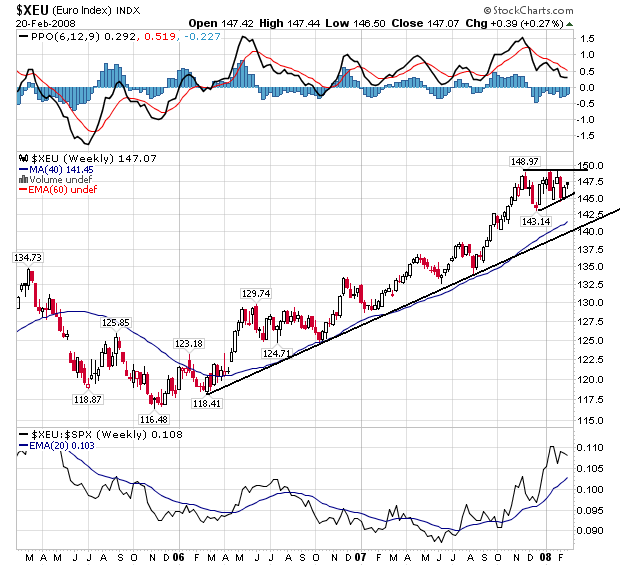
The euro has been the clear beneficiary of the dollar's decline. Notice that since the beginning of 2006 we have a clear rally with higher highs and higher lows. We also have a consolidation pattern that starts in late 2007.


Here is a closer look at the euro's consolidation pattern, which is a clear bull market flag. Also note the euro and dollar chart's are a near mirror image of each other for the last two years.


The yen had a rough time from 2005 to mid 2007. The market found a bottom in 2005, bounced higher and then fell to a new low in late 2007. This looks an awful lot like a dead cat bounce to me.

The yen stared a pretty strong rally in mid-2007 making a continued pattern of higher highs and higher lows. However, until it also looks as though the yen is in a giant bottoming pattern for this entire chart (roughly 3 years). Until the yen makes a strong move from this area to say 100 I think we could continue to call the yen in a bottoming formation.


On the daily chart there is a very gentle rally with higher highs and higher lows. But the lack of a serious upward sloping incline makes me wonder about trader's sincerity about the rally. To me, this chart says, "we really want to bid this chart higher, but we're really not sure that's a good idea."

So, what do these charts tell us?

-- The euro and dollar are clearly in direct competition with each other.

-- There is a lot of hesitancy to the yen's chart. The lack of a serious upward incline to the latest rally makes me wonder about trader's underlying conviction. This chart says, "the Japanese economy isn't out of the woods yet, at least not according to traders."

Monday, February 5, 2007

Administration Urged to Challenge Japanese Currency Practices

Japan has become the latest scapegoat for protectionist rhetoric in Washington, as Congress urges Treasury Secretary Hank Paulson to use this week's meeting of G7 finance ministers to accuse Tokyo of fixing the exchange rate of the yen.

With the Democrats keen to make their mark on Capitol Hill after their victory in November's elections, Michigan Congressman John Dingell sent the President a letter last week - publicised on his website under the title, 'Dingell to Bush: You Just Don't Get It' - urging the White House to prosecute Japan for currency manipulation.

The yen has sunk to four-year lows against the dollar, and the 'big three' US carmakers, Ford, GM and Chrysler, have argued that Tokyo is 'manipulating' the currency markets by talking down the yen, making imported Japanese cars unfairly cheap.


Asian governments have been subsidizing their exports with a cheap currency for some time now. How else do you think the Chinese have amassed about $1 trillion in US dollars. At the same time, the US has provided various subsidies to various industries over the same time (just look at all of the special interest tax deductions in the US tax code).

I don't have an exact answer for this situation -- Asian government's intervention. But, expect more along these lines for now.

Link