Saturday, February 1, 2025

Weekly Indicators for January 27 - 31 at Seeking Alpha


 - by New Deal democrat


My “Weekly Indicators” post is up at Seeking Alpha.

Several of the trend indicators that had been languishing, namely real money supply and manufacturing new orders, have turned up. But that is being offset by an overly strong US$. Once the Dollar increases in value relative to other currencies by 5% or more, it has a significant negative effect on the economy, becuase it makes exports more expensive and imports cheaper (which, not coincidentally, pretty much offsets the effects of tariffs. 

addendum: Here is a special bonus graph of the US$ vs. major currencies, both YoY(red, left scale) and in absolute terms (blue, right scale), show the surge to over 5% YoY that occurred immediately after the November election:

As usual, clicking over and reading the details will bring you up to the virtual moment as to the state of the economy, and bring me a $ or two for my lunch money.

Friday, January 31, 2025

Personal income and spending for December: more “steady as she goes” but with late cycle characteristics


 - by New Deal democrat


The December personal income and spending report showed that for the huge consumption sector of the economy, “steady as she goes” continued, as both nominal and real personal income and spending rose again in December. But as I emphasized one month ago, there are many signs of a late cycle configuration.


Specifically, nominally personal income rose 0.4%, while spending rose 0.7%. Since the deflator increased 0.3%, real income rose 0.1%, and real spending rose 0.4%, continuing their consistent trend since mid-year 2022:


Real income less government transfers, one of the metrics that the NBER looks at to determine economic expansions vs. recessions, also increased, by 0.2%, in December, continuing its uptrend as well:


In the last few months there has been a debate about whether inflation has returned. My position was that there was no persuasive evidence. But this month’s increase of 0.3% was the hottest since April, suggesting that perhaps inflation has returned to some extent. On the other hand, as the below graph makes clear, the disinflation of earlier this year was mainly about the complete lack of inflation in October and November 2023. With those out of the comparisons, it is not a surprise that the YoY comparisons have increased:


Last month I wrote that since April, prices had only risen a total of 0.9%, for a 1.6% annual rate, below the Fed’s target. With the addition of this month, those figures increase to 1.2% and 1.8% respectively:


so whether we get a burst of inflation in January and February, as we have in the past several years, will make all the difference. 


On a full YoY basis, prices increased 2.6%, up from 2.1% in September (blue in the graph below). Services (gold) were up 3.8% YoY. Inflation in this sector has been flat for the past 12 months, varying between 3.7% and 4.2%. What has happened in the past few months is that the *delfation* in goods (red) has ended, as they were unchanged YoY in December:


Note that the long term graph of the YoY inflation in services (normed so that the current 3.8% level shows at the 0 line) shows that these remain quite elevated compared with the last 30 years:


It is noteworthy that goods inflation increasing, and services inflation remaining elevated, is a typical late cycle configuration.

Further, the personal saving rate continued its year-long decline from 5.5% last January to 3.8%. This is the lowest number since December 2022:


Although I won’t bother with the long term historical graph this month, excluding 2022 this is the lowest saving rate ever with the exception of 1999 and 2005-07. As you probably know, those two episodes occurred at or approaching the peaks of each of those two cycles. In other words, as the expansion continued, consumers get further out over their skis, and so more vulnerable to an adverse shock.

Finally, the PCE price index is used to calculate real manufacturing and trade sales (with a one month lag), another metric used by the NBER to determine if the economy is in recession or not. These sales rose 0.3% in November, continuing their post-pandemic uptrend:


In sum, the good news continued to be  is that the consumption sector remained healthy and positive in December, consistent with its trend since June 2022. But as I wrote last month, the decline in the saving rate, together with both the increase in goods prices and the continued elevation in services inflation, suggest that we are later in this expansion cycle.


Thursday, January 30, 2025

Long leading components of GDP suggest continuing if sluggish expansion through 2025


 - by New Deal democrat


As per usual, my focus in reporting on GDP is not the headline number, but the aspects which serve as leading indicators for the economy in the next few quarters.


But to get it out of the way, real GDP increased at a 2.3% rate in the last quarter of last year (red). Since inventories wax and wane, when we take them out and focus on real private sales, real GDP increased at a better 3.2% rate (blue):


This is right in line with average real GDP since the beginning of 2023. The message of the nowcast is “steady as she goes.”

But that doesn’t tell us what to expect going forward. Two metrics, real private residential fixed investment (a proxy for housing) and proprietors’ income (a proxy for corporate profits) do. And there, the news was positive, if tepidly so.

Starting with housing, nominally private fixed investment rose 0.7% in Q4. In real terms, it was up 0.3%:


As you can see, both in nominal and real terms investment in housing has been increasing since the beginning of 2023.

But the actual best way of calculating is housing investment as a percentage of GDP. Here are the nominal and real measures of each:


Nominally, housing investment rose 0.6% as a share of GDP, while in real terms it rose 0.7%. Both of these are average shares since the beginning of 2023, while slightly down from their recent (slight) peak during Q1 2024.

Corporate profits for Q4 will not be reported for another month. Proprietors’ income typically turns simultaneously with or one quarter after corporate profits, so serve as a good placeholder. Here is the long term view (in log terms to better show the historical numbers):


Both of these metrics typically turn down at least one year before the economy as a whole.

Now here is the quarterly change in nominal (light blue) and real (dark blue) proprietors’ income, compare with corporate profits (red):


In Q4, nominally proprietors’ income rose 0.7%. In real terms they rose a meager, but still positive, 0.1%.

Finally, here is the post pandemic close up of the absolute value of each metric, normed to 100 as of Q3 2022:


Since Q3 of 2022, real proprietors income has only risen 0.9%. By contrast, real corporate profits has risen 4.3% through Q3 of last year.

The bottom line is that both of our long leading components of GDP for Q4 came in positive, if only weakly so. A number of indicators have suggested rising recession risk for later in this year, but these two suggest the economy will continue to expand throughout 2025.

Continuing jobless claims trend telegraphs weak but still expanding economy


 - by New Deal democrat


I’ll report on the Q4 GDP release later this morning. But first, let’s get up to date on jobless claims. These have been trending higher YoY, but with lots of seasonal noise, which should now be over.


For the week, initial claims declined -16,000 to 207,000. The four week moving average declined -1,000 to 212,500. With the typical one week lag, continuing claims declined -42,000 to 1.858 million:


Most significant about the above is that continuing claims, as revised, remained at 1.900 for the first time since the pandemic. There is definitely a weakening trend that began last June and intensified during the autumn.

As usual, the YoY comparisons are more important for forecasting purposes. So measured, initial claims were lower for the first time in two months, down -8.0%. The four week average was up 1.4%, and continuing claims were up 1.6%:


This continued the 5 month string of higher YoY comparisons in the latter two measures. These continue to qualify as neutral readings, consistent with a tepid but growing economy, so long as we don’t go above 10% YoY.

Finally, here’s this week’s update of what this might mean for the unemployment rate when January’s jobs report comes out:


Last week I changed this format slightly, by including the total of initial + continuing claims in gold, since the unemployment rolls include people looking for work on both new and continuing basis. Note also as usual that the unemployment rate data is rendered as the % change in a %. Since in the months around one year ago the unemployment rate averaged 3.8%, this suggests that it ought to be tending towards a 4%-5% increase in that, or approximately 4.0%, vs. December’s unemployment rate of 4.1%. 


Wednesday, January 29, 2025

Interstate COVID dashboard: first, preliminary report for the week of January 19


  - by New Deal democrat


In one of his first acts in office, T—-p effectively shut down the entire US public health apparatus, for all intents and purposes turning this country into a third world backwater lagging such developing countries like India and South Africa. 

Despite this termination, a workaround exists by using the combined information generated by the States, many of which still have their own public health “dashboards,” as well as reference to similar statistics still kept by Canada. 

This is my first, bare-bones “Interstate COVID Dashboard” which I hope to update at least biweekly, using the above to estimate the data that is missing due to the termination of CDC information.

For this initial installment, the last CDC estimate of wastewater levels, which somehow did get published last Friday, is still helpful in estimating deaths for the next few weeks, since deaths follow infections by about 4 weeks. In that regard, I should note that - ominously - BIobot has also “paused” its reports due to “maintenance,” which very much looks like it is bending the knee to avoid retaliation from T—-p.

This first, preliminary report only covers COVID deaths and makes use of data generated by a total of 9 States: CO, IN, MA, MI, NJ, NY, OH, OR, and TX. Only 4 of these States have data available for each week for the past 2 years. Some have data for the last year only. One State - OH - lags the others by 2 weeks, but should continue to update. And one - CO - only keeps death *rates* per 100,000 for the past 12 months, but that is still useful for calculating trends. Additionally, I suspect that like the CDC, data for the last few weeks may be preliminary. I will watch over the next few weeks to see if that is the case or not.

With all that out of the way, here is the data:

In week three of 2023, the 4 States which have kept weekly statistics available since 2023, reported 66 deaths. This compares with 79 in week 2 of this year, and 105 in week 1. One year ago in week 3 of the year, these same States reported 238 deaths, a 72% decline YoY. The CDC reported that nationally there were 2,364 deaths in week 3 of last year. This suggests about 700 deaths nationwide in week 3 of this year.

In week 3 of 2024, CO reported 1.8 deaths per 100,000. This year so far it is running at only 0.2 per 100,000, a nearly 90% decline.

A further comparison can be made with this past summer’s wave. At that peak, deaths in reporting States totaled 183. Since we know that infections peaked during the first week of January at a level only 64% of that peak, and per the CDC’s prior reports deaths peaked at 1361 within the next month, that suggests a peak in the next several weeks of roughly 870 deaths nationwide.

Additionally, the last preliminary number reported by the CDC, for the week of January 11, was 445 deaths. Final totals have typically been 2* to 2.5* that number. That suggests the final number for that week will be 900-1100 deaths.

Finally, Canada’s national infection and death data showed that in the past 6 months, the rate of infections has been close to that we know of from the US, i.e., a spike in late summer to 9 deaths per 100,000, and a smaller spike right after the holidays to approximately 6, and only 4 per 100,000 in week 3 of this year. This also suggests a death toll of less than 50% of one year ago; which translated to the US is approximately 1,050 deaths.

Putting all of the sources together, the most likely range of deaths in the US during the week ending January 19 was between 900-1000. Which means that the death toll from COVID during the entire 12 month period through then was about 45,000-46,000.

Finally, as I wrote at the outset, this is a preliminary, bare-bones report to show proof of concept. Several of the States I already checked also publish updates on variant proportions, wastewater data, and hospitalizations. So I hope to expand this report to include that information. In the meantime, I hope that any readers in “Blue” States, or at least States with Democratic governors like KY, who previously discontinued their data reporting, will contact their representative and other officials and ask them to reinstate their respiratory disease dashboards.

Tuesday, January 28, 2025

Repeat home sales indexes for November show YoY deceleration, m/m stabilizing


 - by New Deal democrat


This morning we got the final housing reports for the month, the repeat house price indexes from the FHFA and Case Shiller. Both continued to show deceleration from one year ago, but conflicting signals for the last few months.

On a seasonally adjusted basis, in the three month average through November, U.S. house prices according to the Case-Shiller national index (light blue in the graphs below) rose 0.4%, and the somewhat more leading FHFA purchase only index (dark blue) rose only 0.1%, the lowest monthly increase since June [Note: FRED hasn’t updated the FHFA data yet]:


On a YoY basis, the Case Shiller index accelerated 0.2% to a 3.8% gain, while the FHFA index decelerated -0.3% to a 4.2% YoY increase. both of these are reversals from their October directions:


Because house prices lead the measure of shelter inflation in the CPI, specifically Owners Equivalent Rent by 12-18 months, here is the updated calculation of its trend. There is every reason to believe that OER should continue to trend gradually towards 3-3.5% YoY increases in the months ahead:


The most leading rental indexes, including the Fed’s experimental all new rental index, continue to indicate that YoY rent increases should decline further, which adds to the evidence for further deceleration in that huge component of consumer price inflation.

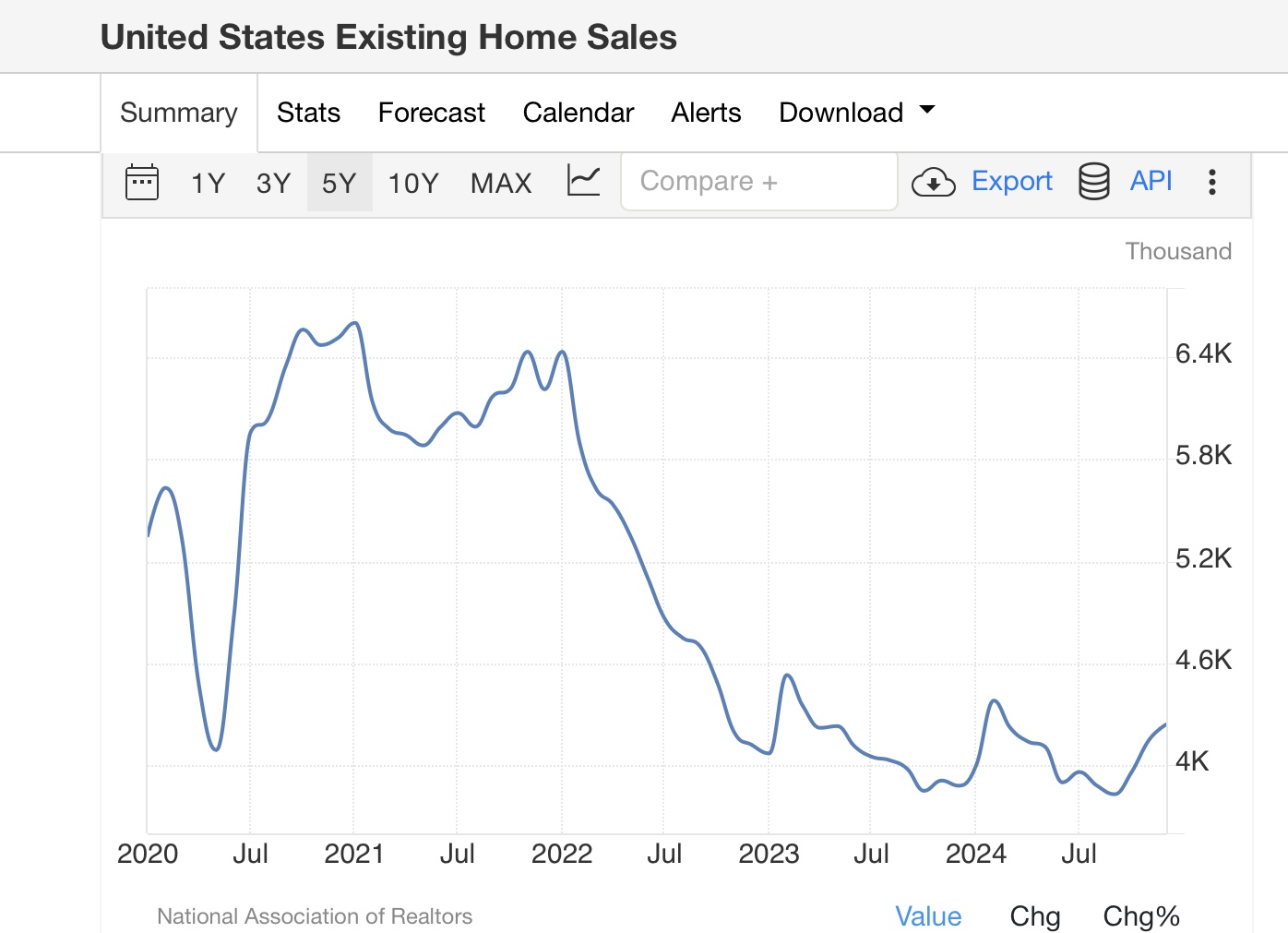
Because prices generally follow sales, and in the past few months existing home sales have risen close to the upper limit of their range in the past 2 years, as per the updated graph below:


An open question is whether the increased price pressure in the existing home market that we saw in the December report earlier this week will persist. If the FHFA and Case Shiller Indexes stabilize near the recent YoY levels, then the trend of slowly abating shelter inflation in the CPI may slow even further.


Monday, January 27, 2025

In December, the theme for new homes was “steady as she goes” in sales, price, and inventory trends


 - by New Deal democrat


To reiterate my theme from the past few months, Ive been looking at new and existing home sales more in tandem, with a rebalancing of the market in mind. For that to happen we need price to abate in existing homes, to compete with new houses where prices have been slightly declining for over a year. Along with that, we should see inventory of existing homes increasing, reflecting softness in that market. This morning’s report on new home sales in December continued that metric.

As usual, let me start with the caveat that new home sales are very noisy and heavily revised, which is why I usually compare them with single family permits, which lag slightly but are much less noisy.

In December new home sales rose to 698,000 annualized, about average for the past 12 months. The below graph shows the last seven years, to put the number in wider context. Except for the surge in 2021 when we had 3% mortgage rates, the 2024 average was on par with the best levels during the long expansion prior to the pandemic:


Housing permits have also been relatively stable in 2024, and probably will remain so for a few months more.


Sales lead prices, which are best viewed in a YoY% comparison. The below graph shows sales, single family permits, and median prices of new homes in that format:


You can see that prices followed sales higher with about a 12 month lag, and settled in to a slightly declining trend with a similar delay. As shown in the graph, on a YoY basis in December, the median price of a new home was 2.1% lower than it was one year ago. But as the below graph of non-seasonally adjusted prices shows over the past several years, the slightly declining trend is intact:


Finally, the inventory of new houses made yet another 15+ year high in December. This is actually “good” news for the moment because as the below long term historical graph shows, recessions have in the past happened after not just sales decline, but the inventory of new homes for sale - which also consistently lag - also decline (as builders pull back):


In sum, December was a “steady as she goes” month for new home sales, with the recent trends in prices and inventory also continuing. Because mortgage rates increased back to 7% in the past several months, I am expecting at least a slight pullback in the next couple of months.


The other fly in the ointment to the rebalancing scenario is that, as I reported last week, sales of existing homes increased in the past several months, and perhaps more importantly, YoY price increases have been accelerating. 

In other words, while the economic news is “good,” in terms of housing being affordable for average Americans, the sector is still out coming up short.

Saturday, January 25, 2025

Weekly Indicators for January 20 - 24 at Seeking Alpha


 - by New Deal democrat


My “Weekly Indicators” post is up at Seeking Alpha.

Seasonality continues to be an important issue in dealing with high frequency indicators - this time because the observance of MLK Day was moved into the following week compared with last year. That’s one of the trade offs you have to make to get data very quickly.

Nevertheless, while the long leading indicators continue to be problematic, the short term and coincident indicators most emphatically are not.

As usual, clicking over and reading will bring you up to the virtual moment, and reward me with a little pocket change for my efforts.

Friday, January 24, 2025

Sales, prices, and inventory in existing home market all up YoY in December


 - by New Deal democrat


There was some tepid good news as to existing home sales in December, which have been flat in the general range of 3.85 -4.10 million annualized for almost two years. Three months ago they made a 10+ year record low of 3.83 million. They have increased in each month since, and in December they rose to 424.4 million annualized, a 9 month high:


This is likely secondary to the relatively low mortgage rates we saw several months ago in September.


The bad news is that the moderation in the YoY% change in prices from the earlier this year has reversed in the past several month, and in December was up 6.0% (below graph shows non-seasonally adjusted data):


On a YoY basis, in response to the longer term decline in inventory, existing home prices have risen consistently since 2014, and accelerated during the COVID shutdowns. After briefly turning negative YoY in early 2023, troughing at -3.0% in May, comparisons accelerated almost relentlessly to a YoY peak of 5.8% in May of this year. Thereafter the YoY% comparisons declined to 2.9% in September, but here the comparisons since:

October 4.0%
November 4.7%
December 6.0%


Finally, while inventory declined seasonally in December (along with January, typically the lowest level of the year) to 1.15 million, it is the highest inventory for that month since 2019 (note: December data is not shown):


This contrasts with the low of 880,000 in December 2021, vs. the best December level in the past 10 years of 1.86 million in 2014.

In summary, on a non-seasonally adjusted basis sales, prices, and inventory were all up from one year ago. This tells us that the market is continuing to slowly recover from the pandemic collapse, but the re-acceleration of YoY price growth indicates that the now-chronic overall shortage of supply in the housing market continues.


Thursday, January 23, 2025

Jobless claims: seasonality and neutrality continue


 - by New Deal democrat


The week’s first meaningful data is jobless claims. These have been trending higher YoY, but with lots of seasonal noise. And that trend continued this week.


Initial claims increased 6,000 to 223,000. The four week moving average (especially more important right now to filter out seasonal noise) increased 750 to 213,500. With the typical one week lag, continuing claims increased 46,000 to 1.899 million:


Th unresolved seasonality in the adjustments for the past couple of years really stands out right now, as we see claims rising from year end lows towards summer peaks, and then back to year end lows in both of the last two years.

Also because of seasonality (in this case having to do with the week in which MLK day is observed), YoY comparisons have added importance, in addition to their being the basis for forecasting. So measured, initial claims were up 0.9%, the four week average up 5.3%, and continuing claims up 3.8%:


This continued the nearly 5 month string of higher YoY comparisons. But since we don’t even get to yellow flag territory until the comparisons hit 10%, these continue to qualify as neutral readings, consistent with a tepid but growing economy.

Finally, let’s take a look at what this might mean for the unemployment rate when January’s jobs report comes out:


Note that I’ve changed this format slightly this week, by including the total of initial + continuing claims in gold, since the unemployment rolls include people looking for work on both new and continuing basis. Also the unemployment rate data is rendered as the % change in a %. Since in the months around one year ago the unemployment rate averaged 3.8%, this suggests that it ought to be tending towards a 5% increase in that, i.e., 2.8 * 1.05 = 4.0% approximately. In December the unemployment rate was 4.1%, so this suggests it should tend slightly lower, leaving aside any continuing upward pressure from new immigrants seeking employment.

Wednesday, January 22, 2025

The new Administration and the return to an Inflationary Era


 - by New Deal democrat


I don’t normally discuss movements in the stock and bond markets, but occasionally there are important paradigm shifts that can tell us a lot about the economy, and the last few months have been one of those times.

The Federal Reserve began to cut interest rates on September 18th. What is instructive is what has happened with bond yields, and the comparative moves in stock prices, since.

The 10 year Treasury bond (dark blue) made a low of 3.63% on September 16. In the below graph, I norm that value to 0, and similarly norm yields on 2 year (light blue), 1 year (gray), 6 month (gold), and 3 month (red) Treasurys, so that their trends before and after that inflection point are apparent:


Interest rates were generally trending down across the spectrum in the five months before September, as signs of economic weakness, particularly in several summer jobs reports, worried investors that the Fed had kept rates high for too long, and needed to start cutting them to boost the economy. 

But what is interesting is what happened since. While the very short maturities followed the Fed rate cuts lower, from the 1 year maturity out, bond yields *rose.* This tells us that in the aggregate, bond investors believed that either the Fed’s rate cutting regimen would be short lived, and/or that inflation would increase. This is referred to in bond trader circles as a “bearish steepening.” In other words, the bond yield curve un-inverted, but did so mainly because longer term rates rose - meaning that things like mortgage rates would also increase.

Which brings us to the stock market. Below I compare yields on the 10 year Treasury to stock prices as measured by the S&P Index for the past five years:


Sometimes the two move in tandem, and sometimes they move in opposite directions. In the immediate post-pandemic aftermath, yields and prices rose together, consistent with an expanding economy. In 2022, as most investors and analysts became nervous that a recession was near (triggered in no small measure by the inversion of the bond yield curve), prices fell even as yields increased in response to Fed rate hikes. In 2023 and earlier in 2024, as fears abated and the “soft landing” scenario took hold, once again prices and yields moved in the same direction.

Now let me focus on the past ten months:


Except for the brief period between the first rate cut and the Election, where both metrics moved in sync along with economic optimism, prices and yields have moved in opposite directions again. In the period between April and September, that was because there was increasing worry that a “hard” landing was in store. 

But the second period began within two days after the Presidential Election in November. At first stock prices rose on economic optimism, while bond yields fell. But stock prices peaked almost immediately, with even the December highs only being only 1.5% above their level on November 11. And bond prices have moved almost relentlessly higher, including to new 12 month highs this month. This is much less likely about future Fed behavior than about inflationary policies likely to be in store from the new Administration.

Long term trends back up this inflationary concern. Bond yields tend to move in very long cycles, equivalent to more or less one human lifespan (or “saeculum”), suggesting the old adage that as lived history is forgotten, old dangers are renewed.

Here is the history of long term bond yields from 1920 to 1980:


After slowly declining from 1920 to 1940, beginning in the 1950s bond yields increased for 30 years, as inflation slowly, and then more quickly, took root.

Now here is the same graph since 1981:


Bond yields declined for a long period, coinciding with disinflation and then even concerns about outright deflation. That period appears to have abruptly ended with the pandemic. 

All the signs are that we have begun a new inflationary era in which bond yields are likely to continue to generally rise. And all the signs are that the policies of the new Administration are going to contribute to that.

Tuesday, January 21, 2025

The economic reasons why the Democrats lost in 2024


 - by New Deal democrat


There is no significant economic news until Thursday. In the meantime, today and tomorrow let me discuss a couple of issues at the intersection of economics and politics.

The 2024 Presidential election was one of the closest popular vote margin for the winning candidate, at 1.5%, since Richard Nixon’s 0.7% margin in 1968. (Note: I’m leaving aside 2000 and 2016, where the winning candidate actually lost the popular vote). In such a case, the reasons one can assign for the victory of one candidate over another are myriad. My analysis below is of the economic issues. That is by no means saying that issues in other dimensions, such as the situation in the Gaza Strip, or racism or sexism did not play a role, or misinformation and disinformation flooding the zone via various tradition and social media controlled by right wing billionaires.

First, I have read a number of analyses lamenting the rightward shift in the vote by people under 30, and in particular men under 30. For the past year, when I have weighed in on the topic, I have insistently harped on the issue of housing costs.

Young people in their 20s move out of their childhood homes, rent apartments, and usually are saving for or buying their first home. And at no time in the past 40 years was the situation facing such young renters and buyers more unfavorable.

Since the beginning of 2021, house prices rose 37.5% according to the FHFA. Meanwhile mortgage rates rose from 3% to 7%. Here is what those prices and mortgage payments look like graphically:


Not only did potential buyers have to come up with a 35% bigger down payment, but their monthly mortgage payment on average rose from about $1000 to $2300.

As a result, the index of Housing Affordability fell to lows it had not seen since the early 1980s:


Needless to say, these prices rose much more than median family income:


Renters did not escape unscathed either. Measured from January 2021, average rents increased about 3% more than wages:


Had I measured from the expiration of COVID rent increase moratoriums, the shortfall would be more than 6%.

Given the sharp deterioration in their housing prospects, is it any wonder that more young people might have turned away from the party in power?

Secondly and more broadly, a trope on progressive sites has been that in addition to an excellent job market, wages did in fact go up faster than inflation. But that’s not nearly as dispositive as those writers thought it was. 

To begin with, I suspect there was an important behavioral econ aspect to why so many people felt that the economy was doing poorly during Biden’s term.  I don’t have graphs, but consider the following two scenarios:

1. Over 4 years, prices rise 8% (2% per year), while wages rise 10%
2. Over 4 years, prices rise 28% (7% per year), while wages rise 30%.

In both cases real wages have risen 2%.

I have little doubt that a majority of people would feel that their well being is much worse under scenario #2 than scenario #1.  Because in scenario #1, their perception would probably be that their wages increased, while prices remained basically stable. But in scenario #2 their perception would be that inflation was very bad, and their wages barely kept up.

But even that doesn’t completely explain the poor feeling many people had about their economic situation. Because wage increases aren’t uniform. Obviously some people make out better than average, and others worse than average.

A good way to show that is via the Atlanta Fed’s wage tracker, which contrasts wage increases obtained by job stayers vs. job switchers. Here’s what that looks like over the past 25 years:


The divergence between the wages earned by job switchers vs. stayers was at its all time high in 2022-23. Job stayers made out much better that inflation in real terms, while job stayers did not keep up. Cumulatively through December 2024, during Biden’s term the wages of job stayers rose on average 20.2%, while CPI rose 21.0%. And remember, many of those job stayers made out worse than that average.

Another way to look at this is to compare real average wages vs. the employment cost index for wages. The big difference between the two is that the latter norms for the type of job. In other words, if there was a switch from being employed in food and drink services to construction during the time period, that change in job mix would show up in average wages. But the employment cost index would compare food and drink servers at the beginning and end of the peiod, and contruction workers at the beginning and end of the period.

Here’s what those two measures look like for Biden’s term:


Real average nonsupervisory wages were up close to 1% at the end of last year vs. the beginning of 2021, while wages normed by the type of industry were *down* by almost 2%. And job stayers are all in that second category.

To reiterate, I am not saying that economics was the sole, or necessarily even the primary reason why the Democrats lost the Presidential election. But there were solid economic reasons why a substantial share of potential voters might decide to vote against the incumbent party.

Monday, January 20, 2025

Joe Biden: the last Institutionalist president


 - by New Deal democrat


Over 5 years ago, I took a look at the 500 year history of the Roman Republic. In my penultimate discussion of its downfall, I wrote:


“By 78 BC the Republic was dead on its feet. Virtually all of its norms of office-holding had been swept away. Political mobs using violence to get their way had become chronic. Even worse from a long-term point of view, prominent politicians of wealth were raising private armies that they themselves paid, and whose loyalty was to them rather than to the Republic, culminating in 3 separate military marches on Rome in short-lived dictatorships.”

The title of this post is not because there will not be future Institutionalist politicians, but because by four years from now I believe those Institutions will similarly be “dead on their feet,” understood to be hollowed out forms that have proven themselves unable to withstand raw power grabs. While Biden had a number of impressive policy triumphs, I believe it is his ultimate complacency about American “norms” that will be his legacy.

Last week Qasim Rashid wrote:
“Here’s a harsh truth. [Biden] ran in 2020 on the promises to ‘save the soul of America’ and to ‘protect American democracy. …. Now as he leaves office, white supremacy and Christian nationalism ar the official policies of a fascist returning to the White House with full control of the House, Senate, and SCOTUS. The harsh truth is Biden failed his promises.”

Let’s leave aside the outline of Trump’s policies, and any assignment of fault to Joe Biden. The simple *fact* is that the ultimate *outcome* of Biden’s Presidency has been that the American “soul” has not been saved, and “American democracy” has not been protected.

At the beginning of his term in office, Joe Biden had a choice: he could either emphasize playing hardball going after the myriad transgressions of Donald Trump and his allies during his Presidency, or he could emphasize restoring the prior norms and “guardrails” that historically allowed the American Republic to function. He chose the latter. 

That choice was epitomized by the choice of Merrick Garland as Attorney General. In his farewell speech last week, Garland said “It is the obligation of each of us to follow our norms, not only when it is easy, but also when it is hard, especially when it is hard …. and especially when the circumstances we face are not normal.” Voting rights attorney Marc Elias said of that speech, “From start to finish, he brought norms to a Trump fight and democracy suffered.”

The next four years are likely to demolish what is left of the “guardrails” upholding the Republic. The next liberal President, presuming there is one, will almost certainly not make that same choice.

As I wrote above, Biden had a number of impressive policy achievements, including the emergency stimulus in 2021 and the Inflation Reduction Act that has been responsible for so much infrastructure spending. Among other things, antitrust law was re-invigorated, skyrocketing prescription costs were brought to heel, “junk fees” were outlawed, labor rights were expanded, renewable energy sources were promoted, marijuana regulations were loosened, many steps were taken to ease student debt, and industrial re-shoring was robustly undertaken. Child poverty was temporarily cut in half during the life of the 2021 economic stimulus. And he ended the war in Afghanistan. And all of this was done with razor thin House and Senate majorities.

But if he may have accomplished more socially progressive goals than any other President in the past 50 years, including Barack Obama, how many Americans - and more specifically how many voters - knew of those accomplishments in November 2024?

Eight years ago, assaying his Presidency, I wrote that Barack Obama was “a noble failure,” because even though he had several important domestic policy achievements - domestically the 2009 emergency stimulus package, the ACA, and his “evolution” on gay marriage, and in foreign policy the agreement with Iran to stop working towards a nuclear bomb, and generally improving the attitude of our allies towards the US - he had failed to sell those accomplishments to the American public, and there was every indication that Trump intended to dismantle them all. Successful Presidents, I argued, did not suffer immediate reversals of all their policy achievements, especially when much of that reversal was their failure to make their own case.

As I read that piece, I realized that much the same critique could be made of Joe Biden’s Presidency. Because just as with Barack Obama, Joe Biden failed to sell his accomplishments to the American public.

Emblematic of that failure is the contrast between Trump’s COVID stimulus payments in 2020 and Biden’s in 2021. The former arrived as a check signed by Trump; the latter were digitally deposited with no hint of who had authorized them in bank or investment accounts. 

Last week in his last interview, Biden told Lawrence O’Donnell that a key regret from his presidency was not taking enough credit for his Administration’s accomplishments, saying:

 “The mistake we made was — I think I made — was not getting our allies to acknowledge that the Democrats did this. So, for example, building a new billion-dollar bridge over the river, we’ll call it the ‘Democratic Bridge,’ figuratively speaking,” Biden said in an interview that aired Thursday with MSNBC’s Lawrence O’Donnell, his final TV sit-down before he leaves office. “Talk about who put it together. Let people know that this was something the Democrats did, that it was done by the party. That’s different than me writing a check and me signing a check and saying I did it.”

“I’m not a very good huckster. I mean, and that – it wasn’t a stupid thing for him to do. It helped him a lot. And it undermined our ability to convince people that we were the ones that were getting this to them,” Biden said. “And so – but I don’t think – ironically, I almost spent too much time on the policy and not enough time on the politics, because, I mean, you have some senators in Congress, Democratic senators in Congress saying, ‘Well, you know, Joe Biden did this, and this is done by so and so and so and so, and this is a – the “new built by the Democratic Party” kind of thing.’”

Biden seemed to think that touting his own accomplishments was unseemly. Like Obama, he seemed to think that his accomplishments would sell themselves. And like with Obama, they did not.

In summary, Biden deserves sterling praise for all of his accomplishments, but his fundamental complacency about norms - whether it was making sure people knew about those accomplishments, or making sure that the leaders of the attempted coup of January 6, 2021 were quickly, vigorously, and resolutely brought to justice - has proven decisive. After four full years there has been an utter failure for justice to be finally rendered for that event. Either the Institutionalists failed to move with sufficient vigor, or else the Institutions themselves - most especially, the Institution of the court system generally and of the Supreme Court itself - were not able to rise up to the task. There is no third choice.

The American Project - fundamentally, the Republic that was established in 1789 - was about the Rule of Law, with checks and balances so that there was no King, and citizens could rely upon the rules being applicable to all and enforced equally. As of January 20, 2025, that Republic is also dead on its feet. There will be no return to the previous norms which allowed it to operate. I am sure there will be elections in 2026 and again in 2028, but whether those - or any others for the foreseeable future - will be in any way conducted in obedience to pre-existing rules agreed upon by all parties is an the results of those elections accepted broadly, is doubtful to say the least. The historical Institutions that Joe Biden sought to uphold have been fatally wounded. And for that reason Joe Biden was the last Institutionalist President.

Addendum: In case it isn’t clear from the above, I fully expect all of the forms of the Institutions to continue to exist in 2028 and beyond. Indeed the Roman Senate continued to exist and meet not just during the Empire, but even for a short while after the last Western Emperor was captured and exiled. But just as Julius Caesar said of the Roman Republic - “The Republic is nothing, a mere name without body or form.” - I expect most people will recognize that the forms are on the order of those we have in the past typically derided as banana republics.