Saturday, September 14, 2024

Weekly Indicators for September 9 - 13 at Seeking Alpha


 - by New Deal democrat


My “Weekly Indicators” post is up at Seeking Alpha.


The imminent likelihood of a Fed rate cut has continued to drive rates down to new 12 month lows (which is good for things like mortgages in particular). Meanwhile consumer spending as measured weekly is also near 12 month highs, which is also very good.

As usual, clicking over and reading will bring you up to the virtual moment as to all the categories of economic data, and put a little lunch money in my pocket for organizing and presenting it to you.

Friday, September 13, 2024

UPDATE: Real median household income for < sigh > 2023


 - by New Deal democrat


I’m a little late to this, since FRED took its time updating, but the annual report of median household income for the US was released on Tuesday for 2023. 


This is an important statistic about the well being of, well, the median American household, so one of my pet peeves is that it is only released annually, and with a 9 month delay at that. So Tuesday’s release tells us about where an important metric was about 18 months ago. Yeah, that’s a problem in my book.

In any even, median household income rose a hair under 4.0% in 2023, to a level only exceeded - by 0.7% - in 2019:


That compares very favorably with the average annual gain in the previous 10 years which was 0.7%. On an annual basis, it was only exceeded by 2015 and 2019 in the previous 10 years.

I really wish the Census Bureau would update this statistic at least quarterly, since it is based on the monthly employment report. But since it doesn’t several private research companies have estimated it on their own. Most recently, the mantle has been taken up by Motio Research, which I have highlighted in several previous posts. Here’s their most recent update:


To see how accurate they were in real time, I went back and compared their monthly 2022 and 2023 updates with the official figures. On an average basis, they had real median household *declining* -0.1% in 2023 YoY. But they had 2022 and 2023 exceeding 2019 by 1.6% and 1.5%, respectively. Even on a year-end vs. year-end basis, they only had 2023 exceeding 2022 by 0.9%.

Obviously the private estimates have been missing the mark.

But stay tuned, one year from now we will find out how well households made out this year.

Thursday, September 12, 2024

Initial claims still positive, moving into very challenging YoY comparisons (plus a note about the PPI)


 - by New Deal democrat


If residual post-pandemic seasonality has been affecting jobless claims statistics, the real acid test is going to begin next week, as for the next 7+ months, any number higher than 220,000 is almost always going to be higher than one year ago.


In the meantime, for this our last week of the seasonal downtrend, initial jobless claims rose 2,000 to 230,000. The four week moving average rose 750 to 230,750. Continuing claims, with the typical one week delay, rose 5,000 to 1.850 million:


Turning to the more important YoY comparisons for forecasting purposes, initial claims were unchanged, the four week moving average was down -0.8%, and continuing claims were higher by 2.2%:


This YoY comparison for continuing claims was the lowest in the past 1.5 years.

Needless to say, these are all positive results which forecast continued economic expansion in the next few months.

Since we are only one week into September, there is not much to say about the implications for the unemployment rate in next month’s report, but here is the updated graph:


Finally, a quick note about the producer price index which was also released this morning. Like employment, goods prices are far more volatile than prices for services, which tend to rise throughout good times and bad. Here is the YoY% look at each:


PPI for services YoY is higher by 2.6%, about average for the past 10 years. For goods it is unchanged YoY, which is not uncommon and is generally a good thing for downstream consumer inflation. On a monthly basis, PPI for goods was also unchanged; for services it rose 0.4%.

Perhaps more significant is that raw commodity prices fell -0.7% in August, and on a YoY basis are down -0.8%:


Such a decline more often than not telegraphs present or short term weakness, but also is a positive coming out of recessions.

An important consideration, therefore, is whether this weakness is a supply side issue (e.g., lower gas prices) or a demand issue (weak global demand at the producer level). 

Both of these may be in play at present. On the one hand, oil prices declined in the past month to the low end of their last two year range. On the other, it appears that China has begun a genuine deflationary spiral, as not only have consumer prices declined there, but there is evidence that in at least some sectors wages have declined as well. This is definitely not good for China, but it may be a boon to the US, since we mainly benefit from the lower prices that are likely to make their way through to consumers without any negative effect on wages. An interesting global situation, with all that implies.

Wednesday, September 11, 2024

August CPI: further important progress towards 2% YoY level, marred (only) by a surprise uptick in shelter


 - by New Deal democrat


August CPI, with the conspicuous exception of shelter, continued to come in tame. And the list of other “problem children” decreased by 1, as only food away from home (restaurants) and transportation services (motor vehicle insurance and repairs) remain.

Let’s get the headlines out of the way:
 - Headline CPI continued increased 0.2% for the month, and decelerated to 2.6% YoY, its best showing since February of 2021. 
 - energy inflation remains non-existent
- there was no inflation at all excluding shelter, as prices were unchanged, and are up 1.1% YoY, the 16th month in a row the YoY change has been below 2.5%.
 - shelter inflation was the only negative surprise, as it remained very elevated, up 0.5% for the month and 5.2% YoY, the highest YoY change in three months.
- core inflation, which includes shelter but excludes gas and food, therefore remained elevated, up 0.3% for the months and 3.2% YoY.

Let’s break this down graphically to better show the trends.

Here are headline (blue), core (red), and ex-shelter (gold) inflation YoY:


To repeat what I have said for months, the only reason for the Fed not to treat inflation as well within its target zone is shelter.

Turning to the big remaining issue of shelter, the upside surprise appears to be due to an upward spike in owners equivalent rent (red), which spiked higher by 0.5% in the month, vs. actual rent (blue), which increased 0.37%, and so was rounded up to 0.4%:


As a result, shelter on a YoY basis increased YoY, here shown vs. the FHFA Index YoY (blue), which has rolled back over:


This was an unpleasant surprise, but may be a quirk of unresolved post-pandemic seasonality or a one-month wonder, as the leading indicators for shelter inflation all continue to point towards continued deceleration.

With gas prices down for the month, energy showed -0.8% *deflation* and is down -4.0% YoY:


The former problem children of new (dark blue) and used (light blue) vehicle prices were unchanged and down -1.0% for the month, are are down -1.8% and -10.4% YoY respectively (shown as the change since right before the pandemic, below). I also show average hourly nonsupervisory wages (red) for comparison, showing that wage growth has actually outpaced vehicle prices (meaning the remaining problem there is interest rates for financing):


Note that used vehicle prices have given back over 50% of their post-pandemic gain.

Electricity (gold) also ended its run as one of the remaining problem children, as it declined -0.7% for the month and is up 3.9% YoY. That leaves food away from home (blue), up 0.3% and transportation services including vehicle maintenance, repair, and insurance (red), up 0.9%. On a YoY basis they remain up 4.0%, and 7.9% respectively, although even those two items are trending downward:


As I have previously pointed out, the last item is a typical delayed reaction to the previous big increase in vehicle prices.

Finally, the CPI release allows me to update the very important metric of real aggregate nonsupervisory payrolls, which once again made a new record high:


Ordinary workers have more spending money, in real terms, than they have ever had before. There has *never* been a recession without that turning down first.

In conclusion, the Fed has really had all the ammunition it has needed to cut interest rates for months. With the sharp YoY deceleration in the headline rate in August, it has even more. If we remove shelter from the core index, that too is only up 1.8% YoY. The outstanding question is whether the Fed has waited too long, and a recession will occur before lower interest rates turn around the now-tepid labor market.

Monday, September 9, 2024

Leading indicators from Friday’s jobs report: not too bad, not bad at all


 - by New Deal democrat


There’s no big economic news today or tomorrow, so let’s take a more detailed look at the leading indicators from Friday’s jobs report. It turns out, the news wasn’t nearly as bad as the headline employment number.


Let’s start with the negative stuff. The simple story is, manufacturing is in a funk. Employment in manufacturing declined -24,000, which is tied for a two year low. Meanwhile, trucking employment declined -1,400  (in the graph below, both numbers are normed to 100 as of their post-pandemic peak):


The big decline in trucking last August was the Yellow Trucking bankruptcy. What is interesting is not only that other firms did not pick up any apparent slack, but that employment has declined again back to that low.

Manufacturing, and the trucking transportation used to deliver those goods, are both leading sectors, although the former in particular is less important than it was before the turn of the Millennium (hello, normalized trade with China).

But if manufacturing was bad news, the other leading sector of construction employment, including total (dark red), residential (light red), and nonresidential (gold) all continued to increase:


And not even all news from the manufacturing sector was bad, as average weekly hours - one of the 10 “official” leading economic indicators - increased 0.1 hour:


After a steep decline from late 2021 through early 2023, the manufacturing workweek has stabilized for over a year. Although I won’t put up the graph, there is evidence that since the 1980s, an important inflection point is the 40.5 hours level. Above that, a decline has usually meant only a slowdown, not a contraction. And as you can see, we are above that level.

Both manufacturing and construction are components of the goods-production sector of the economy, and that headline number also continued to increase, albeit more slowly than before:


I would expect total goods-producing jobs to turn down before any recession begins (because services employment almost never turns down except late in deep recessions).

Turning back to some negative news, consistent with the general trend in the unemployment rate, the number of short term employed (blue) rose to a new 2+ year high last month. Because people file for unemployment after they get laid off, I also include the monthly average for initial jobless claims (red). Both series are normed to their post-pandemic lows. In the case of short term unemployment, I have used the 3 month average because the series is so noisy:


Here is the historical comparison of each. Initial claims are more volatile on a cyclical basis, but the trend is much less noisy in the shorter term, making them a much better short leading indicator:


As I have been noting consistently every week, jobless claims, unlike the unemployment rate, are *not* forecasting any recession.

Finally, although most of the revisions to June and July were negative, that wasn’t the case with one of my favorite fundamentals-based leading indicators, real aggregate nonsupervisory payrolls. July’s reading was revised upward, meaning we set yet another record:


On Friday we found out that *nominal* aggregate payrolls increased 0.4% in August. Barring the very unlikely event of a nasty upside surprise in consumer inflation on Wednesday, we set another record for real aggregate payrolls in August as well.

Basically, outside of the manufacturing sector, the leading elements of employment remain positive and forecast continued growth through the end of this year.

Saturday, September 7, 2024

Weekly Indicators for September 2 - 6 at Seeking Alpha


 - by New Deal democrat


My “Weekly Indicators” post is up at Seeking Alpha.

In the wake of yesterday’s weak jobs report, bond yields and mortgage rates declined to 12 month+ lows, commodities declined across the board, stocks sold off sharply, and the 10 year to 2 year Treasury spread un-inverted.

That’s bad news and good news. It’s bad news because it indicates a belief that the economy has weakened substantially, but good news because lower rates will enable increased activity out in the future.

As usual, clicking over and reading will bring you up to the virtual moment as to the economic data, and reward me with a little lunch money for collating and organizing the data for you.

Friday, September 6, 2024

August jobs report: for the first time, including revisions, more consistent with a hard landing


 - by New Deal democrat


My focus continues to be on whether jobs gains are most consistent with a “soft landing,” i.e., no further deterioration, or whether there is further decline towards a recession. 

For a change, this month the Establishment report was the weakest in several years, if still positive. Meanwhile the Household report rebounded for the month, but now shows an absolute decline in job holders YoY.

Below is my in depth synopsis.


HEADLINES:
  • 142,000 jobs added. Private sector jobs increased 118,000. Government jobs increased by 24,000. 
  • There were big downward revisions to the last two months. June was revised downward by -61,000, and July was revised downward by -25,000, for a net decline of -86,000. This continues the pattern from nearly every month in the past 18 months of a steady drumbeat of downward net revisions.
  • The alternate, and more volatile measure in the household report, showed an increase of 168,000 jobs. On a YoY basis, however, this series has now actually *declined* by -66,000 jobs. With the sole exception of 1952 and one month in 1957, this has always and only occurred shortly before or during recessions.
  • The U3 unemployment rate declined -0.1% to 4.2%, but the “Sahm rule” recession indicator Is still in effect.
  • The U6 underemployment rate rose 0.1% to 7.9%, 1.5% above its low of December 2022.
  • Further out on the spectrum, those who are not in the labor force but want a job now rose another 37,000 to 5.637 million, vs. its post-pandemic low of 4.925 million in early 2023.

Leading employment indicators of a slowdown or recession

These are leading sectors for the economy overall, and help us gauge how much the post-pandemic employment boom is shading towards a downturn. Outside of construction, all of the rest were flat or negative.
  • the average manufacturing workweek, one of the 10 components of the Index of Leading Indicators, increased 0.1 hours to 40.7 hours, but is down -0.8 hours from its February 2022 peak of 41.5 hours.
  • Manufacturing jobs declined -24,000.
  • Within that sector, motor vehicle manufacturing jobs increased 2,500. 
  • Truck driving declilned -1,400.
  • Construction jobs increased 34,000.
  • Residential construction jobs, which are even more leading, rose by 4,800 to another new post-pandemic high.
  • Goods producing jobs as a whole rose 10,000 to another new expansion high. These should decline before any recession occurs. *BUT* these are only up 0.9% YoY, the lowest such increase since the pandemic shutdowns, thus showing clear signs of deceleration.
  • Temporary jobs, which have generally been declining late 2022, fell by another -2,900, and are down about -500,000 since their peak in March 2022. This appears to be not just cyclical, but a secular change in trend.
  • the number of people unemployed for 5 weeks or fewer rose 117,000 to 2,468,000.

Wages of non-managerial workers
  • Average Hourly Earnings for Production and Nonsupervisory Personnel increased $.11, or +0.4%, to $30.27, for a YoY gain of +4.1%. This is an increase from 3.8% YoY growth last month, but the longer term trend continues to be deceleration from their post pandemic peak of 7.0% in March 2022. Importantly, this is significantly higher than the 2.9% YoY inflation rate as of last month.

Aggregate hours and wages: 
  • the index of aggregate hours worked for non-managerial workers increased 0.1%, and is up 1.2% YoY, in trend for the past 12+ months.
  •  the index of aggregate payrolls for non-managerial workers was rose 0.4%, and is up 5.3% YoY. These have been slowly decelerating since the end of the pandemic lockdowns, but have remained almost steady for the past 9 months. With the latest YoY consumer inflation reading of 2.9%, this remains powerful evidence that average working families have continued to see gains in “real” spending money.

Other significant data:
  • Professional and business employment rose 8,000. These tend to be well-paying jobs. This series had generally been declining since May 2023, but earlier this year had resumed increasing again. As of this month, they are only higher YoY by 0.5% - a very low increase that has *only* happened in the past 80+ years immediately before, during, or after recessions.
  • The employment population ratio remained steady at 60.0%, vs. 61.1% in February 2020.
  • The Labor Force Participation Rate also remained steady at 62.7%, vs. 63.4% in February 2020. The prime 25-54 age  participation rate declilned -0.1% from84.0%, the highest rate during the entire history of this series except for the late 1990s tech boom, to 83.9%.


SUMMARY

This month confirmed a significant further downshift in job creation. From 2020 through this past March, the lowest monthly job gains were 136,000 in December 2022, which was the *only* month during that period below this month’s 142,000. But since then, four of the five last months were below 150,000. In addition to this month, April showed 108,000 job gains, June as revised 118,000, and July 89,000. This is just barely enough to keep up with population growth. Further, as indicated the Household report (which has probably underestimated immigration substantially) now shows an absolute decline YoY.

The best news was the continued growth in nonsupervisory payrolls, which after inflation for August is reported will almost certainly show another all-time high. It is unheard of for a recession to happen while real aggregate payrolls for average workers are still growing. That the leading construction sector, and goods production as a whole, continued to show growth also are pluses, and negative any imminent recession.

But manufacturing seems at long last to have rolled over, with the lowest reading in almost two years except for one month in 2023, despite the slight increase in the manufacturing workweek. 

Along with the big downward revisions to the last several months, this month’s report is the first time that there is substantial evidence that the jobs market may have moved past a “soft landing” into a hard slowdown that could easily tip over into outright declines by the end of the year. This adds to the evidence that the Fed has been behind the curve, and needs to cut rates, perhaps aggressively, beginning asap. 

Thursday, September 5, 2024

Economically weighted ISM indexes show an economy on the very cusp of - but not in - contraction


 - by New Deal democrat


Recently I have paid much more attention to the ISM services index. That’s because, since the turn of the Millennium, manufacturing’s share of the economy has contracted to the point where even a significant decline in that index has not translated into an economy-wide recession, as for example in 2015-16. 


When we use an economically weighted average of the non-manufacturing index (75%) with the manufacturing index (25%), it has been a much more reliable signal, particularly when we use the 3 month average, requiring it to be below 50. 

Once again this month the contraction shown in the manufacturing index has been more than counterbalanced by continued expansion in the services index, which was reported at 51.5. The more leading new orders subindex (not shown in the graph below) came in stronger, at 53.0:


Here are the last six months, including August, of both the manufacturing (left column) and non-manufacturing index (center column) numbers, and their monthly weighted average (right) :

MAR 50.3. 51.4. 51.1
APR 49.2  49.4.  49.3 
MAY 48.9. 53.8. 52.5
JUN 48.5. 48.8. 48.7
JUL. 46.8. 51.4. 50.2
AUG. 47.2. 51.5  50.4

And here is the same data for the new orders components:

MAR 51.4. 54.4. 53.6
APR 49.1. 52.2. 51.4
MAY 45.4. 54.1. 51.9
JUN. 49.3  47.3. 47.8 
JUL.  47.4. 52.4. 51.2
AUG. 44.6. 53.0. 50.9 

Note that the single month average for both the headline and new orders components showed contraction in June, but it did not trigger a signal based on the three month average. The current three month weighted average of the headline numbers is just below the 50.0 threshold at 49.7, while the new orders component is 49.97, which rounds to 50.0 for purposes of this analysis.

This is right on the cusp of giving a “recession warning” signal. In fact, had the new orders component of the services report been even -0.1 lower, it would have done so. Next month the poor June readings for the new orders subindex in particular go out of the average. It is quite possible that the weakness in the headline number, which is not leading, will pick up as well.

In the end, the economically weighted ISM reports show an economy which is not contracting, but in the aggregate has stalled, with contracting production being just balanced by weakly expanding services. This puts even more weight on what the leading components of the jobs report will show tomorrow.

Jobless claims: all good news


 - by New Deal democrat


The weekly news from jobless claims continues to be good. The hypotheses that the summer increase was unresolved post-pandemic seasonality, plus the several week spike post-Beryl was all about Texas, both have held up very well. And that has continued to be the case against more challenging YoY comparisons as the data heads into September.


Initial claims declined -5,000 last week to 227,000. The four week moving average declined -1,750 to 230,000. Continuing claims, with the usual one week delay, declined -13,000 to 1.838 million:


The two year chart really pays off in showing the unresolved summer seasonality post-pandemic both in 2023 and this year.
On the more important YoY basis for forecasting purposes, initial claims are down -0.4%, the four week average down -3.3%, and continuing claims up only 2.0%, the lowest YoY increase in over 18 months:


Needless to say, all of these forecast that the economic expansion will continue in the next few months.

Finally, let’s look at the unemployment rate, which will be updated tomorrow. Although I won’t show a graph, it appears that the post-Beryl increase in *continuing* claims in Texas has now abated as well. But because it continued into mid-August, it would not surprise me to show up in yet another 0.1% increase in the unemployment rate tomorrow. In any event, here’s the update graph of initial and continuing claims (right scale) vs. the unemployment rate (left scale):


This year the unemployment rate has departed from over 50 years of almost continuous precedent by not following initial claims in particular. What the above graph shows me is that, absent the surge in immigration-related unemployment, the unemployment rate would be trending down towards 3.8%.

Wednesday, September 4, 2024

July JOLTS report: relentless deterioration?


 - by New Deal democrat


The JOLTS survey parses the jobs market on a monthly basis more thoroughly than the headline employment numbers in the jobs report. In July, it painted a picture of what looks like pretty relentless deterioration.

The theme for three of the four data series I track was the same: job openings, hires, and quits, all had their lowest or second lowest readings since the start of 2021. In the case of the “second worst” hires and quits numbers, it was only because last month’s numbers were even lower.

Specifically, job openings (blue in the graph below), a soft statistic that is polluted by imaginary, permanent, and trolling listings, declined 227,000 to 7.623 million. Actual hires (red) rose 273,000 to 5.521 million (vs. a pre-pandemic peak of 6.0 million). Voluntary quits (gold) rose 63,000 to 3.277 million. In the below graph, they are all normed to a level of 100 as of just before the pandemic:


Both hires and quits are significantly below their immediate pre-pandemic readings, by -7.9% and -5.4% respectively.

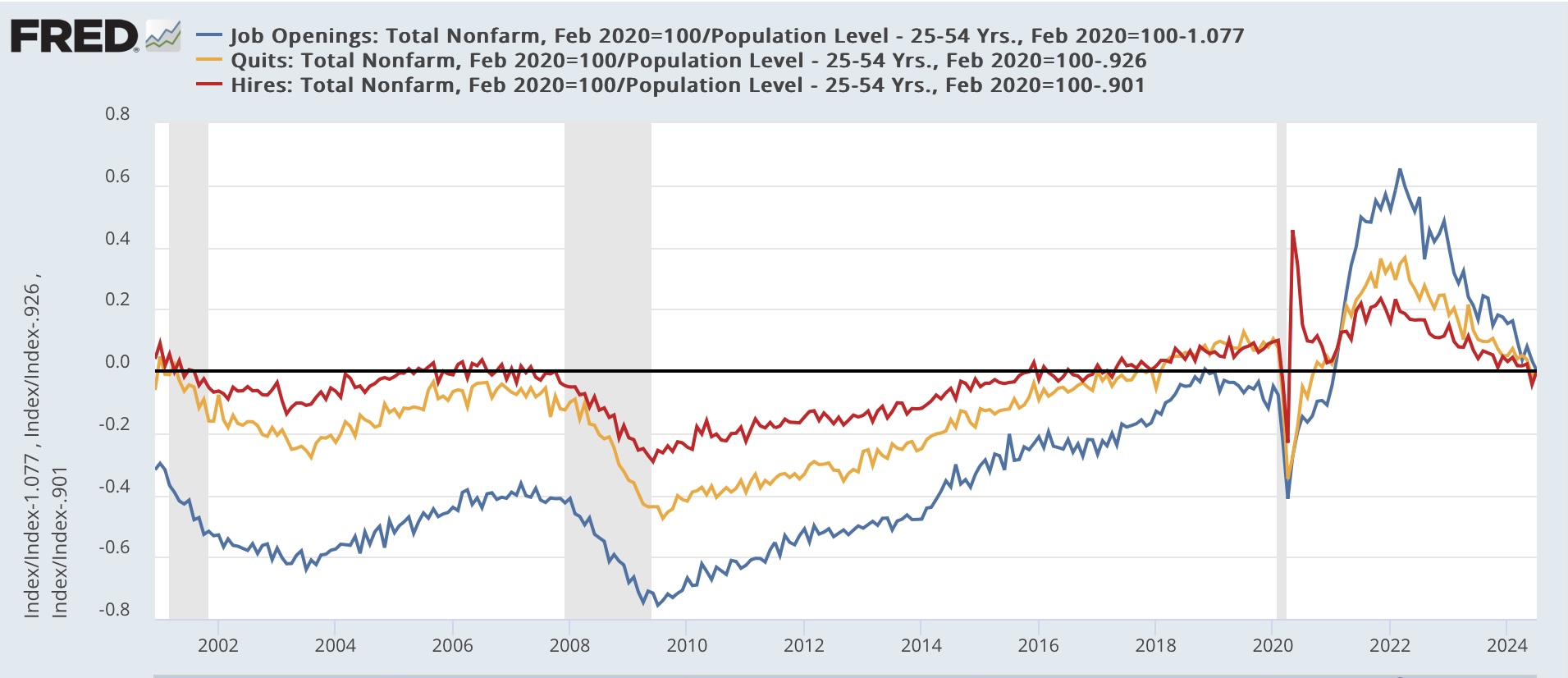
To put them in a wider historical context the below graph shows all three series from their inception in 2001. But because the US population has grown almost 20% since then, I divide by the prime age population over the same time. I have also normed the current values to the zero line to better show the historical comparison:


On the one hand, hires, even on a population adjusted basis, are better than almost any time before the pandemic except 2005-06 and 2017-19. But note they are also at a level equivalent to during the 2001 recession. Quits are better than at any time before the pandemic except for just before the 2001 recession and 2018-19. This suggests to me that the real, “hard data” jobs market is still positive, and not weak by historical standards. It’s just not as strong as we have become accustomed to over the past several years.

Meanwhile, layoffs and discharges increased to their highest level since late 2020 except for several months in early 2023:


The above graph also shows the monthly average of initial jobless claims (red). It appears that layoffs and discharges did pick up the post-pandemic seasonality shown in the  summer increase during May through July.

Finally, the quits rate (blue in the graph below) has a record of being a leading indicator for YoY wage gains (red). For over half a year the quits rate had stabilized. That has no longer been the case in the past two months, as it also is at its lowest point since late 2020:


As you can see above, this forecasts continued deceleration in nominal wage gains, down to 3.5% YoY or even lower in the coming months. Unless consumer inflation moderates further as well, this will put some financial pressure on ordinary workers (not a negative, just significantly less positive).

Tuesday, September 3, 2024

Manufacturing and construction together suggest weak but still expanding leading sectors


 - by New Deal democrat


As usual we start the month with two important reports on the leading sectors of  manufacturing and construction.

First, the ISM manufacturing index showed contraction yet again, with the headline number “less negative” by way of increasing from 46.8 to 47.2, and the more leading new orders subindex declining sharply by -2.8 from 47.4 to 44.6:


Including August, here are the last sis months of both the headline (left column) and new orders (right) numbers:

MAR 50.3. 51.4
APR 49.2   49.1
MAY 48.9. 45.4
JUN 48.5. 49.3
JUL. 46.8. 47.4
AUG 47.2. 44.6

Because manufacturing is of diminishing importance to the economy, and was in deep contraction both in 2015-16 and again in 2022 without any recession occurring, I now use an economically weighted three month average of the manufacturing and non-manufacturing indexes, with a 25% and 75% weighting, respectively, for forecasting purposes.

The three month average of the headline manufacturing number is 47.5. The average for the new orders component is 47.1  For the past two months, the average for the non-manufacturing headline has been 51.1 and the new orders component has been 49.8. That means on Thursday the threshold for the August non-manufacturing numbers is 50.2 and 51.6 respectively for the economically weighted average not to forecast recession.
  
If the news for manufacturing seems a little grim, the status of construction spending is better.

In nominal terms, total construction spending declined -0.3% in July, while the more leading residential construction spending declined -0.4%. Here’s the long term picture:


A post-pandemic close-up shows that spending appears to have been topping for the last 4 months:


But the picture looks better once we adjust for the cost of construction materials:


So deflated, total construction spending rose 0.7% for the month and is at its highest level since 2007. Residential construction spending rose 0.2% for the month and is also at its highest level since 2007, except for three months at year-end 2021.

I do not see the US economy falling into recession unless either both construction and manufacturing are in synchronous decline, or else at least one of them contracts very sharply. While manufacturing is on the brink, that is not the case with construction at this point. Basically the picture is of weak, but overall still slightly positive leading sectors of the economy.

Monday, September 2, 2024

For Labor Day: 4 measures of worker wage growth


 - by New Deal democrat


On this Labor Day, it is fitting to update the economic state of ordinary workers. There is a variety of economic data series to track both average and median wages:

Without further ado, here is the update for all four. Average hourly wages are updated through July; the other three are updated through the end of Q2. All series are normed to 100 as of February 2022; the nominal series are deflated by the CPI:


It is important to keep two things in mind. 

First, with the exception of the “Employment Cost Index,” which follows wages on offer for each given type of employment, all are subject to the distortion that arose from the much bigger layoffs of low wage service workers during the pandemic lockdown era than office workers. This boosted the averages, since more high wage workers were employed.

Second, all of the measures suffered from the spike in gas prices from $3 to $5 as Putin threatened, and then invaded Ukraine. After June 2022, as gas prices retreated back down towards $3 again, all of the measures benefitted.

Of the four, only one - the Employment Cost Index - is below its pre-pandemic level, down -1.7%. This is not nearly as negative as it may seem at first blush, since the Boom in job availability meant that many workers switched jobs to higher paying occupations.

That is reflected in the other three indexes. Real average hourly wages are up 3.8%. Real median usual weekly earnings and real hourly compensation are both up 0.3%.

This improvement in real earnings for workers since June 2022 is reflected in the recent increase in consumer confidence about the economy, and is also reflected in the improvement in the “incumbent” political party’s prospects in November.

Happy Labor Day to all.

Saturday, August 31, 2024

Weekly Indicators for August 26 - 30 at Seeking Alpha


 - by New Deal democrat


My “Weekly Indicators” post is up at Seeking Alpha.

There were two noteworthy events this past week. First, the 10 year minus 2 year Treasury spread briefly normalized during the week, on Wednesday, and ended the week only inverted by 1 basis point  (.01%). Second, almost *all* of the coincident indicators are now positive.

As usual, clicking over and reading will bring you up to the virtual moment as to the state of the economy, and reward me a little bit for organizing the information for you.

Friday, August 30, 2024

July personal income and spending: an excellent report, with only one fly in the ointment


 - by New Deal democrat


The monthly personal income and spending report is now the most important report of all, except for jobs. That’s becuase it tells us so much about the state of the consumer economy. It is the raw material for several important coincident indicators that the NBER looks at, as well as several leading indicators on the spending side.


To the numbers: in July nominal personal income rose 0.3%, and spending rose 0.5%. Since PCE inflation rose 0.2%, real income rounded to an increase of 0.2% and real spending to 0.4%:


Since spending on services tends to rise even during recessions, the more important component to focus on is real spending on goods. This rose 0.7% to a new all-time high. Real spending on services also increased 0.2% to an all-time high as well:


Prof. Edward Leamer’s business cycle model indicates that spending on durable goods tends to peak first, before nondurable or consumer goods. In fact both rose in real terms, by 1.7% and 0.2% for the month, respectively:


As indicated above, PCE inflation was relatively tame, at +0.2%. On a YoY basis, PCE inflation is 2.5%:


While this measure appears to have stopped declining YoY, it has been stable only slightly higher than the Fed’s target.

If there is a fly in the ointment, it is that the personal saving rate declined another 0.2%, to 2.9%. This is the lowest post-pandemic rate of saving except for the month of June 2022, and is lower than at any other point since the turn of the Millennium except for the 2005-07 timeframe, as shown in the below graph which norms the current rate to zero:


The positive of this number is that it indicates increasing consumer confidence. The negative of this number is that consumers are very vulnerable to any adverse shock.

Finally, as indicated above this report goes into the calculation of two important coincident indicators. The first is real personal income less government transfer payments. This rose 0.2% to another all-time record:


Second, with the usual one month delay, real manufacturing and trade sales rose sharply, by 0.4%, also to their highest level ever excluding last December:


In short, this was an excellent report, with all of the important leading and coincident metrics increasing to records or near-records. It is indicative of a healthy economy both now and for the immediate future. As indicated above, the only fly in the ointment is that the very low savings rate is leaving consumers vulnerable to any future financial shock (of which there is no present sign).