Tuesday, March 23, 2021

Seconding Paul Krugman: inflationary pressures will be a transient phenomenon in 2021 (but will they cause a recession in 2022?)


 - by New Deal democrat

Paul Krugman argues once’s again this morning that any increase in inflation this year as part of a post-pandemic boom will be transitory:
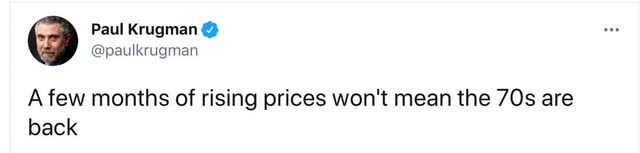


I agree. I want to elaborate on one point he hasn’t emphasized; namely, you can’t have a wage-price inflationary spiral if wages don’t participate!

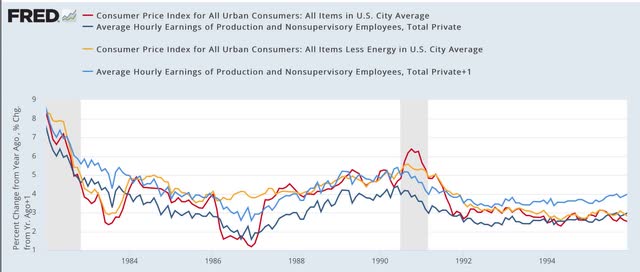
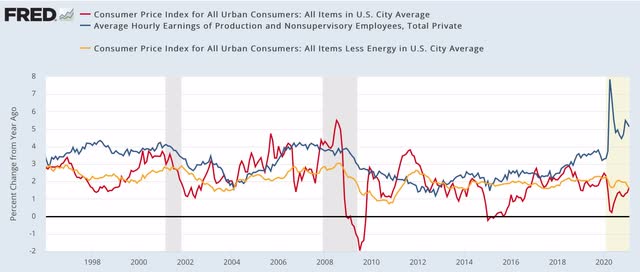
To make my point, let me show you three graphs below, covering wages and prices in three different periods: (1) the inflationary 1960s and ‘70’s, (2) the disinflationary Reagan-era 1980s and early ‘90’s, and (3) the low inflation period of the late 1990s to the present.

In addition to the YoY% change in CPI, I also show CPI less energy (gold), better to show oil shocks, and also that it takes about a year for inflation in energy prices to filter through to inflation in other items. Also, hourly wages were greatly affected (depressed) by the entry of 10,000,000’s of women into the workforce between the 1960s and mid-1990s. This increased median household income, which would be the better metric, but since that statistic is only released once a year, I’ve approximated its impact by adding 1% to the  YoY% change in average hourly wages (light blue).

Here are the three graphs:
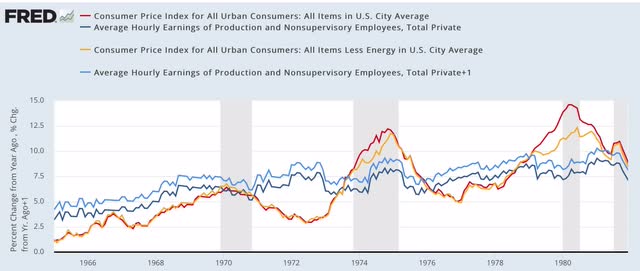


Here’s what I want to call to your attention. Until Reagan endorsed union-busting in 1981, unions were able to negotiate for automatic cost of living increases in the 1960s and ‘70s. So if, say, inflation rose from 3% to 5% in year 1, then the unionized workers got a 5% wage increase in year 2. To compensate for that, their employers raised prices in year 2 as well. 

Now look at the first graph. As inflation rose, and particularly after the 1974 and 1979 oil price shocks, wages quickly rose thereafter. During the 17 year period shown, wages went from rising about 4% YoY to rising 9% YoY.

Now look at the later two periods. Wage growth quickly fell to about 4% YoY in the early 1980s, and have never risen significantly above that since, right up until the pandemic. In fact wage growth continued to decline after recessions until 1992, 2004, and 2013 respectively. Only when unemployment and underemployment fell to roughly 5% and 8% respectively did wage growth start to increase.

Wage growth in 2020 was a side-effect of low-wage entertainment, hospitality, and food services being the hardest hit during the pandemic. Once these businesses resume, average wage growth is going to decline.

In short, unlike the 1960s and 1970s, we aren’t going to have a wage-price inflationary spiral. There is going to be a short burst of inflation, due to the fact that millions of people are going to start spending on things like travel and entertainment again. That big spike in demand is going to cause prices to rise. 

There is one other factor which I’ll mention, which is that the pandemic has also caused bottlenecks in supply, both due to shutdowns in supply industries, and also kinks in transportation, such as shown in the below graph of the Baltic Dry Index:
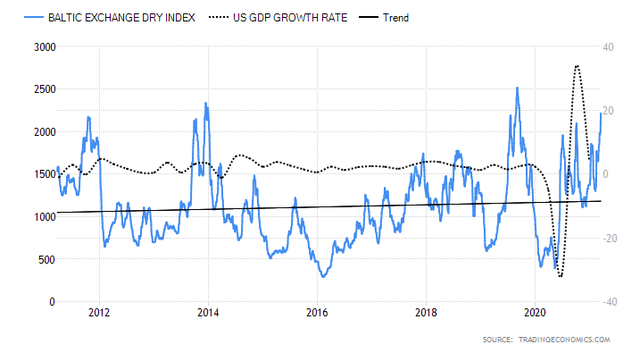

These kinks are going to be worked out. Additionally, because there won’t be wage increases to counteract the inflationary spike, it will be short-lived, most likely abating in 2022.

The question I am thinking about, and don’t have a good answer to yet, is whether the temporary spike in consumer prices in excess of wage gains will be enough to bring about a recession in 2022. This is because the surge in demand will abate, I.e., decline somewhat, and this in turn may well lead to a cutback in production. The long leading indicators, which had been extremely positive, have turned neutral in the past several months. I expect to be writing a lot more about this in the coming few months.

Monday, March 22, 2021

Coronavirus dashboard for March 22: crossing an important threshold, to the *good* side


 - by New Deal democrat

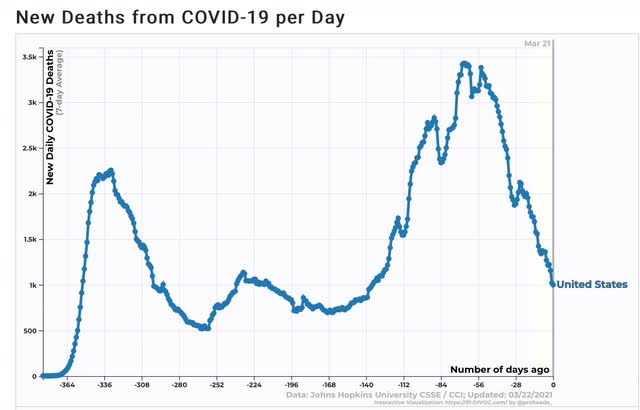
The US is on the verge of crossing an important threshold: as of today, the 7 day average of COVID 19 deaths in the US has declined to exactly 1000:


The last time the US averaged less than 1000 deaths a week from the virus was the beginning of November, almost 5 months ago. Since the January peak, deaths have declined by 70%.

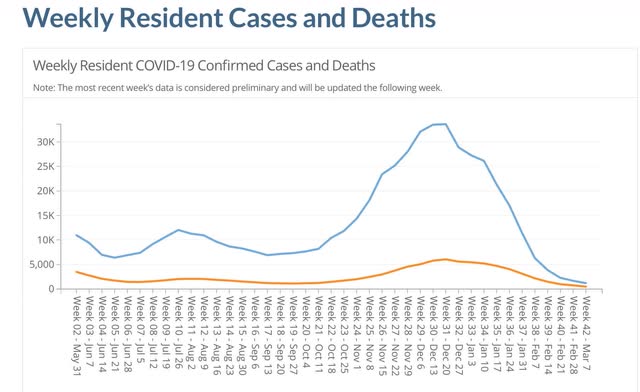
The story is even more breathtaking in nursing homes and other long term care facilities. For the week ending March 7, there were a total of 1,204 cases, a more than 96% decline from peak. There were 492 deaths, a 92% decline from peak:


Both numbers were the lowest weekly totals since data began to be kept 10 months ago. Since deaths follow cases, I expect deaths to decline further in the next couple of weeks.

Even if the recklessly irresponsible spring breakers in Florida and Texas bring back to their home States the more infectious strains of the virus, causing new cases to increase, that over 17% of adults, and over 40% of the more vulnerable seniors, have *completed* their vaccinations causes me to think that deaths will nevertheless continue to decline.

Sunday, March 21, 2021

Democrats: legislate the society you want to live in first; worry about how to pay for it afterward


 - by New Deal democrat

I want to add my voice to and amplify several themes I have read elsewhere in recent weeks. To summarize:


1. If there is no majority to kill the Senate filibuster, reforming it into an actual talking filibuster is almost as good, and maybe even better.

2. Each element of the democratic constituency should have at least one tangible and visible priority of theirs enacted during the Congress, and all other democratic constituencies should support that enactment, so that at midterm election time, Democrats have something to tout to their voters.

3. In contrast to how democrats governed when they had both the Presidency and Congressional majorities in 1993-94 and 2009-10, when they adopted “pay-go,” meaning they had to come up with revenue sources before passing their actual priorities, they should reverse the order now: enact the programs they think are important, and worry about paying for them later.

Let me discuss each of the above in a little more detail in turn.

1. Right now the Senate rules are exactly what the GOP wants them to be: they were able to fill all the judicial vacancies left behind from the Obama years, plus all the new ones with right wing ideologues, via simple majority. Similarly, they only needed a simple majority for tax cuts. Since the GOP does not want any new legislation, and can strangle existing laws simply by refusing to enforce them, they don’t care about a 60 vote supermajority for passing new legislation. Meanwhile Democrats need 60 votes to pass all of the important legislation that they have been begging for in some cases going all the way back to 1980.

This situation is anathema. The filibuster must be changed. 

The cudgel that the GOP always held over Democrats is that they would be willing to repeal or privatize even the Crown Jewels of the 20th Century Democratic agenda - Social Security and Medicare - if they got majorities not subject to Democratic filibuster. At this point Democrats should be willing to call the GOP’s bluff. If the GOP were to do such a thing, not only would they be signing their own death warrants, but Democrats should promise to reenact those programs in full and retroactively once they get back into power. 

Once this bluff is called, the question remains what to do about the filibuster. I actually think that maintaining it, but requiring a real, old-fashioned talking filibuster is the best option - and it seems to be supported by Biden, Manchin, and several other old-school Democrats.

Retaining a talking filibuster means that if the GOP ever achieves a governing trifecta, while Democrats couldn’t *prevent* the enactment of the GOP agenda, they could make it front page news for several weeks while they hold the floor of the Senate in protest. During that time it’s not too difficult to imagine that outraged citizens would be deluging their GOP Senators with opposition and disapproval, in the cases of popular economic programs in particular. In such a case, even minority Democrats might wind up prevailing.

Meanwhile the derision that greeted Lindsay Graham’s threat to filibuster the new Voting Rights Act till he falls over (I.e., “do you promise???”) tells you all you need to know about the popularity of the Democrats’ agenda that the GOP is trying to hold up.

In short, maintaining a talking filibuster is likely even more advantageous to Democrats than killing it altogether. Further, going to a talking filibuster really doesn’t require anything inventive. It’s as simple as the Presiding Officer (e.g., Vice President Harris) announcing, after the failure of a cloture vote, “Debate will now resume on Senate Bill X,” rather than moving on to a separate Senate bill, or adjourning. Keep doing that for a week or two, and ultimately a substantive vote on the underlying bill will be had.

And since the Senate isn’t going to be passing *anything* for the next 20 months if the filibuster isn’t repealed, there is absolutely no reason not to tee up Democratic priorities, and keep the Senate constantly in session until the talking filibusters fail (as historically they always have), and pass as many as we can.

2. One of the processes which has killed progress in the past 40 years is that there are almost always going to be at least a few Democratic legislators who oppose parts of the Democratic agenda. The GOP has always been able to peel those pols off and pass their own agenda, while they stood in the way of a broad Democratic agenda.

This time around, each legislator needs to get behind at least one important item on another part of the Democratic coalition’s agenda, in return for passage of one of their own.

For example, Hispanic groups would be very positively benefitted by passage of the DREAM Act. And it is very popular with the public. Economic populist Democrats need to get behind that bill, in return for support of one or two items on their own agenda.
Similarly, pro-union legislation like the PRO Act, and a hike in the minimum wage (obviously not to $15, but as high as support can be found for), should be enacted in return with full support by social justice Democrats. Reinstating State income tax deductions and mortgage deductions in higher amounts will help upper-income professionals, and should be supported by both economic populists and social justice Democrats.

Simply put, each part of the Democratic coalition should get something they want with the support of the other members of the coalition.

3. Even with the recent panic in the bond market - OMG 10 year Treasury bills are paying 1 1/2% !!! - the carrying costs for additional debt are extraordinarily low. If ever there was a time to go on a spending spree - particularly an effective one like infrastructure repair and upgrades - this is it. 

Democrats should not hesitate to enact programs, such as universal health care coverage with premium subsidies, or subsidized child care for workers, that are very costly. The priorities should be: enact now, find a way to pay later. Once the important programs are in place, *then* start looking around the tax code for ways to raise the money.

A financial transactions tax, a surtax on Executive salaries and stock grants in excess of a certain multiple of the average employee’s pay, and a return to Clinton-era tax rates for the top 1% of incomes, even retroactively clawing back the 2018 tax cuts (yes, it’s Constitutional), all ought to be on the table. And the granddaddy of them all, the Estate Tax, ought to be rechristened an Inheritance Tax - to make clear that it is a tax specifically on *unearned* income by heirs rather than a “Death Tax” on entrepreneurs - and rates raised to 50% on 1st generation transfers by billionaires, and to even higher rates, like 75%, on 3rd generation descendants and further on. Also, repealing the exemption for capital gains pass-throughs for Estates ought to be a priority.

Simply put, enact the type of society you want to live in first. Then, and only then, deal with how you are going to pay for it.
 

Saturday, March 20, 2021

Weekly Indicators for March 15 - 19 at Seeking Alpha


 - by New Deal democrat

My Weekly Indicators post is up at Seeking Alpha.

Both the nowcast and the short term forecast continue to be red hot. But interest rates continue to batter the long term forecast.

As usual, clicking over and reading will bring you up to the virtual moment, and reward me a tiny bit for the efforts I put in.

Friday, March 19, 2021

Coronavirus dashboard for March 19: yes, vaccinations are working


 - by New Deal democrat

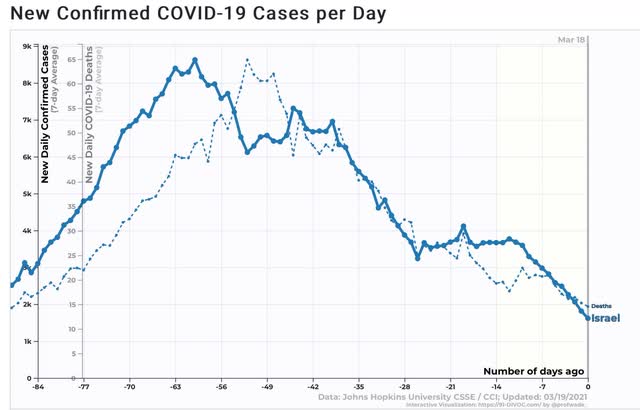
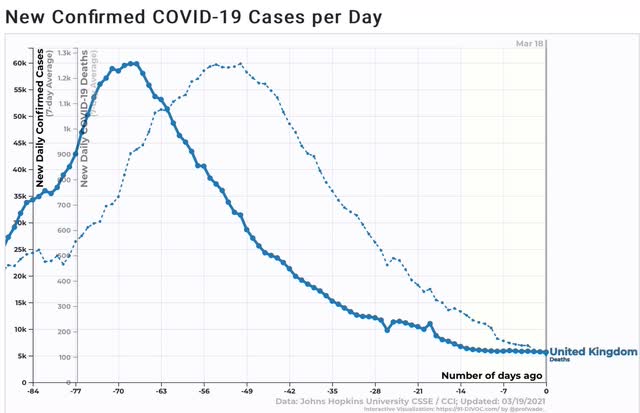
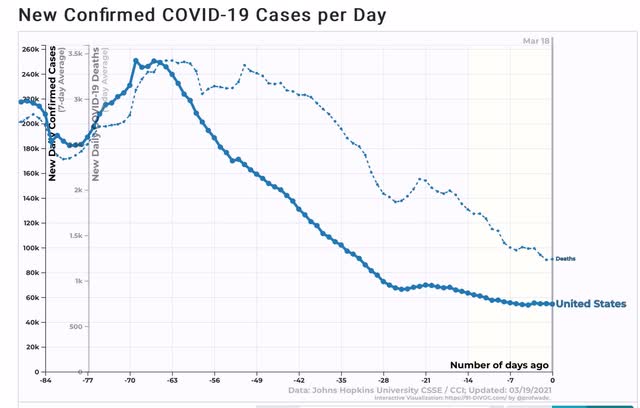
The three big Western standouts for vaccination progress have been Israel, the UK, and the US, respectively. And in all three, there have been dramatic declines in both cases and deaths.


Let’s look at them in order. First, Israel:


56% of all Israelis have had at least one dose of the Pfizer vaccine. 50% have been fully vaccinated.

Cases have declined 81%. Deaths have declined 77%.

The UK’s vaccination program has coincided with a partial lockdown that began on January 4:


40% of the population has had at least one dose. 30% is fully vaccinated.

Both cases and deaths have declined by 91%.

The US is in 3rd place:


23% of the US population has received at least one dose. 12.5% has been fully vaccinated.

Cases have declined by 78%. Deaths have declined by 65%.

Vaccinations are working. Hopefully as those opposed to taking the vaccine see their family, friends, and neighbors returning to close to normal lives without contracting the virus, they will lose their hesitancy and do the obvious, rational, and easy thing.

P.S.: Here is an updated graph on hospitalizations in the US:

This is more evidence that serious illness and death among the institutionalized elderly from COVID has all but disappeared.