Tuesday, October 27, 2020

An examination of the Framers’ arguments as to how the US Supreme Court would function: The Federalist Papers No’s. 78, 79, and 81


 - by New Deal democrat

This is a follow-up on yesterday’s post regarding the history of the Judiciary under republics. In that post I pointed out that the concept of an independent judiciary is a modern one that started in the era of Britain’s Glorious Revolution of 1688, and was radically expanded by the US Constitution. 

How the framers envisioned the US Supreme Court fit into the scheme of three independent branches of government was set forth in The Federalist Papers numbers 78 through 83. Of those, 3 are not relevant to this discussion: Number 80, which deals with types of court jurisdiction, Number 82 on relations between the State vs. Federal judiciaries, and Number 83, explaining that the Constitution does not abolish trial by jury. 

Below I quote extensively from Federalists numbers 78, 79, and 81, all written by Alexander Hamilton, grouping those quotes by subject matter, with cites at the end of each quote. I discuss the historical problems with Hamilton’s arguments thereafter.

Placing the Constitution’s plan in historical context:

That there ought to be one court of supreme and final jurisdiction, is a proposition which is not likely to be contested.... The only question that seems to have been raised concerning it, is, whether it ought to be a distinct body or a branch of the legislature.” (No. 81)

“According to the plan of the convention, all judges who may be appointed by the United States are to hold their offices DURING GOOD BEHAVIOR .... The standard of good behavior for the continuance in office of the judicial magistracy, is certainly one of the most valuable of the modern improvements in the practice of government. In a monarchy it is an excellent barrier to the despotism of the prince; in a republic it is a no less excellent barrier to the encroachments and oppressions of the representative body. And it is the best expedient which can be devised in any government, to secure a steady, upright, and impartial administration of the laws.: (No. 78)

Comparing the US Supreme Court vs. the UK’s House of Lords as court of final appeal:

“In Britain, the judicial power, in the last resort, resides in the House of Lords, which is a branch of the legislature; and this part of the British government has been imitated in the State constitutions in general.” (No. 81)

“the particular organization of the Supreme Court [is] being composed of a distinct body of magistrates, instead of being one of the branches of the legislature, as in the government of Great Britain and that of the State. ....” (No. 81)

“Considerations [of legal specialization and acumen of judges vs. legislators should] cause us to applaud the wisdom of those States who have committed the judicial power, in the last resort, not to a part of the legislature, but to distinct and independent bodies of men. Contrary to the supposition of those who have represented the plan of the convention, in this respect, as novel and unprecedented, it is but a copy of the constitutions of New Hampshire, Massachusetts, Pennsylvania, Delaware, Maryland, Virginia, North Carolina, South Carolina, and Georgia; and the preference which has been given to those models is highly to be commended.....” (No. 81)

The Judiciary would have to rely on the Executive to enforce its judgments:

“Whoever attentively considers the different departments of power must perceive, that, in a government in which they are separated from each other, the judiciary, from the nature of its functions, will always be the least dangerous to the political rights of the Constitution; because it will be least in a capacity to annoy or injure them.

“The judiciary ... can take no active resolution whatever. It may truly be said to have neither FORCE nor WILL, but merely judgment; and must ultimately depend upon the aid of the executive arm even for the efficacy of its judgments....” (No. 78)


To preserve judicial independence, judges must be appointed for life:

“judges, [ ] if they behave properly, will be secured in their places for life....” (No. 79)

“Every reason which recommends the tenure of good behavior for judicial offices, militates against placing the judiciary power, in the last resort, in a body composed of men chosen for a limited period. There is an absurdity in referring the determination of causes, in the first instance, to judges of permanent standing; in the last, to those of a temporary and mutable constitution.” (No. 82)

“That inflexible and uniform adherence to the rights of the Constitution, and of individuals, which we perceive to be indispensable in the courts of justice, can certainly not be expected from judges who hold their offices by a temporary commission. Periodical appointments, however regulated, or by whomsoever made, would, in some way or other, be fatal to their necessary independence.” (No. 78)

It was anticipated that the Court would increasingly be bound by precedent, which would require a lifetime of learning to master:

[Comparing Judge’s with the House of Lords]: “And there is a still greater absurdity in subjecting the decisions of men, selected for their knowledge of the laws, acquired by long and laborious study, to the revision and control of men who, for want of the same advantage, cannot but be deficient in that knowledge.” (No. 82)

“There is yet a further and a weightier reason for the permanency of the judicial offices, which is deducible from the nature of the qualifications they require. It has been frequently remarked, with great propriety, that a voluminous code of laws is one of the inconveniences necessarily connected with the advantages of a free government. To avoid an arbitrary discretion in the courts, it is indispensable that they should be bound down by strict rules and precedents, which serve to define and point out their duty in every particular case that comes before them; and it will readily be conceived from the variety of controversies which grow out of the folly and wickedness of mankind, that the records of those precedents must unavoidably swell to a very considerable bulk, and must demand long and laborious study to acquire a competent knowledge of them. Hence it is, that there can be but few men in the society who will have sufficient skill in the laws to qualify them for the stations of judges.” (No.78)(My emphasis)


Discussing the objection that the Supreme Court would become a Superlegislature:

“Some perplexity respecting the rights of the courts to pronounce legislative acts void, because contrary to the Constitution, has arisen from an imagination that the doctrine would imply a superiority of the judiciary to the legislative power. It is urged that the authority which can declare the acts of another void, must necessarily be superior to the one whose acts may be declared void. As this doctrine is of great importance in all the American constitutions, a brief discussion of the ground on which it rests cannot be unacceptable. (No. 78)

“The arguments, or rather suggestions, upon which this charge is founded, are to this effect: "The authority of the proposed Supreme Court of the United States, which is to be a separate and independent body, will be superior to that of the legislature. The power of construing the laws according to the SPIRIT of the Constitution, will enable that court to mould them into whatever shape it may think proper; especially as its decisions will not be in any manner subject to the revision or correction of the legislative body. This is as unprecedented as it is dangerous. ...The Parliament of Great Britain, and the legislatures of the several States, can at any time rectify, by law, the exceptionable decisions of their respective courts. But the errors and usurpations of the Supreme Court of the United States will be uncontrollable and remediless." This, upon examination, will be found to be made up altogether of false reasoning upon misconceived fact.


“In the first place, there is not a syllable in the plan under consideration which DIRECTLY empowers the national courts to construe the laws according to the spirit of the Constitution, or which gives them any greater latitude in this respect than may be claimed by the courts of every State. I admit, however, that the Constitution ought to be the standard of construction for the laws, and that wherever there is an evident opposition, the laws ought to give place to the Constitution.... (No. 81)(My emphasis)


“[Further, ]No legislative act ... contrary to the Constitution, can be valid. .... A constitution is, in fact, and must be regarded by the judges, as a fundamental law. It therefore belongs to them to ascertain its meaning, as well as the meaning of any particular act proceeding from the legislative body. If there should happen to be an irreconcilable variance between the two, that which has the superior obligation and validity ought, of course, to be preferred; or, in other words, the Constitution ought to be preferred to the statute, the intention of the people to the intention of their agents.

“[W]here the will of the legislature, declared in its statutes, stands in opposition to that of the people, declared in the Constitution, the judges ought to be governed by the latter rather than the former. 

“This exercise of judicial discretion, in determining between two contradictory laws, is exemplified in a familiar instance. It not uncommonly happens, that there are two statutes existing at one time, clashing in whole or in part with each other, and neither of them containing any repealing clause or expression. In such a case, it is the province of the courts to liquidate and fix their meaning and operation. So far as they can, by any fair construction, be reconciled to each other, reason and law conspire to dictate that this should be done; where this is impracticable, it becomes a matter of necessity to give effect to one, in exclusion of the other.

“It can be of no weight to say that the courts, on the pretense of a repugnancy, may substitute their own pleasure to the constitutional intentions of the legislature. This might as well happen in the case of two contradictory statutes; or it might as well happen in every adjudication upon any single statute. The courts must declare the sense of the law; and if they should be disposed to exercise WILL instead of JUDGMENT, the consequence would equally be the substitution of their pleasure to that of the legislative body. The observation, if it prove any thing, would prove that there ought to be no judges distinct from that body.... (No. 78)(My emphasis)

Poor Supreme Court decisions can be remedied by Constitutional Amendment:

“A legislature, without exceeding its province, cannot reverse a determination once made in a particular case; though it may prescribe a new rule for future cases. This is the principle, and it applies in all its consequences, exactly in the same manner and extent, to the State governments, as to the national government now under consideration. Not the least difference can be pointed out in any view of the subject.” (No. 78)


The remedy for Judges who do not neutrally apply the Constitution is to remove them via impeachment:

“The precautions for their responsibility are comprised in the article respecting impeachments. They are liable to be impeached for malconduct by the House of Representatives, and tried by the Senate; and, if convicted, may be dismissed from office, and disqualified for holding any other. This is the only provision on the point which is consistent with the necessary independence of the judicial character, and is the only one which we find in our own Constitution [of New York] in respect to our own judges.” (No. 79)

“It may in the last place be observed that the supposed danger of judiciary encroachments on the legislative authority, which has been upon many occasions reiterated, is in reality a phantom. Particular misconstructions and contraventions of the will of the legislature may now and then happen; but they can never be so extensive as to amount to an inconvenience, or in any sensible degree to affect the order of the political system. This may be inferred with certainty, from the general nature of the judicial power, from the objects to which it relates, from the manner in which it is exercised, from its comparative weakness, and from its total incapacity to support its usurpations by force. And the inference is greatly fortified by the consideration of the important constitutional check which the power of instituting impeachments in one part of the legislative body, and of determining upon them in the other, would give to that body upon the members of the judicial department. This is alone a complete security. There never can be danger that the judges, by a series of deliberate usurpations on the authority of the legislature, would hazard the united resentment of the body entrusted with it, while this body was possessed of the means of punishing their presumption, by degrading them from their stations. While this ought to remove all apprehensions on the subject, it affords, at the same time, a cogent argument for constituting the Senate a court for the trial of impeachments.” (No. 81)(My emphasis)


In summary, lawyers selected for their lifetime of skill and acumen in understanding past precedents would essentially engage in statutory interpretation according to the long-established rules for such interpretation. Any errors they made would be no more than an “inconvenience” that would never “affect the order of the political system.” In any event, they would be powerless to enforce their decisions, and would have to rely on the Executive. Further, their errors they made could be remedied by Constitutional Amendments. Finally, if they did attempt to act like superlegislators, they would suffer impeachment and removal from office.

At the time Hamilton made these arguments, there was no historical record against which to compare his conclusions. Over 200 years later, the record is extensive, and it shows that the objection that the court would act like a tyrannical superlegislature was well-founded. 

Note in particular that although Hamilton *says* that the argument that the court would act like a superlegislature is unfounded, he never actually *engages* with the argument, but simply states that the Constitution does not “directly” authorize such a result, and that if the argument is correct, it militates against an independent Court altogether; and  concludes that the processes of Constitutional Amendment and Impeachment are sufficient bulwarks in any event.

To the contrary, the Court’s decisions about voting rights and more broadly civil rights, for good or ill, have had major impacts on everyday life. Its radical Dred Scot decision was a major precipitating factor leading to the Civil War, leaving 700,000 dead in its wake. Only thereafter, and only with the Confederate States being excluded from the Constitutional  process were the 13th, 14th, and 15th Amendments able to be passed. For the vast majority of its subsequent history, the Court has manifested hostility to the 15th Amendment in particular. And so long as a Justice’s views are aligned with those of at least 1/3+1 of the Senate, impeachment is a dead letter.

In short, it turns out that the objection to the US Constitution’s treatment of the Supreme Court quoted above by Hamilton in Federalist Number 81 turns out to have been well-founded.

Monday, October 26, 2020

A brief history of the Judiciary under Republics; the radical departure of the US Constitution, and how to reform it now


 - by New Deal democrat

I’ll have a note up, probably at Seeking Alpha tomorrow, on new home sales, which get reported later this morning.


In the meantime, especially with the likely confirmation of the 6th movement conservative Justice today, who will probably immediately start to rule on election issues, I want to flesh out in outline form my thoughts on the Supreme Court. I am going by memory in this note, so some of this info is not entirely correct and will need to be checked further.

1. Historically, the judiciary was not an independent branch of government. In monarchies, the sovereign typically could both appoint and remove judges at pleasure. In ancient and medieval republics, the Executive branch enforced the law. For example, in the Roman Republic, both consuls and praetors heard civil and criminal cases. In Venice, as memorably recounted in The Merchant of Venice, the final appeal was to the Doge. Sometimes the senior legislative body, like the Senate in Rome or the House of Lords in England, was the court of final appeal. In those republics, judges changed with each change of government.

2. The modern independent judiciary started with John Locke and the Glorious Revolution of 1688. After the revolution, the Act of Settelement provided that the sovereign appointed judges on the recommendation of Parliament. The judge served “on good behaviour,” (exactly as specified later in the US Constitution), but could be removed by the sovereign upon a petition agreed to by a majority of both Houses of Parliament.

3. Montesquieu formalized the idea of the judiciary as an independent 3rd branch of government, and the US Constitution took an even more “radical” turn. Not only were judges given appointments “on good behavior,” but they could only be removed with the agreement of 2/3’s of the Senate upon recommendation by a majority of the House.

4. The Federalist Number 78 is the most important discussion of the framers’ intentions as to the Supreme Court. There it is made clear that the Court will have the power to set aside Unconstitutional laws passed by Congress and the States.

5. This “judicial supremacy” was viewed as no different than how courts interpret statutes in conflict. There are rules of interpretation guiding courts as to which statute must give way to the other, and these would be used by the Supreme Court to determine if a statute must give way to an inconsistent provision in the Constitution. Where historically this argument has proven wrong is that it is not difficult for a legislature to pass a new statute to overcome inconsistencies between two prior statutes, but it is monumentally difficult to overcome a Supreme Court interpretation by amending the Constitution.

6. The objection that the Court would turn into a “Superlegislature” was already strongly voiced. In addition to the check of impeachment, the framers also envisioned that the Court would be bound by its prior precedent, just as common law courts in the UK had been for centuries, and that an ever more detailed body of precedent would be built up to prevent the court from going rogue and substituting its judgment for that of the Congress. The framers never envisioned that there would be wildly different schools of how the Constitution should be interpreted, let alone that a Court majority would use a new theory of construction to overturn long-existing precedents. (Before you consider this a universally bad thing, remember that Plessy v. Ferguson was good law for about 70 years before being overturned by Brown v. Board of Education.)

7. As a result, the idea of a judicial retirement age was specifically rejected. It was envisioned that a lawyer would need a lifetime of experience to become fully versed in the precedents that would govern their decisions as a Supreme Court Justice.

8. We are now on the verge of all of the errors in the framers’ arguments for the Supreme Court coming to fruition. In the 19th Century, the average tenure of a Justice was less than 10 years, due mainly to life expectancy. Now that it is common to live into one’s 80s, Justices serving for 25 years or more are becoming increasingly common. Movement conservatives are using a theory of construction that did not even exist until about 40 years ago, and using it to overturn long-standing precedents (and are also inventing novel constructions nowhere found in the Constitution when it suits them: see Shelby County). They have declared statutes unconstitutional at a rate never before seen, and they are likely to revive the Lochner doctrine of 100 years ago that deemed almost all economic regulation unconstitutional.

9. Fundamentally, there are 3 approaches that can be used to change this dynamic, but 1 of them almost certainly involves a new Constitutional Amendment.

10. The first approach is to make all circuit court appellate judges also members of the Supreme Court, and delegate the jurisdiction of the Supreme Court to rotating panels (just as the Circuit Courts of Appeal operate now). This requires being comfortable with the quality of the Appellate judiciary now, and probably moves the point of contention down from the Supreme Court to the Circuit Courts. By the way, this approach was seriously considered in the wake of Dred Scott by the Reconstruction Congress of 1869 which passed the 15th Amendment.

11. The second approach is to have single 18 year term appointments to the Supreme Court. This almost certainly requires a Constitutional Amendment, since there would be an involuntary retirement from the Court after 18 years regardless of “good behavior,” and we can certainly expect that the movement conservative justices are going to object.

12. The third approach is to have the President nominate two Justices during the 1st and 3rd years of their term, regardless of the number of justices that would create. The Court would probably have an even number of justices about half the time, leading to more split decisions (in which case the judgment of the lower court would stand).

13. Potentially the first and third approaches could be combined, so that panels of 9 Justices would hear any given case.

14. If it were up to me, I would expand the Court to 11 members immediately after Biden takes office, and also enact the third approach immediately. That would give Biden 3 appointment next year, immediately evening the number of justices appointed by Presidents of each party. Biden would get another appointment in 2023, and thereafter the winner of any Presidential election would get two appointments. Note that under this scenario the retirement or death of a Justice does not lead to any replacement appointment.

15. If the GOP got tired of this arrangement, then they could sign on to a Constitutional Amendment enacting the second option (a single 18 year term).

16. Because Biden would not get an automatic majority, this is not quite “court-packing.” It also would encourage justices to become more moderate in their decision-making, and nudge the political parties to a more permanent fair solution that maintains the framers’ intent for an independent judiciary.

Sunday, October 25, 2020

The 2020 Presidential and Senate nowcasts: in 2020 the “blue wall” looks very likely to hold, but expect surprises in the Senate


 - by New Deal democrat


Here is my weekly update on the 2020 elections, based on State rather than national polling in the past 30 days, since that directly reflects what is likely to happen in the Electoral College. 

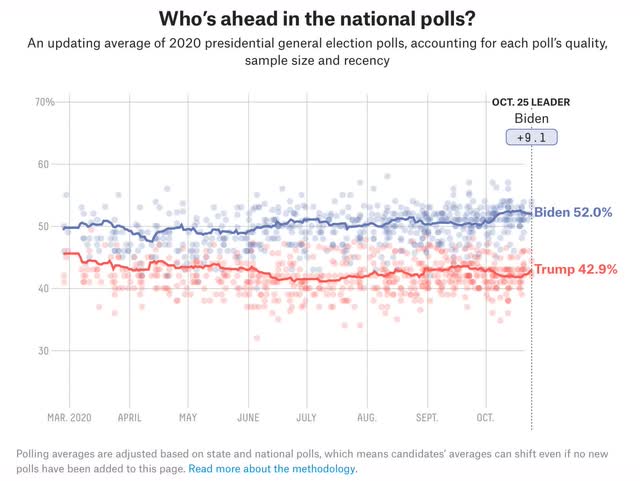
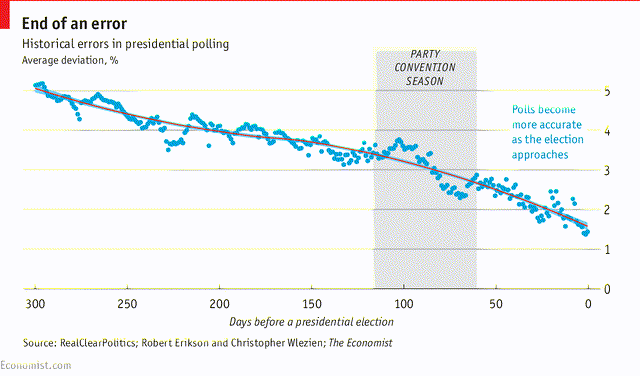
At only 9 days from Election Day, the polls, while actually nowcasts rather than forecasts, are probably less than 1.75% off the final result. All of the fundamentals of the election are already “baked into the cake,” and it appears Trump’s attempt at an “October surprise” has fizzled. I’ve been suggesting for several months that some GOP voters would likely  “come home” in the closing days of the election, and that appears to be developing, with national polls generally tightening slightly.

Also, to reiterate what I wrote last week, unlike 2016, Biden’s lead been at very least steady for over 4 full months:


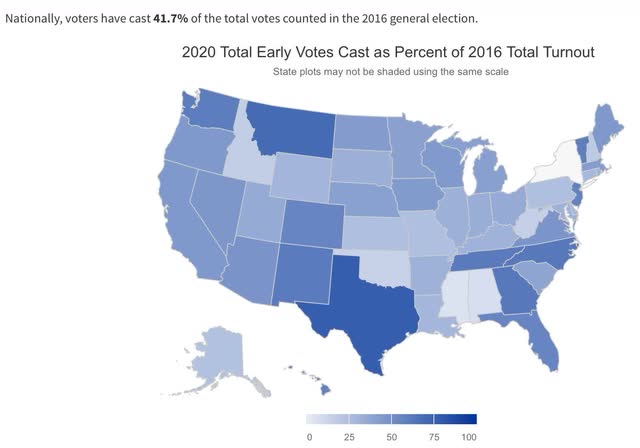
Not only that, but as of yesterday almost 42% of the total number of ballots compared with 2016 have already been cast this year:


New York has just started early voting. This number should easily top 50% by Election Day. For these voters, the race is already over. Those votes are going to stay put.

Finally, the Senate elections show very little variation from Presidential polling in the affected States. Only in tight Presidential swing States does it look like the Senate results might turn out differently.

So here is this week’s penultimate update.

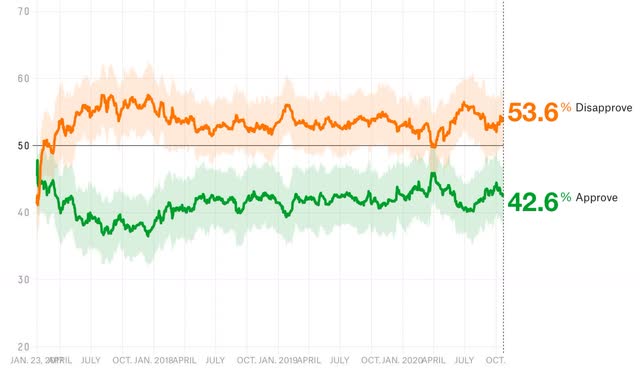
Trump has continued to have a bad October, as in the past 2+ weeks since the first debate and his own diagnosis of COVID-19, his approval rating has declined. It dropped by another -0.2% this week to 42.6, although his disapproval rate also declined -0.6% to 53.6%. This is still within the normal range of approval going back over 3.5 years: 


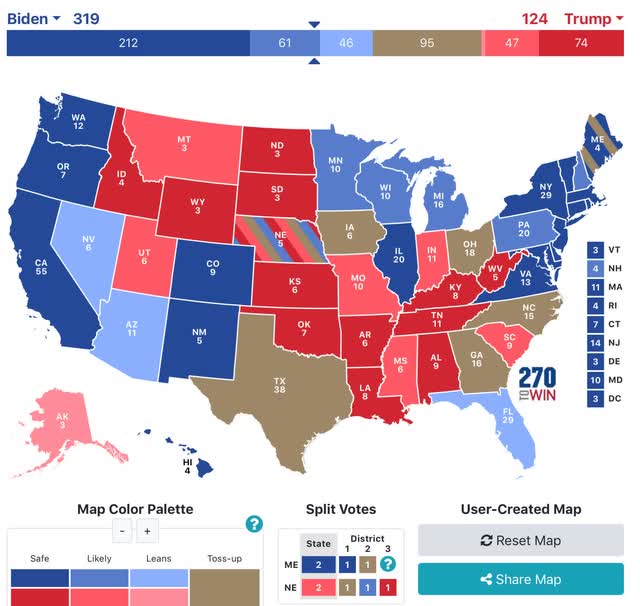
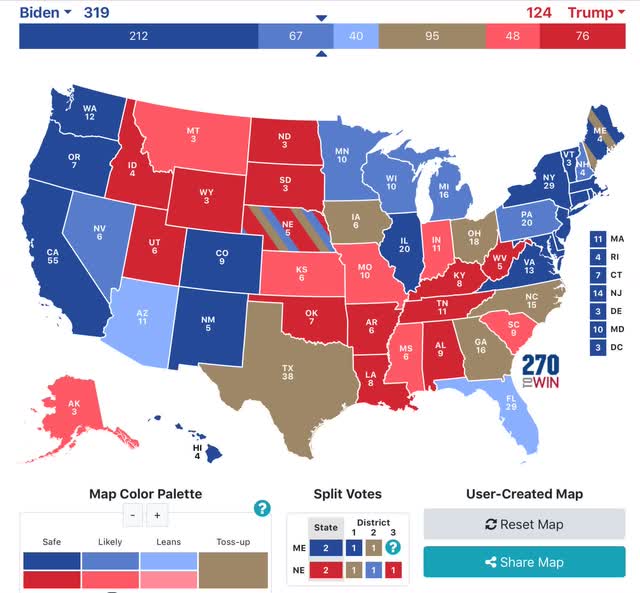
Here is this week’s updated map through October 17 for the Presidential election. To refresh, here is how  it works:

- States where the race is closer than 3% are shown as toss-ups.
- States where the range is between 3% to 5% are light colors.
- States where the range is between 5% and 10% are medium colors.
- States where the candidate is leading by 10% plus are dark colors.

A reminder: next week I will also include a map that includes any State with a 1%+ differential to “lean Democrat/GOP” category.


The only change of note this week was that Nevada fell just barely into the “lean Biden” category, so that Biden’s “solid” plus “likely” Electoral College votes declined by 6 to 273, meaning that Biden still doesn’t need Florida or Arizona in order to win. Three Trump States, Alaska, Nebraska, and Utah, tightened to “lean” and “likely” Trump, respectively, while Kansas moved from “likely” to “solid” Trump.

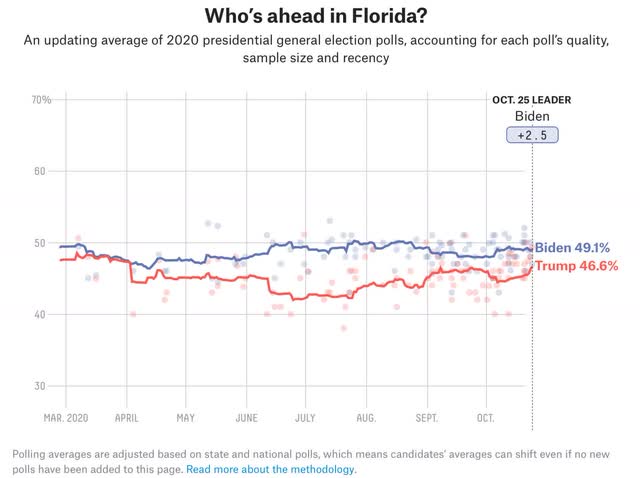
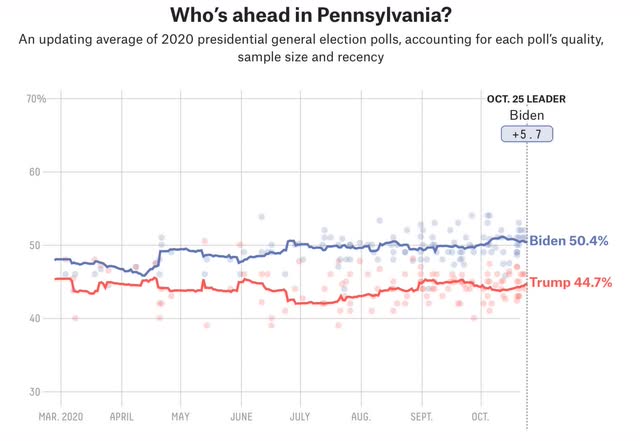
Biden’s support improved to or remained at 50%+ in Michigan, Minnesota, Nevada, New Hampshire, Pennsylvania, and Wisconsin. Florida and North Carolina were 49%+. Only Arizona declined below 49%. This makes it extremely hard for Trump to mount a successful comeback in those States. 

Here is Florida, showing some tightening. Arizona is similar:


But perhaps more importantly, here is Pennsylvania. Although I won’t post the graphs, Minnesota, Wisconsin, and Michigan are similar:


Biden’s lead in these States has been durable, and he has an actual majority. In short, even though we are still 9 days away from the actual “Election Day,” I will boldly State that most observers - probably traumatized by 2016 - have been too cautious this year. The “blue wall” is extremely likely to hold. And if it does, Trump’s chances of victory are foreclosed.

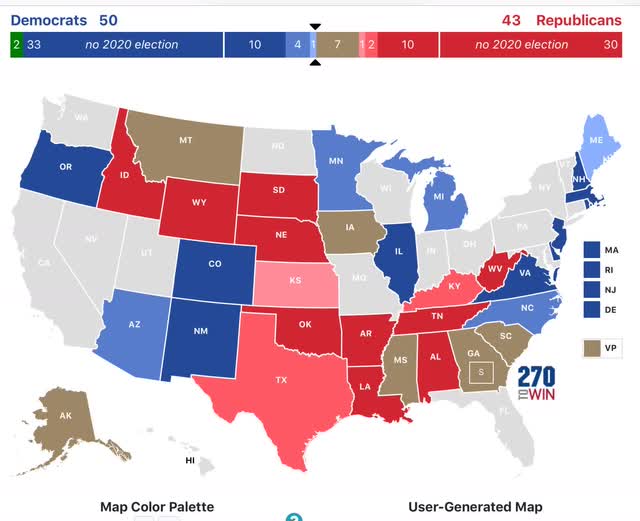
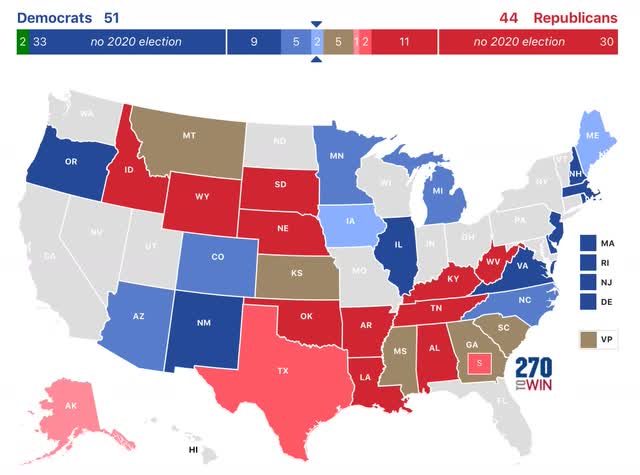
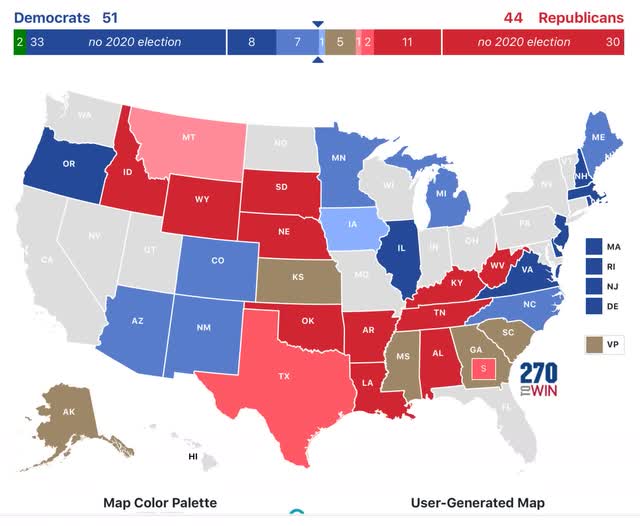
Turing to the Senate, there were 6 changes this week, 4 favoring Democrats and 2 favoring the GOP. Alaska and Georgia’s special election both moved back from lean GOP to toss-up. Colorado moved from likely to solid Democrat. Kentucky moved from solid to likely GOP. On the other hand, Iowa moved from lean Democrat to toss-up and Kansas moved from toss-up to lean GOP:


At current polling, if Democrats win all those seats in which they are favored, they will have 50 Senate seats, down from 51 last week. The number of  races now rated “toss-up” increased to 7.  It remains likely that the Democrats wind up with a majority in the next Senate, although my in-box is filling up with pleas that Mitch McConnell’s superPAC has begun to deploy nuclear levels of spending in the tightest races. 

In sum, I am increasingly confident of a Biden victory, perhaps a decisive one, while the Senate makes me very nervous. It is at this level where I think we will see a number of surprises, perhaps in both directions.

Saturday, October 24, 2020

Weekly Indicators for October 19 - 23 at Seeking Alpha


 - by New Deal democrat


My Weekly Indicators post is up at Seeking Alpha.

Although there has been no new stimulus package, and none looks likely at least until possibly a new Administration takes over on January 20, the overall tenor of the economy is one of slow, in some cases glacial, improvement.

As usual, clicking over and reading brings you virtually up to the moment on the economic data, and rewards me with a penny or two in my pocket for compiling that information.

Thursday, October 22, 2020

Jobless claims: a very positive reversal


 - by New Deal democrat


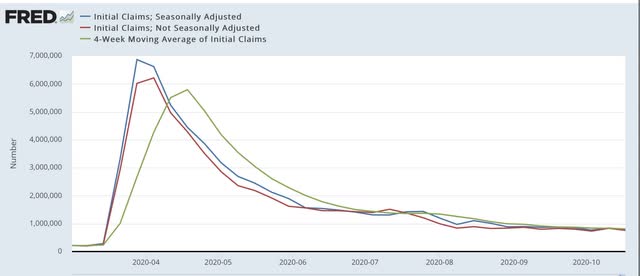
This week’s new jobless claims report not only reversed last week’s increase, but declined below 800,000 for the first time on an *un*revised basis. I say that because revisions from two weeks ago now have that week as the lowest since the pandemic struck.  [NOTE: California has restarted reporting its claims, and has also reported for the past two weeks, and is the likely cause of the big revisions - generally downward, or positive.]

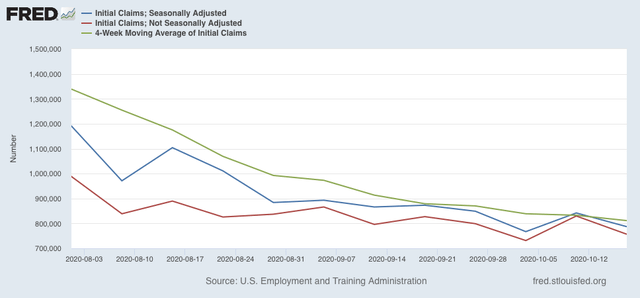
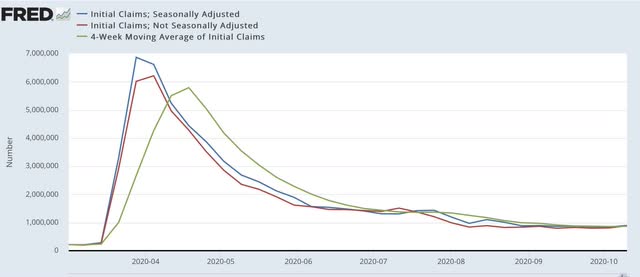
On a non-seasonally adjusted basis, new jobless claims declined by 73,125 to 756,617. This would be a new low, except two weeks ago was revised down to 731,249. After seasonal adjustment (which is far less important than usual at this time), claims declined by 55,000 to 787,000. This would be a new low as well, except two weeks ago was revised down to 767,000. The 4 week moving average also decreased by 21,500 to 811,250, a new pandemic low: 


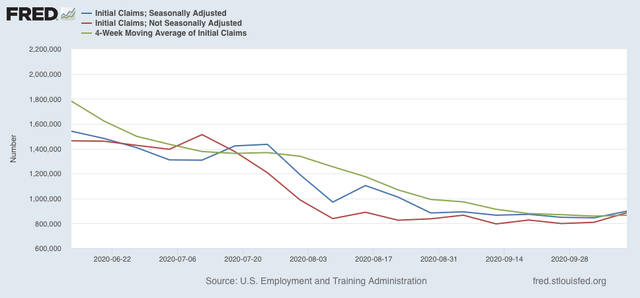
Here is a close-up of the last three months since the end of July highlighting the overall slow progress in initial claims since then:


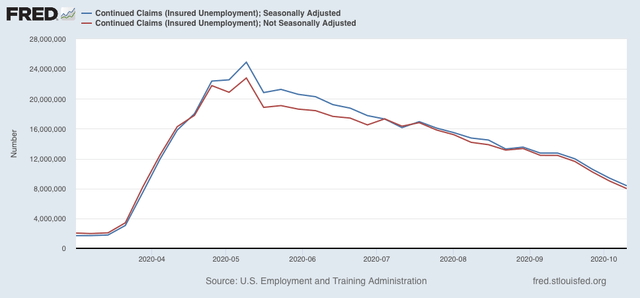
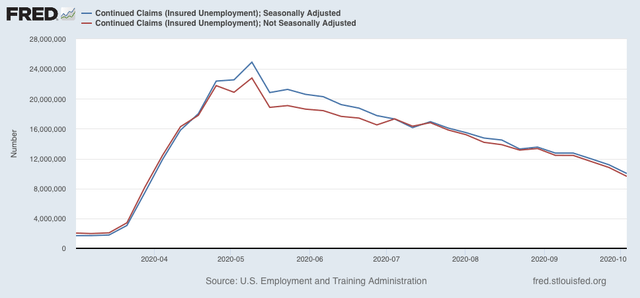
Continuing claims (which lag initial claims typically by a few weeks to several months) on a non-adjusted basis declined by 2,238,268 to 7,992,238. With seasonal adjustment they declined by 2,221,000 to 8,373,000. Both of these are new pandemic lows:


Continuing claims are now about 2/3’s below their worst level from the beginning of May, but are still about 1.5 to 2 million higher than their worst levels during the Great Recession.

Last week I noted my concern for the big weekly increase in claims, while cautioning that it was “only one week’s data.” This week’s big reversal explains that caution.

Overall the situation with layoffs has continued to improve at a very slow pace. This is of a piece with the same slow continued improvement in most of the “weekly indicators” I update each Saturday. At the same time, we are still at the mercy of the pandemic, and there are new indications that it is about to worsen again with the onset of cold weather and people retreating indoors.

Wednesday, October 21, 2020

Coronavirus dashboard for October 20: some good news among the gloom


 - by New Deal democrat


Total US confirmed infections: 8,273,296*

Average US infections last 7 days: 59,527 (vs. recent low of 34,354 on Sept 12)
Total US deaths: 221,052
Average US deaths last 7 days: 738 (vs. recent low of 689 4 days ago)

*I suspect the real number is 14-15,000,000, or over 4% of the total US population
Source: COVID Tracking Project

As we head into the cold weather, experts are warning that, as bad as the pandemic has been up until now, it is likely to be far worse over the next few months.

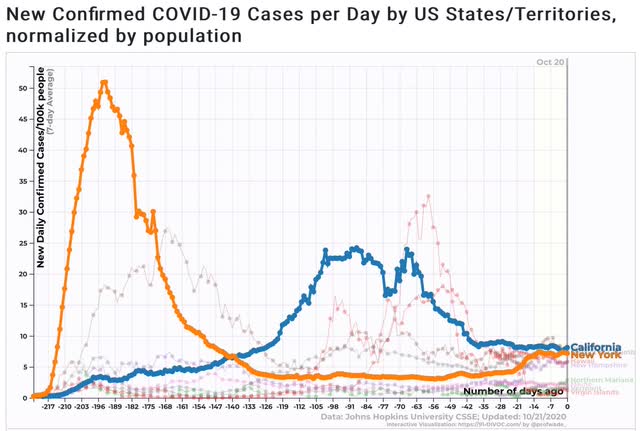
We’ll look at the bad news. But first, let’s look at some good news: 60,000,000 Americans live in two large States that have largely contained the pandemic - California and New York.

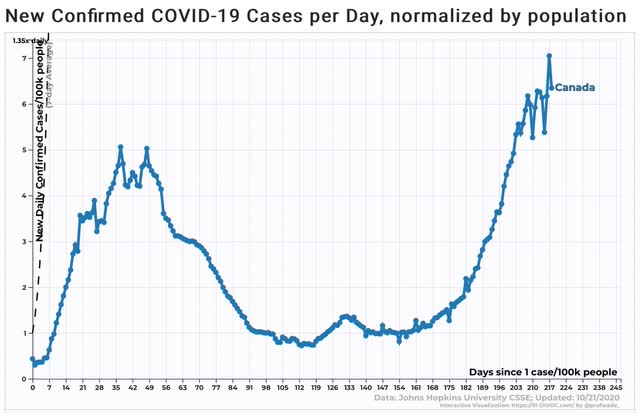
My benchmark, as usual is adjoining Canada, which most recently has averaged 6.34 infections per 100,000 people daily:


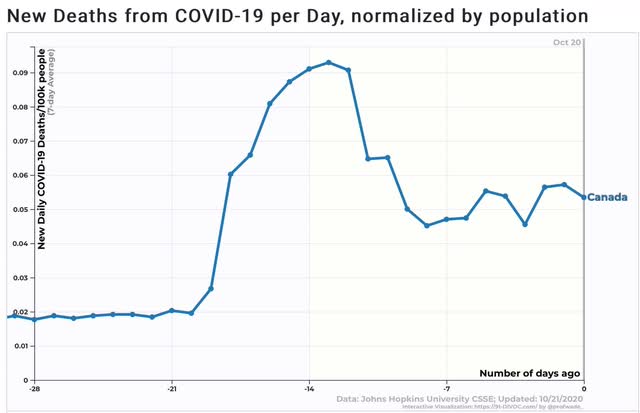
Canada’s most recent death rate has averaged 0.0534 per 100,000 over the past week (or roughly 1 death daily for every 2,000,000 people):


By contrast, California has most recently averaged 8.11 infections per 100,000 people, and New York 7.18 infections:


These are not much higher than Canada.

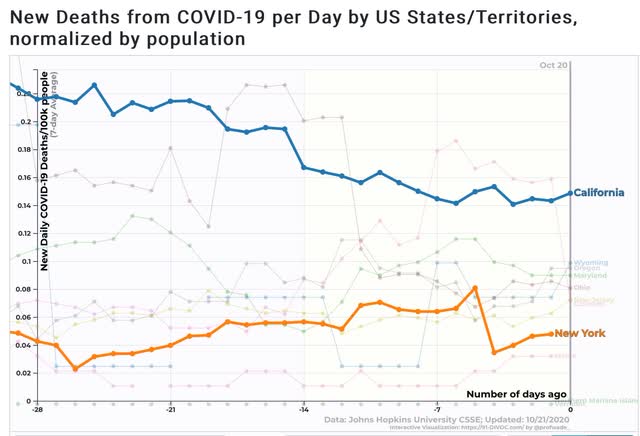
California has most recently averaged 0.149 deaths per 100,000 people, and New York 0.0477:


California’s death rate is still elevated, but can be expected to follow its infection rate. New York’s death rate is now *lower* than Canada’s.

In short, over 1/6th of the entire US population - over 60,000,000 people - lives in States (also including Maine, New Hampshire, Vermont, and in terms of cases, Hawaii) where the pandemic has largely been contained due to intelligent and relentless government action.

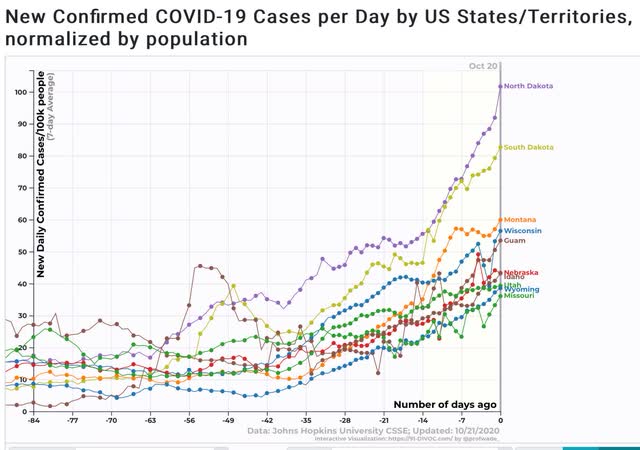
And now, the bad news. The pandemic is raging in the upper Plains and Mountain States.

Here are the top 10 States for infections:


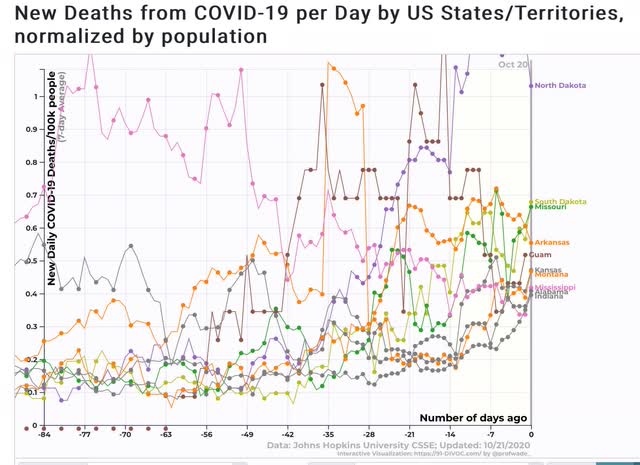
And here are the top 10 States for deaths:


With the exception of Wisconsin, there are all deep Red States. Wisconsin has a reactionary deep Red Supreme Court which has prevented the governor from taking any effective action.

Four States - Wisconsin, Montana, North and South Dakota - all have rates of infection exceeding that of New York in March and April, and Arizona in July. The “relatively” good news is that treatments have improved so much that even North Dakota’s death rate is only about 1/7th of that of New York’s early in the pandemic, and is not yet worse than Arizona’s in July.

The bottom line for me is that, if California and New York have been able to contain the pandemic during Trump’s malAdministration, then only States that are willfully recalcitrant need to face the pandemic uncontrolled after a few months into a Biden Administration.

September housing construction: another very positive month


 - by New Deal democrat

Yesterday September housing permits and starts were reported. Permits made yet another 10+ year high. This bodes very well for the economy in 2021, if the pandemic can be contained.


Sorry about the delay. Seeking Alpha didn’t get around to publishing it until this morning. Here’s the link.

Monday, October 19, 2020

Two noteworthy tweets


 - by New Deal democrat

It’s a slow economic news week. Housing starts and permits are reported tomorrow, and jobless claims and existing home sales on Thursday. I’ll update the Coronavirus Dashboard Wednesday.  So for today, two nuggets.

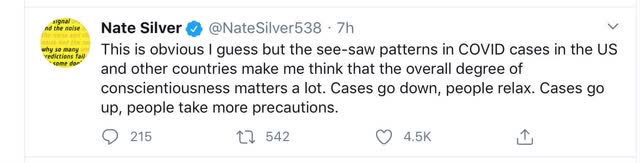
1. Nate Silver discovers behavioral psychology:


This has been my paradigm for months. Panic breeds compliance with mask-wearing and social distancing. Complacency breeds risk-taking. Over time both trends wane, breeding the conditions necessary for the opposite outcome. Not only has this been true in almost all US States, but we have now seen the same dynamic play out in Europe.


Nice to see that Nate Silver is learning about learning.

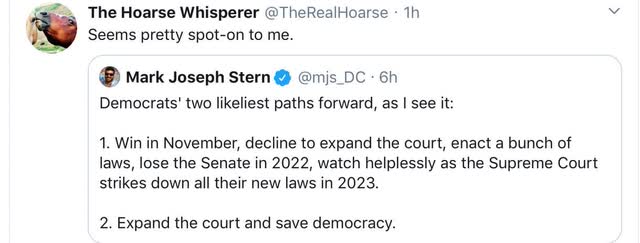
2. What is the solution to the Supreme Court?

Hoarse is right, although I suspect the Supreme Court will immediately issue injunctions against laws passed by the Democrats, or uphold injunctions issued by lower courts, and won’t wait for 2023 to strike them down. 

In the short term, the Democrats can certainly expand the Court. Of course, the GOP will retaliate the next time they are in power. And on we go, destroying the institution (to be fair, the movement conservatives on the Court, after Bush v. Gore and Shelby County, not to mention fast-tracking Trump appeals while slow-walking those of Congressional Democrats, have brought this on themselves.)

The better long term solution, which I have previously endorsed, as have others like Matt Yglesias, is for a single 18 year term on the Court, with appointments made during the 1st and 3rd year of each Presidential term, after which the Justices can become “Senior Justices” who sit on the Appellate Courts for life or until they choose to retire.

Lower courts already have “senior judge” status - but it is *voluntary.* I doubt Clarence Thomas or Samuel Alito will voluntarily retire during a Democratic Presidency. Making it mandatory would require a Constitutional Amendment. Good luck with that.

So the bigger quandary with the solution, as I see it, is how to club the GOP with the short term retaliation for their own misbehavior (see Garland, Merritt) while offering a neutral longer term solution that they could endorse, and hopefully without necessity of a Constitutional Amendment.

I have a couple of ideas, but they require a longer post. Once I flesh them out, I’ll have more to say.

Sunday, October 18, 2020

The 2020 election nowcast: Biden widens national lead; Senate races likely to follow Presidential result in each State
 

  - by New Deal democrat

Here is my weekly update on the 2020 elections, based on State rather than national polling in the past 30 days, since that directly reflects what is likely to happen in the Electoral College. 

At only 16 days from Election Day, the polls, while actually nowcasts rather than forecasts, are probably less than 2% off the final result. With the exception of the last Presidential debate, and any *significant* “October surprise,” all of the fundamentals of the election are already “baked into the cake.” Because some GOP voters will likely still “come home” in the next two weeks, I expect the race to tighten a little bit.

There are two big takeaways from the present situation:
1. In the Presidential election, Biden’s lead has not just been steady, but on a national level has been pulling decisively away from Trump, to the biggest lead of the entire year:


2. The Senate elections show very little variation from Presidential polling in the affected States. The only 4 States in which contrary results at the two levels look reasonably possible are Georgia, Iowa, North Carolina, and South Carolina. 

With those statements out of the way, here is this week’s update.

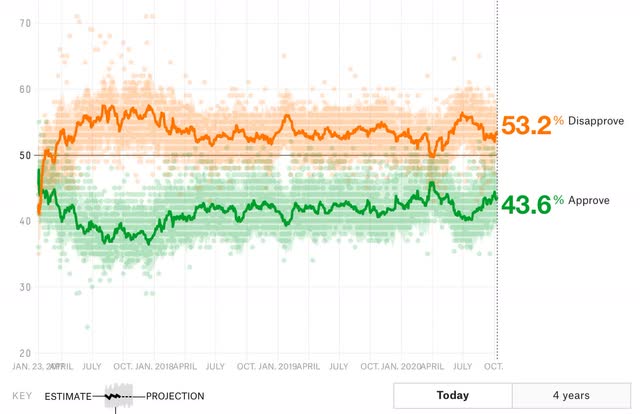
Trump has continued to have a bad October. In the past week his approval rating declined by another -0.8%, while his disapproval rate rose a full 1.0% to 53.2% - which is still within the normal range of approval going back over 3.5 years: 


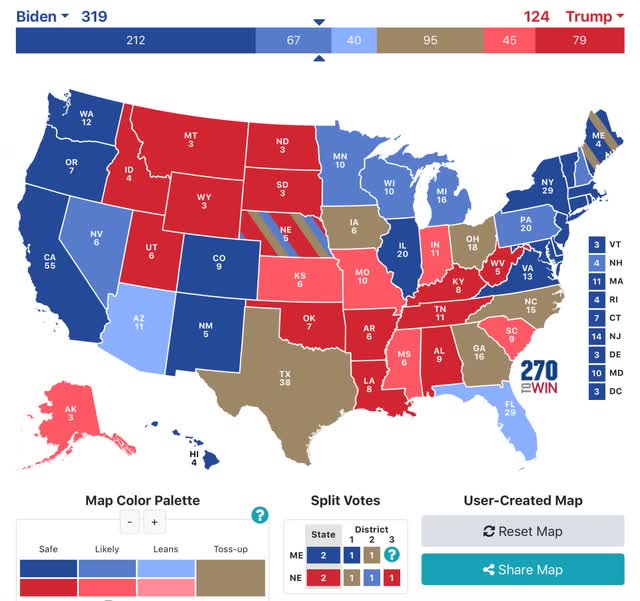
Here is this week’s updated map through October 17 for the Presidential election. To refresh, here is how  it works:

- States where the race is closer than 3% are shown as toss-ups.
- States where the range is between 3% to 5% are light colors.
- States where the range is between 5% and 10% are medium colors.
- States where the candidate is leading by 10% plus are dark colors.

A reminder: When we get to the last week before the election I will probably move any State with a 1%+ differential to “lean Democrat/GOP,” rather than stay with 3%.

 
There was something remarkable this week: not a single State changed ratings. That’s how static this race is. Biden’s “solid” plus “likely” Electoral College votes remained at 279 this week, below their peak of 302 over two months ago - but Biden still doesn’t need Florida or Arizona in order to win.

Biden’s support remained at 50%+ in Michigan, New Hampshire, Pennsylvania, Wisconsin, and Minnesota. While Arizona declined to 49%, Florida and North Carolina were 49%+. This makes it extremely hard for Trump to mount a successful comeback in those States.

Turing to the Senate, there were 5 small changes this week, as Alaska moved from toss-up to lean GOP, Maine moved from likely to lean Democrat, Montana moved from lean GOP to toss-up, and New Mexico moved from likely to solid Democrat:


At current polling, if Democrats win all those seats in which they are favored, they will have 51 Senate seats. There are also 5 races now rated “toss-ups,” as to which the most important question is how many undecided voters “come home” to the GOP candidate. Still, it is quite likely that the Democrats wind up with a majority in the next Senate.

Saturday, October 17, 2020

Weekly Indicators for October 12 - 16 at Seeking Alpha


 - by New Deal democrat

My Weekly Indicators post is up at Seeking Alpha.

What was most noteworthy about the past week is the confirmation that consumer spending, so far, has continued to hold up even as emergency Congressional assistance has been terminated for a month and a half.

As usual, clicking over and reading will bring you up to the moment on all of the important economic data, and will reward me with a penny or two in my pocket for putting the information together for you.

Friday, October 16, 2020

Real retail sales continue (inexplicably) strong, still bode well for employment


 - by New Deal democrat


This morning we got two important monthly September reports: industrial production and retail sales.

I have more to say about industrial production, and some general economic analysis about retail sales, which are pending at Seeking Alpha. I will post a link once that article goes up. UPDATE: Here’s the link: Link

For this blog, let’s focus on how real retail sales are likely to affect employment. 

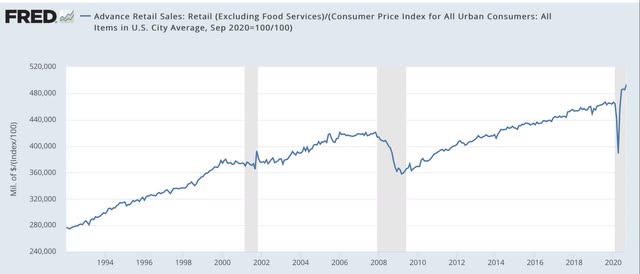
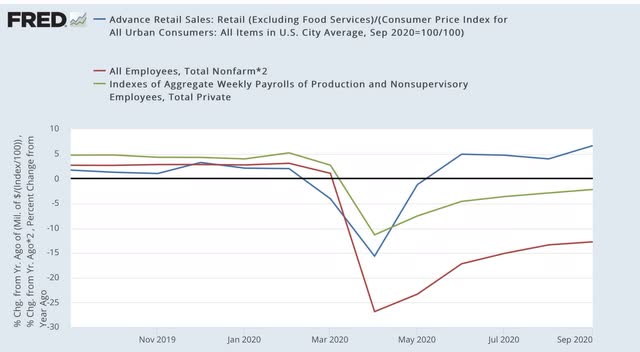
Just to start, here is are CPI adjusted retail sales. You can see that they have actually jumped once the Congressional stimulus kicked in, and have remained well ahead of pre-pandemic levels:


As I have said many times in the past, consumption slightly leads employment. It has almost universally done so for the entire 70+ year history that both measures have been kept. Basically, demand for goods and services drives hiring to fulfill that demand (or at least to an increase in hours employed) typically within a few months later.

I am frankly very surprised that sales have held up in the past several months, despite the ending of emergency Congressional assistance. But done so they have - although it may largely be a function of seasonal distortions caused by the pandemic.

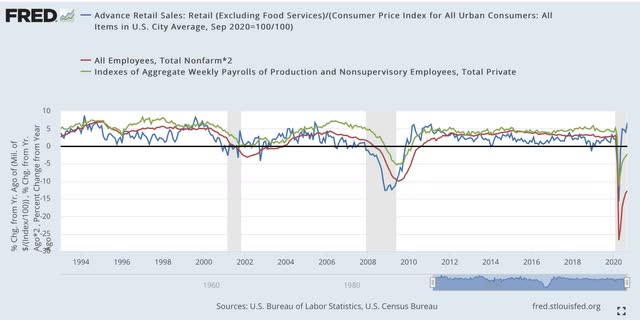
But, turning to employment, historically consumption has led employment (/2) by several months (albeit with lots of noise), and has an even closer relationship with aggregate hours (all shown YoY below):


Here is a close-up on the past year:


Because sales have made a full recovery, and indeed on a YoY basis are accelerating, I expect employment and hours worked to continue to show gains for the next several  months, although at a slower pace similar to what we have seen in the August and September reports. 

Thursday, October 15, 2020

Jobless claims: only one week’s data, but cause for significant concern


 - by New Deal democrat

Today marked the biggest increase in new jobless claims in two months, and one of the two biggest increases since May, while the slightly lagging continuing claims continued to decline.

On a non-seasonally adjusted basis, new jobless claims rose by 76,670 to 885,885. After seasonal adjustment (which is far less important than usual at this time), claims rose by 53,000 to 898,000. The 4 week moving average also increased by 8,000 to 866,250: 


Here is a close-up of the last four months highlighting the overall glacial progress in initial claims since the beginning of August:


Continuing claims declined on a non-adjusted basis declined by -1,188,202 to 9,631,790. With seasonal adjustment they declined by 1,165,000 to 10,018,000. On the bright side, both of these numbers are new pandemic lows:


 Continuing claims are now about 60% below their worst level from the beginning of May, but remain about 3 to 3.5 million higher than their worst levels during the Great Recession.

Only one week’s data, but it is a significant concern that claims have risen, after largely stalling for two months. The situation is at best only improving at a snail’s pace, and at worst is deteriorating again as we head into winter and a likely renewed increase in COVID cases.

Wednesday, October 14, 2020

Coronavirus dashboard for October 14: winter is coming


 - by New Deal democrat

Total US confirmed cases: 7,806,805*
Average cases last 7 days: 51,038
Total US deaths: 215,887
Average deaths last 7 days: 714

*Actual cases probably more like 14 million, or over 4% of the US population

Source: COVID Tracking Project

Today let’s take a look at the most recent upsurge in COVID not just in the US, but in the entire West.

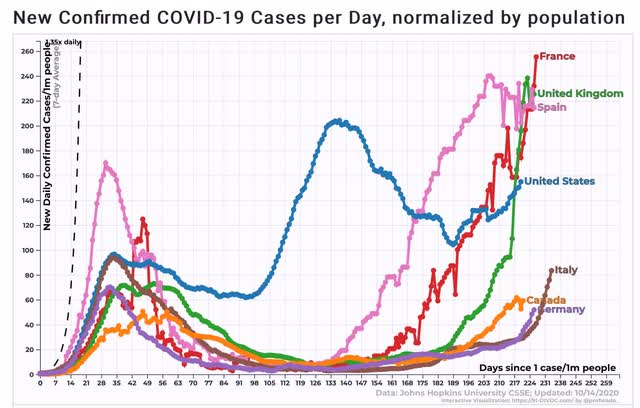
Here is the 7 day average of new cases per capita in the US, Canada, and the 5 most populous countries in Europe:


Every single country, even Germany, is experiencing an upsurge. France, Spain, and the UK are having an even worse outbreak than the US.

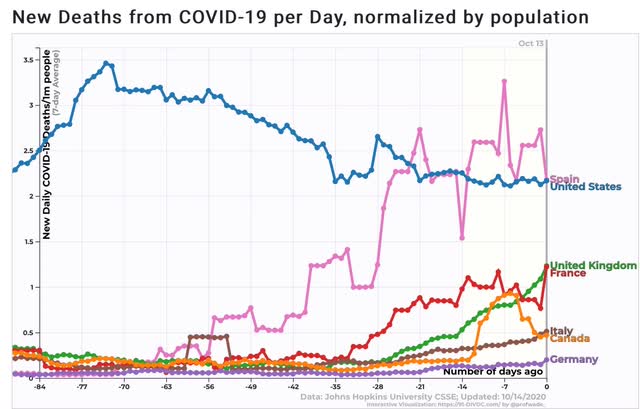
Here are deaths per capita. Note that this graph only shows the past 12 weeks. Early on the US, UK, Spain and Italy all had daily deaths on the order of 14 to 18 per capita, dwarfing everything since:


We know that these will follow new cases with a 2 to 4 week lag. Spain already exceeds the US. France and the UK are following behind.

All things considered, Canada and Germany are still doing quite well. But the increase in cases there certainly points to how hard it is to keep this virus contained.

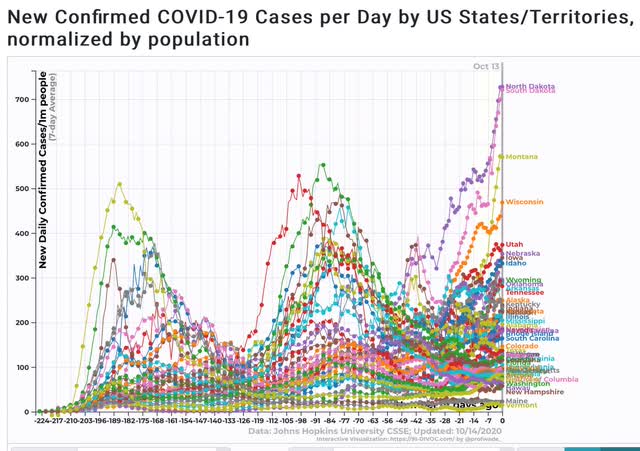
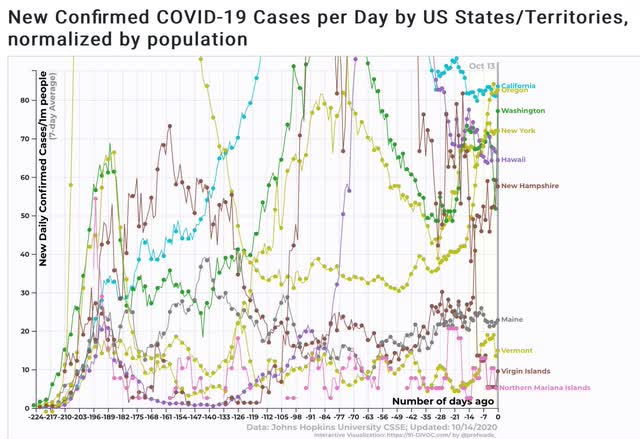
Within the US, here is the spaghetti chart of cases in all 50 States plus DC and the territories:


Note that the Dakotas and Montana now have worse outbreaks than even NY did in April.

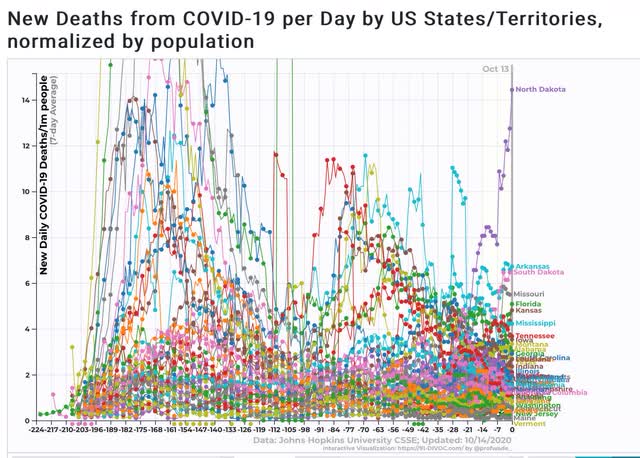
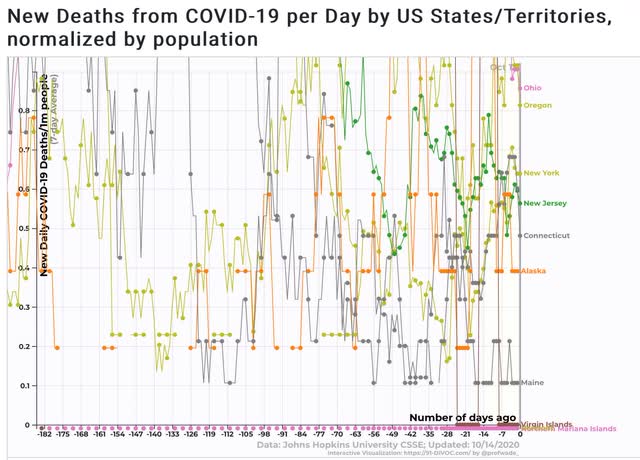
Here are deaths:


In April, NY had deaths of about 50 per capita every day, so even North Dakota, at 14 per day, while the worst since then - even surpassing Arizona’s summer spike - is nowhere near that bad - yet.

Here are the bottom 10 jurisdictions for infections:


Only Maine and Vermont among the 50 States still have the pandemic controlled.

Finally, here are the bottom 10 for deaths:


Again, only Maine and Vermont have still fully contained the virus.

And winter is coming.

Tuesday, October 13, 2020

Consumer prices rise a “normal” 0.2% in September


 - by New Deal democrat

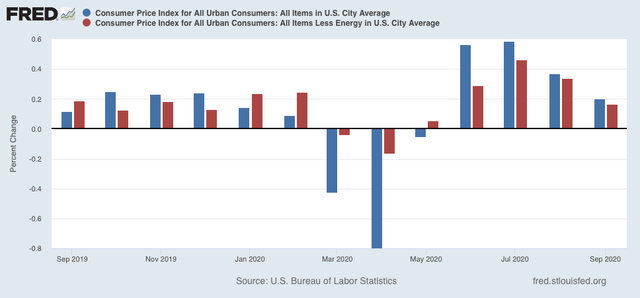
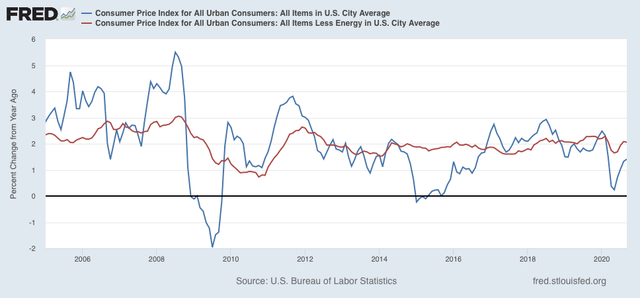
In September Consumer prices rose a “normal” 0.2%, the first such typical increase since the pandemic began (blue in the graph below):


For the past 40 years, recessions had typically happened when CPI less energy costs (red) had risen to close to or over 3%/year. We are nowhere near that now (last 15 years shown in graph):


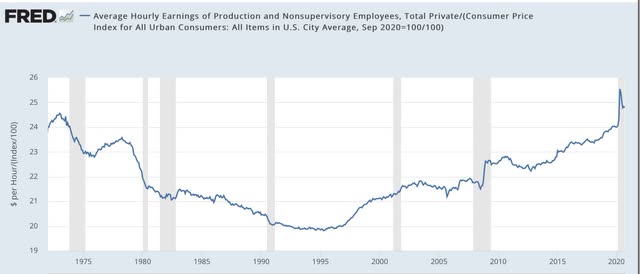
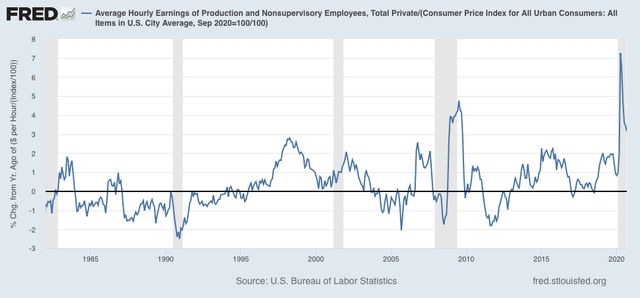
Because wages are “stickier” than prices, typically as recessions beat down prices (or at least price increases), in real terms wages rise. That has been the case for the coronavirus recession as well:


As a result, as I’ve noted for the past several months, real hourly wages for non-supervisory workers have finally exceeded their previous 1973 peak:


Of course, this is also because lower wage workers disproportionately lost their jobs during the pandemic. Until several months ago, they were buoyed by emergency Congressional assistance. One of the big mysteries in the past few months is why the expiration of those benefits has not caused a steep drop in consumer spending. Retail sales will be reported on Friday, and that is when we will know the answer for September.

Monday, October 12, 2020

College educational attainment by age demographic


 - by New Deal democrat


There is no economic data today due to the Columbus Day observance.


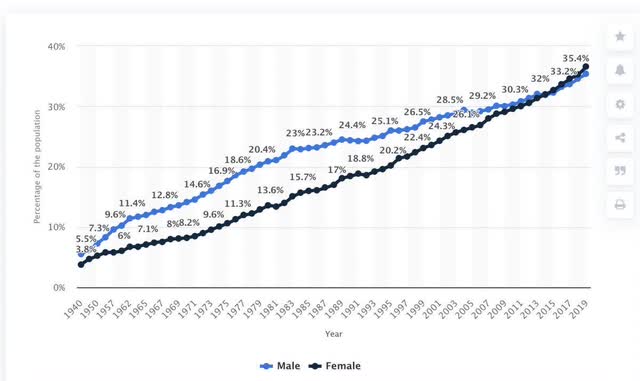
So let me drop this graph of a metric I have been trying to find, of college educational attainment by age demographic, that I finally came across a couple of days ago:


It is a commonplace that among Whites at least, support for Democrats is highly correlated by college education. What is unclear is whether that is actually a function of education itself, or is simply confounded by age group.

The above graph shows are steady rise in the percentage of both men and women with college degrees over the past 80 years. But we know that the strongest support for the GOP, and for Trump in particular, is in the age cohort of younger Boomers and the first half of Gen X, roughly birth years 1960-1970. That equates with college degrees being granted about 20 years later, from 1980 to 1990 or so.

Yet there is no notable exception in the growth of the percent of college educated persons during the 1980s. That strongly suggests that it was the condition of the economy in particular during the 1970s and 1980s that led to such strong GOP identification among that age group, rather than their educational attainment.

I still haven’t found any good information that provides cross-tabs on both educational attainment and age group, to more specifically sort out the strongest correlation. So for now, this will have to do.

Sunday, October 11, 2020

The 2020 Presidential and Senate nowcast: birds coming home to roost


 - by New Deal democrat


Here is my weekly update on the 2020 elections, based on State rather than national polling in the past 30 days, since that directly reflects what is likely to happen in the Electoral College. 

Now that we are only 23 days from Election Day, let me update and revise a few comments. First of all, while polls are really only nowcasts - snapshots of the present, rather than forecasts - at this point they are probably only about 2% off the final result: 


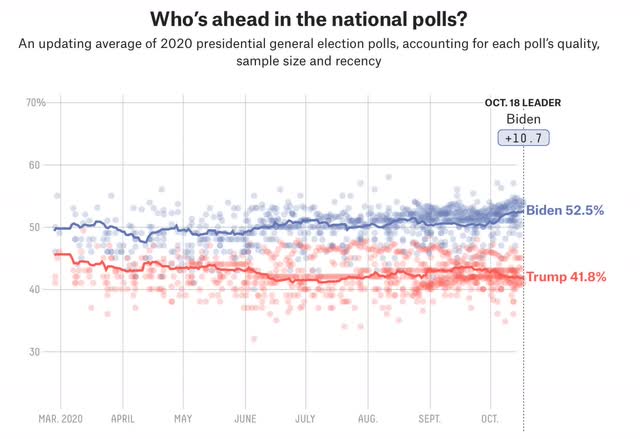
At the moment, according to 538, Biden is up 52.2% to 41.9%. Even if each % moved 2% favorable to Trump, that would still be a 50.2% to 43.9%, or 6.3%, advantage for Biden. That’s a pretty solid lead.

A dditionally, all of the important COVID and economic information is already “baked in the cake.” There is nothing that is going to greatly change perceptions for either outlook (unless one of Trump’s inner circle were to die of the disease). The one issue that is likely to be very front and center in the next several weeks is the Supreme Court. So far I have not seen any polling indicating which if either of the candidates might benefit.

Further, I expect that we are already seeing marginal voters “come home” to their respective parties, as will be apparent in the maps below. 

Because of the vast increase in the numbers of early voters in States where voting is already underway, it’s not clear at all that polls in late October or the first several days of November should receive increased weight. Beginning next week, my plan is to slightly increase the weighting of any polls conducted during October vs. September, and leave it at that. 

Finally, because the polling has become extremely persistent, when we get to the last week before the election I will probably move any State with a 1%+ differential to “lean Democrat/GOP, rather than stay with 3%.

With those statements out of the way, here is this week’s update.

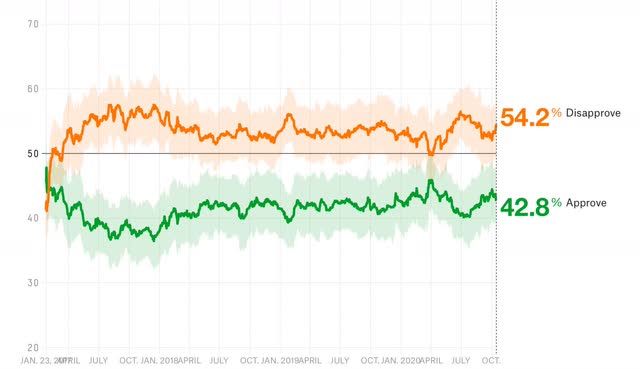
Trump had a particularly bad past 12 days - and as a presumed result of which, his approval rate has declined all of -0.6%, while his disapproval rate has increased by +0.9%. Needless to say, this is well within the normal range of approval going back 3.5 years: 


Here is this week’s updated map through October 10 for the Presidential election. To refresh, here is how  it works:

- States where the race is closer than 3% are shown as toss-ups.
- States where the range is between 3% to 5% are light colors.
- States where the range is between 5% and 10% are medium colors.
- States where the candidate is leading by 10% plus are dark colors.


Two weeks ago there were a number of changes adverse to Biden. This week they have all disappeared. Additionally, both Indiana and Mississippi went from “solid” to “likely” GOP, on the basis of relatively weak new polls. But most importantly, Florida has moved back from toss-up to “lean Biden.” I have seen lots of information that seniors have decisively soured on Trump, and it appears to be showing up there.

Biden’s “solid” plus “likely” Electoral College votes remained at 279 this week, below their peak of 302 two months ago. In other words, Biden doesn’t even need Florida or Arizona in order to win.

Biden’s support also improved to 50%+ in Arizona, in addition to Michigan, New Hampshire, Pennsylvania, Wisconsin, and Minnesota. This makes it extremely hard for Trump to mount a successful comeback in those States.

Turing to the Senate, there were 3 changes: Montana went from toss-up to “lean GOP,” while Iowa, importantly, went from toss-up to “lean Democrat.” Additionally, we have more clarity in the 2nd Georgia “jungle primary” election. It appears that Democrat Warnock will make it through to the finals. But once there, the combined GOP vote looks to be nearly 10% more than the combined Democrat vote. I have thus moved the race to “likely GOP”:


At current polling, if Democrats win all those races in which they lead, they will have 51 seats. The number of “toss-ups” has declined to 5.

A Biden victory and a majority Democrat Senate looks increasingly likely, which is probably why we are beginning to see a few Senate Republicans publicly put distance between themselves and Trump.


Saturday, October 10, 2020

Weekly Indicators for October 5 - 9 at Seeking Alpha


 - by New Deal democrat

My Weekly Indicators post is up at Seeking Alpha.

Because the pandemic so quickly and completely put the economy in a coma back in April, and the economy remains at severely depressed levels by most metrics compared with a year ago, in June I started to compared current levels with the worst pandemic readings.  This week I went further, and calculated the best readings since the pandemic began for most indicators, and am tracking those as well.

The results as of now confirm that the economy has *slowly* continued to improve into the autumn compared with summer.

As usual, clicking over and reading will give you a comprehensive look at where the economy is right up until this week, and it will also reward me with a penny or so for my efforts in keeping you up to date.

Friday, October 9, 2020

Coronavirus dashboard for October 9: everybody has to touch the hot stove at least once


 - by New Deal democrat

Total confirmed US infections: 7,605,218*
Average infections last 7 days: 46,869

Total US deaths: 212,762
Average deaths last 7 days: 717

*Actual number is probably 5 to 7 million higher, or about 4% of the total US population
Source: COVID Tracking Project

In the last 4 weeks, the average number of new infections has risen again. Here is the breakdown by regions: 


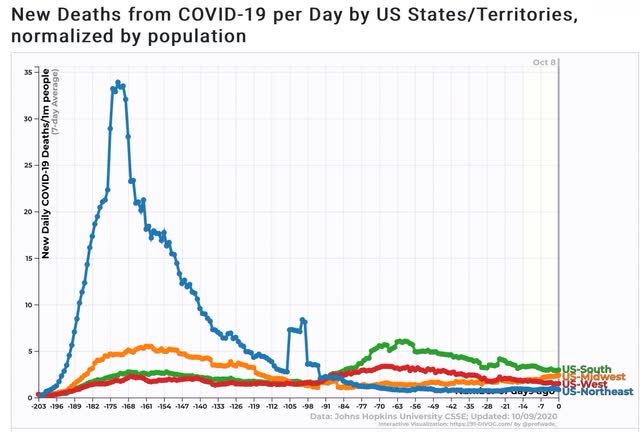
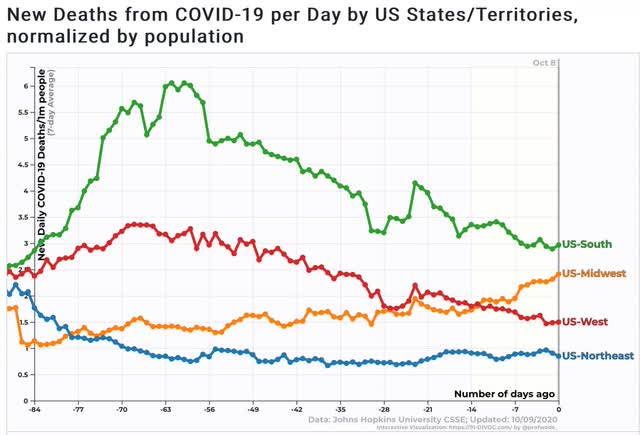
Here is the same for deaths:

 
The early outbreak in the NYC metro area remains the single most deadly outbreak per capita by far. So here is the rate of deaths for the past 12 weeks:


The South and parts of the West, which were the epicenters of the second outbreak during the summer, have seen their numbers decline, while the Midwest in particular has seen its number increase sharply. The increase in the Northeast is primarily being driven by Massachusetts and Rhode Island, although NY and NJ have seen significant new  increases as well.

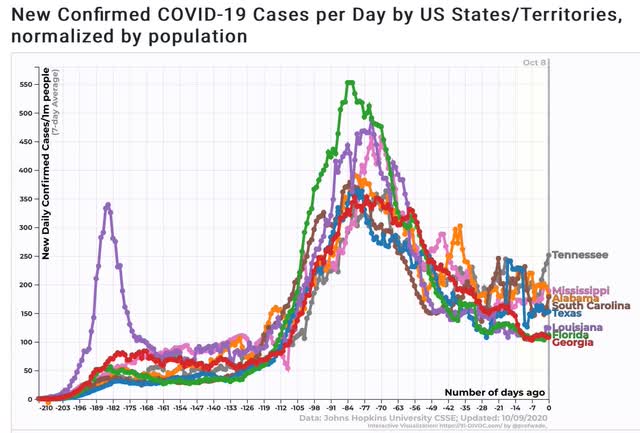
What we have seen since the pandemic started is that, when it gets out of control, there is a pain threshold after which States take action - like enforcing mask wearing and closing bars - and individuals get serious about limiting their exposure, that brings the rate of new infections down. A very good example is in the below graph, which tracks those States in the Sou th which were at the epicenter of the summer outbreak:


All of them (except Tennessee) have seen their rates of infection decline by more than 50% since then.

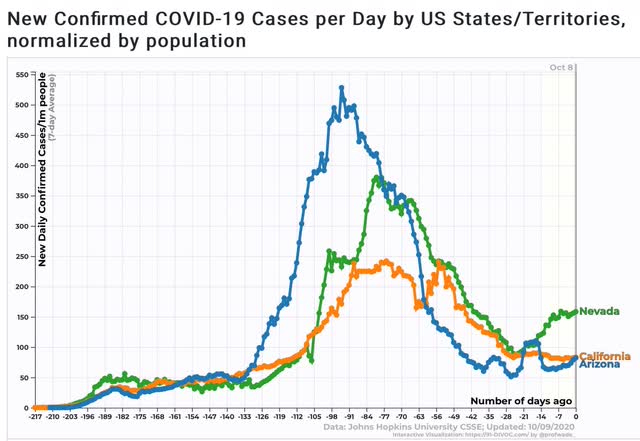
The same is true for Arizona, California, and Nevada in the West:


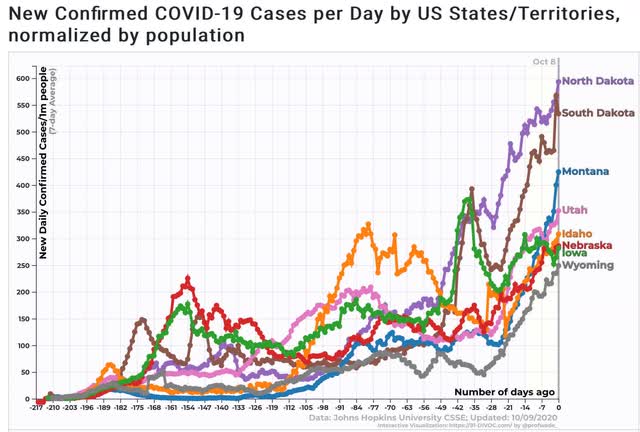
Meanwhile, States in the Upper Midwest and Mountain areas, which had very low infections rates during the first few months of the pandemic, were lax and have let their infection rates grow out of control:


They are now reaching the pain threshold, so we can expect counter-measures to finally be enacted, or taken voluntarily by individuals, to stem the spread.

It seems that every State in every region has to learn the hard way. Getting lax leads to severe outbreaks, which leads to panic and vigilance - which ebbs over time in turn.