Thursday, February 27, 2020

January durable goods orders show no important weakening


 - by New Deal democrat

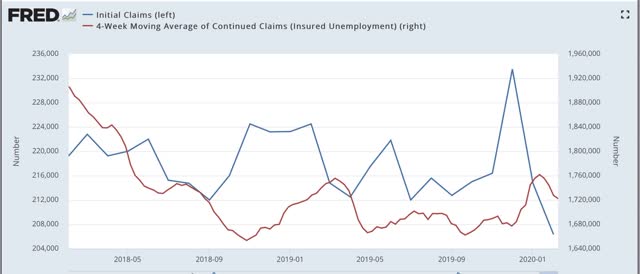
Just to update: neither initial jobless claims nor continuing claims met either of my thresholds for concern this week. Both are below their levels a year ago, and the four week average of initial claims is less than 5% above its lows for this expansion.

Ordinarily I don’t pay too much attention to durable goods orders, because they are too volatile, but because consumer durable goods orders are an important marker for how well the consumer is holding up, they are particularly worth a look now.

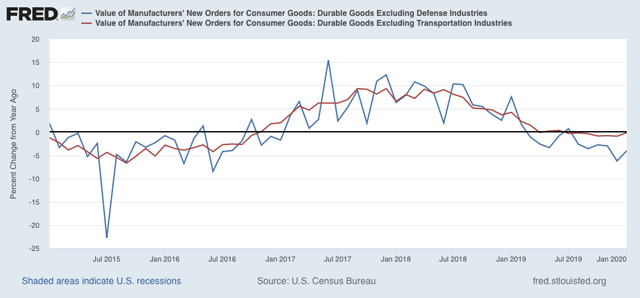
Here the news for January was positive, as both non-transportation and total consumer durable goods orders improved slightly:


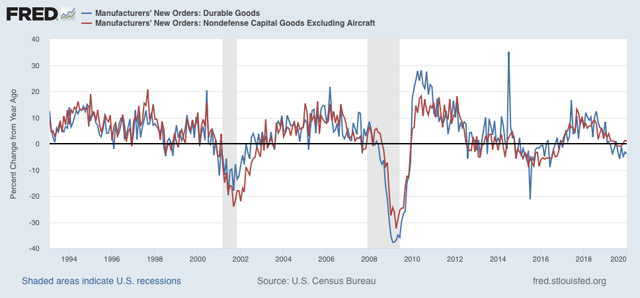
The former is flat YoY, while total orders are down, but no moreso than during 2015-16:


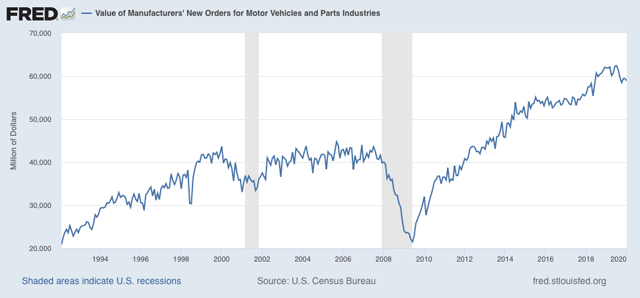
One important soft spot, however, is motor vehicle orders:


But these aren’t down as much as they were before the 2001 producer-led recession.

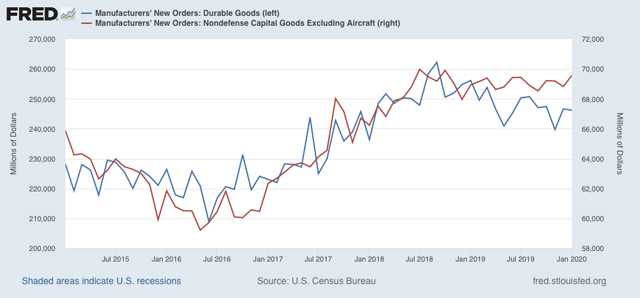
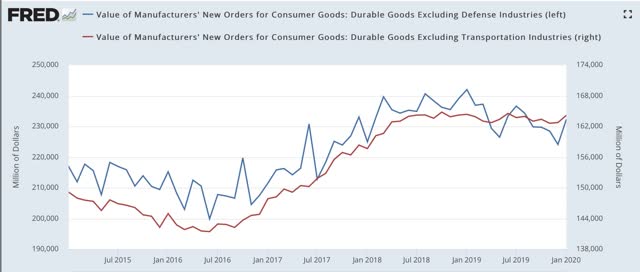
Broadening out from consumers, total manufacturers’ new orders declined slightly, while “core” manufacturer’s new orders improved:


Because the latter excludes Boeing, which is having unique problems now, I think the former is more important at this point. Again, we aren’t down as much YoY as we were right before the 2001 producer-led recession:


Bottom line: no worsening in January, except for the important motor vehicle industry.

Wednesday, February 26, 2020

The impact of coronavirus on my slowdown vs. recession forecast


 - by New Deal democrat

For roughly the last half year, my forecast has been that a slowdown without a recession was the most likely scenario, *IF* the economy were left to its own devices.

Well, given the horror scenarios possible with the coronavirus outbreak, the economy is certainly not being “left to its own devices.”

I took a look at how that intersects with my forecast over at Seeking Alpha.

As usual, clicking over and reading should be helpful to you, and rewards me a little bit for my work.

New home sales complete data confirming rebound


 - by New Deal democrat

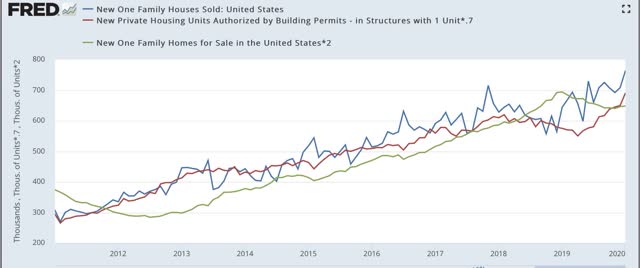
This morning’s new single home sales report for January came in at the highest level since July 2007.    As a brief reminder, this series is probably the most leading of all housing data, but it is extremely volatile and heavily revised, so as always take this initial number with a grain of salt.

In any event, here is a graph covering the last nine years since the bottom, showing sales (blue), single family permits (red, *.7 for scale), and inventory of new homes for sale (green, *2 for scale):


Both permits and sales are at new expansion highs. The difference is that permits are *much* less volatile. Note that inventory, as always, is lagging, being slightly above its bottom this past November.

I’ll have a much more extensive look up at Seeking Alpha later, and will link to it here. For now, the takeaway is that, except for the very real concern about coronavirus, housing strength would completely negative a recession in the near future.

Tuesday, February 25, 2020

Housing: prices follow sales, February 2020 edition


 - by New Deal democrat

One of the consistent things I have written about the housing market for going on 10 years is that interest rates lead sales, and sales in turn lead prices. Last week with the continued increase in housing starts and permits we got further proof of the former, and this morning with the release of several house price indexes, we got further proof of the latter.

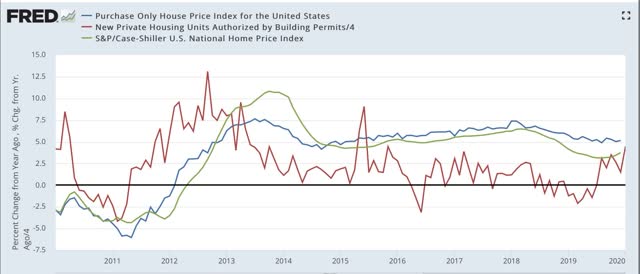
Below I show the FHFA house price index (blue), Case Shiller national house price index (green), and housing permits (red, /4 for scale). Because prices are seasonal, I show all of these metrics YoY:


The trough for permits YoY was last March. The trough for both the FHFA and the Case Shiller indexes was last August. The YoY change increased m/m for the FHFA from 4.9% to 5.1% in December. For the Case Shiller national index the YoY rate of change increased from 3.5% to 3.8%.

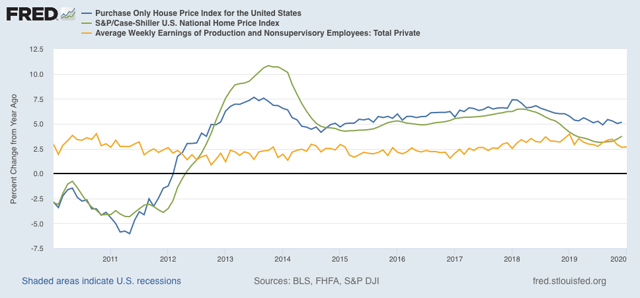
Although median household income is the best measure, since it is not available m/m from government sources, as a proxy the below compares average weekly earnings for non-supervisory households (gold) with both the FHFA and Case Shiller indexes:


Earnings have not kept pace with house price increases. What is undergirding the upswing in housing sales is the steep decline in interest rates since the end of 2018.

Monday, February 24, 2020

An updated look at transportation


 - by New Deal democrat

Production of goods and their transport to market should generally move in unison. A month ago I took an extended look at why most analyses of transportation were too bearish. This is of heightened interest because the coincident data on production, sales, and income are all so close to recessionary levels.

Well, we have another month of data, so it’s time for an updated look. This post is up at Seeking Alpha. As usual, clicking over and reading puts a penny or two in my pocket.

Sunday, February 23, 2020

Live-blogging the Fifteenth Amendment: February 22, 1869


 - by New Deal democrat

On February 22, the Senate took up the revisions that the House of Representatives had made to their proposals from one week prior. The House had struck from the Senate’s version, as sent to the House, the section extending the protections of the Amendment to qualifications for office, as well as the companion Amendment reforming the Electoral College.

Senator Stewart (Republican from Nevada) proposed that the Senate disagree with the House and send back the following version:

The right of citizens of the United States to vote and hold office shall not be denied or abridged by any State on account of race, color, nativity, property, creed, or previous condition of servitude. 
The Congress by appropriate legislation may enforce the provisions of this article.

Stewart moved that the Senate ask for a conference committee to iron out their differences. There was dismay that the House was insisting on having its exact way as to this amendment, as had been the case for the past number of years as to all legislation, and that the attempt to reconcile their differences might be futile. 

The Senate decided to put off voting on the proposal for a day. 

Source: Congressional Globe, 40th Congress, 3rd Session, pp. 1440-42.

Saturday, February 22, 2020

Weekly Indicators for February 17 - 21 at Seeking Alpha


 - by New Deal democrat

My Weekly Indicators post is up at Seeking Alpha.

Aside from the sudden improvement in new manufacturing orders I wrote about earlier this week, the significant changes have moved from the short leading forecast to the coincident nowcast.

Clicking through and reading will give you the reason I say that, and as usual reward me a little bit for my efforts.

Friday, February 21, 2020

Production, transportation, and sales show a stalled economy


 - by New Deal democrat

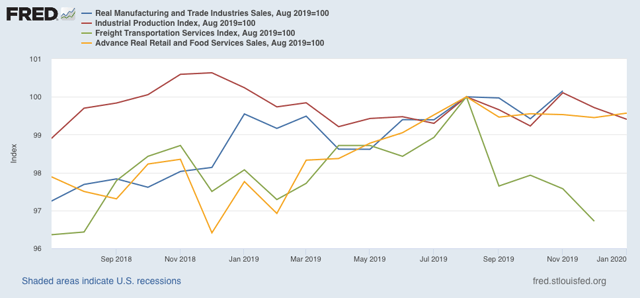
Below is a graph I put together in a discussion of transportation that I’ll probably post next week at Seeking Alpha.

The idea behind the graph is that (1) everything that is produced needs to be transported to market; i.e., the two metrics should move essentially in tandem (this is known as the “Dow theory” in financial markets); and (2) sales also ought to reflect - and slightly lead - what is being transported to market, since production is geared to match anticipated sales.

Anyway, here it is:


The blue and gold lines are two measures of sales. The green line is retail, the blue also adds manufacturing and wholesale sales to retail. Both are inflation-adjusted. The red and green lines are production and transportation, respectively. All are normed to 100 as of last August.

What we see is that production, transportation, and sales are all either flat or down since then. Although I didn’t include it, real personal income is only up +0.2% since then. Only jobs continue to show significant growth.

In short, since 6 months ago the economy has been in a very real slowdown, and in many respects has stalled.

Note that this is a nowcast, not a forecast, so you shouldn’t project this forward. But given how badly coronavirus is affecting China’s output, if the economy otherwise remains weak for the next several months, that might be enough to tip it into contraction.


Thursday, February 20, 2020

Housing analysis at Seeking Alpha; updated jobless claims


 - by New Deal democrat

I have a more detailed analysis of yesterday’s very positive housing permits and starts data, and what it means for the economy for the rest of this year, over at Seeking Alpha.  As usual, clicking over and reading helps reward me a little bit for my efforts.

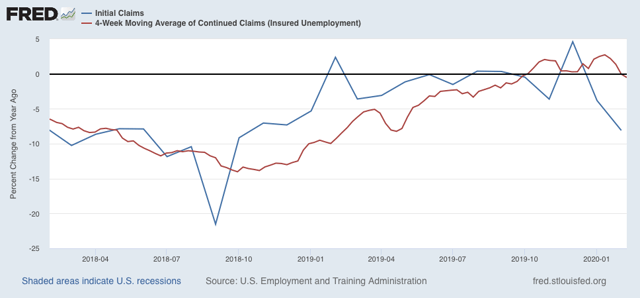
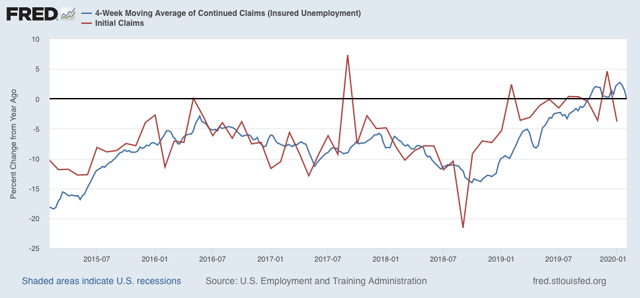
This morning’s weekly jobless claims report continues the recent string of very positive numbers. Here’s the updated graph of the monthly average of initial claims, plus the 4 week average of continuing claims:


And here is the same information graphed YoY:


There isn’t going to be a recession so long as jobless claims stay close to their lowest levels and are lower YoY.

Wednesday, February 19, 2020

Housing continues to surge


 - by New Deal democrat

Low interest rates continue to fuel a strong upsurge in new housing construction.

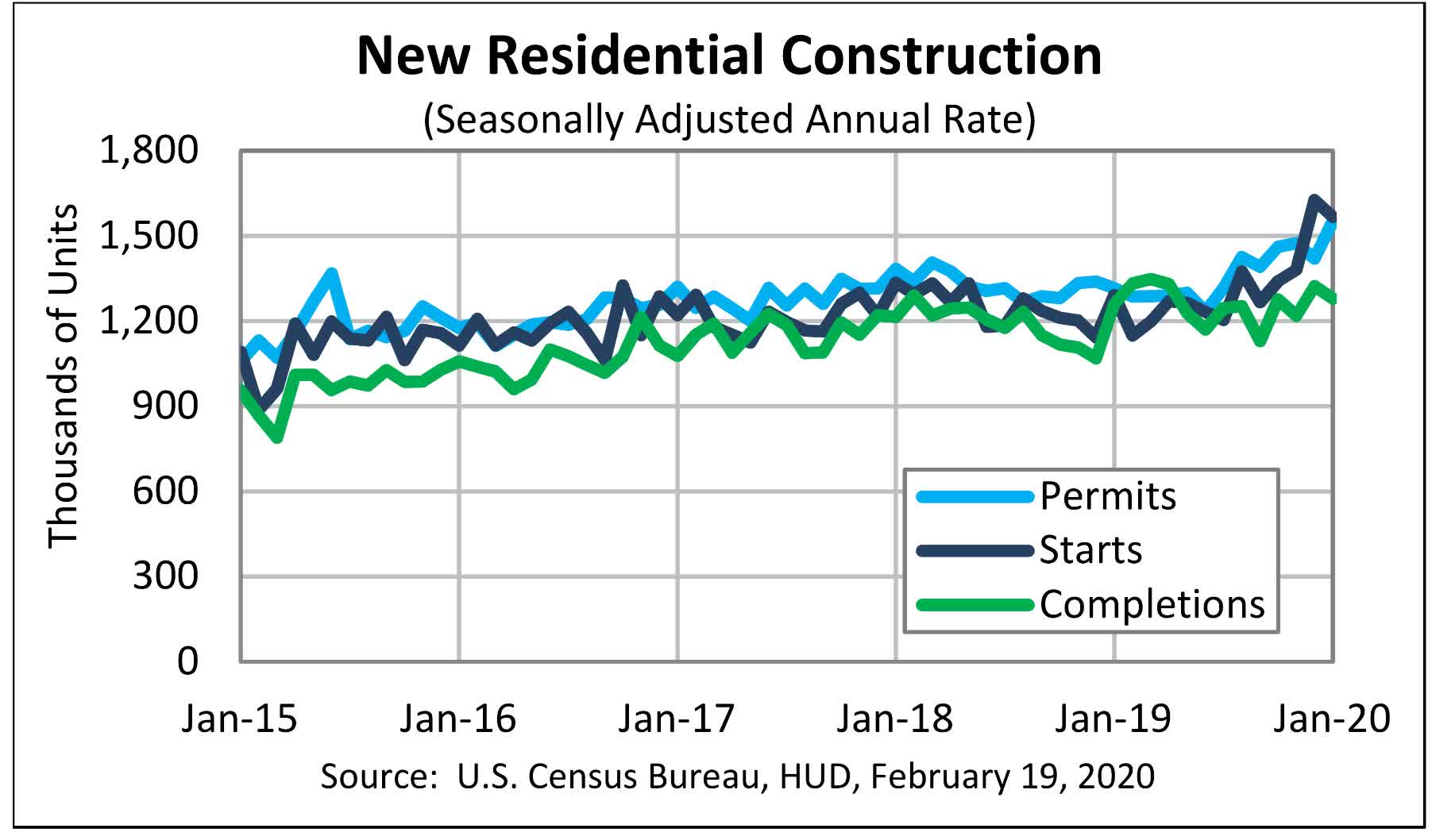
I’ll put up a more detailed post later, but for now simply note that housing permits, both overall and for the less volatile single family housing component, made new expansion highs, at levels not seen since 2007. Housing starts backed off from December - but to only the second highest numbers of the entire expansion.

Here’s the graph from the Census Bureau:


This is extremely bullish for the economy at the end of this year and into next year.

Tuesday, February 18, 2020

Regional Fed Manufacturing Indexes Improving


 - by New Deal democrat

It’s been a really slow newsweek so far, with no important data until tomorrow.  Until then, here’s a note of interest.

This morning's Empire State Manufacturing Survey was the third regional report in a row (after Richmond and Dallas in the last week of January) to show a strong rebound in strength, as the new orders index jumped 15.5 to 22.1 (values over zero indicate improvement).

Here’s what the average of the five regions look like as of now (this is taken straight from my weekly update):

Regional Fed New Orders Indexes
(*indicates report this week) 
The regional average had been only +3 only 3 weeks ago. A reading of +13 shows pretty strong growth on the order of what we saw in 2018.
Between coronavirus fears and always the possibility that Tariff Man launches new trade wars, I’m not making any promises about where this goes from here. But for now, a clear rebound in manufacturing.

Saturday, February 15, 2020

Weekly Indicators for February 10 - 14 at Seeking Alpha


 - by New Deal democrat

My Weekly Indicators post is up at Seeking Alpha.

Several of the coincident indicators that turned positive one week ago turned right back to negative this week. The bifurcation between the producer and consumer sides of the economy continues.

As usual, clicking over and reading should be educational for you, and ever so slightly enumerative for me.


Friday, February 14, 2020

Real retail sales continue flat in January; production sector still in recession


 - by New Deal democrat

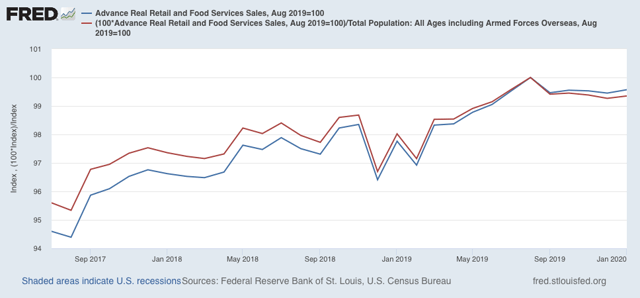
Retail sales increased nominally by +0.3% in January, while December was revised downward by -0.1%, for a net gain of +0.2%. Since consumer inflation increased by +0.4% during those two months, real retail sales were unchanged.  On a per capita basis, they declined less than -0.1%.

This means that neither real retail sales, and real retail sales per capita have made new highs since last August. The former is off -0.4% and the latter -0.6%. Here are both measures, normed to 100 as of then:


As I’ve noted several times recently, We’ve had similar periods of flatness previously during this expansion, for example late 2018 as shown in the above graph. It would still take one more month of a reading below the August peak for me to flip this to neutral. For now it remains a very weak positive.

The bottom line is that, while there is some flatness, there are no signs of the consumer actually rolling over. 

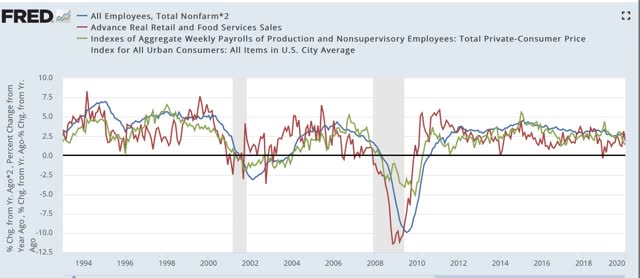
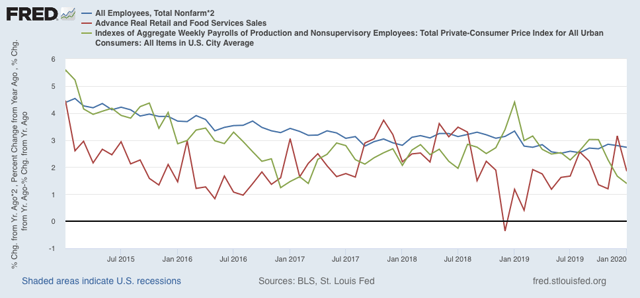
At the same time, this may signal a cooling in employment gains in the next few months, as real retail sales (red in the graph below) tend to lead jobs (blue), and are an even better fit for aggregate payrolls (green), first over the past 25 years:


And here is a close-up view of the past five years:

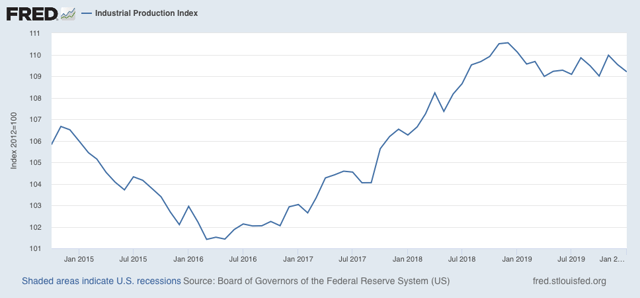
Meanwhile, industrial production, the King of Coincident Indicators, declined -0.3% in January. It is back where it was last July, and still more than 1% below where it was at its December 2018 peak:


Note that the decline is not nearly so severe as the nearly -5% decline of 2015-16.

Together, industrial production and real retail sales tell us that the production sector remains in recession, while the consumer sector, while not contracting, has been treading water for nearly a half year.

Thursday, February 13, 2020

Live-blogging the Fifteenth Amendment: February 9, 1869 (2) The Senate votes to reform the Electoral College


 - by New Deal democrat

As I mentioned several days ago, the Senate endured a pair of marathon sessions on February 8 and 9, 1869, and considered a variety of subjects. Perhaps most breathtakingly, they discussed further amending the Constitution to ensure that the winner of the popular vote was elected President.
Sen. Morton [Republican, Indiana]: I desire to renew the amendment I offered in regard to electing electors directly by the people.... It is very important. It will popularize the whole thing ...: 
Article XVI
“[As to the Electoral College,] each State shall appoint, by the vote of the people thereof qualified to vote for Representatives in Congress, a number of electors equal to the whole number of Senators and Representatives to which the State may be entitled to in the  Congress; but no Senator or Representative, or person holding an office of trust or profit under the United States shall be appointed an elector; and the Congress shall have power to prescribe the manner in which such electors shall be chosen by the people.” 
....  
Sen. Cameron [Republican, Pennsylvania]: I do not see how I can vote for that amendment. If he will allow the people to vote directly for President and Vice President, I will agree to any amendment he will offer for that purpose; but I cannot see what we shall gain by this proposed amendment. If the people are allowed to vote at once for President and Vice President and you count the votes all over the United States, that will come up to the notion which I have held for a long time on the subject, for I think the people ought to be brought directly in contact with the candidates for whom they vote.
Sen. Morton:... It is now left to the legislature. The legislature may elect the electors themselves.... This amendment requires these electors be appointed directly by the people, and leaves to Congress the mode of regulating that appointment....
Sen. Harlan [Republican, Iowa]: ... [is it] contemplated by the honorable Senator that an elector may be elected from each Congressional district, or by districts to be arranged by Congress in each State?
Sen. Morton: It gives the power to Congress to require election by districts; it leaves the manner of election to Congress just as it is now left in regard to Representatives.
Sen. Frelinghuysen [Republican, New Jersey]: [would] Congress [ ] not also have the power to provide by law for minority representation under that?
Sen. Morton: I suppose it would ....
....
Sen. Sherman [Republican, Ohio] : The only change, if I correctly read it, is that the Legislature shall not itself elect the electors, but it may either require them to be elected by a general ticket or by a separate district vote. 
.... Sen. Fessenden [Republican, Massachusetts]: It gives Congress the power to change it.

The amendment was passed, 37-19.

Sen. Edmunds [Republican, Vermont]:.... Now, it is asked that the state of Vermont shall surrender that right [to appoint Presidential electors] that belo ngs to her to Congress, who, according to their own predilections, may every four years district and redistrict that State and every other one where the majority in Congress can gain votes by it, in order to elect a part of her electors of a different political opinion from that of a majority of her people....

Sen. Morton: ... What interest can the [ ] States have in the continuation of the present anomalous condition of the Constitution on the subject of choosing electors it is impossible to see.... it is right everywhere to allow electors to be chosen by the people; and that is the substance of this provision. We know that the people everywhere desire this. The danger likely to result from the continuation of the present system has been shown on a prior occasion.... 

Sen. Buckalew [Republican, Pennsylvania]: ... the present condition of things in regard to choosing Presidents [is] in a deplorable light, and prove that there is danger ahead of difficulty in our country from the imperfect machinery of the electoral colleges. [He then discusses the election of 1824, in which Jackson won a plurality of the vote, but the House chose John Quincy Adams as President, and also the disproportionate number of electors won by the victor in 1828, 1852, and 1860].  ...[In] several other presidential elections  [1864 and 1868] ....  the popular majority, as reported, secured the result they desired. But this was fortunate or accidental rather than a certain result under our electoral system now constituted. The election of 1824 proves that a plurality as well as a minority candidate may suffer heavy loss of electoral votes and in fact be defeated. And the subsequent cases must convince us that there is danger of defeat in future elections even to majority candidates.  
The conclusion to be drawn from the facts in our political history is that at any time a candidate with a minority of the votes given to him by the people of the United States may have a majority in the Electoral College. ...[T]he committee examined the subject ... [and] acted wisely in recommending the proposition before us. It is in my opinion wise and timely ....

On third reading the proposition passed 39-16. The resolution for reforming the Electoral College under a Sixteenth Amendment, as well as the Fifteenth Amendment, passed by the required 2/3’s majority.

Source: Congressional Globe, 40th Congress, 3rd Session, pp. 1042-44.   

Ultimately we know that the proposal to enable the national popular vote to prevail in the Electoral College did not get included in the Fifteenth Amendment, nor was it passed on its own as the Sixteenth.

Of course the exact problem feared by Sen. Buckalew happened in 1876, as the popular vote winner, Samuel Tilden, with 50.9% of the vote, was passed over in favor of Rutherford B. Hayes, who had 47.9%. And twice in the last 20 years in our own time the situation has happened again, most disastrously in 2016.

But it is breathtaking to read the Senate, in 1869, foreseeing and grappling with the exact time bombs in the Electoral College that have detonated twice in our lifetimes, and passing a proposed amendment by a 2/3’s margin.

Note also the reiteration that Congress has the power to determine the manner of election of US Representatives,  by such method -e.g., general ticket voting or by districts -as they may choose, and the understanding that Congress could determine the boundaries of those districts, as well as the fear that a temporary majority in Congress could use gerrymandering of such districts to lock in electoral advantage in Presidential elections.

Utterly prescient.


Have we reached “full employment”? An update


 - by New Deal democrat

As an initial matter, this morning’s initial and continuing jobless claims report were positive as to all metrics by which I judge them. They are near the bottom of their recent ranges and/or are lower YoY (lower being good). I’ll add a graph once the info is available at FRED.  UPDATE: Here it is:


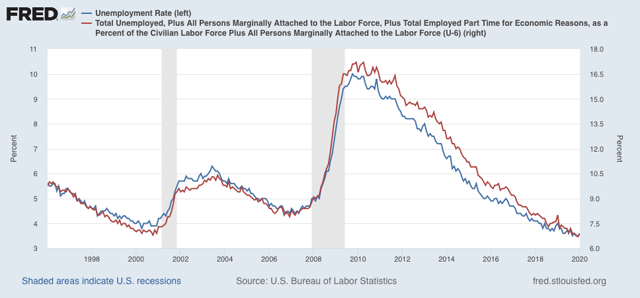
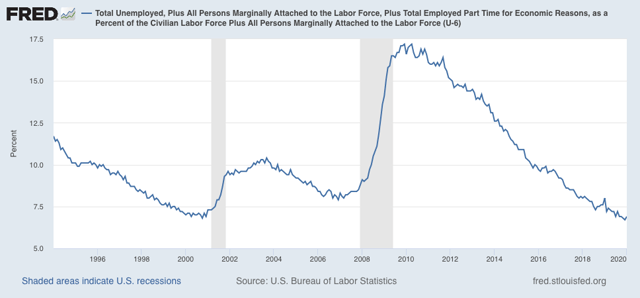
Here is something I haven’t updated in a couple of months: given recent gains in labor force participation and declines in unemployment, have we finally, by at least by some measures, arrived at “full employment”?

At 3.6% in January, the unemployment rate is only 0.1% above its November and December 65 year low (except for a few months in 1968-69). The underemployment rate, at 6.9%, is only 0.2% above its series low from December:


Similarly, even beyond that, when we add in those who aren’t even in the labor force, but say they want a job now, December remains the lowest level of all:


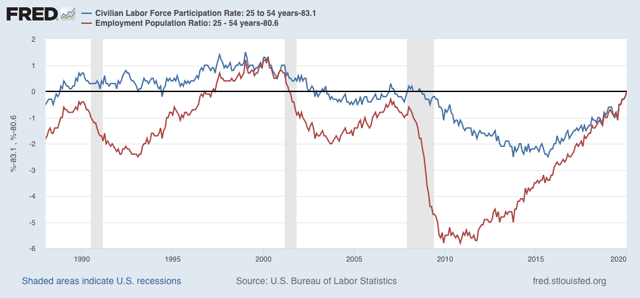
Further, among the prime age group, both participation in the labor force (blue in the graph below) and the employment/population ratio (red) jumped by a stunning +1.0% and 1.1%, respectively, just in the past six months! In the graph, the current levels for both are normed at the zero level, to show how the present level compares with earlier expansions (prior to 1987, the levels were never as high as presently):


Prime age EPOP is now above its levels at the peak of the 1980s and 2000s expansions. Only during the 1997-2001 boom was it higher. This is even more important than labor force participation, which is “(employment + unemployment)/population.” Unless you think that the 1997-2001 levels should be the norm, it certainly looks like we are at or very close to “full employment.”

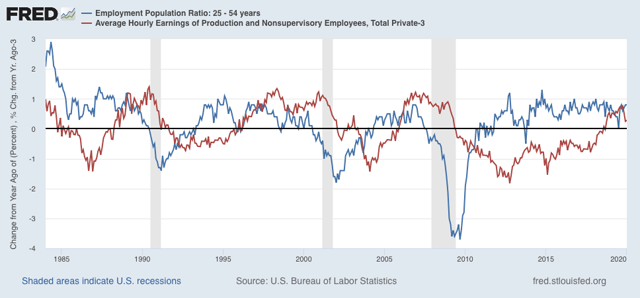
Next, here is a look at the YoY percent change in the prime age EPOP ratio compared with the YoY% growth in nominal wages (-3% for easier comparison):


There are two things I want you to pull out from this graph. The first is that wage growth very much lags employment. In terms of the economy, it is a “long lagging” indicator. Secondly, note that wage growth tends to be suppressed the bigger the entry into labor market participation. The biggest increases in participation, in the 1970s and 1980s, led to outright declines in average nominal wages. Conversely, the late 1990s, when there was both a strong economy and little movement into the labor force from the sidelines, was the one time since the 1960s that real wage growth really boomed. I suspect the slowdown in wage growth in the past few months is a result of the big surge of entrants into the labor market in the past six months.

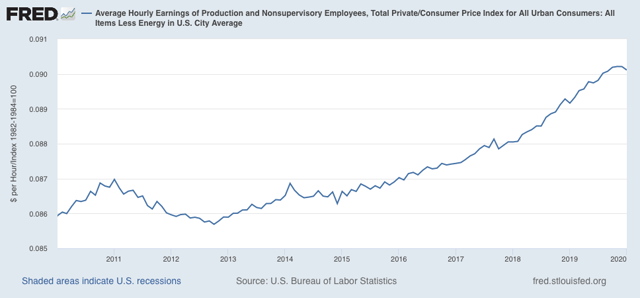
Finally, although CPI came in at only +0.1% for January, that is still higher than its 0.0% reading last January, so YoY inflation slightly accelerated. This means that real wage growth after inflation was flat. [I’ll add the graph once the data is available on FRED]. UPDATE: Here it is:


This means that real average wages for non-supervisory workers have not increased since September. Stalls like this have happened several times before during this expansion, so its not terrible, but it’s certainly not a positive either, since it tends to correlate down the line with consumer spending.

Wednesday, February 12, 2020

Where is the puzzling growth in service jobs coming from?


 - by New Deal democrat

Continuing with my week of follow-up stories based on last Friday’s jobs report, I noted last Friday that there was a completely anomalous upwards revision of nearly 100,000 jobs in the last 8 months of 2019. This after a -500,000 decrease, based on full data, in the previous 12 months!

So I took two approaches: a bottoms-up micro view, and a top-down macro view — and got contradictory answers. This post is up at Seeking Alpha.

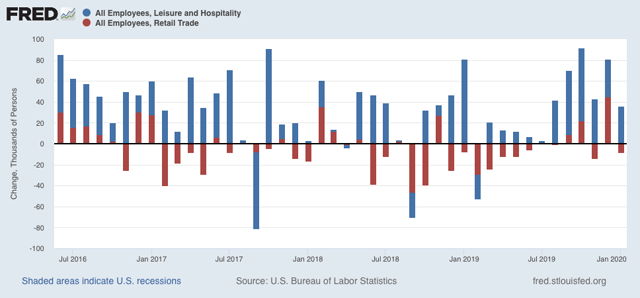
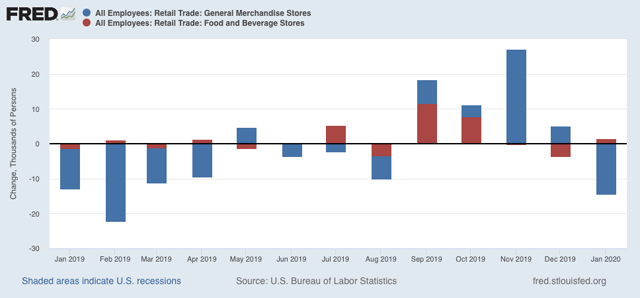
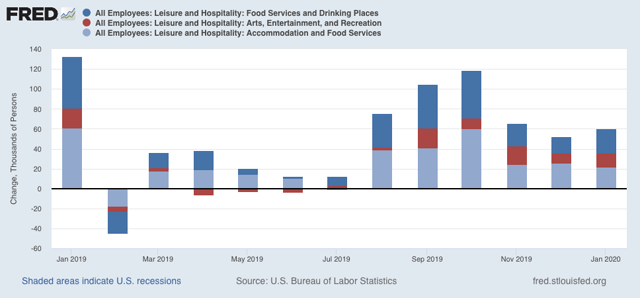
Since that article was posted, a correspondent pointed out that some of the biggest upward revisions were to the retail trade. So here are a few supplemental graphs.

First, all retail jobs plus all leisure and entertainment jobs:


Next, the sectors of retail with the biggest gains:


Finally, the sectors of leisure and entertainment with the biggest gains:


As of now, we went from outright losses in the 12 months from July 2018 through July 2019, to roughly 50,000 gains per month in the 6 months since. I have a very strong feeling that these are going to be revised down substantially in the future. Since the only contrary explanation is the surge in retail sales during last spring and summer, which ended in August, this makes this Friday’s retail sales number look even more important.

As usual, clicking over and reading the article at Seeking Alpha should be educational for you, and puts a $ or 2 in my pocket.


Tuesday, February 11, 2020

December JOLTS report continues the trend of confusing jobs data


 - by New Deal democrat

The December JOLTS report came out this morning, and it continues the streak of confusing employment data.

To recapitulate, the JOLTS report decomposes the jobs numbers into openings, hires, quits, layoffs and discharges, and total separations. Since the series is only 20 years old,  however, it only covers one full business cycle, so is of limited forecasting use.

The order in which the JOLTS series peaked during the 2000s expansion was as follows:

  • Hires peaked first, from December 2004 through September 2005
  • Quits peaked next, in September 2005
  • Layoffs and Discharges peaked next, from October 2005 through September 2006
  • Openings peaked last, in April 2007 
I’ll treat these in that order, below.

So to start, here are YoY hires (blue, left scale) and quits (turquoise, right scale) for the entirety of the series:
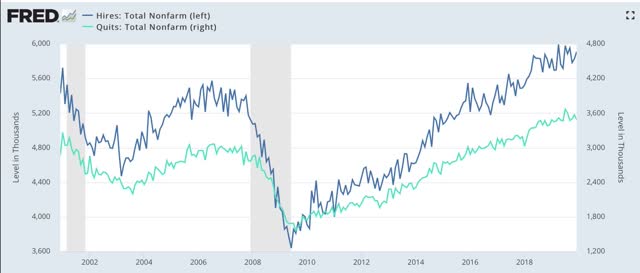

For the last nine months, hires have formed what in the stock market would be called a “pennant” pattern of lower highs and higher lows, i.e., the range is compressing and could break out in either direction.

Here’s the same data measured YoY:
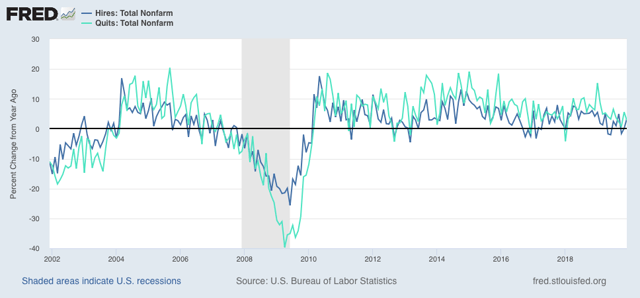

There’s clear deceleration, but have hires turned decisively negative? Impossible to tell.

Next, as I have often said, hiring leads firing (actually, total separations). Here’s what that looks like for the entire series:
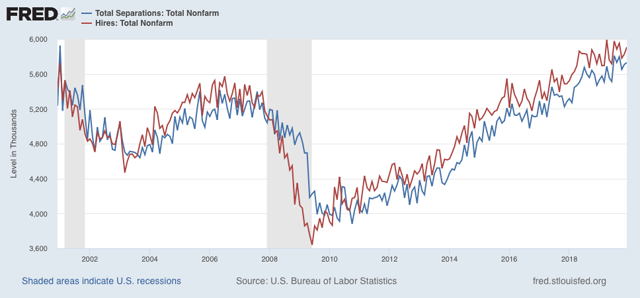

Separations still appear to be trending up, but may also be forming a “pennant” pattern.

Next, here are layoffs and discharges (blue, left scale), which I am comparing against the monthly average of initial jobless claims (red, right scale):
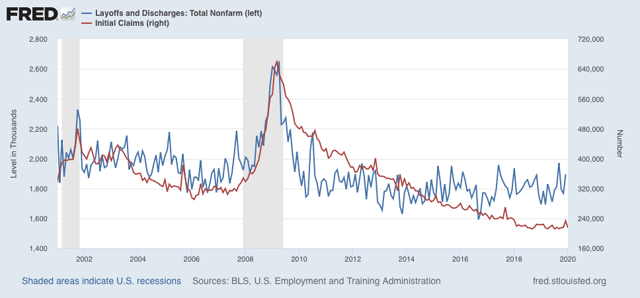

Layoffs and discharges have been trending higher for the past year. But the series is very noisy compared with initial jobless claims, which measures a very similar thing.

Finally, here are job openings, measured absolutely (blue, right scale) and YoY (red, left scale):
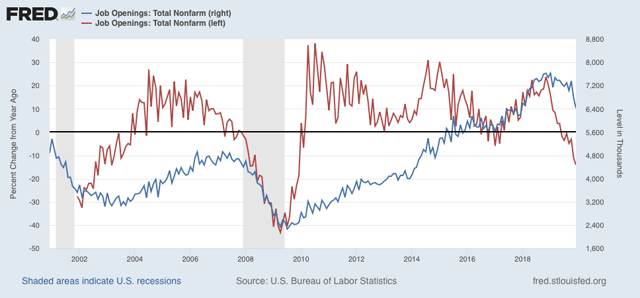

Openings are telling a terrible story. They are down 14% YoY. More significantly, they are down 15.8% from their November 2018 peak. This is equivalent to where they were off peak in May 2001 and March and April 2008 - early in recessions. 

I am going to be consistent here: I have been downplaying job openings as a “soft” metric when they were booming, and there is no reason to treat them differently when they appear to be collapsing. But it is a very significant move for this series, so I cannot ignore it.

To sum up, in the order these series turned in the last business cycle:
  • Hires have been flat for nearly a year, with an ambiguous trend
  • Quits appear to be still rising, but may also be turning flat
  • Layoffs and discharges have been trending higher, a negative
  • Job openings have fallen off the proverbial cliff and are recessionary

In other words, the four metrics have turned neutral or negative in reverse order from their one and only previous cycle. It’s all very confusing. For now, my takeaway is a slowdown only.
Monday, February 10, 2020

Why I expect further declines in manufacturing jobs


 - by New Deal democrat

This is the week I highlight further information from last Friday’s jobs report. 

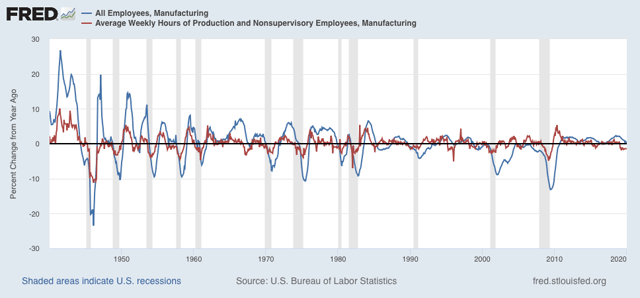
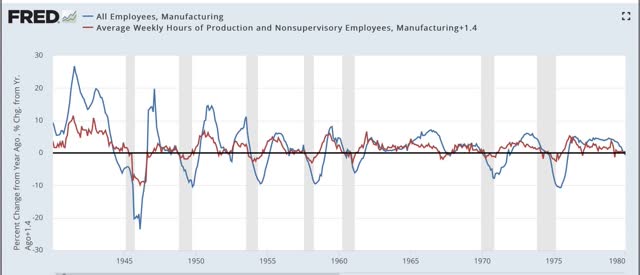
One thing that struck me is that we’ve now had two months of declines in manufacturing jobs. This is something I have been anticipating since about the middle of last year, because the manufacturing work week had been declining significantly, and it has a reliable 80+ year history of leading manufacturing jobs. Here’s the entire history measured as YoY% changes: 


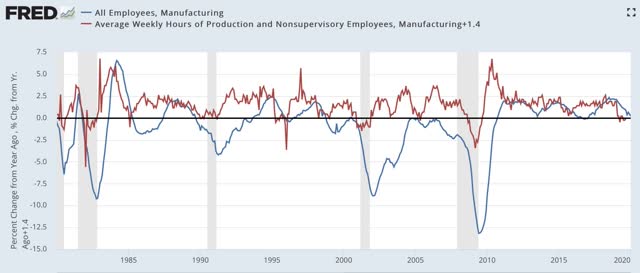
The manufacturing work week is down -1.4% YoY. So in the next two graphs I’ve added +1.4% to that number so that it is exactly equal to the zero line. Here is that data split up into two 40 year intervals:


There has literally *never* been a time, in all of that 80 year history, when hours have been down this much for this long, and manufacturing jobs have not gone down YoY. Further, leaving out one month YoY declines, in all but three occasions (1953, 1966, and 1995) a recession has resulted. That’s 11 out of 14 times total, with at least two of the other three being slowdowns.

In short, I am expecting further losses in manufacturing jobs in the next few months.

Sunday, February 9, 2020

Live-blogging the Fifteenth Amendment: February 9, 1869 (1)


 - by New Deal democrat

The Senate continued its debate on the proposed amendment for a second long day after only a one hour break. Ninety percent of the debate centered on four topics: whether and how to exclude Asians in general and Chinese in particular from voting; whether of not to extend the amendment’s prohibitions to other preconditions from voting; extending the amendment to include State office-holding conditions as well; and de facto abolition of the Electoral College.

Because the debate was so important and voluminous, I am breaking it down by subject. What follow deals only with the issue of Chinese immigration.

By way of background, in the 20 years since the end of the Mexican War, tens of thousands (one Senator said 100,000) Chinese had emigrated to the West coast. Senators representing the West Coast States were fearful that the “yellow hordes” would come to outnumber the white settlers and take control of the State governments. Here is a sample of the debate, that came to the fore when an amendment was offered to remove the words “of citizens of the United States” from the amendment which as proposed read “The right of citizens of the United States to vote”. 

Mr. Morton: ... [T]he gist of th[is] amendment ... would make the Chinese eligible to vote and to hold office. As the amendment is presented by the Committee on the Judiciary it provides that the right of citizens of the United States to vote and hold office shall not be denied or abridged by the United States nor any State on account of race or color. That does not admit the Chinese, because the Chinese are not citizens of the United States and cannot be naturalized under the law as it now stands, because the naturalization laws contain the word “white.” This will not enfranchise the Chinese, because the Chinese are not citizens of the United States; but if you strike out these words, then you make the Chinese, without being citizens, eligible to office and to vote.

Mr. Doolittle: ... [T]here is no restriction upon Congress over the laws of naturalization; and they may, and judging by all the history of the past, they probably will, strike the word “white” out of the naturalization laws.... and our friends from California and Nevada and Oregon may just as well understand it now as understand it one, two, three, or five years hence. The thing is coming. 

I suppose it will not be gainsayed by any person who is acquainted with the Chinese character and population that not one in ten thousand of them has any capacity whatsoever for American citizenship.

There can be no question that the right will be granted when the demand is made. But then there may be a deluge of Chinese upon the Pacific coast. I think there must be some words of exclusion for the Chinese. The negro race in our midst, having lived here for generations, know no other civilization other than our own. The Chinese belong to another civilization, one that can never unite or assimilate with ours. They can never become Americans in heart and feeling. They can never fuse with us.... and I doubt whether their children born in this country can or will assimilate with our civilization.

... the time may come when they will find out their power, and then they will desire to become American citizens. They are now treated most brutally .... Their personal and civil rights are not regarded. ... [but] in the next ten or twenty years they may outnumber all other populations on that coast; and then they will come to understand their power, and then the cruelties and brutalities that they now suffer and have suffered ... may drive them to seize the political power into their hands.

.... The authorities in China might send over hundreds of thousands of Chinamen to the Pacific coast instructed to become citizens for the purpose of securing in every possible way the productions of that vast and rich country for the benefit of the Chinese empire.

So vehement was the opposition that the sponsor of the amendment, Sen. Sumner, finally said:

I say that this country has the absolute power to protect itself from Chinamen or any other sort of foreigners by such legislation as in its judgment is necessary for the purposes of  protection. 
... I find that I have opened an immense debate, and therefore I withdraw the amendment.

But not to leave you totally downhearted, here is Sen. Cameron:

I must express my surprise about all this talk about the poor Chinaman. I never heard of his doing any harm to anybody in America. He has enriched the Pacific slope by his toil. He  has made that great railroad which is the miracle of the world by his patient industry. Who ever heard before of a people doing so much work in so short a space of time and getting so little reward for it as they have done.... [T]heir children, who remain here, will after awhile imitate our people, adopt our institutions, and become citizens of our country, and by their toil add to the wealth of the country. 

Source: Congressional Globe, 40th Congress, 3rd Session, pp. 1028-42
———-
Note that the “progressive” position in 1869 was that Chinese could be excluded via naturalization laws, so that the amendment would not affect their lack of ability to vote.

But perhaps most striking is how close the debate is to the current right-wing paroxysms of fear and anger as to Mexicans, Muslims and others immigrating from “sh*thole countries.”

Saturday, February 8, 2020

Live-blogging the Fifteenth Amendment: February 8 - 9, 1869


 - by New Deal democrat

Note: I fell a little behind on this project. I hope to be fully up to date by the end of this weekend.

On February 8 and 9, 1869, the Senate did something I daresay it would never consider now: it pulled an all-nighter! Despite numerous requests to adjourn, the session ran nearly 24 hours straight, only ending at about 11:30 AM on the 9th (and picked up again at 1 pm).

The text goes on for close to 100 pages, so I can only hope to hit a few highlights here. Numerous subjects were addressed.

Several members, e.g., Sen. Hendricks again posited that the Congress did not have authority even to amend the Constitution if it impinged on the ability of States to pass laws with regard to suffrage: 

There is a particular proposition in the Constitution of the United States that it may be amended. Where ... does the power of amendment stop? I say the power of amendment is limited to the correction of defects that might appear in the practical operations of the Government; but the power of amendment does not carry with it the power to destroy one form of overnment and establish another.

This was a small minority opinion, which was quite sensibly met with the Supremacy Clause. For example, here is Sen. Freylinghuysen:

All that is proposed by this amendment is to permit the people of this country to determine whether suffrage as to this numerous class [African Americans] be destroyed. It does not take away from the States the right to regulate. It leaves the States to declare in favor of or against female suffrage; to declare that a man shall vote when he is eighteen or when he is thirty-five; to declare that he shall not vote unless possessed of a freehold, or that he shall not vote unless he has an education and can read the Constitution.

A few members also declaimed on the inferiority of black people:

I think they are the only normal conditions that the negro, as a race, can ever occupy. I have known him as an ignorant savage from Africa with only the faintest lights of reason and intelligence; I have known him as a comparatively intelligent and contented slave, and I have known him as a political vagabond hovering under the shadow of the Freedman’s Bureau [i.e., Frederick Douglass].... He is inferior in physical condition, in mental and moral endowment, to the white race or to the yellow race. Every ethnologist knows it. Every man who is acquainted with the negro practically and from experience knows it.

This argument too went nowhere. The overwhelming sense was that intellect was distributed widely among all races of people, and if lack of intelligence were to be a disqualification, then millions of whites should also be disqualified:

Intelligence and virtue are not the distinctive characterizations of races; they are not peculiar to any race; they are not monopolized by nor wholly excluded from any people on the round earth. Intelligence and virtue are individual possessions, inconstant qualities  varying ad infinitum among the individuals of every people ....

Nearly hysterical rants that heathen Chinese immigrants to the West Coast States should not be allowed to vote were made:

Another amendment ... is to make this amendment inapplicable to persons of foreign birth. The reasons for this proposition, doubtless, is that those States which are on or near the Pacific Coast dread the immigration of Asiatics.... I am not in favor of giving the rights of citizenship or the right of suffrage to either pagans or heathens. I believe that the history of this country, and its laws as well as the spirit of its people, declare just as clearly that this is a Christian as well as a free country; and I am not in favor of taking steps backward into the slough of ignorance and of vice, even under the cry of progress.

These were also met with arguments of equality, and that if anything, the Chinese were far more intellectually capable of voting than uneducated slaves:

[H]ow can you contend in favor of giving this power to the African race if you deny it to the Chinese? You know that the Chinese are far in advance of the African in point of civilization. You know that, in comparison with the Chinaman, the African is inferior. You know that in point of industry the testimony of all men upon the western coast in relation to the Chinaman is that he loves industry; that he loves to labor. He is trained to labor and habits of industry and habits of frugality and economy that are most remarkable.

Relatedly, a proposed change to limit the amendment’s applications to Africans was made, by Senator Howard of Nevada. His proposed amendment read:

Citizens of the United States of African descent shall have the same right to vote and hold office in States and Territories as other citizens, electors of the most numerous branch of their respective Legislatures.

This was defeated. Among other things, how much African blood was necessary to qualify one as of African descent was seen as a stumbling block.

Reminiscent of the argument for 18 year olds’ voting 100 years later, the fact that 1000s of slaves had volunteered to fight for, and died for, the union cause was a potent argument that they had earned the right to protect their equality via the power of the vote:

During the war we were all very glad to witness the alacrity with which the negroes flocked to our standard. He was deemed good enough to stand shoulder to shoulder with us on the bloody field, but now that the time of trial is past too many are prone to forget the lesson learned in the hour of danger, and to conclude that the negro, though good enough to die for liberty, is far too inferior a being to enjoy its full blessings now that it is permanently won.

Perhaps the primary argument made was that embraced by Frederick Douglass, that the right to vote was the “completion” of the eradication of slavery, that would enable the freed slaves to prevent the rollback of their rights by the States:

No class, no race is truly free until it is clothed with political power sufficient to make it the peer of its kindred class or race and enable it to resist the contingencies of popular emotion.
——
It is of ...[the] great[est] importance to have our liberties and our rights secured, guarantied, chartered, and written in the Constitution, so that we can maintain them and leave them to our posterity. Therefore I desire to see that the important measure which we are now considering made a part of the fundamental law of the land.
—-
[I]t is certain that this Government was founded on the idea that all political power was vested in the people; not a third of a half or a fraction, but all of the people.
—-
Black men are denied the right to hold office now; the next step will be to take from him the ballot; and the next his freedom. 
...[T]his question [must] be definitely and permanently settled .... Certainly no one here can desire to see repeated the issue then presented, of the naked sword, or a repudiation of the act of emancipation, and of all the guarantees of protection which the Government had vouchsafed to its friends in the late rebellious States. 
The only sure protection of this nation against the ultimate re-establishment of that institution, is by the adoption and rigid maintenance in all the States of the doctrine of impartial suffrage.

Source: Congressional Globe, 4oth Congress, 3rd Session, pp. 978-1014

I will update this post with identifying information as to the speakers and some further comment tomorrow.