Saturday, July 25, 2015
Weekly Indicators for July 20 - 24 at XE.com
- by New Deal democrat
My Weekly Indicator post is up at XE.com. The continuing collapse in commodities is the biggest story, followed by renewed strength in the US$ and increasing weakness in temporary staffing.


Dear God: Powerline Still Believes in the "CRA Caused the Great Recession" Theory.
Paul Mirengoff over at Powerline still believes the CRA caused the Great Recession. Thankfully, Barry Ritholtz did the heavy lifting on this "theory" some time ago, thoroughly debunking it. Here's the key piece of data: the housing bubble was global. Take a look at this chart from the article:

So, either a ton of other countries had the CRA, or there were other causes.
Of course, economic facts and data haven't meant anything to the PL boys in decades, so this won't change their minds. But, it is good to know the PL boys have maintained their 100% error rate on economic matters streak.

So, either a ton of other countries had the CRA, or there were other causes.
Of course, economic facts and data haven't meant anything to the PL boys in decades, so this won't change their minds. But, it is good to know the PL boys have maintained their 100% error rate on economic matters streak.
Friday, July 24, 2015
Thursday, July 23, 2015
Initial jobless claims adjusted for population set a new all-time low
- by New Deal democrat
This morning population adjusted initial jobless claims set a new all-time record.
On an unadjusted basis, initial jobless claims set an all-time low of 161,000 on November 30,1968, when the US population was a little over 201 million. But US population is now over 310 million. Here's what initial jobless claims look like (blue) compared with population (red), normed to be equal on November 1968:

Now here is a close-up of the last year:

In short, right now is the most secure US workers have been in their jobs for the last 50 years.
Sub-$2/gas this winter?
- by New Deal democrat
I have a new post, discussing gas prices, at XE.com.
We've probably already hit our peak in gas prices this summer, and the longer-term trajectory looks like it is pointing to even cheaper gas than last winter.
Tuesday, July 21, 2015
The shallow industrial recession and the strong US$
- by New Deal democrat
I have a new post up at XE.com.
The New York Fed recently released a report on the effects of an appreciation of the US$ on imports, exports, and GDP. Recent declines in both industrial production and transportation indexes are in accord with that effect, but consumer spending is more than offsetting that decline.
Monday, July 20, 2015
Black September revisited: On planet Earth, 2008 was a credit event, not a housing event
- by New Deal democrat
In December 2008, I wrote "Black September: Why the economy suddenly went into free fall" a day-by-day chronology of the events of that month, intending it to be a "first draft of history," and leave a concise record of what happened, and why it happened while it was still fresh in everyone's mind.
Now in 2015, memories have already faded, and there is an internet tussle between Brad DeLong and Dean Baker about whether the Great Recession was primarily a housing event or a credit event.
In particular, as summarized by Robert Waldmann at Angry Bear, Baker has argued that:
"the decline in construction plus the decline in consumption due to reduced housing wealth explains the decline in aggregate demand (without any need to discuss finance, underwater mortgages, or clogged credit channels...."
Waldmann is inclined to agree with Baker:
"I think his calculations make sense. He gets to his conclusion with simple estimates (no finance included) using data from before the great recession. He has a problem with the timing of the recession which was very mild until Lehman collapsed then very severe. I think he can argue that this was a short run fluctuation with effects which didn’t last ...."
This argument is a variation on the joke about economists that "it works in practice, but will it work in theory?" Because we have the facts: the anomalous consumer decline between September 1 and October 10, 2008, during which the shallow recession which had crippled the housing industry and Wall Street, but left Main Street virtually intact, suddenly metastasized into a collapse of the consumer economy that some were beginning to liken to the 1930s, was due to a complete drying up of credit due to a fundamental loss of faith in the financial system.
As I said at the time:
The decline in housing values did not have a major effect on most American consumers’ behavior. The 30%+ who do not own houses, and the 20%+ who own their houses in full, were completely unaffected. Of the remaining minority, ... although their home equity position may have declined, even now [December 2008] 90% of all homeowners are “above water”, meaning they have positive equity in their houses.
But the dramatic 45% decline in the stock market from its October 2007 highs is another matter entirely. It [ ] created perhaps the biggest single negative wealth effect ... in all of American financial history....
Below are selections from by "Black September" post. If you don't want to read the whole edited chronology, skip to September 24 and 30, and you'll get the gist.
=====
=====
[In August 2008,] Despite all of these things, the unfolding events ... [left] Main Street unscathed. For example, Prof. Brad DeLong, who has been an astute observer of the collapse, noted that "The Financial Economy Has Galloping Pneumonia, Influenza, *and* the Grippe, But the Real Economy Just Has a Cold."
.... In short, the August picture of the economy as a whole showed a recession, but so far a shallow one.
[But by] December 3, John Bergstrom of Bergrstrom Automotive, a major auto dealer, appeared on CNBC and said, "on about September 10, we saw our business fall off 30-35%."
A similar sudden decline in consumer spending during September was reported by Shoppertrak:
...While the consumer has remained fairly resilient during this time [2008], two very recent events are dramatically impacting mall visits and consumer confidence.-
Once the financial crisis emerged at the beginning of September, retail traffic declined even further. Between August 31 and September 20, SRTI total U.S. traffic fell an estimated 9.2 percent per day….
- After the failure of Washington Mutual, President Bush’s address to the nation, the presidential debate and the initial rejection of the TARP bailout, traffic fell by an average of 10.5 percent (September 21 – 29).
- The day the TARP bailout package was rejected by congress (September 29) and the NYSE Dow Jones Industrial Average lost 778 points, consumers again responded negatively as shopper traffic fell 12 percent as compared to the same day in 2007
-----
- Sept 7
- Report that treasury is going to do $500Bln bailout/backstop of Fannie/Freddie in a “conservatorship"
- Sept 8
- Treasury officially takes control of Fannie/Freddie
- The late Tanta, in one of her last posts, notes that US Today headline says taxpayers on hook for $5.4 trillion, says that’s what average Americans are reading
- Sept 9
- Lehman in imminent peril per news – faills from $13 to $9 in one day – put on “credit watch” by S & P
- WaMu “cliff diving” credit outlook cut to “negative”
- Sept 15
- Lehman fails
- AIG seeks $40 Billion bailout, is downgraded
- Prof. Paul Krugman calls allowing Lehman to fail “financial russian roulette” with entire financial system
- WaMu bonds cut to junk rating
- Sept 16
- US considering AIG “conservatorship” agrees to inject $85 billion to AIG to avoid collapse. Breadth of AIG failure a complete surprise
- The NYT reports:
- rumor that large money market fund has halted redemptions
- Sept 19
- Treasury to insure money market funds possible downgrades of MBIA, Ambac
- From the NY Times: Congressional Leaders Stunned by Warnings As the Fed chairman, Ben S. Bernanke, laid out the potentially devastating ramifications of the financial crisis before congressional leaders on Thursday night, there was a stunned silence at first. Senator Christopher J. Dodd [said] the congressional leaders were told “that we’re literally maybe days away from a complete meltdown of our financial system, with all the implications here at home and globally.”
- Sept 21
- Paulson announces $700 bln bailout plan
Sept 24
- From the WSJ: Bush Addresses Bailout Plan President George W. Bush on Wednesday warned Americans and legislators reluctant to pass a historic financial rescue plan that failing to act fast risks wiping out retirement savings, rising foreclosures, lost jobs, closed business and “a long and painful recession.”
- From the NY Times: President Issues Warning to Americans
- From the WaPo: Bush: ‘Our Entire Economy Is in Danger’ Bush painted a grim picture view of the future if Congress doesn’t act, but he really didn’t address how the plan would work. Bush did comment that the plan was to buy assets “at the current low price”, seemingly contradicting the comments from Bernanke and Paulson earlier today that they would buy at above the current “fire sale” prices.
- Calculated risk observed, "I’m not sure if this speech will motivate people to call their representatives, but it might motivate people that haven’t been paying attention to say: “Wow, this is bad. Let’s make sure our money is safe, and watch our expenditures.” And that could lead to a deeper recession"
- Sept 29
- House of Representatives votes down [bailout] plan
- Sept 30
- Christoph Rieger, a fixed- income strategist at Dresdner Kleinwort, says:“The money markets have completely broken down, with no trading taking place at all. There is no market any more. Central banks are the only providers of cash to the market, no-one else is lending.
- Christoph Rieger, a fixed- income strategist at Dresdner Kleinwort, says:
- Sept 29
I concluded:
The bottom line is that, while economic theory may be able to generate equations which can generally shoehorn the huge decline of the Great Recession into a "decline in housing wealth" story, what factually happened was an abrupt and discontinuous decline in consumer spending and business hiring due to a nearly complete loss of faith in the fundamental financial system.
[Note: updated to better reflect chronology]
American consumers sustained two massive shocks as a result of Black September. First, their confidence was shattered ... mo[st] importantly by the magnification of those collapses by the public figures (the President, the Treasury Secretary, the Chairman of the Federal Reserve, Senator and Members of Congress) in statements that quite plainly advised Americans that imminent panic over the fate of the entire economy was a proper reaction. And panic American consumers did, as millions of households listened to a President’s speech telling them that the End was Imminent, and then had sober discussions over the kitchen table in which they decided to drastically pull back on discretionary spending, literally overnight.
The bottom line is that, while economic theory may be able to generate equations which can generally shoehorn the huge decline of the Great Recession into a "decline in housing wealth" story, what factually happened was an abrupt and discontinuous decline in consumer spending and business hiring due to a nearly complete loss of faith in the fundamental financial system.
[Note: updated to better reflect chronology]
Sunday, July 19, 2015
The Niagara Frontier
- by New Deal democrat
Just got back from the area where I grew up: the Niagara Frontier of NY and Canada. Normally you only hear of this area in winter when someone from the Weather Channel is standing out in a blizzard with a yardstick, but in the summer it is pretty awesome. Typically the daytime highs from June through August are 70-85 F and lows in the 50s and 60s with lowish humidity. Perfect vacation weather.


On the Canadian side there is a beautiful small town at the mouth of the river called Niagara On The Lake:
A nice few hours on a rainy afternoon were spent on this veranda sipping red wine:
On the American side there is the similar smaller town of Lewiston, NY. Drank a toast there too.
And of course there is the falls:
and the gorge:
and the rapids just above the falls:
There is also a huge, ferocious whirlpool downstream where the river narrows to about 200 feet wide and makes a dogleg.
Riding the "Maid of the Mist" boat to the inside of the horseshoe-shaped Canadian Falls is awesome, leaving me and most of the other adults giggling and repeating "Wow!" just like little kids.


Then there's the local food. Of course, there are chicken wings, reputedly invented at the (still-open) Anchor Bar in Buffalo, but the best are reputedly served at Duff's, and incongruous Mexian adobe style former cocktail lounge located in an affluent suburb. Here it is as it looked in the 1950's:
I grew up a mile from this place and had never set foot inside until this past week!
Then there's Beef on Weck, a roast beef sandwich on a hard, salty Kimmelweck roll that stands up to au jus sauce and isn't made anywhere else. And Ted's charcoal grilled hot dogs:
Nathan's, eat your heart out. Not even close.
Here is a photo taken at the waterfront looking east to the downtown skyline of the much-maligned Buffalo:
And here is the west view from the same location:
Not too shabby, right? On the left side of the photo you can just barely see the NY shoreline stretching southwest. On the far right is the shoreline of Ontario, Canada, where there are a bunch of nice sandy beaches only about 15 minutes from downtown. Since Lake Erie is shallow, in summer the water warms up to about 70 - 75 F, so it's great for swimming. On a typical summer afternoon there are dozens of sailboats out on the lake.
In wintertime, during those huge snow events, typically everywhere north of that lake shore - which is everywhere north of downtown Buffalo - sees bright sunshine and bright blue skies, while across the entire southern horizon from west to east is the snowstorm.
All in all, a great short summertime vacation.
Saturday, July 18, 2015
Weekly Indicators for July 13 - 17 at XE.com
-by New Deal democrat
My Weekly Indicator post is up at XE.com. The recent trends all continued this past week.
Friday, July 17, 2015
It's Another Policy Fail From Ed Morrissey of Hot Air
In several recent
articles, Ed Morrissey of Hot Air has argued against the ACA in quite
vociferous terms. Unfortunately, his
articles not only misdiagnose the basic problems that led to passage of the
ACA, but offer completely unworkable solutions.
Let’s begin with
his mis-diagnosis, beginning with this:
Before we get to
ObamaCare, let’s recall the rationales for government imposing top-down control
over one-sixth of the nation’s economy. First,
we had to end the issue of the uninsured, which had spiked as a percentage of
the population after the Great Recession, mainly from unemployment.
Yes, Ed, it did spike after the recession. But the rate of uninsured was a 20+ year problem
in the making:
During 1968–1980, the percentage of
persons under age 65 years who had private coverage remained stable at about
79%, while the number with private coverage increased from 140.5 million to
154.1 million persons (Tables 1 and 2). During
1980–2007, the percentage with private coverage declined steadily, except
during 1996–1999. From 1999 to 2007, the percentage of persons under age 65
with any private coverage declined at an average rate of more than 1% per year,
to 67% in 2007; the number of persons with private coverage remained at about
174 million during this period. The downward trend in private coverage was
driven in large part by a decline in employer-sponsored coverage. In 2007, 62%
of persons reported employer-sponsored coverage, down from 71% in 1980.
From The National Health Statistics Reports of July 1, 2009:
Here’s a
chart of the data:

In short,
Ed, the uninsured was a growing problem for decades.
And the quality
of the insurance was decreasing. Most of
the people who previously filed for bankruptcy did due to medical costs, and a majority of those individuals had insurance:
Bankruptcies resulting from unpaid
medical bills will affect nearly 2 million people this year—making health care
the No. 1 cause of such filings, and outpacing bankruptcies due to credit-card
bills or unpaid mortgages, according to new data. And even
having health insurance doesn't buffer consumers against financial hardship.
The findings are from NerdWallet Health, a division of the price-comparison
website. It analyzed data from the U.S. Census, Centers for Disease Control,
the federal court system and the Commonwealth Fund, a private foundation that
promotes access, quality and efficiency in the health-care system.
…..
Even outside of bankruptcy, about 56
million adults—more than 20 percent of the population between the ages of 19
and 64—will still struggle with health-care-related bills this year, according
to NerdWallet Health.
And then there’s the fact that
insurance companies continued to whittle down the risks they covered, largely
by denying coverage to people with pre-existing conditions. So, the only people that were covered were
those who really didn’t need it.
So, to sum up, the health insurance
marketplace didn’t cover an increasing number of people for an extended period
of time. Insurers were legally allowed to
discriminate against people with pre-existing conditions. These two factors meant a
large number of people didn’t get medical care they needed. So, when they were finally able to get that
care, they had a lot of problems that built-up over a period of time. This is called pent-up demand, which isexactly how an insurance executive describes the current situation:
By contrast,
Marinan R. Williams, chief executive of the Scott & White Health Plan in
Texas, which is seeking a 32 percent rate increase, said the requests showed
that “there was a real need for the Affordable Care Act.”
“People are getting
services they needed for a very long time,” Ms. Williams said. “There was a
pent-up demand. Over the next three years, I hope, rates will start to
stabilize.”
Now, let’s look at Ed’s proposal for health care:
The only option
is to repeal it and introduce market-based reforms that eliminate price-signal
opacity, especially in routine care.
I love this option. For non-emergency care, consumers are going
to start calling around to doctors to compare prices. Really Ed?
Let me use a routine physical as an example. First of all, what is supposed to happen at a
routine physical? What tests should be
done? What types of analysis should occur? I honestly don’t know. And, neither do most people. This alone gives dishonest doctors and
advantage: they can advertise the lowest price, do minimal work, and tell the
consumer that, “you don’t need all that other stuff.” Unless the consumer also happens to be a
doctor, he’ll most likely listen to the “learned professional” on this matter,
pay little money and receive sub-standard service. And, what about the idea of having a doctor
who actually knows you and your family history?
Doesn’t that provide an asset to the patient that Ed’s system would
completely obliterate? And just how will be learn about prices, Ed? Wouldn't an exchange (like what we currently have and that was originally proposed by Republicans in response to Hillarycare in the mid-1990s) be the best place to accomplish that?
And then there’s the huge glaring problem of when most people access
medical care: when they need it, and so are therefore at an extreme negotiating
disadvantage. Let’s say you break your
arm. Under Ed’s scenario, this might not be considered
a catastrophe, and so would fall out of coverage. Are you going to call around to every doctor
to get a price quote on that?
Dear Ed: take it from someone who not only knows economics but also designs insurance programs for a living: you don't know what you're talking about.
Monday, July 13, 2015
It's past the 5th inning for jobs
- by New Deal democrat
I have a new post up at XE.com. There are a number of signs that we are after the midpoint in the economic expansion for job growth.
Jazz Shaw of Hot Air: Economic Simpleton
Over at Hot Air, Jazz Shaw assures us that Germany's demands are only fair, as they are a Greek creditor. In short, this isn't a coup, but instead parent simply taking control of a situation made worse by an errant child.
But for an article that deals with a very complex international economic situation, his piece is completely devoid of any data. So, let's provide some context to point out how completely wrong his analysis is.
To start, you might want to go to the website tradingeconomics.com, which has a ton of economic information on literally every country in the world. Let's start by looking at what the Greeks have already done, starting with government spending. By the way -- I'll use pictures to make it easier.


Both long-term and standard unemployment metrics are at depression levels. Again, THIS IS BAD.
And, let's take a look at the debt/GDP ratio:

But for an article that deals with a very complex international economic situation, his piece is completely devoid of any data. So, let's provide some context to point out how completely wrong his analysis is.
To start, you might want to go to the website tradingeconomics.com, which has a ton of economic information on literally every country in the world. Let's start by looking at what the Greeks have already done, starting with government spending. By the way -- I'll use pictures to make it easier.

Greece has already cut government spending by about 23% since 2009. That is called austerity, Jazz. Let's see what kind of effect it has had on the economy, starting with total GDP:

Total GDP at constant prices has decreased about 25%. That means there has been NO GROWTH. For the economically challenged, NO GROWTH IS BAD. Let's look at this from another perspective -- the GDP growth rate:
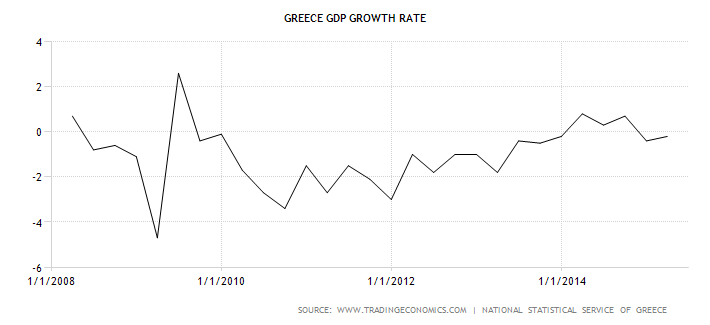
The Greek economy had three straight years of contraction. Again -- THIS IS BAD.
And, as a result, unemployment is very high:


Both long-term and standard unemployment metrics are at depression levels. Again, THIS IS BAD.
And, let's take a look at the debt/GDP ratio:

The purpose of austerity is to cut spending. This will make the bond vigilantes happy and also encourage consumer spending, thereby growing the economy, allowing it to increase at rate sufficient to lower the debt/gdp ratio. There's just one problem: as the chart above shows, it doesn't work as advertised. Not even close. In fact -- the EXACT OPPOSITE HAPPENS.
And, ask yourself this question: how many creditors negotiating with a bankrupt debtor don't take some kind of haircut on their loans? Answer from the real world: quite literally, none.
There is no reason to believe anyone at Hot Air has the background or capabilities to seriously discuss international or domestic economics. They embarrass themselves on a regular basis with their articles. But this latest piece is especially bad due to its complete omission of any data. And that is the real crime here: their readers think they're getting meaningful analysis. But, instead, they're getting noting of substance.
Greeks fail to get their pony
- by New Deal democrat
It appears that Germany and its creditor allies have crushed Greece. An insightful article in this mornings's Washington Post helps to expalin what Greeks have been thinking:
An overwhelming majority of those who voted no– about 88 percent — believed that, as a result of an OXI vote, negotiations would continue, as you can see below. Only 5 percent believed that a no vote would mean Greece would exit the euro zone.
By contrast, those who voted yes were much more worried about Grexit. In fact, 61 percent of them believed that would be the most likely outcome of a no vote.
In other words, the 61% of Greeks who voted "no" a week ago thought they were going to get an end to austerity and to keep the Euro too (and a pony!). So, apparently, did Tsipras. Syriza never had any intention of actually exiting the Euro if they couldn't get an end to austerity. Since a credible threat, carried through, to leave the Euro was their only leverage, they have been crushed by the creditors.
This entire episode, given Tsipras's apparent cluelessness, has been a failed turning point. Either there will be a move towards fiscal union on Germany's terms, or other southern European protest parties will understand that they must actually be prepared to leave the Euro.
Addendum: I don't mean to be hard on the Greek people, who have suffered badly and will now suffer even more. But they tried to bluff, when other Europeans could read poll results too, and knew that the Greek people were not in favor or leaving the Euro. So the creditors called Greece's bluff, and Greece folded.
It is easy for Americans to be armchair strategists from 4000 miles away, and think that surely, the Greeks must have a contingency plan for leaving the Euro. They didn't.
I don't mean to be too hard on the creditor nations either. It wasn't just the German people who opposed a bailout. Imagine your cousin Joe, to whom you made a loan last month, comes to you. He says he can't pay it back, so he asks you for a writedown. But he also asks for a new loan. How accomodating would you be? Probably, if you considered a new loan at all, you would demand a security - something you could sell if Joe defaults on the new loan too.
But again, the bottom line is, the Greek people had unrealistic expectations. They have been crushed, and now the creditor nations, like Germany, will use Greece as an example to insist that Europe follow their fiscal terms.
Addendum: I don't mean to be hard on the Greek people, who have suffered badly and will now suffer even more. But they tried to bluff, when other Europeans could read poll results too, and knew that the Greek people were not in favor or leaving the Euro. So the creditors called Greece's bluff, and Greece folded.
It is easy for Americans to be armchair strategists from 4000 miles away, and think that surely, the Greeks must have a contingency plan for leaving the Euro. They didn't.
I don't mean to be too hard on the creditor nations either. It wasn't just the German people who opposed a bailout. Imagine your cousin Joe, to whom you made a loan last month, comes to you. He says he can't pay it back, so he asks you for a writedown. But he also asks for a new loan. How accomodating would you be? Probably, if you considered a new loan at all, you would demand a security - something you could sell if Joe defaults on the new loan too.
But again, the bottom line is, the Greek people had unrealistic expectations. They have been crushed, and now the creditor nations, like Germany, will use Greece as an example to insist that Europe follow their fiscal terms.
Sunday, July 12, 2015
Saturday, July 11, 2015
Weekly Indicators for July 6 - 10 at XE.com
- by New Deal democrat
My Weekly Indicator piece is up at XE.com. It used to be that a downturn in commodities was a leading indicator for the US economy. I suspect that is not their message any more.
Subscribe to:
Posts (Atom)